
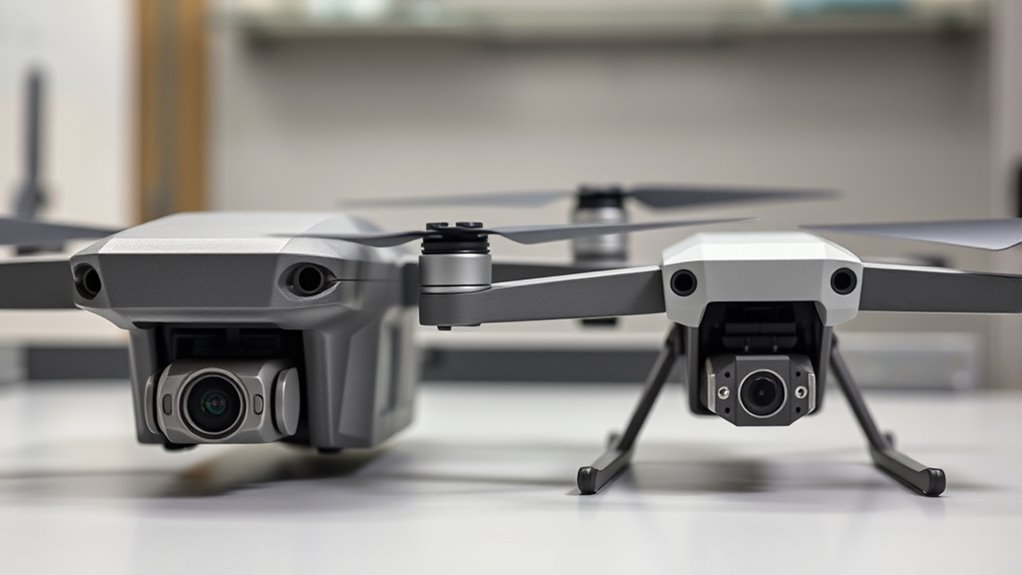
When you’re comparing the AeroVironment Puma and Brinc Responder for safety camera features, you’ll find Puma’s 4K camera delivers sharper images with superior stabilization, ideal for detailed surveillance, while Responder’s HD camera offers AI-enhanced quick responses. Puma excels in obstacle avoidance via radar and LiDAR, and boasts longer battery life for extended missions, plus better low-light thermal imaging. Integration is seamless for both, but these differences could refine your operational choices ahead.
Camera Resolution and Image Quality
When comparing the camera resolution and image quality of the AeroVironment Puma and Brinc Responder, you’ll notice that the Puma’s 4K electro-optical system delivers sharper details for surveillance tasks, while the Responder’s HD camera prioritizes reliable performance in rapid-response scenarios. The Puma excels with its robust image stabilization, minimizing blur from vibrations and enhancing clarity during dynamic flights, allowing you to capture precise visuals with ease. Its color accuracy is outstanding, reproducing hues faithfully for detailed analysis without distortion.
In contrast, the Responder’s image stabilization is competent for fast-paced operations, keeping footage usable in challenging environments, though it may not match the Puma’s finesse. Regarding color accuracy, the Responder provides solid, dependable results that suffice for quick decisions, empowering you to act freely with trustworthy imagery. Ultimately, your choice hinges on whether you value the Puma’s high-fidelity output or the Responder’s streamlined efficiency, both fostering independent oversight in your endeavors.
Real-Time Surveillance Capabilities
As you evaluate the real-time surveillance capabilities of the AeroVironment Puma and Brinc Responder, you’ll first notice their approaches to live video feed, which determines how smoothly you receive ongoing visual updates. Their instant alert response systems then come into play, varying in speed and reliability to notify you of potential issues. This comparison helps you identify which drone better meets your needs for timely situational awareness.
Live Video Feed
One standout feature in real-time surveillance is the live video feed, where the AeroVironment Puma delivers high-resolution imagery with up to 1080p output and a stable 30fps rate, while the Brinc Responder offers comparable quality but integrates AI-enhanced object recognition for quicker threat identification. You’ll appreciate how the Puma’s live streaming guarantees reliable video transmission, letting you access clear, real-time footage from remote locations with ease. This capability empowers you to maintain autonomy in monitoring, as its stable 30fps delivery minimizes disruptions during critical operations. In comparison, the Brinc Responder’s live streaming balances high-quality video transmission with AI features, giving you enhanced flexibility to adapt surveillance to your needs. Both options prioritize seamless connectivity, but the Puma’s focus on uninterrupted feeds supports your desire for independent oversight, fostering a sense of freedom in security management.
Instant Alert Response
Instant alert response elevates real-time surveillance by enabling the AeroVironment Puma to send rapid notifications upon detecting threats, ensuring you’re alerted without delay for effective intervention. In contrast, the Brinc Responder’s alert systems integrate seamlessly with your network, offering comparable response times that minimize delays in threat identification. You’ll appreciate how the Puma’s swift notifications—often under a second—empower you to act freely in dynamic environments, while the Responder matches this speed through AI-driven alerts, enhancing your situational awareness. Analytically, both drones excel in response time, but the Puma edges out with broader compatibility, allowing you to maintain autonomy without vendor lock-in. This feature underscores your freedom to respond proactively, making real-time surveillance a tool for personal security rather than restriction.
Obstacle Detection and Avoidance Systems
As you compare the AeroVironment Puma and Brinc Responder, you’ll find that their sensor technologies vary in detecting obstacles, such as using radar or cameras for precision. These differences directly impact avoidance capabilities, determining how effectively each drone can maneuver around hazards. Understanding this contrast helps you assess which system offers superior reliability in dynamic environments.
Sensor Technologies
While both the AeroVironment Puma and Brinc Responder rely on sensor technologies for obstacle detection and avoidance, their systems reflect distinct engineering priorities. You’ll notice how sensor types vary, with the Puma favoring robust radar and LiDAR for enhanced sensor accuracy in diverse environments, while the Responder opts for compact cameras and ultrasonic sensors, prioritizing adaptability. This difference lets you choose based on your needs for freedom in operations.
| Drone Model | Sensor Types | Sensor Accuracy |
|---|---|---|
| AeroVironment Puma | Radar, LiDAR | High in open areas |
| Brinc Responder | Cameras, Ultrasonic | Moderate in varied light |
As you evaluate these, sensor accuracy empowers your decisions, ensuring reliable data for safer flights without unnecessary complexity.
Avoidance Capabilities
In building on their sensor foundations, the AeroVironment Puma’s avoidance system leverages radar and LiDAR for precise obstacle detection in open spaces, enabling reliable evasion, while the Brinc Responder uses cameras and ultrasonic sensors to offer adaptable responses in diverse, dynamic environments, helping you select based on operational demands. For collision prevention, the Puma delivers superior navigation accuracy in expansive areas, allowing you to navigate freely with minimal interference from unexpected obstacles. Conversely, the Responder’s setup prioritizes adaptability, ensuring effective collision prevention in confined or variable settings, where quick adjustments enhance your navigation accuracy. This contrast empowers you to choose based on whether you value open-field reliability or versatile freedom in tighter scenarios, ultimately supporting autonomous operations tailored to your needs.
Emergency Response Features
When examining the emergency response features of the AeroVironment Puma and Brinc Responder, you’ll find that the Puma excels in long-endurance surveillance with its robust battery life and thermal imaging, while the Responder offers rapid deployment for first-responder tasks through its intuitive controls and payload versatility. In crisis management, the Puma’s extended flight time lets you maintain oversight during prolonged operations, integrating seamlessly with emergency protocols to deliver real-time data without frequent interruptions. Conversely, the Brinc Responder empowers you with agile setup, allowing quick adaptation to dynamic scenarios, which enhances crisis management by facilitating immediate payload swaps for tasks like search and rescue. This versatility means you’re not tied down; both drones promote freedom in operations, giving you the tools to respond effectively while adhering to strict emergency protocols. Ultimately, your choice depends on whether you prioritize endurance or speed in safeguarding communities.
Low-Light and Night Vision Performance
The AeroVironment Puma’s thermal imaging gives it an edge in low-light and night vision tasks, delivering clear imagery even in total darkness, whereas the Brinc Responder uses advanced sensors for reliable performance in dim conditions. You’ll appreciate how these technologies empower your operations in challenging environments, ensuring you’re never left in the dark. For instance, the Puma’s night vision technology excels in total blackout scenarios, enhancing your situational awareness, while the Responder’s low light optimization keeps you effective in twilight settings.
| Aspect | Key Capability |
|---|---|
| Night Vision Technology | Thermal imaging for clear, heat-based views in pitch-black conditions |
| Low Light Optimization | Advanced sensors providing reliable visibility in low-illumination areas |
| Overall Performance | Superior edge in darkness for Puma; consistent dim-light results for Responder |
As you evaluate these drones, remember that strong low light optimization means you’re freer to respond anytime, without visibility constraints, making informed choices that align with your pursuit of operational liberty.
Integration With Other Safety Tools
As drones evolve, seamless integration with other safety tools becomes essential for enhancing operational efficiency, where the AeroVironment Puma excels through its compatibility with advanced command systems and GIS software, while the Brinc Responder connects via intuitive APIs to emergency response platforms. You’ll find that the Puma’s robust system interoperability lets you blend it smoothly with your existing networks, streamlining workflows without unnecessary complications. This means you’re free to adapt tools on the fly, boosting your autonomy in safety operations. In comparison, the Brinc Responder’s flexible APIs enhance system interoperability by linking effortlessly to emergency platforms, giving you quick access to critical data. User training for both is key; the Puma offers in-depth sessions to guarantee you’re fully equipped for integrations, promoting self-reliance. Meanwhile, the Brinc Responder provides streamlined training modules, allowing you to master connections rapidly and maintain operational freedom without heavy time investments. Ultimately, these features empower you to choose integrations that align with your needs, fostering a versatile safety ecosystem.
Battery Endurance for Continuous Monitoring
Battery endurance directly influences your ability to maintain uninterrupted monitoring with drones. When comparing the AeroVironment Puma and Brinc Responder, you’ll notice stark differences in battery life that impact operational freedom. The Puma boasts up to 3.5 hours of flight time, allowing you to cover extensive areas without frequent recharges, thanks to its efficient power management systems. This feature guarantees reliable, extended surveillance, minimizing downtime and enhancing your autonomy in safety operations.
In contrast, the Brinc Responder offers around 1-2 hours of battery life, which can limit your monitoring capabilities in dynamic environments. Its power management focuses on quick swaps and modular designs, helping you adapt faster but potentially interrupting long-term tasks. Analytically, the Puma’s superior endurance gives you greater flexibility for freedom-oriented applications, like border patrols, while the Responder suits shorter, responsive missions. Ultimately, effective power management in both models empowers you to choose based on your needs for sustained oversight.
Frequently Asked Questions
What Is the Price of the Aerovironment Puma?
You’re asking about the AeroVironment price of the Puma drone, which boasts impressive features like extended flight endurance and autonomous capabilities that enhance your freedom in operations. The Puma’s base price is around $250,000, varying by configuration and add-ons. Analytically, you’ll find its features offer strong value, justifying the cost for missions demanding reliability and independence in challenging environments.
Where Can I Purchase the Brinc Responder?
You’re wondering where you can purchase the Brinc Responder. For your Brinc Responder purchase, start with online retailers like the official Brinc website, Amazon, or Best Buy, which offer convenient access and competitive pricing. This empowers you to compare options freely, read reviews, and choose based on your needs, ensuring autonomy in your decision. Always verify sellers for authenticity to secure a genuine product with warranties.
How Much Do These Drones Weigh?
You’re curious about how much these drones weigh, aren’t you? Picture a bird soaring effortlessly, symbolizing the freedom in lightweight design—a key drone specification. In weight comparison, the AeroVironment Puma clocks in at about 15 pounds, while the Brinc Responder is lighter at around 3.3 pounds, offering you greater portability for your adventures. This difference impacts flight time and ease, empowering your choices.
Is Pilot Training Required for Operation?
When you’re wondering if pilot training is required for operation, pilot requirements vary by drone model and regulations. For many systems, basic familiarization with operational guidelines suffices, granting you the freedom to fly safely without extensive formal training. However, always review specific rules to guarantee compliance, as some setups demand certified pilots for maximum safety and performance. This approach empowers your independent use while prioritizing risk management.
What Is the Warranty Period for These Devices?
You’re wondering about the warranty period for these devices, a key factor in ensuring device reliability and your freedom to operate without interruptions. Warranty coverage typically varies: the AeroVironment Puma offers a one-year standard warranty, while the Brinc Responder provides two years. This difference highlights how extended coverage enhances long-term dependability, empowering you to focus on safe, autonomous use. Always check official sources for details.
