
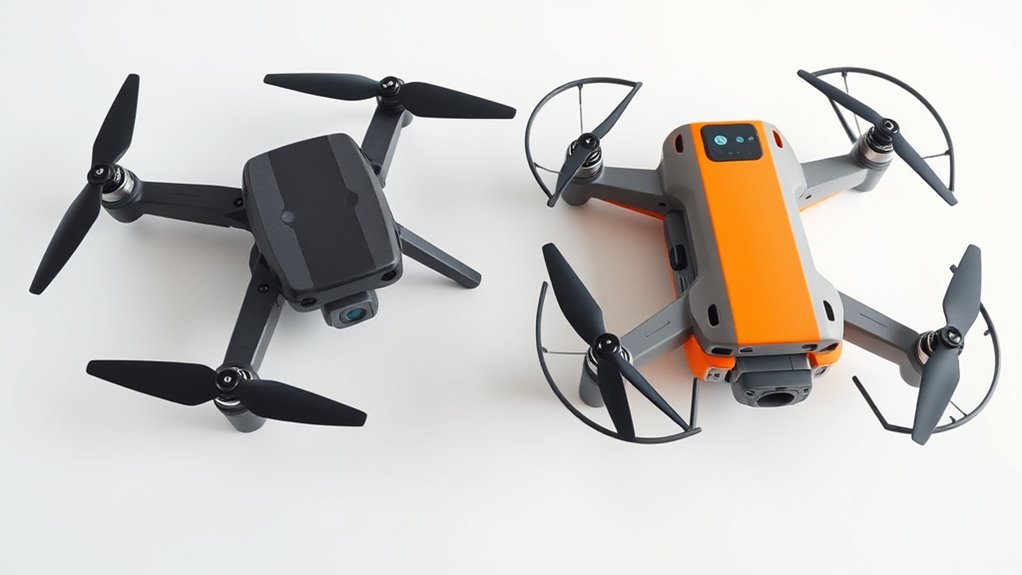
You’ll find the JJRC H36’s lightweight design ideal for casual flights, offering a 720p camera and about 10 minutes of flight time at an affordable price. In contrast, the Flyability Elios 3 boasts a rugged build with 4K resolution, collision avoidance, and longer battery life for tough industrial inspections. While H36 suits budget fun, Elios 3 excels in stability and durability for pros. Key differences emerge in the full analysis ahead.
Design and Build
While the JJRC H36 emphasizes lightweight portability for everyday use, the Flyability Elios 3 prioritizes robust construction for industrial environments. You’ll appreciate how this design choice impacts your durability assessment; the Elios 3’s reinforced frame and impact-resistant materials excel in tough settings, offering superior longevity for demanding tasks, while the H36’s simpler build suits casual outings but may falter under stress. Regarding aesthetic appeal, the Elios 3 presents a utilitarian, armored look that conveys reliability, empowering you to navigate confined spaces with confidence. Conversely, the H36’s streamlined, modern design provides a clean, unobtrusive vibe that enhances your freedom for spontaneous flights. By analyzing these elements, you’re better equipped to select a drone that aligns with your exploratory spirit, balancing form and function without compromise.
Features and Specifications
Delving into the features and specifications, you’ll find the JJRC H36 offers straightforward essentials like a 720p camera and up to 10 minutes of flight time, making it ideal for casual users, whereas the Flyability Elios 3 boasts advanced capabilities such as a 4K camera, collision avoidance sensors, and extended endurance for professional inspections. When evaluating battery life, the JJRC H36’s modest 10 minutes suits spontaneous, freeing outings, while the Elios 3’s superior longevity empowers uninterrupted exploration. Its user interface remains intuitive for effortless control, contrasting the Elios 3’s robust system for precise, professional demands.
To grasp the deeper implications for your aerial freedom:
- Battery life analysis: JJRC H36’s shorter runtime limits extended adventures but keeps things light and portable, whereas Elios 3’s endurance liberates you for thorough, worry-free missions.
- User interface comparison: H36’s simple design lets you engage quickly without barriers, enhancing accessibility and independence for beginners.
- Camera capabilities: H36’s 720p suffices for basic visuals, allowing casual documentation, while Elios 3’s 4K reveals high-fidelity insights for detailed, liberated decision-making.
- Sensor integration: Elios 3’s advanced sensors provide safety layers that expand your operational freedom in risky environments, unlike H36’s basic setup.
Performance in Flight
In flight, the JJRC H36 delivers responsive handling and stability for everyday maneuvers, making it easy for you to navigate open spaces without advanced skills. Its flight stability shines in calm conditions, offering intuitive control that lets you enjoy aerial freedom effortlessly. In contrast, the Flyability Elios 3 excels in demanding scenarios, with advanced flight stability that helps you maneuver through tight, obstructed areas safely and precisely—ideal for professional inspections.
When it comes to battery life, the H36’s modest 7-10 minutes suits spontaneous, carefree flights, empowering you to seize the moment without heavy commitments. The Elios 3, however, boasts 10-15 minutes, providing extended endurance for thorough explorations, so you’re less tethered to charging stations. Analytically, the H36 prioritizes accessibility for casual users seeking liberation in the skies, while the Elios 3’s robust performance guarantees reliable autonomy in complex operations, balancing your desire for uninhibited adventure with practical needs.
Camera Quality Comparison
When examining the camera quality of the JJRC H36 and Flyability Elios 3, you’ll find the H36 equipped with a modest 720p resolution and basic stabilization, making it suitable for simple aerial snapshots during casual outings. In contrast, the Elios 3 offers a superior 4K image resolution with robust stabilization and enhanced low light capability, empowering you to capture detailed footage in challenging environments. This difference highlights how the Elios 3’s features liberate your exploratory potential.
To investigate deeper into this comparison:
- Image Resolution Impact: The H36’s 720p limits detail in captures, while the Elios 3’s 4K enhances clarity for precise analysis, giving you freedom to spot fine details without compromise.
- Low Light Capability Analysis: H36 struggles in dim conditions, reducing usability, whereas Elios 3’s superior low light performance guarantees reliable imaging, allowing you to operate freely in varied lighting.
- Stabilization Effectiveness: Basic stabilization on the H36 leads to shaky footage during movement, but Elios 3’s advanced system provides steady shots, enabling smoother, more liberating flights.
- Overall Analytical Edge: By integrating high image resolution and low light capability, Elios 3 offers analytical depth that the H36 lacks, freeing you to tackle complex tasks with confidence.
Value and Recommendations
Although the JJRC H36 offers an affordable entry into drone flying, you’ll find the Flyability Elios 3 provides better overall value for professionals, given its superior durability, advanced capabilities, and long-term reliability in demanding scenarios. In our affordability analysis, the H36’s lower initial cost appeals to hobbyists, but the Elios 3’s robust build justifies its price through extended lifespan and reduced maintenance, freeing you from frequent replacements. For user experience, the Elios 3 excels with intuitive controls and seamless integration in complex environments, enhancing your operational freedom, while the H36 suits casual flights but may frustrate in tougher conditions due to its limitations. Ultimately, if you’re seeking liberation in aerial tasks, we recommend the Elios 3 for professional inspections; opt for the H36 only if budget constraints prioritize basic enjoyment, allowing you to explore drone tech without heavy investment. This balanced approach guarantees you maximize value based on your needs.
Frequently Asked Questions
Is Professional Training Required?
You’re wondering if professional training is required for tasks like operating drones or cameras. It depends on regulatory requirements in your area, which might mandate it for safety and compliance. Skill acquisition through training enhances your abilities, allowing you to master operations efficiently. However, if you’re pursuing personal freedom, you can often self-learn, minimizing obligations while ensuring responsible use. Balance is key.
What Is the Expected Lifespan?
To cut to the chase, you’ll want to know the expected lifespan of your device—it varies based on usage, but typically spans 2-5 years with proper care. Battery longevity is essential; it’s often 200-500 cycles before noticeable decline, while maintenance requirements like routine inspections keep things running smoothly. You’re free to extend this by staying proactive, ensuring your gear doesn’t let you down when it matters most.
Can It Be Used for Search and Rescue?
You’re wondering if it can be used for search and rescue, and yes, its drone capabilities make it a viable option for rescue missions. You’ll find that advanced features like thermal imaging and maneuverability allow you to navigate tight spaces and locate individuals quickly, enhancing your freedom to respond effectively in emergencies. However, factors like battery life and weather resistance must be analyzed for peak performance.
How Does It Handle Electromagnetic Interference?
When you’re exploring how your device handles electromagnetic interference, it’s like stumbling upon a reliable ally in chaos—ensuring uninterrupted operations. Electromagnetic shielding plays a key role, protecting internal components from disruptive signals, while signal stability keeps your connection steady and free from interference. This analytical approach empowers you to operate autonomously, analyzing risks objectively for enhanced freedom in challenging environments.
Are There Insurance Options Available?
When you’re asking if there are insurance options available, you’ll find that various insurance policies can protect your investments. By conducting a risk assessment, you analyze potential threats and select policies tailored to your needs, offering peace of mind. This empowers you to explore freely, minimizing financial risks while maintaining autonomy in your ventures. It’s crucial to consult providers for customized coverage options.
