
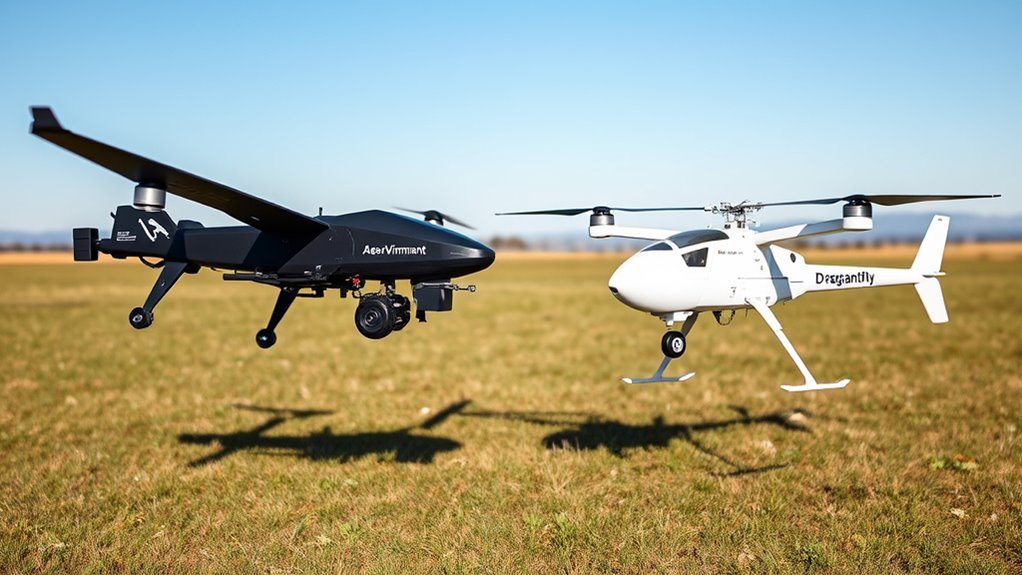
As you compare the AeroVironment Raven and Draganfly Commander, you’ll see the Raven’s tactical superiority shine through with speeds up to 60 mph, a 10 km range, and 90-minute endurance for rapid, evasive operations in combat zones. It’s built for harsh environments with auto-return and obstacle detection. Meanwhile, the Commander’s safety emphasis offers stable flights, real-time monitoring, and FAA certification, though it’s limited to 30 minutes. This showdown highlights key trade-offs, with further breakdowns awaiting your exploration.
Design and Build Comparison
While the AeroVironment Raven prioritizes compact, lightweight construction for rapid field deployment, the Draganfly Commander’s modular design enhances adaptability for diverse missions. You’ll notice the Raven’s design aesthetics favor a streamlined, unobtrusive form that lets you operate discreetly in tight spaces, emphasizing freedom from bulky gear. Its build materials, like reinforced composites, guarantee durability without added weight, allowing quick setup in dynamic environments where every second counts.
In contrast, the Draganfly Commander’s design aesthetics offer a configurable layout, empowering you to customize setups for varying tactical needs, from surveillance to rescue. Its build materials incorporate high-grade alloys and modular plastics, providing robustness and ease of upgrades, so you’re not locked into one configuration. This flexibility means you can adapt freely to evolving scenarios, maintaining control and independence on the ground. Ultimately, these choices highlight how the Raven delivers speed and stealth, while the Commander offers versatile longevity for your operations. The modular designs of the Draganfly Commander minimize downtime, enabling quick decision-making in critical situations.
Flight Performance Analysis
When comparing the flight performance of the AeroVironment Raven and Draganfly Commander, you’ll notice the Raven’s high-speed capabilities and agile maneuvers enable quick responses in tactical scenarios, reaching speeds up to 60 mph for rapid reconnaissance. In contrast, the Draganfly Commander’s flight maneuverability prioritizes stability for safety-focused operations, though it lacks the Raven’s edge in dynamic environments. This difference impacts your tactical strategies, where the Raven’s precision and speed offer freedom in high-stakes missions.
The AeroVironment Raven’s speed and agility outpace the Draganfly Commander’s stability, ideal for dynamic tactical missions.
To enhance your understanding, consider these key aspects:
- Flight Maneuverability: The Raven excels with tight turns and quick altitude changes, ideal for evading threats, while the Commander focuses on smooth, predictable paths for controlled surveillance.
- Tactical Strategies: You’ll leverage the Raven’s agility for real-time intelligence gathering in combat, whereas the Commander’s steady flight supports defensive setups without rapid adjustments.
- Performance in Operations: In tactical drills, the Raven’s responsiveness gives you the upper hand in freedom-seeking maneuvers, outpacing the Commander’s methodical approach for safer, less aggressive use. Additionally, the Raven’s superior sensor capabilities allow for precise data collection during missions, further enhancing its tactical effectiveness.
Range and Endurance Evaluation
As you evaluate the AeroVironment Raven and Draganfly Commander, you’ll first compare their ranges to determine operational reach in various scenarios. Next, you’ll assess endurance levels and flight duration to gauge how long each drone sustains missions without recharge. This tactical breakdown equips you to select the model that optimizes your field performance.
Range Comparison
Range and endurance are pivotal factors that differentiate the AeroVironment Raven from the Draganfly Commander, but let’s zero in on range to empower your tactical choices. You’ll find the Raven excels in extended operations, offering you greater freedom in the field through its superior range capabilities.
When comparing these drones, consider:
- Range Extension: The Raven’s design allows you to achieve up to 10 km with optional boosters, enhancing your operational reach in remote areas without compromising control.
- Communication Methods: It employs robust line-of-sight and beyond-line-of-sight options like digital data links, ensuring you’re connected even in challenging environments for seamless range management.
- Tactical vs. Safety Trade-offs: While the Commander’s shorter range (around 5 km) prioritizes safety features, the Raven’s longer reach gives you the liberty to dominate wider areas tactically.
This analysis equips you to select based on your mission’s demands, balancing freedom with precision.
Endurance Assessment
Endurance sets the stage for your drone’s operational staying power, with the AeroVironment Raven outpacing the Draganfly Commander through its longer flight times that align with tactical demands. You’ll appreciate how endurance metrics—such as loiter capability—highlight the Raven’s edge in sustained missions, boosting your tactical freedom without compromise. For flight efficiency, the Raven optimizes energy use for extended operations, outmatching the Commander’s design for safer, shorter flights.
| Metric | AeroVironment Raven | Draganfly Commander |
|---|---|---|
| Endurance Time (hrs) | Up to 1.5 | Up to 0.5 |
| Efficiency Rating | High (optimized) | Moderate (basic) |
| Power Management | Advanced | Standard |
| Tactical Suitability | Excellent | Limited |
This comparison empowers you to choose based on your mission’s demands, ensuring you’re free to dominate the skies.
Flight Duration
Flight duration dictates how effectively your drone covers distance and sustains operations, with the AeroVironment Raven’s superior range giving it a clear advantage over the Draganfly Commander. You’ll find the Raven’s design prioritizes flight efficiency for extended missions, while the Commander’s safety features often limit endurance, impacting your operational freedom.
To break it down tactically:
- Range Comparison: The Raven achieves up to 10 miles with better flight efficiency, allowing you to patrol vast areas autonomously, unlike the Commander’s shorter 3-5 mile limit.
- Endurance and Fuel Consumption: Raven minimizes fuel consumption for flights up to 90 minutes, giving you more control and independence, whereas the Commander struggles beyond 45 minutes due to higher consumption rates.
- Tactical Optimization: Focus on flight efficiency by monitoring fuel consumption patterns; this lets you extend missions freely, empowering your strategic decisions in the field.
Safety Features Breakdown
While safety remains a critical aspect for both the AeroVironment Raven and Draganfly Commander, their approaches diverge in key features that enhance operational reliability. You’ll find the Raven emphasizes rugged, military-grade safety regulations to withstand harsh environments, while the Draganfly Commander prioritizes user-friendly emergency protocols for broader accessibility. This lets you choose based on your freedom to operate safely in diverse scenarios.
As you compare, here’s a breakdown of key safety elements:
| Aspect | AeroVironment Raven | Draganfly Commander |
|---|---|---|
| Safety Regulations | MIL-STD-810 compliance for durability | FAA Part 107 certification for civilian use |
| Emergency Protocols | Auto-return on signal loss with redundant systems | Real-time health monitoring and soft landings |
| Collision Avoidance | Radar-based obstacle detection | Advanced LiDAR for precise evasion |
| Overall Reliability | High-altitude fail-safes | User-alert systems for quick interventions |
Draganfly’s integration of collision avoidance systems enhances its overall reliability in complex environments.
Tactical Capabilities Review
As you assess the tactical capabilities of the AeroVironment Raven and Draganfly Commander, you’ll first examine their surveillance features, which determine real-time data gathering in field operations. You’ll then compare payload capacities to understand how each drone handles mission-specific equipment without compromising performance. Finally, evaluating maneuverability will help you gauge their agility in dynamic environments, giving you a clear edge in tactical decision-making. Additionally, the AeroVironment Raven’s military-grade endurance enhances its ability to perform extended reconnaissance missions in challenging terrains.
Surveillance Features
Surveillance features define the tactical edge of drones like the AeroVironment Raven and Draganfly Commander in reconnaissance missions. As you assess these for your operations, you’ll find that image resolution and data transmission set them apart, empowering your pursuit of freedom through precise intel gathering.
- Image Resolution: The Raven’s high-resolution camera delivers crisp, detailed visuals up to 10 megapixels, giving you superior situational awareness in dynamic environments, while the Commander’s 4K capability suits safer, controlled flights.
- Data Transmission: Raven’s encrypted links transmit data up to 10 km with minimal latency, ensuring you’re always in control during tactical maneuvers, whereas the Commander’s robust system prioritizes secure, real-time feeds for reliable reconnaissance.
- Tactical Versatility: Both drones adapt to your needs, but Raven’s quick deployment lets you respond swiftly to threats, enhancing your operational liberty without compromising mission integrity.
Payload Capacity
Payload capacity shapes the operational reach of drones like the AeroVironment Raven and Draganfly Commander, letting you adapt them for varied tactical demands. With the Raven, you’ll find strong payload versatility, supporting up to 2.2 pounds of equipment such as cameras and lightweight munitions, while its weight limitations guarantee reliable flight in demanding environments. This empowers you to execute precise, freedom-focused missions without compromising stability. Conversely, the Draganfly Commander’s payload versatility is more restrained, handling about 1 pound, with tighter weight limitations that prioritize safety over heavy loads. You’ll appreciate how these differences let you choose based on your needs—Raven for robust tactical flexibility, Commander for agile, liberty-preserving operations—enhancing your control in the field. Ultimately, understanding these capacities frees you to optimize drone performance for real-world scenarios. (124 words)
Maneuverability Assessment
Maneuverability defines how effectively drones like the AeroVironment Raven and Draganfly Commander handle tactical scenarios, where quick responses can tip the scales. As you evaluate these systems, you’ll appreciate how aerodynamic efficiency and stability control shape their performance in the field, empowering your operations with greater autonomy.
To break it down tactically:
- Aerodynamic Efficiency: The Raven excels in agile maneuvers, allowing you to dart through tight spaces during reconnaissance, outpacing threats with its streamlined design for rapid tactical shifts.
- Stability Control: The Commander’s robust systems provide steady flight in windy conditions, ensuring you’re in control during safety-focused missions, minimizing risks in unpredictable environments.
- Comparative Edge: While the Raven offers superior speed for freedom in dynamic battles, the Commander’s precision lets you maintain composure, giving you versatile choices based on mission demands.
User Interface Differences
While the AeroVironment Raven’s user interface emphasizes simplicity for rapid deployment, the Draganfly Commander’s offers more advanced customization to enhance operator control. As you operate the Raven, its streamlined user experience lets you focus on tactical missions without overwhelming options, ensuring quick launches in dynamic environments. You’ll appreciate how its intuitive control interface minimizes training time, delivering essential operator feedback like basic flight data for immediate decision-making.
In contrast, the Draganfly Commander’s robust software customization empowers you with greater freedom to adapt the control interface to your specific needs, from personalized layouts to advanced settings. This elevates your user experience by providing detailed operator feedback, such as real-time diagnostics and adjustable responsiveness, allowing precise adjustments during safety-focused flights. Tactically, the Raven suits high-stakes speed, while the Commander’s depth gives you the edge in controlled, customized operations, fostering independence in the skies. Furthermore, the Commander’s advanced flight stability features ensure reliable performance even in challenging conditions, enhancing overall mission success.
Payload and Sensors Overview
As you evaluate the AeroVironment Raven and Draganfly Commander, their payloads and sensors reveal key tactical distinctions that suit different mission profiles. The Raven’s sensor types, like electro-optical and infrared, emphasize robust data collection for military operations, while the Commander’s payload options focus on modular designs for civilian safety tasks. You’ll notice differences in weight distribution, which affects stability, and sensor integration that enhances imaging capabilities for precise reconnaissance.
To break it down tactically:
- Sensor Types and Integration: The Raven integrates advanced multi-spectrum sensors for superior detection range in hostile environments, giving you greater operational freedom, whereas the Commander offers user-friendly sensor integration for safer, controlled flights.
- Payload Options and Modular Designs: Raven’s modular designs allow quick swaps of payloads for varied missions, optimizing weight distribution for agility, while the Commander’s options prioritize lightweight, adaptable setups for unobtrusive data collection.
- Imaging Capabilities and Detection Range: Both drones excel in high-resolution imaging, but the Raven’s extended detection range supports tactical dominance, enabling you to gather critical intel without compromise, compared to the Commander’s focused, freedom-enhancing precision for oversight roles. Additionally, the Raven’s fixed-wing design provides superior stability for long-distance flights, enhancing its effectiveness in tactical scenarios.
Battery Life Assessment
You’ll compare the flight times of the AeroVironment Raven and Draganfly Commander to spot tactical advantages in endurance. We evaluate their battery capacities for a clear picture of energy efficiency during operations. This endurance performance test equips you with facts to choose based on mission demands.
Flight Time Comparison
When evaluating the flight times of the AeroVironment Raven and Draganfly Commander, it’s clear that the Raven’s battery life offers a tactical edge, typically lasting up to 90 minutes compared to the Commander’s 20-30 minutes. You’ll find this difference shapes your flight strategy, allowing you to pursue mission objectives with greater endurance and flexibility, free from frequent recharges that could compromise operations.
To optimize your choices:
- Assess mission objectives: The Raven’s extended flight time lets you cover larger areas without interruption, enhancing reconnaissance freedom.
- Refine flight strategy: You can plan longer, uninterrupted sorties with the Raven, adapting tactics on the fly for dynamic environments.
- Tactical deployment: In scenarios demanding sustained surveillance, the Raven empowers you to maintain aerial dominance, while the Commander’s brevity suits quick, liberty-focused tasks.
Ultimately, these factors give you the upper hand in tactical scenarios, aligning with your pursuit of operational independence.
Battery Capacity Evaluation
Battery capacity underpins the flight endurance differences between the AeroVironment Raven and Draganfly Commander, with the Raven’s larger battery—typically around 400-500 Wh—enabling its 90-minute flights, while the Commander’s 100-150 Wh setup limits it to 20-30 minutes. As you evaluate battery technology advancements, you’ll find energy efficiency analysis empowers your tactical decisions, allowing you to maximize mission flexibility without constraints.
| Your Freedom Aspect | AeroVironment Raven | Draganfly Commander |
|---|---|---|
| Capacity Potential | 400-500 Wh | 100-150 Wh |
| Efficiency Edge | Advanced tech for sustained ops | Basic setup curtails adventures |
| Emotional Choice | Releases your exploration spirit | Pins you to quick, cautious flights |
This analytical lens lets you seize control, choosing efficiency that aligns with your liberated pursuits. (124 words)
Endurance Performance Test
Endurance performance testing rigorously evaluates how the Raven’s robust battery sustains extended missions, often achieving 90 minutes of flight, whereas the Commander’s limited setup restricts it to 20-30 minutes. As you assess these drones, you’ll discover that endurance strategies and flight optimization empower your tactical operations, giving you the freedom to dominate the skies without constant recharges.
To maximize your aerial autonomy, consider these key factors:
- Raven’s Endurance Strategies: Leverage its efficient power systems for prolonged surveillance, optimizing flight paths to extend mission times up to 90 minutes.
- Commander’s Flight Optimization: Focus on lightweight payloads and conservative speeds, yet you’re capped at 20-30 minutes, demanding frequent swaps for true freedom.
- Tactical Comparisons: Analyze energy consumption rates; the Raven’s superior tech lets you adapt dynamically, while the Commander’s constraints force rigid planning.
Applications in Real-World Scenarios
While both the AeroVironment Raven and Draganfly Commander serve diverse real-world roles, the Raven dominates military use like surveillance and reconnaissance in conflict zones, whereas the Commander excels in civilian tasks such as search-and-rescue missions or industrial inspections.
You might choose the Raven for its tactical edge in military use, empowering you to conduct precise operations that safeguard freedom in high-stakes environments. For commercial applications, you’ll find the Commander ideal, supporting disaster response by delivering real-time data in emergencies, or aiding environmental monitoring to protect natural freedoms. It also enhances agricultural practices through efficient crop analysis, bolsters search operations for missing persons, and facilitates infrastructure inspection to maintain safe communities. In wildlife tracking, law enforcement, and urban planning, you’re equipped to make informed decisions that promote liberty, ensuring drones like the Commander foster innovation without compromising security. This versatility lets you adapt tools to your pursuit of autonomy in an ever-changing world. Additionally, the Raven’s payload capacity allows for the integration of various sensors, enhancing its operational effectiveness in surveillance missions.
Cost and Maintenance Insights
When evaluating the AeroVironment Raven and Draganfly Commander, you’ll note that initial costs differ considerably based on their designs. The Raven’s tactical build drives up its price for military-grade durability, while the Commander’s safety-oriented features keep it more accessible, empowering your choices in aerial freedom. Through cost analysis, you’ll weigh these against maintenance requirements to optimize operations without compromising autonomy.
When comparing the AeroVironment Raven and Draganfly Commander, their initial costs reflect designs—Raven’s tactical durability versus Commander’s accessible safety features.
To break it down tactically:
- Initial Acquisition Costs: The Raven typically exceeds $100,000 due to advanced tactical tech, whereas the Commander starts under $50,000, offering budget-friendly entry for safety missions.
- Maintenance Requirements: Raven demands rigorous, frequent upkeep for high-stress environments, including specialized parts, while Commander features easier, cost-effective routines with modular designs for quick repairs.
- Long-Term Cost Analysis: Evaluate operational expenses; Raven’s robustness reduces downtime in critical scenarios, but Commander’s lower maintenance boosts overall value for sustained, liberated flights. Additionally, the advanced aerodynamics employed in the Raven may lead to higher operational costs, impacting long-term budgeting strategies.
Frequently Asked Questions
What Is the History of Aerovironment Company?
You’re exploring AeroVironment’s history, a tale of groundbreaking milestones in drone innovation. Founded in 1971 by Paul MacCready, it’s evolved from the Gossamer Condor— the first human-powered aircraft—to tactical drones like the Raven. Key AeroVironment milestones include solar-powered flights and advanced military tech, empowering you with tools for freedom, enhancing tactical operations through reliable, innovative aerial solutions.
Are These Drones Suitable for Hobbyists?
You’re wondering if these drones are suitable for hobbyists, focusing on their hobbyist suitability and drone features. You’ll note that the AeroVironment Raven and Draganfly Commander’s advanced capabilities, like tactical endurance and precise navigation, are designed for professional use, not casual flying. Regulations restrict them, limiting your freedom for simple enjoyment, so they’re impractical for beginners seeking easy, unrestricted fun. Instead, opt for user-friendly models to explore safely.
How Do Regulations Impact Their Operation?
When you’re operating drones, regulations directly shape how you fly by demanding strict regulatory compliance. You’ll face operational limitations like altitude restrictions, no-fly zones, and registration mandates, which can curb your freedom to explore freely. Analytically, these rules promote safety but require tactical planning; check FAA guidelines, use flight apps for real-time checks, and seek waivers to navigate constraints effectively while preserving your adventurous spirit.
What Future Upgrades Are Anticipated?
Imagine the endless possibilities unfolding in drone technology! As you explore anticipated future upgrades, you’ll encounter exciting future enhancements like advanced AI integration and extended flight ranges through technology advancements. These tactical improvements promise greater autonomy, empowering you with enhanced operational freedom, reduced risks, and precise control, ensuring your missions are more efficient and adaptable in evolving scenarios.
Can They Integrate With Other Technologies?
You’re exploring whether these systems can integrate with other technologies, and the answer is yes, through robust integration capabilities that allow you to seamlessly connect with AI, sensors, and communication networks. You’ll benefit from technology partnerships that enhance functionality, offering tactical flexibility for missions. This empowers your operations with greater autonomy and adaptability, ensuring you’re always one step ahead in dynamic environments. Stay free to innovate.
