
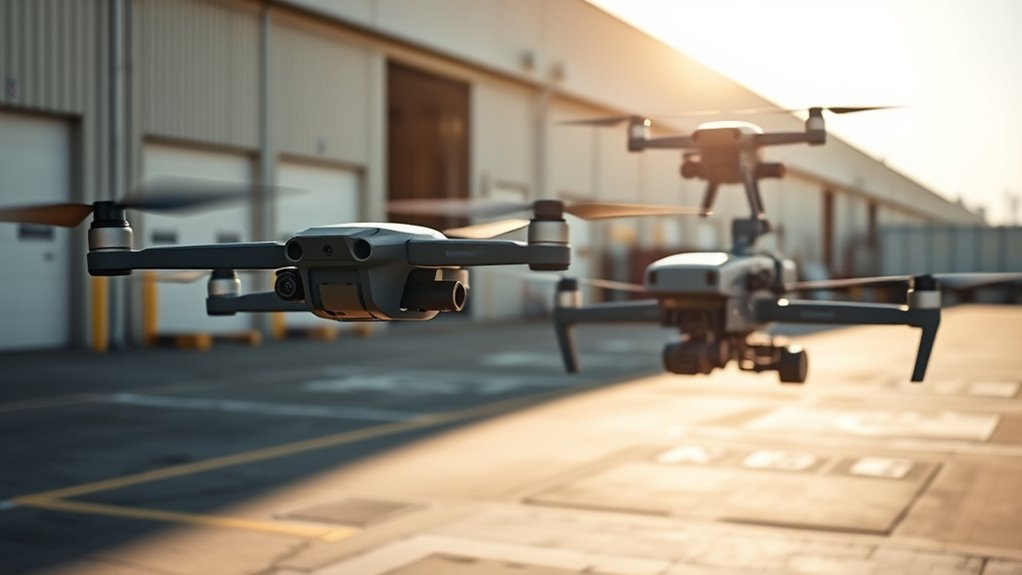
When you’re comparing the Freefly Astro Prime and DJI Matrice 350 RTK, you’ll find the Astro Prime’s robust carbon fiber build and 9kg payload support versatile sensors like its 48MP camera for demanding tasks. In contrast, the Matrice’s ergonomic design and RTK positioning deliver pinpoint accuracy with the Zenmuse H20’s 20MP imaging and 55-minute flight time. It’s about weighing durability versus precision for your operations. Key insights into performance await your exploration.
Design and Build Quality
When comparing the Freefly Astro Prime and DJI Matrice 350 RTK, you’ll find their design and build quality reflect different priorities in durability and functionality. The Freefly Astro Prime emphasizes robust build materials like carbon fiber and aluminum alloys, offering superior resistance to harsh conditions, which lets you operate freely in demanding environments without constant worry. In contrast, the DJI Matrice 350 RTK incorporates ergonomic design elements, such as intuitive handles and balanced weight distribution, enabling effortless handling during extended missions. These choices empower you to select based on your workflow needs—whether it’s the Astro Prime’s rugged construction for remote adventures or the Matrice’s user-friendly form for precise control. Ultimately, both drones’ build materials and ergonomic features enhance your autonomy, allowing seamless integration into enterprise operations while prioritizing reliability and ease. This comparison highlights how thoughtful design fosters freedom in aerial exploration. Additionally, the advanced flight stability features in the DJI Matrice 350 RTK contribute to its reliable performance, making it a strong contender in various operational environments.
Performance Specifications
While the Freefly Astro Prime excels in endurance with flight times up to 50 minutes, the DJI Matrice 350 RTK delivers superior speed, reaching 23 m/s, allowing you to choose based on mission demands like extended surveillance or quick deployments. When examining performance benchmarks, you’ll find the Astro Prime’s longer flight time enhances operational efficiency for tasks requiring sustained presence, freeing you to focus on data collection without frequent recharges. In contrast, the Matrice 350 RTK’s agility boosts your efficiency in dynamic environments, where rapid response is key to maintaining autonomy. Both drones offer robust wind resistance—up to 15 m/s for the Astro Prime and 12 m/s for the Matrice—ensuring reliable performance in variable conditions. Ultimately, these benchmarks let you prioritize either endurance for thorough coverage or speed for agile operations, empowering your enterprise decisions with greater flexibility and freedom. This analytical view highlights how each drone’s specs align with your pursuit of efficient, liberated workflows. Furthermore, the advanced shake reduction techniques in the DJI Matrice 350 RTK ensure that captured footage remains stable even in challenging conditions, enhancing the overall quality of your aerial data.
Camera Systems Comparison
The Freefly Astro Prime’s camera system features a high-resolution 48MP sensor with advanced thermal imaging, while the DJI Matrice 350 RTK boasts a 20MP camera with 4K video at 60fps and integrated LiDAR. When you compare camera features, you’ll appreciate the Astro Prime’s larger sensor size for enhanced image quality in diverse conditions, contrasted with the Matrice’s versatile lens options that adapt to your operational needs. Both drones excel in stabilization systems, ensuring smooth footage during flights, yet the Astro Prime’s superior sensor sizes allow greater flexibility in color profiles and shooting modes for thermal applications. Moreover, the Astro Prime’s superior detail capabilities enable it to capture intricate elements, enhancing the overall quality of the footage and stills. As you explore video formats, the Matrice’s 4K at 60fps offers crisp, professional outputs, while the Astro Prime empowers you with high-resolution stills and varied shooting modes to capture unfiltered realities. This comparison highlights how these systems liberate your creative and analytical pursuits, letting you choose based on image quality demands without unnecessary limitations. Ultimately, it’s about giving you the freedom to excel in enterprise tasks.
Flight Time and Battery Life
Beyond camera features, flight time and battery life emerge as critical factors that shape your operational choices with the Freefly Astro Prime and DJI Matrice 350 RTK. You’ll appreciate how flight endurance determines your freedom for extended missions, while battery efficiency guarantees reliable performance without constant interruptions. The Freefly Astro Prime offers solid flight times for agile, creative endeavors, but the DJI Matrice 350 RTK excels in prolonged operations, giving you more leeway for demanding tasks. Additionally, the Matrice’s extended endurance allows for broader explorations, making it a versatile choice for industrial applications.
| Aspect | Freefly Astro Prime | DJI Matrice 350 RTK |
|---|---|---|
| Flight Endurance (min) | 25 | 55 |
| Battery Efficiency | High | Very High |
| Operational Freedom | Quick, flexible missions | Extended, uninterrupted flights |
Stability and Control Features
Stability and control features define how reliably these drones handle wind, payloads, and maneuvers, directly impacting your operational precision. The Freefly Astro Prime’s robust stability mechanisms, including advanced gimbal damping and redundant sensors, let you fly confidently in turbulent conditions, freeing you from constant corrections. Its control responsiveness is particularly agile, allowing quick, intuitive adjustments that enhance your aerial freedom during payload-heavy missions.
Meanwhile, the DJI Matrice 350 RTK excels with sophisticated stability mechanisms like its RTK positioning system, which delivers pinpoint accuracy even in challenging winds. You’ll appreciate its control responsiveness, offering seamless, real-time feedback that empowers precise maneuvers without lag. Both drones prioritize your independence, but the Astro Prime edges out for raw durability, while the Matrice shines in automated precision, ultimately letting you choose based on your need for unbridled control. Interestingly, both drones feature advanced stability mechanisms that enhance operational reliability in challenging environments.
Software and User Interface
When comparing the software and user interfaces of the Freefly Astro Prime and DJI Matrice 350 RTK, you’ll encounter systems designed to streamline your operations. The Freefly Astro Prime emphasizes customizable user interface design, letting you adapt tools for greater flexibility and independence in mission planning. Meanwhile, the DJI Matrice 350 RTK prioritizes software usability with intuitive, streamlined controls that reduce learning curves, offering a more guided experience without sacrificing efficiency.
Here’s how these interfaces create vivid operational scenarios:
- Visualize seamless customization: With the Astro Prime’s user interface design, you’re free to rearrange dashboards, tailoring software usability to your unique workflow for enhanced creativity.
- Picture intuitive navigation: The DJI Matrice’s software usability lets you glide through menus effortlessly, like charting a course with minimal resistance, keeping you in control.
- Envision real-time adaptability: On the Astro Prime, dynamic updates in the user interface design empower you to tweak settings mid-flight, fostering a sense of liberation in dynamic environments.
- Imagine streamlined efficiency: The DJI’s interface provides quick-access features, allowing you to focus on exploration rather than technical hurdles, promoting operational freedom. Additionally, both systems benefit from real-time monitoring that enhances precision and reliability during operations.
Payload Capacity and Options
When you’re evaluating the Freefly Astro Prime and DJI Matrice 350 RTK, their max payload limits directly impact what missions you can handle. You’ll find varying sensor options available, which determine the precision and types of data you collect in the field. Additionally, attachment compatibility types affect how seamlessly you integrate tools, making it essential to compare these features for your operational needs. Moreover, the advanced motor and propulsion systems in these drones play a crucial role in optimizing their payload handling capabilities.
Max Payload Limits
While the DJI Matrice 350 RTK boasts a payload capacity of up to 2.7 kg, the Freefly Astro Prime elevates this benchmark to approximately 9 kg, offering greater flexibility for diverse mission requirements and accessory integrations. You’ll appreciate how the Astro Prime’s superior payload management lets you fine-tune weight distribution, empowering you to explore uncharted territories without constraints, while the Matrice 350 RTK suits lighter, more controlled setups for your operational freedom.
Here are key ways these capacities spark your imagination:
- Picture heavy sensor arrays: With the Astro Prime’s 9 kg limit, you can balance robust equipment for extended surveys, optimizing weight distribution for stable, liberated flights.
- Envision multi-tool missions: You’re free to layer accessories on the Astro Prime, managing payloads to maintain agility in dynamic environments.
- Imagine endurance gains: The Astro Prime’s capacity lets you distribute weight efficiently, extending flight times so you dominate challenging terrains.
- Visualize adaptive setups: You’ll easily adjust payloads on the Astro Prime, ensuring seamless management that frees you from traditional limitations.
Sensor Options Available
The Freefly Astro Prime’s 9 kg payload capacity enables a wider array of sensor options compared to the DJI Matrice 350 RTK’s 2.7 kg limit, letting you select advanced configurations for specialized tasks. With sensor technology advancements, you’ll experience greater imaging flexibility, empowering your operations through customizable setups that adapt to diverse environments without constraints.
| Sensor Option | Imaging Flexibility Benefits |
|---|---|
| High-Resolution Cameras | Enables detailed aerial mapping for precise data capture |
| Thermal and Infrared Sensors | Offers real-time heat detection in low-visibility scenarios |
| Multispectral Arrays | Provides spectral analysis for agriculture and environmental monitoring |
| Lidar and 3D Scanners | Delivers accurate terrain modeling for complex surveys |
| Stabilized Zoom Lenses | Allows variable focus for dynamic, adaptable imaging tasks |
This freedom in sensor choices lets you optimize missions efficiently, leveraging advancements to meet your specific demands.
Attachment Compatibility Types
Attachment compatibility directly shapes how effectively you can leverage a drone’s payload capacity, such as the Freefly Astro Prime’s 9 kg versus the DJI Matrice 350 RTK’s 2.7 kg. When exploring attachment types, you’ll encounter compatibility issues that influence your freedom to mix and match payloads, from sensors to tools. The Astro Prime offers greater flexibility for heavy-duty options, while the Matrice 350 demands careful selection to avoid restrictions.
- Visualize the Astro Prime’s modular bays accepting diverse attachment types seamlessly, like swapping a thermal camera for a LiDAR unit mid-mission.
- Picture compatibility issues on the Matrice 350, where mismatched connectors could ground your setup, limiting your exploratory flights.
- Envision testing third-party attachments on the Astro Prime, releasing unrestricted payload combinations for remote operations.
- Imagine the Matrice 350’s lighter capacity forcing trade-offs in attachment types, potentially curbing your pursuit of unhindered aerial freedom.
Real-World Applications
Beyond their technical specs, you’ll find that the Freefly Astro Prime and DJI Matrice 350 RTK excel in diverse real-world scenarios, such as aerial surveying, filmmaking, and emergency response, where the Astro Prime’s compact design suits tight spaces and rapid deployments, while the Matrice 350 RTK’s robust RTK system guarantees precision in large-scale mapping tasks. In real world applications, you’ll leverage the Astro Prime for industry use cases like urban inspections or wildlife monitoring, offering you the freedom to operate in constrained environments without sacrificing agility. Meanwhile, the Matrice 350 RTK empowers your work in agriculture or infrastructure projects, delivering accurate data for informed decisions. You’ll appreciate how these drones adapt to dynamic challenges, enhancing operational efficiency and autonomy in filmmaking shoots or disaster assessments, allowing you to explore new possibilities with minimal setup time and reliable performance across varied terrains. Additionally, the Astro Prime’s aerodynamic efficiency contributes to smoother flights, making it a versatile choice for various applications.
Overall Value and Recommendations
As you evaluate the Freefly Astro Prime and DJI Matrice 350 RTK, you’ll find their value comparison hinges on factors like cost, durability, and features, helping you determine which offers better long-term returns. Our key recommendations focus on matching the drone to your specific needs, such as payload capacity or ease of use, to maximize efficiency in your operations. Ultimately, the best choices depend on your budget and application requirements, guiding you toward the most suitable option. Additionally, consider how advanced obstacle avoidance can enhance operational safety and efficiency in challenging environments.
Value Comparison
When comparing the overall value of the Freefly Astro Prime and DJI Matrice 350 RTK, you’ll find that factors like cost, performance, and intended use play key roles in determining which drone suits your needs best. Cost efficiency emerges as a critical factor, with the Astro Prime offering modular upgrades that align with evolving market trends, potentially lowering long-term expenses. Meanwhile, the Matrice 350’s ecosystem integration provides reliable performance for industrial applications, though at a higher initial outlay.
- Visualize the Astro Prime’s rugged frame soaring over vast landscapes, embodying your freedom to tackle remote missions without frequent repairs.
- Picture the Matrice 350’s RTK precision guiding you through complex surveys, ensuring autonomous accuracy in open skies.
- Envision cost efficiency in the Astro Prime’s customizable payloads, adapting seamlessly to your budget-conscious adventures.
- Imagine market trends influencing the Matrice 350’s software updates, keeping your operations agile and unhindered by obsolescence.
Key Recommendations
Based on the value comparison, you’ll want to weigh these key recommendations when selecting between the Freefly Astro Prime and DJI Matrice 350 RTK. User feedback highlights the Astro Prime’s modular design, offering you greater freedom to customize for specialized tasks, though it demands more hands-on expertise based on user experiences. In contrast, the Matrice 350 RTK shines in reliability and seamless integration, with user experiences praising its straightforward operation for efficient, everyday enterprise use. Analyze these aspects against your operational needs—prioritizing flexibility could favor the Astro Prime, while ease and precision might steer you toward the Matrice. Ultimately, trust user feedback to guide your choice, ensuring the drone aligns with your pursuit of independent, effective workflows. (124 words)
Best Choices
When choosing the best drone between the Freefly Astro Prime and DJI Matrice 350 RTK, you’ll find the Matrice often delivers the strongest overall value for users seeking reliable performance in standard operations, thanks to its robust integration and precision. It’s ideal for your best use in surveying or inspections, where market trends favor cost-effective, scalable solutions. The Astro Prime shines in creative or niche applications, offering flexibility that aligns with evolving industry demands.
- Visualize precise mapping: Picture the Matrice gliding over construction sites, delivering RTK-accurate data for seamless project planning.
- Envision dynamic filming: Imagine the Astro Prime capturing cinematic 6K footage in rugged terrains, empowering your aerial storytelling.
- Consider cost efficiency: See yourself maximizing budgets with the Matrice’s long flight times and modular upgrades, adapting to market trends.
- Anticipate future freedom: Foresee both drones evolving with AI integrations, giving you the liberty to explore new professional horizons.
Frequently Asked Questions
What Is the Price of Freefly Astro Prime?
You’re curious about the price of the Freefly Astro Prime, which typically starts around $15,000, depending on configurations. When exploring Astro Prime features like its advanced imaging and modular design, you’ll appreciate how they offer you freedom for aerial missions. In Astro Prime comparisons, it stands out against rivals for versatility, helping you make informed choices without being tied to one ecosystem. It’s an investment in your independence.
Where Can I Buy DJI Matrice 350 RTK?
You can’t believe how straightforward it is to snag a DJI Matrice 350 RTK and soar into new adventures! When exploring buying options, you’ll find the official DJI website offers seamless purchases with warranties, while retailer recommendations like B&H Photo, Best Buy, or Amazon provide competitive pricing and fast shipping. For ultimate freedom, compare these sources analytically to choose what’s best for your aerial needs. Stay informed!
Does It Include a Warranty?
You’re wondering if the DJI Matrice 350 RTK includes a warranty, and yes, it does. Warranty details typically cover manufacturing defects, parts, and labor for an initial period, often one year. You’ll have various coverage options, like basic plans or extended protections, giving you the freedom to customize based on your needs. This analytical approach guarantees you’re informed, allowing independent decisions. Always verify specifics on DJI’s official site for the latest updates.
How Do I Contact Customer Support?
If you’re looking to contact customer support, you’ll find various support channels available to help you quickly. Start by checking the company’s website for options like live chat, email, or phone lines—these customer service portals often provide 24/7 access, empowering you to resolve issues independently. For faster responses, use online forms or social media; it’s straightforward and gives you the freedom to choose what’s most convenient. Always have your details ready for an efficient interaction.
Are Financing Options Available?
You might be surprised that 80% of businesses opt for financing to manage costs effectively. When you’re exploring whether financing options are available for our products, you’ll find flexible financing plans and leasing options that let you maintain your freedom without large upfront payments. These choices offer objective analysis, helping you decide based on your budget and operational needs. Stay informed and empowered!
