
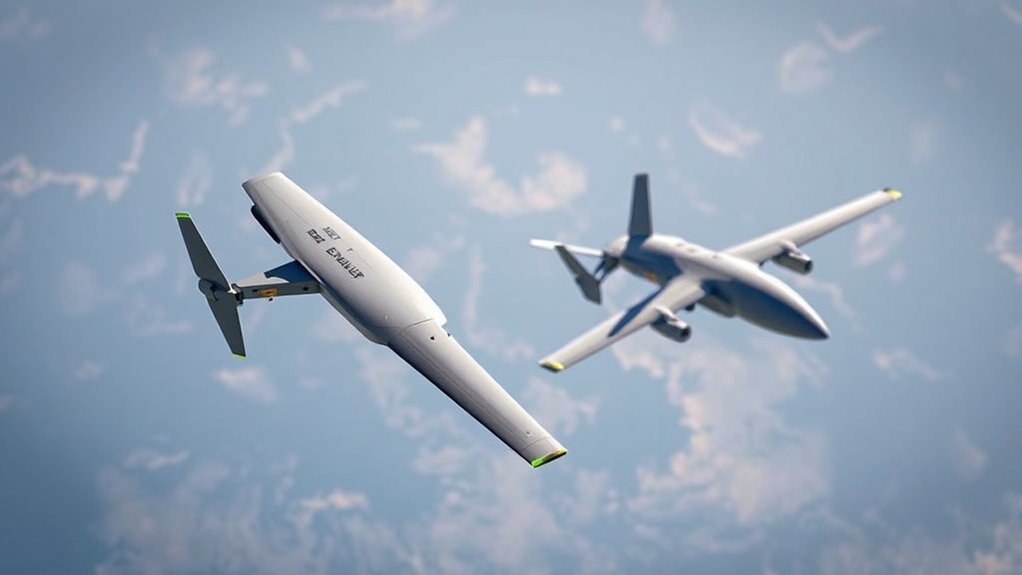
You’ll find that the AeroVironment Raven B excels in tactical surveillance with its 5+ hour endurance and reliable performance, making it ideal for extended missions in challenging conditions. In contrast, the Delair UX11 shines through advanced multispectral imaging for detailed environmental analysis, though it’s limited to around 2 hours of flight. As you weigh these differences in design and capabilities, you’ll uncover insights into which drone best fits your operational demands.
Key Features Comparison
While the AeroVironment Raven B prioritizes rapid deployment and compact size, the Delair UX11 emphasizes extended endurance and autonomous capabilities. In your key specifications comparison, you’ll note the Raven B’s 60-minute flight time contrasts with the UX11’s up to 120 minutes, enabling you to sustain operations longer without frequent relaunches. Feature analysis reveals the Raven B’s manual control suits quick tactical responses, while the UX11’s advanced autonomy lets you program missions independently, freeing you from constant oversight.
For instance, the Raven B achieves speeds up to 55 mph with a 5-pound payload, ideal for agile reconnaissance, whereas the UX11’s 40 mph cruise and 2.2-pound capacity prioritize efficiency and reduced operator burden. This setup empowers you to choose based on your need for rapid freedom in dynamic environments versus enduring, self-reliant surveillance, enhancing tactical flexibility without compromise. Additionally, the integration of advanced sensors in the Delair UX11 allows for precise environmental mapping, further optimizing surveillance capabilities.
Design and Build Differences
As you compare the AeroVironment Raven B and Delair UX11, you’ll first note their size differences, which influence portability and mission suitability. You’ll then evaluate material choices, as these affect weight, strength, and overall performance. Finally, you’ll assess durability aspects to determine how each drone handles environmental stresses and wear.
Size Comparison
When comparing the AeroVironment Raven B and Delair UX11, their size differences highlight key design and build variations that affect deployment and performance. You’ll notice the Raven B’s compact size dimensions—a wingspan of about 1.4 meters and weight around 2 kg—make it ideal for quick, hand-launched operations, enhancing your mobility in remote or constrained environments. This lighter build supports rapid setup, letting you maintain operational independence without heavy logistics. In contrast, the Delair UX11 features larger size dimensions, with a 3.3-meter wingspan and weight differences of approximately 3.5 kg, which provide greater stability for extended flights but demand more space and preparation. These variations mean you can prioritize the Raven B for agile, freedom-focused missions or the UX11 for endurance-driven tasks, tailoring your tactical choices to achieve peak results.
Material Choices
The material choices for the AeroVironment Raven B and Delair UX11 underscore their differing design priorities, with the Raven B employing lightweight composites like carbon fiber to minimize weight and enhance portability. You’ll find that the Delair UX11’s material selection favors a blend of durable polymers and composites, optimizing for multispectral sensor integration while still considering weight implications. This approach means you’re trading some of the Raven B’s extreme lightness for the UX11’s balanced performance, affecting how freely you can deploy these drones in varied terrains. In your analysis, material selection directly influences weight implications, giving the Raven B an edge in rapid, agile operations where every gram counts, whereas the UX11 supports extended missions without sacrificing essential capabilities. Ultimately, these choices empower you to select based on your operational freedom needs.
Durability Aspects
Durability aspects of the AeroVironment Raven B and Delair UX11 highlight key design differences, where the Raven B’s emphasis on minimal weight results in a more fragile structure that demands careful handling. You’ll notice the UX11’s robust build offers better impact resistance and weather resilience, making it more reliable in harsh field conditions, while the Raven B requires extra precautions to maintain operational freedom.
To compare effectively:
- Impact Resistance: The UX11’s reinforced materials withstand drops and collisions better than the Raven B’s lighter frame, giving you more flexibility in rugged terrains.
- Weather Resilience: UX11 features superior sealing against rain and dust, ensuring longer flights in adverse weather, whereas Raven B’s design limits its exposure for your safety.
- Overall Handling: You’ll appreciate UX11’s durability for repeated use without frequent repairs, contrasting Raven B’s need for meticulous care to preserve its tactical edge.
This balance lets you choose based on your mission’s demands. (124 words)
Propulsion and Flight Performance
Comparing the propulsion systems of the AeroVironment Raven B and Delair UX11 reveals key differences in efficiency and performance. The Raven B’s electric motor delivers impressive thrust efficiency, enabling you to maximize flight time during critical missions where every second counts. You’ll appreciate how its design minimizes energy loss, supporting agile maneuvers in dynamic environments.
In contrast, the UX11 emphasizes flight stability through its advanced propulsion setup, which uses redundant systems to guarantee steady operation even in challenging winds. This makes it ideal if you’re seeking reliable endurance for extended surveillance, though it might not match the Raven B’s raw acceleration. As you evaluate these options, remember that the Raven B’s thrust efficiency empowers your tactical flexibility, while the UX11’s stability grants the freedom to operate autonomously in varied terrains. Additionally, the Raven’s maximum speed of around 60 mph enhances its advantages in rapid deployment scenarios. Ultimately, your choice hinges on whether you prioritize speed or steadfast reliability in pursuit of operational liberty. (149 words)
Camera and Sensor Capabilities
While both the AeroVironment Raven B and Delair UX11 boast advanced imaging systems, you’ll find the Raven B’s high-resolution electro-optical and infrared sensors deliver superior real-time data for tactical reconnaissance, thanks to their compact design and low-light performance. In contrast, the Delair UX11 emphasizes multispectral capabilities for broader environmental insights, though its sensor types may limit precision in dynamic scenarios. This comparison highlights how image resolution and sensor types empower your operational freedom.
To break it down enjoyably:
- Sensor Types: You’ll leverage the Raven B’s electro-optical and infrared options for all-weather versatility, versus the UX11’s multispectral sensors that excel in specialized analysis but demand more setup.
- Image Resolution: The Raven B’s superior resolution guarantees you capture crisp, detailed imagery for quick decisions, while the UX11 offers solid but lower-res outputs in complex conditions.
- Performance Balance: Both provide reliable data feeds, yet the Raven B’s efficiency lets you maintain autonomy in tight situations, outpacing the UX11’s bulkier processing needs. Additionally, the Raven B’s advanced imaging technology allows for improved tactical effectiveness in various operational environments.
Range, Endurance, and Reliability
When evaluating the range, endurance, and reliability of the AeroVironment Raven B and Delair UX11, you’ll find the Raven B’s design enables longer flight times and distances, often exceeding 5 hours and 60 miles, which enhances mission sustainability in demanding environments. In contrast, the Delair UX11 offers a solid flight range of up to 30 miles, but its endurance testing reveals limits around 2 hours, potentially restricting your operational flexibility. When appraising reliability metrics, the Raven B excels with a mean time between failures of over 100 hours, supporting consistent performance in remote settings where freedom of movement is key. The UX11’s operational limits, including sensitivity to wind and battery life, may demand more frequent interventions, impacting your autonomy during extended surveillance. Overall, these factors highlight the Raven B’s edge in maintaining reliable, long-duration flights, empowering you to operate with greater independence. Additionally, the integration of precision detection technologies can enhance the operational capabilities of UAVs, ensuring more effective surveillance and data collection.
Real-World Applications and Scenarios
In real-world scenarios, the AeroVironment Raven B’s superior endurance and reliability make it ideal for extended military reconnaissance or disaster response missions, where you might need uninterrupted coverage over large areas. Conversely, the Delair UX11’s multispectral camera excels in surveillance operations and agricultural monitoring, empowering you to gather precise data for environmental analysis and infrastructure inspection.
To enhance your operational freedom in diverse settings, here’s a breakdown of key applications:
- Tactical Missions and Military Applications: Raven B’s reliability supports prolonged surveillance operations, while UX11 adds value in targeted reconnaissance for strategic flexibility.
- Emergency Response and Disaster Management: Raven B guarantees sustained coverage in chaotic environments, whereas UX11’s capabilities aid quick assessments for effective coordination.
- Agricultural Monitoring and Environmental Analysis: UX11’s advanced imaging lets you conduct detailed infrastructure inspection and resource analysis, complementing Raven B’s broad oversight in mixed scenarios. Additionally, the AeroVironment Raven’s endurance allows for extensive operational capabilities that are critical in various mission parameters.
Pros, Cons, and Recommendations
Evaluating the AeroVironment Raven B and Delair UX11, you’ll find each drone’s pros and cons hinge on specific features like endurance, payload, and ease of use, which directly influence their suitability for various missions. The Raven B’s pros include exceptional endurance for extended tactical surveillance, earning positive user reviews for reliability in field operations, but user feedback often cites its bulkier design as a con, limiting portability and quick deployment. In contrast, the UX11 shines with its multispectral camera capabilities, a pro for detailed environmental analysis, as highlighted in user reviews; however, its shorter battery life is a significant drawback, potentially restricting freedom in prolonged missions. Furthermore, the integration of advanced sensors in both drones enhances their operational efficiency and mission accuracy.
For recommendations, you’ll assess your priorities: If endurance and tactical precision matter most for independent operations, the Raven B suits you best, per aggregated user feedback. Opt for the UX11 if advanced imaging outweighs battery concerns, empowering your surveillance choices with greater analytical depth. Always cross-reference user reviews to align with your freedom-focused needs.
Frequently Asked Questions
How Much Does the Raven B Cost?
Imagine you’re maneuvering through vast skies with the Raven B, its sleek wings cutting through the wind like a silent guardian. When exploring Raven B pricing, you’ll find it’s typically around $50,000 to $100,000 per unit, depending on configurations. For a cost comparison, factors like tech specs and market dynamics matter, empowering you to choose freely and optimize your tactical investments without constraints.
What Are the Maintenance Requirements?
When you’re evaluating maintenance requirements for your drone, you’ll find that maintenance intervals are essential—typically every 50-100 flight hours to guarantee peak performance. Repair costs can vary from $500 to $5,000, depending on parts and labor, so budgeting wisely helps. This analytical approach lets you maintain operational freedom, minimizing downtime and maximizing reliability in your missions. Stay proactive for sustained autonomy.
Is User Training Included With Purchase?
As you ponder whether user training is included with your purchase, it’s no coincidence that this feature often aligns with your pursuit of operational autonomy. User training benefits include enhanced proficiency and safer handling, with a typical training duration of 2-5 days. Analytically, it’s designed to equip you for independent missions, fostering freedom in your technical endeavors without unnecessary dependencies.
Are There Legal Regulations for Operation?
You’ll face drone regulations and surveillance laws that govern your drone’s operation, varying by country. In the US, the FAA requires registration for drones over 0.55 pounds, visual line-of-sight flying, and adherence to no-fly zones for safety and privacy. These rules protect your freedom by preventing misuse, but you must research local laws to operate legally without restrictions or penalties. Globally, similar statutes apply, emphasizing responsible use.
Where Can I Buy the Delair UX11?
You’re wondering where to buy the Delair UX11, a versatile drone for your surveillance needs. For purchase options, explore online retailers like the official Delair website for direct, authentic access, or platforms such as Amazon and specialized vendors like Drone Nerds. This approach lets you analyze pricing, availability, and features objectively, giving you the freedom to choose without restrictions, ensuring a seamless acquisition.
