
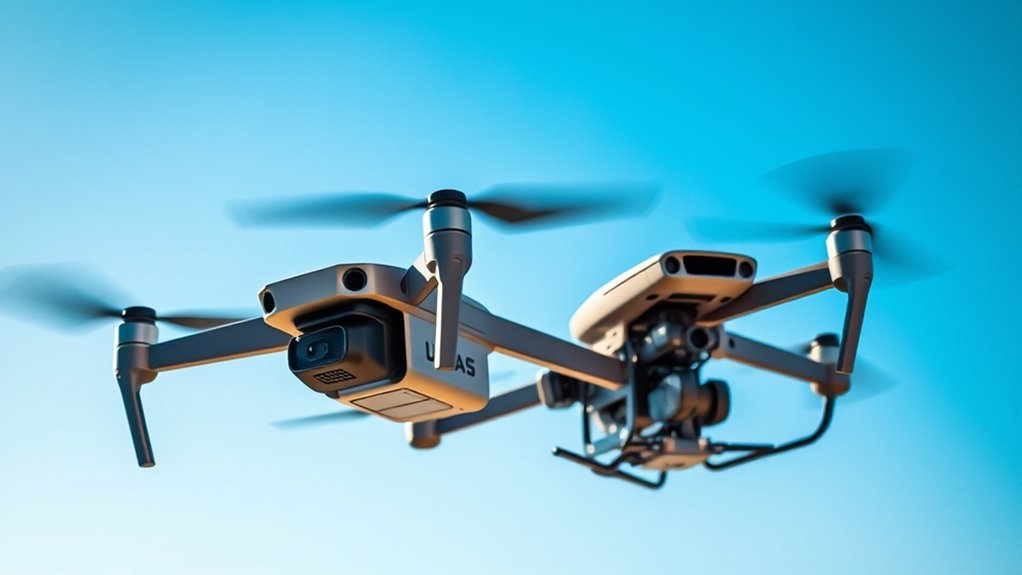
If you’re comparing the Wingtra One Gen II and Freefly Alta X, you’ll notice the Wingtra’s 42MP sensor delivers sharper images for precise mapping tasks, backed by its stable flight and up to 59 minutes of battery life. In contrast, the Alta X’s Cinematic Movi Gimbal excels in smooth aerial footage for filmmaking, with agile maneuvers and customizable payloads. Further insights await in this matchup’s key aspects.
Design and Build Quality
While the Wingtra One Gen II emphasizes a lightweight, aerodynamic design with its carbon fiber construction for better portability, you’ll notice that the Freefly Alta X prioritizes rugged durability through a modular aluminum frame, offering superior resistance to harsh conditions without compromising payload capacity.
When evaluating design aesthetics, you’ll find the Wingtra’s sleek, streamlined profile appeals to your need for agile, unobtrusive operations, freeing you to explore remote areas effortlessly. In contrast, the Alta X’s bold, industrial look enhances material durability, with its aluminum components withstanding impacts and corrosion better than carbon fiber in extreme environments. This comparative edge means you’re not tethered by fragility; the Alta X’s modularity lets you adapt quickly, while the Wingtra’s featherlight build guarantees easy transport for spontaneous missions. Ultimately, both drones empower your freedom through thoughtful engineering, but the Alta X’s superior material durability gives you confidence in harsher settings, balancing aesthetics with real-world resilience. Additionally, Wingtra One’s high-resolution cameras ensure detailed mapping, enhancing its operational efficiency in diverse environments.
Camera and Sensor Specifications
As you compare the Wingtra One Gen II and Freefly Alta X, you’ll first notice their resolution differences, which directly influence image detail and clarity. You’ll then analyze sensor sizes, as these affect light sensitivity and overall quality between the two drones. Finally, the image sensor features, such as dynamic range and noise reduction, provide key insights into how each model suits your mapping or surveying needs. Additionally, the camera resolution plays a significant role in determining the level of detail captured during flight, especially for professional-grade applications.
Resolution Comparison
When you compare the camera and sensor resolutions of the Wingtra One Gen II and Freefly Alta X, you’ll see that the Wingtra’s 42-megapixel sensor outperforms the Alta X’s 24-megapixel option, delivering sharper images for detailed mapping and surveying tasks. This higher resolution translates to greater pixel density, which amplifies the resolution impact by capturing more intricate details in every shot, empowering you to achieve superior image quality without constraints. You’ll notice how the Wingtra’s enhanced pixel density enables finer distinctions in aerial photography, allowing for more precise data extraction and analysis, so you can explore projects with unmatched freedom. In comparison, the Alta X’s lower pixel density reduces the resolution impact, potentially limiting your ability to generate highly detailed outputs, where every pixel counts for excellent results in demanding scenarios. This difference lets you choose the tool that best liberates your creative and professional pursuits.
Sensor Size Analysis
Beyond resolution, the Wingtra One Gen II’s larger sensor—typically a full-frame 35.9 x 24 mm—outshines the Freefly Alta X’s options, like a full-frame or APS-C sensor, by capturing more light and reducing noise for superior low-light performance. You’ll notice this enhances your sensor performance, allowing freer aerial mapping with less grain in challenging conditions. When comparing pixel density, the Wingtra’s setup offers better efficiency, packing pixels more effectively for sharper details without overcrowding, while the Alta X might compromise on that front.
| Aspect | Wingtra One Gen II | Freefly Alta X |
|---|---|---|
| Sensor Size | 35.9 x 24 mm full-frame | Full-frame or APS-C |
| Pixel Density | Lower, for better light | Higher, potential noise |
| Sensor Performance | Superior low-light | Good, but less dynamic |
| Overall Impact | More freedom in varied light | Limited in low light |
Image Sensor Features
While the Wingtra One Gen II features a high-performance CMOS sensor with robust dynamic range and advanced noise reduction, you’ll find the Freefly Alta X’s options, such as its variable ISO capabilities, provide solid versatility but may lag in low-light scenarios. When exploring sensor technology, the Wingtra’s advanced CMOS delivers superior imaging capabilities for precise mapping, boasting 42MP resolution that empowers you to capture detailed aerial data with minimal distortion. In contrast, the Alta X’s sensor technology offers flexible imaging capabilities through its adaptable ISO, letting you experiment freely in varied lighting, though it compromises on the Wingtra’s noise handling for cleaner outputs. This comparison highlights your freedom to choose based on needs—opt for Wingtra if high-fidelity results drive you, or Alta X for adaptable cinematic pursuits, ensuring your aerial ventures remain unhindered by technical limits. Ultimately, these features let you soar with confidence, tailoring sensor performance to your creative or professional demands.
Flight Performance Comparison
The Wingtra One Gen II and Freefly Alta X deliver distinct flight performance profiles that cater to varied operational needs. You’ll appreciate how the Wingtra One Gen II excels in flight stability, offering superior resistance to wind gusts for precise, hands-off mapping missions, letting you focus on exploration without constant adjustments. In contrast, during your maneuverability assessment, the Freefly Alta X shines with its agile, multi-rotor design, enabling quick pivots and dynamic flight paths ideal for cinematic pursuits where freedom of movement is key.
As you compare these drones, the Wingtra’s fixed-wing setup provides efficient, long-duration stability in open skies, minimizing pilot intervention for a liberated flying experience. Meanwhile, the Alta X’s enhanced maneuverability allows you to navigate tight spaces and complex terrains effortlessly, empowering your creative visions. Additionally, the mapping precision metrics of the Wingtra One Gen II ensure that you achieve high-quality results without compromising on detail. Ultimately, your choice hinges on whether you prioritize rock-steady performance or versatile agility in the skies.
Battery Life and Range Analysis
When you compare the battery durations of the Wingtra One Gen II and the Freefly Alta X, you’ll note that the Gen II offers longer flight times in standard conditions, while the Alta X prioritizes payload capacity over endurance. In evaluating flight ranges, you’ll find the Gen II achieves greater distances in VTOL mode, contrasting with the Alta X’s robust performance for heavy-lift operations. This analysis helps you determine which drone aligns with your specific mission requirements. Additionally, the Wingtra One’s sub-centimeter accuracy in mapping applications can significantly enhance the quality of aerial surveys compared to the Alta X’s capabilities.
Battery Duration Comparison
Battery duration is a crucial factor in drone selection, where the Wingtra One Gen II delivers up to 59 minutes of flight time, outpacing the Freefly Alta X’s 45 minutes and enabling longer missions with less downtime. You’ll appreciate the Wingtra’s superior battery capacity, boasting a robust 620 Wh compared to the Alta X’s 500 Wh, which lets you capture more without frequent swaps. This enhanced capacity empowers your aerial adventures, giving you the freedom to explore extensively before recharging. Additionally, the Wingtra excels in charging efficiency, reaching 80% in just 45 minutes versus the Alta X’s hour-long process, minimizing interruptions and maximizing your operational liberty. As you compare, you’ll find the Wingtra’s efficient power management reduces downtime, letting you focus on what matters—unleashed creativity in the skies. Ultimately, its advantages in battery capacity and charging efficiency make it ideal for those seeking true flight autonomy.
Flight Range Evaluation
Building on battery life, you’ll discover that flight range hinges on efficiency and conditions, where the Wingtra One Gen II achieves up to 59 minutes of flight to cover approximately 10-15 km depending on wind, compared to the Freefly Alta X’s 45 minutes and 8-12 km range. When it comes to flight path optimization, the Wingtra One Gen II lets you maximize distance through advanced algorithms that adapt to terrain, giving you greater freedom to explore without frequent returns. In contrast, the Alta X’s range limitations, such as higher wind sensitivity and less efficient routing, may constrain your aerial adventures, potentially requiring more battery swaps. You’ll appreciate how these factors empower the Wingtra for longer, uninterrupted missions, while the Alta X demands careful planning to avoid mid-flight setbacks, ultimately offering you more operational liberty with the Gen II’s superior reach.
Software and Control Systems
While the Wingtra One Gen II features an intuitive software interface designed for seamless operation, the Freefly Alta X offers a more advanced control system with enhanced autopilot capabilities. You’ll appreciate how the Wingtra’s control interface simplifies your workflow, enabling effortless software integration that lets you focus on capturing precise 42MP mapping data without unnecessary complications. This setup grants you the freedom to operate independently, minimizing downtime through user-friendly updates and reliable connectivity. Additionally, the Wingtra’s enhancements in battery efficiency contribute to longer operational times, allowing you to maximize your mapping endeavors.
In comparison, the Freefly Alta X’s sophisticated control system elevates your experience with robust autopilot features, allowing you to automate complex flight paths for cinematic endeavors. You’ll notice its superior software integration provides real-time adjustments and advanced algorithms, ensuring you’re not bogged down by manual interventions. Ultimately, both systems empower your aerial pursuits, but the Alta X’s edge in automation gives you more liberty to innovate, while the Wingtra prioritizes straightforward, hassle-free control.
Payload and Customization Options
Moving to payload and customization options, the Wingtra One Gen II offers modular attachments for specialized sensors like its 42MP camera, letting you tailor missions for mapping with ease. This payload versatility means you’re free to swap components swiftly, enhancing your operational efficiency without downtime. For instance, you can integrate various sensors for precise data collection, giving you the flexibility to adapt to diverse mapping needs on the fly. Additionally, the Wingtra One’s advanced spectral capabilities enable precise multispectral data collection, enhancing the quality of your mapping missions.
In comparison, the Freefly Alta X excels in payload versatility through its robust support for heavy payloads, such as the Cinematic Movi Gimbal, which lets you mount professional-grade cameras for dynamic shots. You’ll enjoy the customization flexibility here too, as it accommodates multiple configurations, empowering you to experiment with setups that prioritize stability and cinematic quality. Ultimately, Wingtra provides streamlined modularity for mapping enthusiasts, while Alta X offers broader freedom for creative, payload-heavy endeavors, ensuring your projects remain adaptable and autonomous.
Real-World Applications and Use Cases
In real-world applications, you’ll find that the Wingtra One Gen II excels in surveying and mapping tasks, such as precision agriculture or infrastructure inspections, where its autonomous flight delivers accurate, efficient data collection through superior mapping efficiency and drone technology. This makes it ideal for professional applications in industries like construction and environmental monitoring, giving you the freedom to capture high-resolution aerial photography with minimal intervention. Additionally, its advanced high-resolution sensors ensure that the data collected is of exceptional detail and clarity, further enhancing the quality of the mapping outcomes.
On the other hand, the Freefly Alta X shines in cinematic versatility, perfect for filmmaking techniques and surveying tasks that demand dynamic aerial maneuvers. You’ll appreciate its robustness in industry use cases like film production or event coverage, where quick payload swaps enhance your creative control. Comparing the two, Wingtra’s precision suits data-driven scenarios, while Freefly’s adaptability frees you for expressive, on-the-fly adjustments in professional applications, empowering your drone technology explorations without constraints.
Overall Value and Recommendations
When you weigh the overall value of the Wingtra One Gen II against the Freefly Alta X, you’ll find that Wingtra’s precision and efficiency translate to a higher return on investment for data-intensive operations, while Freefly’s adaptability suits budget-conscious users seeking versatility in creative or rapid-response scenarios. Regarding overall performance, Wingtra excels in high-resolution mapping with its 42MP sensor, delivering superior data accuracy that enhances your workflow in surveying tasks. Conversely, the Freefly Alta X’s cinematic Movi gimbal offers smoother maneuverability for dynamic shoots, giving you the freedom to adapt quickly without compromising on quality. User experience with Wingtra emphasizes streamlined autonomy and reliability for professional mapping, whereas Freefly provides intuitive controls that let you explore creative liberties effortlessly. For recommendations, choose Wingtra if your priorities lie in precise, data-driven outcomes; opt for Freefly if you crave the flexibility to innovate on the fly, ensuring your aerial endeavors align with your pursuit of unrestricted exploration. Additionally, both drones improve survey efficiency by reducing flight times and errors, making them valuable assets for various applications.
Frequently Asked Questions
How Much Do These Drones Cost?
You might picture drone pricing as charting a vast sky, where each dollar is a gust of wind propelling your freedom. When you’re exploring how much these drones cost, you’ll find drone pricing varies: entry-level models start around $500, but for a cost comparison, professional ones can range from $10,000 to $20,000 or more, based on features and tech specs. This lets you choose wisely for your aerial adventures.
What Is the Warranty Period?
When you’re examining warranty periods for tech gear, you’ll find warranty details vary by manufacturer. Standard coverage options often include a 1-year period for basic protection, while some offer 2- or 3-year extensions. This comparative flexibility lets you choose based on your freedom-seeking lifestyle, weighing essential safeguards against thorough plans for uninterrupted adventures. Always review terms for ideal reliability.
Where Are These Drones Manufactured?
You’re wondering where these drones are manufactured, and it’s key to evaluate manufacturing locations alongside production quality. Various drones are produced in places like Switzerland, where precision engineering guarantees robust, high-standard builds, or the US, emphasizing innovative tech for adaptable performance. Comparing these options gives you the freedom to choose based on your needs, balancing durability with cutting-edge features for ideal aerial exploration. This insight empowers your decisions.
Can They Operate in Rainy Conditions?
Have you ever wondered if your drone can handle a sudden downpour without skipping a beat? When it comes to operating in rainy conditions, you’ll find that models with strong rain resistance and weather durability vary. For instance, one might boast IP-rated seals for reliable performance in light rain, while another’s robust build lets you explore freely in tougher weather. Compare these features to choose what’s best for your adventurous flights.
Is Pilot Training Required?
You’re wondering if pilot training is required for drone operations. Yes, it often is, depending on regulations and drone type. You’ll need pilot certification through structured training programs, which vary in intensity—some demand rigorous courses for safety, while others provide flexible, user-friendly options. This lets you compare and choose programs that offer the freedom to fly efficiently without excessive constraints, empowering your aerial adventures.
