
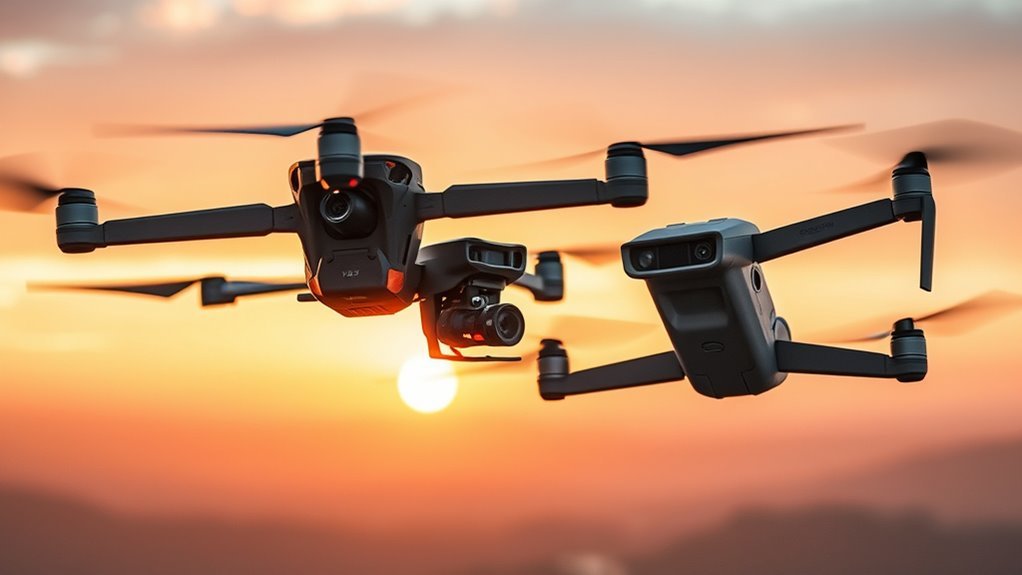
When you’re deciding between the Freefly Alta 8 Pro and HoverAir X1 Pro in this 6K camera showdown, you’ll notice the Alta 8 Pro’s cinematic 6K excels with superior stabilization and low-light performance for professional-grade footage, while the X1 Pro’s 6K selfie camera offers agile portability for spontaneous shots. It’s a balance of precision versus ease, depending on your needs. Further exploration reveals how each stacks up in real scenarios.
Design and Build Quality
When comparing the Freefly Alta 8 Pro and the HoverAir X1 Pro, their design and build quality highlight key differences in durability and portability. You’ll appreciate how the Alta 8 Pro’s material durability stems from its high-grade carbon fiber and reinforced frame, enabling you to tackle demanding terrains with confidence, liberating you for extended adventures. In contrast, the HoverAir X1 Pro emphasizes ergonomic design, with its compact, user-friendly shape that fits seamlessly into your daily life, allowing effortless transport without sacrificing stability.
Analytically, the Alta 8 Pro’s robust build offers superior protection against elements, but its weight limits quick mobility, whereas the X1 Pro’s lighter materials enhance portability for spontaneous exploration. This ergonomic design in the X1 Pro lets you focus on creativity, while the Alta 8 Pro’s durability guarantees reliability in freer, more challenging settings. Ultimately, your choice depends on whether you prioritize rugged endurance or agile freedom in your aerial pursuits. Additionally, understanding the flight performance of each model can further inform your decision-making process.
Camera Specifications
You’ll notice that the Freefly Alta 8 Pro and HoverAir X1 Pro differ in camera specs, particularly video resolution and sensor capabilities, which directly affect your footage quality. As you analyze these, pay attention to how each drone’s stabilization features handle motion and vibrations for smoother results. This examination will reveal which option aligns better with your specific filming requirements. Additionally, consider how the advanced shake reduction techniques employed by each model can enhance the overall quality of your footage.
Video Resolution
The Freefly Alta 8 Pro excels in video resolution, supporting up to 8K at 30fps, while the HoverAir X1 Pro tops out at 4K at 60fps. You’ll appreciate how these options let you capture footage with the freedom to choose based on your creative needs, balancing 6K clarity for cinematic depth against versatile video formats.
- 6K Clarity Comparison: The Alta 8 Pro’s higher resolution gives you sharper 6K clarity, ideal for professional edits, whereas the X1 Pro’s 4K limits finer details in dynamic scenes.
- Video Formats Supported: You’ll find the Alta 8 Pro offers more flexible formats like ProRes for post-production freedom, while the X1 Pro sticks to H.265, constraining your workflow options.
- Frame Rate Analysis: At 60fps, the X1 Pro provides smoother motion for fast-paced action, empowering you to film freely without resolution trade-offs.
- Overall Versatility: This resolution gap means you’re freer with the Alta 8 Pro for large-scale projects, but the X1 Pro’s efficiency suits spontaneous, on-the-go adventures.
In this duel, your choice hinges on prioritizing resolution’s analytical edge over practical usability. (124 words)
Sensor Capabilities
Sensors in the Freefly Alta 8 Pro and HoverAir X1 Pro vary greatly, with the former boasting a larger 1-inch CMOS sensor for superior light capture and dynamic range, while the latter relies on a more compact 1/2.3-inch sensor that favors portability over low-light prowess. As you explore sensor technology, you’ll see how the Alta 8 Pro’s larger sensor excels in image processing, delivering richer details and reduced noise in challenging lighting, empowering your creative freedom on the go.
| Aspect | Freefly Alta 8 Pro | HoverAir X1 Pro |
|---|---|---|
| Sensor Size | 1-inch CMOS | 1/2.3-inch |
| Sensor Technology | Superior light sensitivity | Compact for agility |
| Image Processing | Enhanced dynamic range | Streamlined for portability |
This setup lets you choose based on whether you prioritize expansive, high-fidelity captures or lightweight, liberated shooting experiences.
Stabilization Features
Stabilization features set the Freefly Alta 8 Pro and HoverAir X1 Pro apart in handling camera shake during flights, ensuring you capture smooth, cinematic footage as you explore the skies freely.
- Gimbal Technology in Alta 8 Pro: This drone’s advanced mechanical gimbal provides robust, multi-axis stabilization, allowing you to fly aggressively without compromising video quality, ideal for dynamic adventures.
- Electronic Stabilization in X1 Pro: Relying on software-based electronic stabilization, the HoverAir X1 Pro corrects shakes efficiently in compact scenarios, giving you lightweight freedom for spontaneous outings.
- Comparative Effectiveness: While the Alta 8 Pro’s gimbal excels in high-wind conditions, the X1 Pro’s electronic system offers quicker responses for everyday use, helping you decide based on your flight style.
- Impact on Your Experience: Both technologies enhance footage stability, but the Alta 8 Pro’s precision might appeal if you seek unbridled exploration, whereas the X1 Pro prioritizes portability for liberated mobility.
In essence, choosing depends on whether you value mechanical reliability or electronic agility for your aerial pursuits. (124 words)
Video Performance Comparison
When you’re comparing the Freefly Alta 8 Pro and HoverAir X1 Pro, you’ll notice differences in resolution quality that affect video sharpness and detail. Frame rate speed varies between the two, influencing how smoothly action sequences appear in your footage. Stabilization features also play a key role, as they determine how steady your videos remain during flight. Additionally, the EIS and OIS technologies utilized by these drones significantly impact their performance in various shooting conditions.
Resolution Quality
While the Freefly Alta 8 Pro delivers up to 6K resolution for superior video detail, the HoverAir X1 Pro offers 4K capabilities, creating a clear contrast in performance. You’ll appreciate how this difference empowers your creative choices, as the Alta 8 Pro’s higher resolution enhances resolution clarity and image sharpness, letting you zoom in without losing detail. It’s all about giving you the freedom to produce professional-grade videos that stand out.
- Resolution Clarity Comparison: The Alta 8 Pro’s 6K provides finer details in landscapes, ideal for your aerial adventures, versus the X1 Pro’s 4K, which may blur finer elements.
- Image Sharpness Benefits: You’ll experience crisper edges with the Alta 8 Pro, maintaining sharpness in fast-moving scenes, while the X1 Pro might show slight softening.
- Practical Implications: For your free-flying shoots, 6K means more post-editing flexibility, allowing precise cropping without quality loss, unlike 4K’s limitations.
- User Freedom Aspect: Choosing the Alta 8 Pro lets you break free from resolution constraints, offering sharper, clearer outputs for unrestricted storytelling.
Frame Rate Speed
Moving on from resolution, frame rate speed determines how smoothly your videos capture motion, with the Freefly Alta 8 Pro offering up to 60fps for fluid, professional-grade footage, while the HoverAir X1 Pro tops out at 30fps, potentially leading to less seamless results in fast-paced scenes. In frame rate comparisons, the Alta 8 Pro’s higher speed gives you greater flexibility to freeze action and create cinematic effects, empowering your storytelling without constraints. For slow motion capabilities, you’ll appreciate the Alta 8 Pro’s ability to record at 60fps, allowing detailed playback at half speed for dramatic sequences, whereas the X1 Pro’s 30fps limits your options in high-energy shoots. This difference means you can choose the Alta 8 Pro if you crave the freedom to explore dynamic, unrestrained videography, ensuring every moment flows naturally and creatively. Ultimately, these specs let you decide based on your need for speed and control in capturing life’s adventures.
Stabilization Features
Beyond frame rate, stabilization features greatly influence video quality, with the Freefly Alta 8 Pro’s advanced gimbal system delivering exceptional smoothness to counteract shakes and vibrations, while the HoverAir X1 Pro’s electronic stabilization offers basic correction that might falter in dynamic scenarios. As you capture footage, you’ll appreciate how gimbal technology enhances stability for professional results, giving you the freedom to fly freely without compromising clarity.
- Gimbal Technology Comparison: The Freefly Alta 8 Pro’s mechanical gimbal provides superior 3-axis stabilization, reducing blur in windy conditions, unlike the HoverAir X1 Pro’s software-based approach.
- Stabilization Modes Available: Freefly offers multiple modes like follow and sport for adaptive control, allowing you to tailor shots to your adventurous style, whereas HoverAir limits options to basic auto-stabilize.
- Effectiveness in Motion: In fast-paced scenarios, Freefly’s system maintains steady horizons, empowering your creative pursuits, while HoverAir’s may introduce jitters during aggressive maneuvers.
- Impact on Your Freedom: With robust stabilization, you can explore unrestricted aerial views, but HoverAir’s constraints might hinder your spontaneous, liberated filming experiences.
Flight Stability and Controls
When evaluating the flight stability and controls of the Freefly Alta 8 Pro versus the HoverAir X1 Pro, you’ll notice that the Alta 8 Pro excels in windy conditions due to its robust GPS and inertial systems, which provide superior resistance to gusts and maintain precise positioning. Its advanced stability algorithms guarantee seamless control responsiveness, letting you navigate complex aerial paths with effortless precision, as if you’re truly free in the skies.
In contrast, the HoverAir X1 Pro offers intuitive controls that prioritize ease, but its stability algorithms fall short in turbulent environments, potentially limiting your freedom during dynamic shoots. You’ll appreciate the Alta 8 Pro’s quicker control responsiveness, which minimizes latency and enhances maneuverability for professional-grade stability. However, the X1 Pro’s simplified interface might appeal if you’re seeking a more accessible experience without sacrificing basic steadiness, empowering you to capture footage on the fly with less fuss. Ultimately, the Alta 8 Pro gives you the edge for demanding scenarios where stability reigns supreme. Additionally, its superior flight stability is crucial for cinematic applications that require precise movements and control.
Battery Life and Range
While the Freefly Alta 8 Pro boasts impressive battery life, offering up to 15-20 minutes of flight time depending on payload, the HoverAir X1 Pro typically delivers around 10-15 minutes, making it less ideal for extended shoots. You’ll appreciate how the Alta 8 Pro’s greater battery capacity empowers your aerial explorations, allowing longer flights without frequent interruptions, whereas the X1 Pro’s flight endurance might tether you during spontaneous adventures. This difference highlights trade-offs in design for freedom seekers.
- Battery Capacity Comparison: The Alta 8 Pro’s larger battery capacity (around 4S 16000mAh) supports extended sessions, giving you more liberty to capture vast landscapes, unlike the X1 Pro’s compact 3000mAh, which prioritizes portability over endurance.
- Flight Endurance Factors: Variables like wind and payload affect both drones’ flight endurance; you’ll note the Alta 8 Pro handles heavier loads better, enabling freer movement in challenging conditions compared to the X1 Pro’s sensitivity.
- Range Implications: While battery life directly influences range, the Alta 8 Pro’s robust endurance lets you roam farther with confidence, whereas the X1 Pro’s shorter flights may require you to plan more conservatively for uninterrupted freedom.
- Analytical Trade-offs: Objectively, superior battery capacity in the Alta 8 Pro enhances your exploratory potential, but the X1 Pro’s quicker recharge offers a different kind of liberation for quick, on-the-go shoots. Additionally, the battery life of a drone is crucial for filmmakers aiming for uninterrupted cinematic captures.
User Experience and Interface
Shifting to user experience and interface, you’ll notice the Freefly Alta 8 Pro offers a robust, customizable setup with its dedicated controller and app, which includes detailed flight planning tools for professional users. Its user interface design emphasizes freedom through intuitive, modular controls that let you tailor flights effortlessly, drawing positive user feedback for reliability in complex scenarios. In contrast, the HoverAir X1 Pro’s user interface design prioritizes simplicity, with a streamlined app that enables quick, autonomous operations via gesture controls, appealing to those seeking hassle-free adventures. User feedback highlights its ease for beginners, though it offers less customization, potentially limiting your exploratory options. Analytically, the Freefly provides more depth for creative freedom, while the HoverAir guarantees accessible independence—your choice depends on whether you value intricate control or straightforward mobility in aerial pursuits. Additionally, Autel’s emphasis on user-friendly design elements supports a growing trend in drone usability, which could influence future developments in aerial technology.
Accessories and Customization
Exploring accessories and customization, the Freefly Alta 8 Pro stands out with its expansive ecosystem, including modular payloads, swappable batteries, and compatible third-party add-ons that let you adapt the drone for specialized tasks like cinematography or surveying. You’ll appreciate its robust accessory options, which provide unparalleled flexibility for creative pursuits. In comparison, the HoverAir X1 Pro delivers simpler customization features focused on user-friendly enhancements, allowing you to modify it quickly without overwhelming complexity.
- Freefly Alta 8 Pro’s accessory options: Offer modular attachments for seamless upgrades, giving you freedom to explore diverse applications.
- HoverAir X1 Pro’s customization features: Include easy-swap accessories like filters and mounts, enabling effortless personalization for spontaneous flights.
- Comparative accessory options: Freefly provides more third-party compatibility, while HoverAir emphasizes compact, integrated solutions for liberated mobility.
- Overall customization features: Both drones enhance your aerial freedom, but Freefly’s depth suits professional tweaks, whereas HoverAir’s simplicity favors quick, hassle-free adjustments. Additionally, Freefly’s modular components allow for improved adaptability in various operational environments.
Performance in Real-World Scenarios
When you put the Freefly Alta 8 Pro and HoverAir X1 Pro to the test in real-world conditions, such as windy environments or uneven terrain, the Alta 8 Pro’s robust design and advanced stabilization systems deliver consistent performance for professional tasks, whereas the HoverAir X1 Pro’s lightweight build guarantees agile handling for spontaneous, everyday use. In real world testing, you’ll appreciate how the Alta 8 Pro maintains steady footage during demanding shoots, like aerial surveys or action sequences, making it ideal for practical applications where precision matters. Conversely, the HoverAir X1 Pro’s quick responsiveness lets you capture impromptu moments with ease, freeing you from bulky setups in daily adventures. Analytically, both drones shine in their niches: the Alta 8 Pro excels in controlled environments, ensuring reliable results for creative professionals, while the X1 Pro’s portability empowers on-the-go users to explore without limitations, enhancing your freedom in practical applications like travel vlogging or casual outings. Ultimately, your choice hinges on whether you prioritize stability or spontaneity in real world testing. Additionally, the Alta 8 Pro’s ability to handle gusts up to 10 m/s enhances its performance in challenging conditions, further solidifying its position in professional aerial cinematography.
Frequently Asked Questions
What Is the Price of Freefly Alta 8 Pro?
You’re exploring the financial aspect of acquiring the Freefly Alta 8 Pro, a drone that elegantly balances Freefly features with Alta performance for your liberated aerial adventures. It’s not just about cost; think of it as an investment in seamless, high-flying freedom. Typically, you’ll find it priced around $10,000, varying by retailer, reflecting its robust capabilities for professional-grade endeavors. This empowers your creative skies.
Where Can I Buy Hoverair X1 Pro?
You’re wondering where to buy the HoverAir X1 Pro, giving you the freedom to explore various buying options. Top online retailers like Amazon, Best Buy, and the official HoverAir website offer it, allowing easy comparisons of prices and availability. You’ll find these platforms provide secure transactions and sometimes bundle deals, empowering your independent purchase decision. Check stock regularly for the best options.
Does It Support Ios Compatibility?
Imagine you’re on an epic outdoor adventure, using your HoverAir X1 Pro to capture stunning aerial shots, but you need seamless iOS compatibility to edit on the go. Yes, it supports iOS compatibility, allowing you to connect via the app for easy control and real-time viewing. Regular software updates keep things optimized, ensuring your device’s freedom to evolve with new features for flexible flying experiences.
What Is the Warranty Duration?
You’re wondering about the warranty duration for your devices, and it’s key to understand warranty coverage to guarantee you’re protected. For many tech gadgets, you’ll find a standard one-year warranty, but a warranty comparison reveals variations—like extended options up to two years from some manufacturers. This gives you the freedom to choose based on your needs, offering peace of mind and flexibility in repairs or replacements. Always check specifics for full analytical insight.
Are There Any Current Promotions?
You’re checking for current promotions, and it’s worth noting that current discounts on various products, including drones, often align with seasonal sales like Black Friday or end-of-year events. These offers can help you save money, giving you more freedom to choose upgrades without overspending. Always verify with retailers for the latest deals, as they vary by region and time. Stay informed to maximize your options.
