
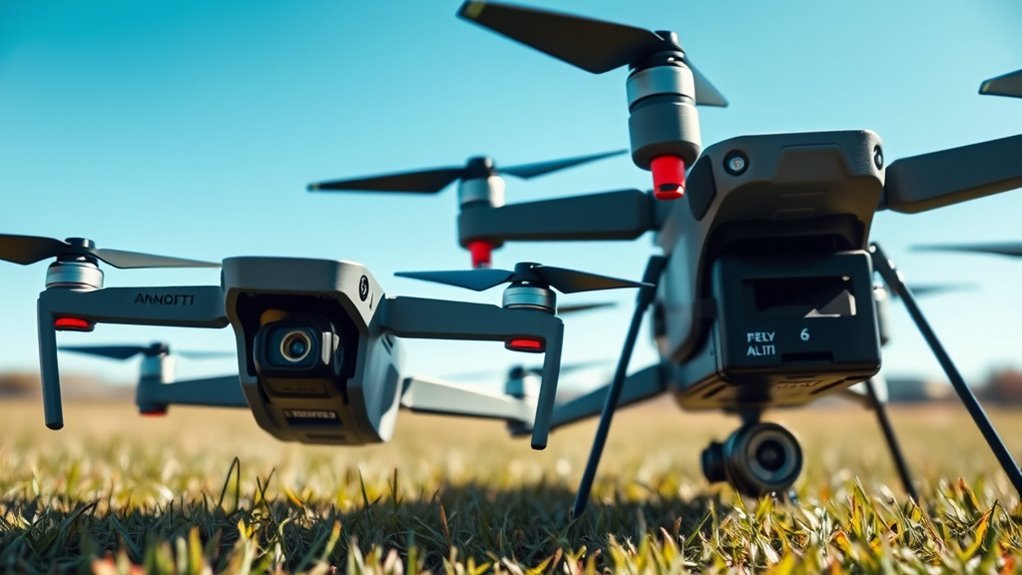
You’ll find that the Parrot Anafi AI’s lightweight, foldable design and 21MP AI camera deliver agile flights and high-resolution shots, ideal for everyday adventures, while the Freefly Alta X’s robust build and cinematic Movi gimbal offer superior stability for professional-grade videography. In flight handling, Anafi AI excels in responsiveness, but Alta X provides better endurance with hot-swappable batteries. When weighing features, Anafi AI prioritizes affordability, whereas Alta X focuses on precision—uncover these insights further to match your setup.
Design and Build Quality
When examining the design and build quality of the Parrot Anafi AI and Freefly Alta X, you’ll find that the Anafi AI prioritizes lightweight portability with its foldable frame and carbon fiber components, weighing in at under 1 kg for easy transport. Its ergonomic design guarantees comfortable handling during flights, allowing you to explore freely without fatigue. The build materials, including durable carbon fiber and high-grade plastics, enhance resilience while keeping the drone agile for on-the-go adventures.
In contrast, the Freefly Alta X emphasizes robust build materials like aluminum and reinforced composites, making it heavier at around 7 kg for stability in demanding scenarios. You’ll appreciate its ergonomic design features, such as intuitive controls and modular setup, which promote seamless operation in professional settings. However, this comes at the cost of portability compared to the Anafi AI’s nimble form. Overall, both drones offer freedom through thoughtful engineering, but the Anafi AI suits spontaneous, liberated use, while the Alta X excels in structured, enduring applications. Additionally, while the Anafi AI focuses on lightweight portability, the Alta X’s design is tailored for enhanced stability in professional settings.
Camera Performance Comparison
Shifting to camera performance, you’ll find that the Parrot Anafi AI’s 4K HDR camera excels in portability-focused scenarios, capturing vibrant footage with its 21MP sensor and electronic image stabilization for smooth, agile shots during dynamic flights. In contrast, the Freefly Alta X’s cinematic Movi gimbal offers superior image stabilization through mechanical precision, ideal for professional, stabilized cinematic work that demands rock-steady framing. When it comes to low light performance, the Anafi AI holds its own with its sensor’s efficiency, delivering clearer details in dim conditions without excessive noise, empowering you to explore freely at dusk. However, the Alta X edges ahead with better dynamic range in low light, preserving highlights and shadows for more versatile, unobstructed creativity. Ultimately, your choice hinges on whether you prioritize the Anafi AI’s agile, freedom-oriented capture or the Alta X’s refined, cinematic control. The larger sensor in Air 3S enhances low-light handling, making it a key consideration for drone users focused on intricate detail capture.
Flight Handling and Controls
Shifting from camera features, the Parrot Anafi AI’s flight handling stands out for its intuitive controls and agile responsiveness, making it ideal for beginners who need quick, effortless maneuvers in various environments. You’ll find its flight stability exceptional, allowing you to glide smoothly through unpredictable winds without losing composure, while control responsiveness lets you execute sharp, precise adjustments that liberate you to explore confidently. In contrast, the Freefly Alta X prioritizes professional-grade flight stability, supporting heavier setups for demanding shoots, but its control responsiveness can feel more deliberate, demanding a steady hand for intricate flights. As you compare, the Anafi AI empowers spontaneous adventures with its lightweight agility, whereas the Alta X suits structured operations where robust stability guarantees freedom from unexpected disruptions. Ultimately, your choice hinges on whether you crave nimble handling or unyielding reliability to pursue aerial freedom. Additionally, affordable pricing strategies enable new enthusiasts to easily enter the drone market without the burden of high costs.
Battery Life and Endurance
While the Parrot Anafi AI boasts agile performance, its battery life typically supports shorter flights, often around 25-30 minutes, allowing you to capture quick adventures without frequent recharges. This limited endurance stems from its modest battery capacity, usually around 2,700 mAh, which endurance testing reveals can vary based on factors like wind and payload, giving you the freedom to dart through spontaneous explorations but demanding strategic planning.
In contrast, the Freefly Alta X offers superior longevity with a higher battery capacity—often up to 12,000 mAh per pack—enabling flights of 15-20 minutes per battery, extendable via hot-swapping for longer sessions. Endurance testing shows the Alta X’s robust system performs reliably under demanding conditions, letting you roam vast areas with less interruption and embrace true aerial liberty. Additionally, the Alta X’s advanced lithium-ion variants enhance overall capacity, ensuring you can tackle extended missions without frequent stops. Ultimately, your choice hinges on whether you prioritize the Anafi AI’s nimble, recharge-friendly setup or the Alta X’s extended runtime for unfettered journeys.
Features and Value Analysis
After examining battery endurance, you’ll find that the Parrot Anafi AI emphasizes user-friendly features like AI-assisted obstacle avoidance and 4K HDR video, delivering solid value for hobbyists at a lower price point. Now, as you explore feature highlights, the Freefly Alta X offers professional-grade cinematic capabilities with its Movi gimbal, appealing to creators seeking advanced control. Both drones present distinct value propositions: the Anafi AI prioritizes affordability and ease for free exploration, while the Alta X delivers precision for demanding projects, empowering your aerial freedom without compromise. Additionally, the Anafi AI’s AI-driven algorithms enhance its stability, making it a versatile option for varied flying conditions.
To compare effectively:
| Feature Highlights | Value Propositions |
|---|---|
| AI obstacle avoidance | Cost-effective for hobbies |
| 4K HDR video | Enhances creative liberty |
| Cinematic Movi gimbal | Professional-grade returns |
In this analysis, you’ll see how these elements align with your desire for unrestricted adventures, making the choice clear based on your needs.
Frequently Asked Questions
What Are the Legal Requirements for Flying These Drones?
When you’re flying drones, you must comply with drone regulations to guarantee safe operations. You’ll need to register your device with the FAA or equivalent authority if it weighs over 0.55 pounds, obtain flight permits for controlled airspace, and adhere to altitude limits like 400 feet. These rules protect your freedom to soar while preventing risks, so always check no-fly zones for hassle-free adventures.
How Do I Maintain and Clean the Drones?
Like a bird soaring freely in the skies, you’ve got to keep your drone in prime condition. For effective drone maintenance, regularly inspect propellers and batteries for wear, ensuring they’re securely fastened. Cleaning tips include using a soft microfiber cloth and isopropyl alcohol to gently wipe sensors and frames, preventing dust buildup. This analytical approach lets you maintain peak performance objectively, embracing your aerial freedom. Stay vigilant!
Are There Any Insurance Options Available?
You’re wondering about insurance options for your drone, and yes, they’re readily available to protect your aerial freedom. Drone insurance offers various coverage options, including hull damage for physical repairs, liability for third-party incidents, and even worldwide policies for global flights. Analytically, you’ll want to compare providers based on premiums, deductibles, and exclusions, ensuring you select a plan that lets you fly worry-free. Research thoroughly for the best fit.
Can I Upgrade the Camera or Parts?
You’re wondering if you can upgrade your camera or parts, and it’s all about exploring upgrade options while ensuring camera compatibility. Many drones offer modular designs, letting you swap components for better performance, like higher-resolution sensors, giving you the freedom to customize freely. Analytically, check manufacturer guidelines first to avoid compatibility pitfalls and maintain safety, extending your device’s life objectively. Always weigh costs and benefits for best results.
Where Can I Find User Communities?
You’re seeking user communities to connect with fellow drone enthusiasts. Explore online forums like Reddit’s r/drones or specialized sites for in-depth discussions and analytical insights. Don’t overlook social media platforms such as Facebook groups and Twitter communities, where you can engage freely, share experiences, and access objective advice. These spaces empower you to learn independently, fostering a sense of liberation in your explorations.
