
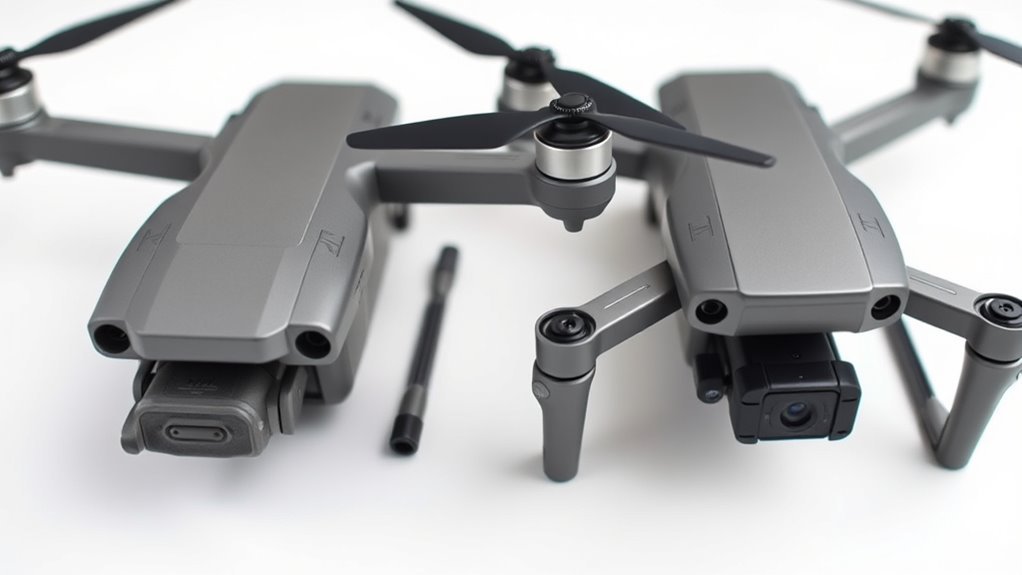
If you’re comparing the Potensic Atom 3 and Freefly Astro Prime, you’ll find the Atom 3’s budget 4K camera offers portability at 249 grams with 30 minutes of flight time, ideal for casual users seeking simple controls and value. In contrast, the Astro Prime’s enterprise 6K system delivers superior image detail and accuracy, backed by 45-60 minutes of flight for professional precision. While the Atom 3 excels in ease and affordability, the Astro Prime suits demanding tasks. Further insights on specs and performance lie ahead.
Specifications Comparison
As you compare the specifications of the Potensic Atom 3 and Freefly Astro Prime, you’ll find key differences in weight, battery life, and imaging capabilities that directly impact their performance. The Potensic Atom 3, weighing just 249 grams, offers lightweight drone features that enhance portability, letting you explore freely without the burden of heavy gear. In contrast, the Freefly Astro Prime’s 1.2 kg build prioritizes stability for demanding tasks, though it may limit your spontaneous adventures.
When examining battery life, the Atom 3 provides around 30 minutes of flight time, empowering quick, agile outings where you dictate the pace. The Astro Prime extends this to 45-60 minutes, supporting longer missions for those seeking extended freedom in professional settings.
For camera capabilities, the Atom 3 features a 4K camera with basic stabilization, ideal for casual users capturing life’s moments on a budget. Meanwhile, the Astro Prime boasts advanced 6K capabilities, including higher dynamic range sensors, giving you more versatile tools for precise aerial work. These drone features ultimately let you choose the right balance for your liberated pursuits. Additionally, the Atom 3’s user-friendly interface simplifies navigation, making it accessible for novice drone enthusiasts.
Image Quality Analysis
While the Potensic Atom 3’s 4K camera delivers competent image quality with basic stabilization, the Freefly Astro Prime’s 6K sensor and advanced dynamic range provide superior clarity and detail, enabling you to achieve more professional results under challenging lighting conditions.
As you compare image clarity, the Astro Prime’s enhanced sensor captures finer details, giving you the freedom to explore complex scenes without compromise. Regarding color accuracy, it’s clear the Astro Prime maintains truer hues across various lighting, empowering your creative endeavors with reliable fidelity. Additionally, the Astro Prime’s superior mapping precision enhances its versatility for various imaging projects.
| Aspect | Potensic Atom 3 | Freefly Astro Prime |
|---|---|---|
| Resolution | 4K | 6K |
| Image Clarity | Good, with limitations | Superior detail |
| Color Accuracy | Decent reproduction | Excellent fidelity |
This analytical breakdown shows how the Astro Prime’s capabilities let you push boundaries in your imaging projects.
Ease of Use and Value Evaluation
When evaluating the ease of use and value of the Potensic Atom 3 versus the Freefly Astro Prime, you’ll notice that the Atom 3’s intuitive controls and lightweight design make it accessible for beginners, while the Astro Prime demands more expertise due to its advanced features. The Atom 3’s user-friendly interface simplifies setup and operation, letting you focus on capturing footage without overwhelming complexity, which enhances your creative freedom on a budget. In contrast, the Astro Prime’s sophisticated controls require training, appealing to professionals who need precision but at a higher learning curve.
For value, the Atom 3 excels in cost efficiency, offering 4K capabilities at an affordable price, so you can invest in other gear or experiences without breaking the bank. The Astro Prime’s 6K prowess justifies its premium cost for enterprise users seeking top-tier results, but it may limit your options if budget constraints matter. Ultimately, the Atom 3 empowers everyday adventurers with accessible tools, while the Astro Prime suits those prioritizing advanced performance over simplicity. Additionally, the Atom 3’s superior agility and wind resistance make it ideal for spontaneous flights, enhancing its practicality for casual users.
Frequently Asked Questions
Where Can I Buy the Potensic Atom 3?
Imagine you’re charting your own course across vast skies, much like piloting a drone—it’s all about freedom in choices. When seeking the Potensic Atom 3, you’ll find options at online retailers like Amazon or Best Buy for easy access and deals, or check local stores such as electronics shops for hands-on trials. This analytical approach guarantees you’re making an informed, objective purchase, empowering your aerial adventures.
Does the Freefly Astro Prime Require FAA Registration?
You might be wondering if your Freefly Astro Prime requires FAA registration. Under FAA regulations, you’ll need to register your drone if it weighs more than 0.55 pounds and you’re flying it recreationally or commercially. This guarantees you’re complying with drone registration rules, allowing you to enjoy aerial freedom responsibly while avoiding potential fines or restrictions. Always verify specifics on the FAA website.
What Warranty Options Are Available for These Drones?
You’re wondering about warranty options for these drones, focusing on drone warranty coverage and camera durability to keep your flights worry-free. Budget models like the Potensic Atom 3 often offer a standard one-year limited warranty, covering basic defects but emphasizing camera resilience. Enterprise options, such as the Freefly Astro Prime, provide two-year warranties with extensions, including extensive protection for advanced camera systems. This gives you the freedom to soar confidently, minimizing repair concerns.
Are There Any Recommended Apps for Controlling Them?
You’ll find that delving into tools for your aerial escapades offers a subtle path to greater autonomy. When it comes to drone apps and camera controls, you’ll appreciate recommendations like manufacturer-specific software, which provides intuitive interfaces for precise flight and imaging tweaks. Analytically, these options empower you objectively, ensuring seamless, freedom-oriented experiences to capture the skies on your terms.
How Do I Contact Customer Support for Troubleshooting?
If you’re troubleshooting drone maintenance issues, start by consulting your user manuals for analytical, step-by-step guidance—they’re designed to give you the freedom to resolve problems independently. For further help, contact customer support through the manufacturer’s website, app, or email; look for live chat or phone options to guarantee objective assistance without delays, keeping your flights seamless.
