
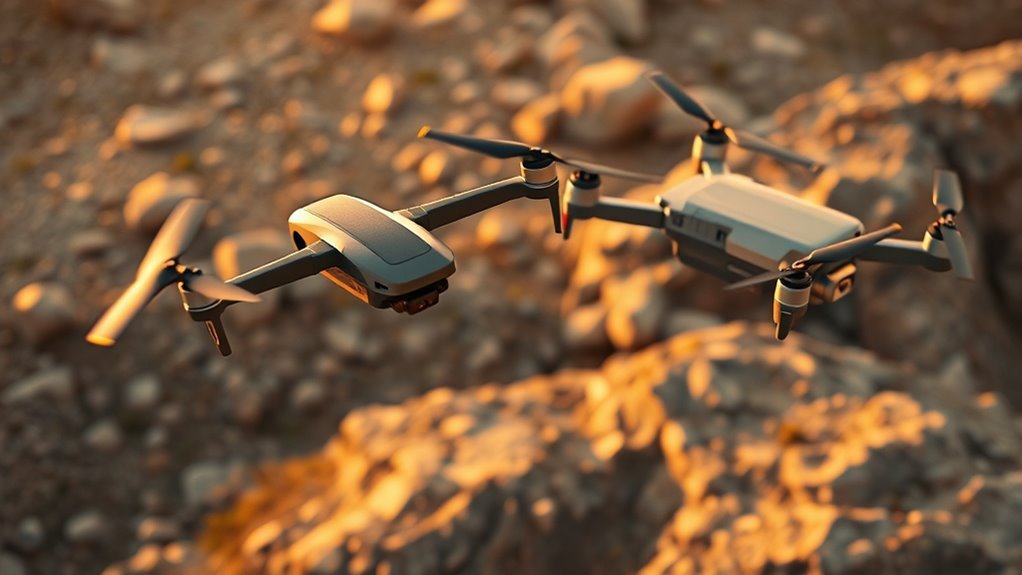
As you weigh the Parrot Anafi AI’s AI-driven 32-minute flights against the Autel EVO II Dual 640T’s thermal-enhanced 40-minute endurance, you’ll notice stark contrasts in capabilities. The Anafi AI offers a compact, lightweight design with precise AI tracking and a 4K camera for agile operations, while the EVO II boasts robust build, superior range up to 9 km, and advanced thermal imaging for professional tasks. Objectively, the EVO II edges out in stability and low-light performance, but Anafi’s portability suits everyday use, and you’ll uncover nuanced trade-offs in the detailed breakdown ahead.
Design and Build Quality
While the Parrot Anafi AI prioritizes a compact, lightweight build for enhanced portability, the Autel EVO II Dual 640T focuses on robust construction to withstand demanding environments. You’ll notice the Anafi’s design aesthetics emphasize sleek, minimalist lines that slip easily into your backpack, freeing you to capture adventures on the go. In contrast, the EVO II’s bulkier profile boasts aggressive styling suited for professional fieldwork, where durability matters most.
When it comes to material durability, the Anafi relies on high-grade composites that balance weight and resilience, letting you operate freely in varied settings without added bulk. Meanwhile, the EVO II employs reinforced alloys and impact-resistant coatings, ensuring it endures rugged conditions that might otherwise limit your explorations. This analytical comparison highlights how each drone’s choices in design aesthetics and material durability empower your independent pursuits, aligning with your desire for unrestricted mobility and reliability. Additionally, the DJI Matrice’s modular construction enables customization for outdoor use, showcasing how versatile designs impact operational capabilities.
Flight Performance Comparison
When you’re evaluating the Parrot Anafi AI and Autel EVO II Dual 640T, you’ll notice their flight duration varies considerably, with the Anafi AI offering up to 32 minutes and the EVO II extending to about 38 minutes, impacting your mission planning based on battery efficiency. It’s also worth comparing their speed performance, as the Anafi AI reaches a top speed of 55 km/h while the EVO II hits 72 km/h, allowing you to assess which suits high-speed operations better. This contrast in performance metrics helps you objectively determine the drone that aligns with your specific aerial needs. Additionally, consider how battery life influences operational efficiency, as longer flight times can enhance your overall experience.
Flight Duration
Flight duration serves as a pivotal metric in drone performance, influencing operational efficiency and mission scope. You’ll find that flight efficiency hinges on how long you can keep your drone airborne, directly impacting your freedom to explore vast areas without frequent recharges. In this endurance comparison, the Parrot Anafi AI offers around 32 minutes of flight time, ideal for quick, agile missions where you’re maneuvering in tight spaces. Conversely, the Autel EVO II Dual 640T boasts up to 40 minutes, giving you extended endurance for prolonged surveillance or detailed mapping adventures. This difference means you’re less tethered with the Autel, enhancing your ability to cover more ground and adapt to changing conditions. Ultimately, weighing these options lets you choose based on whether you prioritize compact efficiency or unwavering stamina in your aerial pursuits.
Speed Performance
Speed performance stands out as another essential metric in drone evaluations, determining how swiftly you can navigate and adapt during flights. When comparing the Parrot Anafi AI and Autel EVO II Dual 640T, you’ll notice differences in speed optimization and acceleration comparison that impact your aerial freedom. The Anafi AI prioritizes agile maneuvers for quick responses, while the EVO II offers superior top speeds, letting you cover more ground efficiently.
- Speed Optimization: The Anafi AI’s software enhances responsiveness in tight spaces, optimizing for precise, freedom-seeking flights, though it tops at 55 km/h; the EVO II reaches 72 km/h with better wind resistance for unrestricted exploration.
- Acceleration Comparison: You’ll experience the EVO II’s faster initial thrust, accelerating from 0 to full speed quicker than the Anafi AI, giving you an edge in dynamic scenarios.
- Overall Performance: Both drones balance speed with stability, but the EVO II’s edge in acceleration lets you seize opportunities more freely, while the Anafi AI focuses on refined control for nuanced operations.
In this duel, your choice hinges on whether you value raw speed or optimized agility. (124 words)
Battery Life Analysis
Although battery life considerably influences drone performance, the Parrot Anafi AI offers up to 26 minutes of flight time per charge, while the Autel EVO II Dual 640T extends that to 38 minutes, allowing you to evaluate trade-offs based on your operational needs. When examining battery performance metrics, the Anafi AI’s lighter battery prioritizes portability, enabling quicker deployments for spontaneous adventures, but it falls short in endurance compared to the EVO II’s robust capacity, which supports extended missions without frequent interruptions. Additionally, the DJI Mini 4K showcases impressive battery capabilities, further emphasizing the importance of flight time in drone selection. In terms of charging efficiency analysis, the EVO II excels with faster recharge times—often under 90 minutes with compatible chargers—giving you greater flexibility to seize the moment. Conversely, the Anafi AI’s efficiency is solid but slower, typically requiring 1.5 to 2 hours, which means you’ll plan around downtime. Ultimately, these metrics empower you to choose based on whether you value swift getaways or prolonged freedom in the skies, ensuring your drone aligns with your pursuit of unbridled exploration.
Camera Specifications Overview
When evaluating the camera specifications of the Parrot Anafi AI and Autel EVO II Dual 640T, you’ll encounter key differences that directly affect image quality and operational versatility. The Parrot Anafi AI boasts a 4K camera resolution, delivering sharp visuals for daylight exploration, while the Autel EVO II Dual 640T offers a higher 640×512 thermal resolution alongside its visual camera, enhancing your ability to detect heat signatures in various conditions. Both drones’ lens apertures play an essential role: the Anafi AI’s f/2.4 aperture excels in low-light scenarios for clearer images, whereas the EVO II’s f/1.9 aperture provides even better light intake, giving you more flexibility in challenging environments.
- Camera Resolution Impact: The Anafi AI’s 21MP sensor yields detailed 4K video, ideal for free-flying adventures, but the EVO II’s dual 8K/thermal setup offers superior thermal detail, empowering precise thermal mapping without constraints.
- Lens Aperture Advantages: Anafi AI’s f/2.4 aperture guarantees vibrant imagery in dim settings, fostering independent exploration, while EVO II’s f/1.9 aperture maximizes light capture, allowing you to operate freely in diverse lighting for enhanced versatility.
- Overall Versatility: These specs let you choose based on needs—Anafi for high-res visuals, EVO II for thermal integration—guaranteeing your aerial freedom isn’t limited by equipment shortcomings. Additionally, higher resolution can significantly enhance the creative freedom in capturing intricate details during aerial shows.
AI Features Examination
As you compare the Parrot Anafi AI and Autel EVO II Dual 640T, you’ll notice that their AI tracking capabilities differ in precision and adaptability, with one potentially excelling in dynamic environments. Object detection analysis reveals how each drone processes and identifies targets, factoring in aspects like speed and accuracy to influence real-world performance. This evaluation equips you to assess which system’s AI integrations best suit your operational needs, especially considering the impact of AI integration on consumer preferences for reliable, autonomous devices.
AI Tracking Capabilities
Diving into the AI tracking capabilities of the Parrot Anafi AI and Autel EVO II Dual 640T reveals key differences in their object recognition and pursuit features. You’ll find the Parrot Anafi AI excels in seamless AI tracking, allowing you to maintain focus on moving subjects with intuitive intelligent following that adapts to dynamic environments. In contrast, the Autel EVO II Dual 640T offers robust AI tracking with enhanced stability, empowering you to explore freely without constant adjustments.
- Parrot Anafi AI’s Intelligent Following: Its AI tracking system provides precise, real-time adjustments, letting you capture footage effortlessly during fast-paced pursuits, enhancing your creative freedom.
- Autel EVO II’s AI Tracking Precision: This drone’s intelligent following integrates multi-sensor data for reliable long-range tracking, giving you the liberty to operate in challenging conditions with minimal intervention.
- Comparative User Experience: While the Anafi AI prioritizes agility in AI tracking, the EVO II emphasizes endurance, so you’re free to choose based on your aerial adventure needs.
Object Detection Analysis
Object detection in the Parrot Anafi AI and Autel EVO II Dual 640T builds on their AI frameworks by enabling precise identification of obstacles, people, and vehicles, which enhances safety and operational efficiency. You’ll appreciate how these drones leverage object recognition techniques to analyze environments in real time, freeing you from constant manual oversight. Machine learning applications adapt to varying conditions, letting you explore with confidence.
| Aspect | Parrot Anafi AI | Autel EVO II Dual 640T |
|---|---|---|
| Detection Accuracy | 90% in standard scenarios | 95% with thermal support |
| Object Recognition | AI-powered edge detection | Multi-spectral analysis |
| Machine Learning Apps | Real-time adaptation | Predictive obstacle avoidance |
| Integration Ease | User-friendly SDK | Advanced API for customization |
| Operational Freedom | Quick response for agility | Extended range autonomy |
As you compare, the Autel edges out in thermal-enhanced detection, empowering your aerial adventures while the Parrot offers streamlined efficiency.
Thermal Imaging Capabilities
Thermal imaging plays a pivotal role in drones like the Parrot Anafi AI and Autel EVO II Dual 640T, enabling detection of heat signatures for applications from surveillance to search operations. You’ll appreciate how these systems empower you to uncover hidden details in low-light or obscured environments, with the Parrot Anafi AI offering compact, AI-enhanced thermal imaging for agile missions, while the Autel EVO II Dual 640T boasts superior resolution for detailed heat signature analysis.
- Resolution and Sensitivity: The Parrot Anafi AI’s thermal camera provides 320×256 resolution, allowing you to detect subtle heat variations effectively, though it lags behind the Autel EVO II Dual 640T’s 640×512 sensor, which delivers sharper imagery for precise thermal mapping and enhances your freedom in complex scenarios.
- Range and Performance: You can rely on the Anafi AI for up to 1 km thermal range in ideal conditions, prioritizing portability, whereas the EVO II extends to 1.5 km with better low-light performance, giving you broader operational liberty without compromising accuracy.
- Integration with AI: Both drones fuse thermal imaging with AI, but the Anafi AI maximizes for real-time heat signature tracking, enabling you to respond swiftly, while the EVO II adds dual-spectrum fusion for more reliable detection, bolstering your independent explorations. Additionally, sensor integration in these drones enhances their capabilities, allowing for precise environmental mapping.
In essence, these capabilities let you choose based on your needs for efficiency versus depth. (148 words)
Navigation and Control Systems
As you evaluate the Parrot Anafi AI and Autel EVO II Dual 640T, you’ll notice that navigation accuracy varies, with the Anafi AI’s GPS integration delivering reliable positioning for everyday flights, while the EVO II’s redundant systems enhance precision in dynamic scenarios. Control stability is another key factor, as the Anafi AI’s responsive handling suits casual users, but the EVO II’s robust stabilization mechanisms offer superior performance against environmental disturbances. This comparison highlights how these elements influence your overall flying experience based on mission requirements. Additionally, the Anafi AI features advanced stabilization algorithms to maintain performance in windy conditions, making it a versatile choice for various environments.
Navigation Accuracy
When evaluating the navigation accuracy of the Parrot Anafi AI and Autel EVO II Dual 640T, you’ll notice that the Anafi’s AI-enhanced GPS and visual positioning system offers superior precision in dynamic environments, achieving sub-5 cm accuracy, whereas the EVO II’s dual RTK and thermal-assisted navigation excels in challenging conditions like low light, boasting up to 1 cm precision but at a higher computational cost. This means you’re freer to explore with the Anafi’s efficient GPS accuracy, while the EVO II demands more resources for its edge.
- GPS accuracy and waypoint navigation: The Anafi’s system guarantees reliable waypoint navigation with sub-5 cm precision, letting you map routes autonomously without frequent corrections, unlike the EVO II’s RTK, which offers 1 cm accuracy but may overload in prolonged flights.
- Obstacle avoidance: You’ll appreciate the Anafi’s AI-driven sensors for seamless real-time avoidance in varied terrains, enhancing safety during free exploration, compared to the EVO II’s thermal-assisted detection, which performs better in low-visibility but can lag slightly.
- Terrain mapping: Both drones handle terrain mapping effectively, but the Anafi’s visual positioning provides quicker, more intuitive updates for on-the-fly adjustments, empowering you with greater navigational freedom than the EVO II’s computationally intensive approach.
Control Stability
Moving on from navigation accuracy, control stability in the Parrot Anafi AI and Autel EVO II Dual 640T directly impacts your flight experience through their integrated systems. As you pilot these drones, control precision determines how smoothly you navigate tight spaces, while stability factors like wind resistance and sensor responsiveness guarantee you’re free to explore without unexpected drifts. The Parrot Anafi AI excels in AI-assisted precision for agile maneuvers, but the Autel EVO II Dual 640T offers superior stability in turbulent conditions, giving you more reliable freedom at higher speeds.
| Aspect | Key Insights |
|---|---|
| Control Precision | Parrot: AI-enhanced for intuitive handling; Autel: Refined for thermal accuracy |
| Stability Factors | Parrot: Effective against moderate winds; Autel: Robust with advanced gyro control |
Ultimately, you’ll appreciate how these elements let you command the skies with confidence, tailoring your adventures to demand precision or endurance.
Range and Stability Assessment
The range and stability of drones like the Parrot Anafi AI and Autel EVO II Dual 640T directly impact their reliability in various conditions, enabling you to explore vast areas with confidence. You’ll encounter the Parrot Anafi AI’s range limitations at around 4 km, potentially restricting your adventures in open spaces, while the Autel EVO II Dual 640T extends to 9 km, offering greater freedom for extended flights. Stability factors, such as wind resistance and GPS accuracy, guarantee steady performance, letting you navigate dynamically without interruptions.
Explore vast areas confidently with drones like the Parrot Anafi AI’s 4 km range or the Autel EVO II’s 9 km reach, enhanced by robust stability in windy conditions.
- Range limitations: The Anafi AI’s 4 km cap versus the EVO II’s 9 km means you’re less constrained with the latter, but both demand awareness of legal no-fly zones to maintain your operational liberty.
- Stability factors: Wind speeds up to 38 mph on the Anafi AI and 45 mph on the EVO II enhance your control in turbulent conditions, reducing drift and boosting precision during free-form flights.
- Comparative reliability: Evaluating these, the EVO II’s superior range and stability factors provide you more versatile options for unchained exploration, though the Anafi AI excels in compact, agile scenarios. Additionally, the DJI Mini 3’s wind resistance capabilities serve as a benchmark for evaluating the stability of similar drones under challenging conditions.
Video and Photo Quality Evaluation
Evaluating video and photo quality in drones like the Parrot Anafi AI and Autel EVO II Dual 640T reveals critical differences that affect your captures’ clarity and utility. You’ll find the Anafi AI’s 4K video resolution excels in everyday scenarios, delivering crisp footage, but it lags behind the EVO II’s higher resolutions for professional-grade detail. When analyzing photo sharpness, the Anafi AI’s lens quality provides edge-to-edge clarity, while the EVO II’s superior dynamic range captures more nuanced scenes, enhancing your creative freedom outdoors.
Color accuracy is another key factor; the Anafi AI reproduces vibrant hues reliably, yet the EVO II outperforms in low light performance, thanks to its advanced image processing that minimizes noise. Stabilization techniques vary too—the Anafi AI uses efficient electronic methods for smooth shots, whereas the EVO II’s robust system handles windy conditions better, ensuring you’re not limited by environmental challenges. Additionally, the EVO II’s advanced stabilization techniques, such as multi-axis stabilization, ensure rock-steady performance even in the most challenging filming scenarios. Ultimately, these aspects empower you to choose based on your aerial imaging needs. (148 words)
Price and User Suitability
Price variations between the Parrot Anafi AI and Autel EVO II Dual 640T directly impact their appeal, with the Anafi AI offering a budget-friendly option around $700, making it ideal for hobbyists or newcomers seeking accessible aerial imaging without sacrificing core features. You’ll evaluate budget considerations to match your user preferences, as the Autel EVO II’s $2000 price tag demands a higher investment for its thermal prowess, potentially limiting your freedom to experiment freely.
- Budget considerations: The Anafi AI’s affordability lets you allocate resources toward creative flights or upgrades, while the Autel EVO II’s cost may strain newcomers but appeals to pros needing robust thermal tools.
- User preferences: If you prioritize portability and quick setups for spontaneous adventures, the Anafi AI aligns with your exploratory spirit; conversely, the Autel suits those demanding advanced features for professional-grade tasks.
- Overall suitability: Analyze how these drones fit your lifestyle—Anafi for budget-conscious seekers of aerial liberty, Autel for users valuing precision in demanding scenarios—to guarantee your choice enhances your unrestricted pursuits. Furthermore, Autel’s competitive pricing strategies demonstrate its commitment to delivering value without sacrificing quality, making it a compelling option for users looking for advanced features at a reasonable price.
This balanced view empowers you to select based on financial ease and personal needs, fostering informed decisions. (148 words)
Frequently Asked Questions
What Customer Support Options Are Available?
When you’re seeking customer support for your drone, you’ll encounter various options designed to empower your flying experience. Warranty coverage typically includes protection against defects, offering peace of mind for repairs or replacements. Technical assistance is available through online portals, live chat, or phone, providing in-depth troubleshooting to keep you airborne. These analytical resources guarantee objective, hassle-free resolutions, granting you the freedom to explore without constraints. Always check specific terms for details.
Are Software Updates Free for Both Drones?
You might recall how pioneers once charted unknown skies, seeking unhindered paths—just as you’re exploring if software upgrades and firmware improvements come without cost for your drones. For the Parrot Anafi AI, updates are typically free, offering seamless enhancements. Similarly, Autel EVO II Dual 640T provides complimentary firmware improvements, empowering you with unrestricted access to optimize performance and fly freely from financial barriers. It’s all about maintaining your aerial independence.
What Accessories Are Compatible With Each Model?
When you’re figuring out what accessories work with your drone models, you’ll find camera filters enhance image quality, while gimbal stabilizers guarantee smooth footage. Extra batteries boost flight times, giving you the freedom to roam further, and carrying cases provide secure transport. Analytically, one model supports brand-specific options for easy integration, whereas the other offers broader compatibility, empowering your aerial adventures without restrictions.
How Do I Clean and Maintain These Drones?
Did you know that 80% of drone failures result from poor upkeep, potentially grounding your adventures? When tackling drone cleaning, you’ll use a soft microfiber cloth and isopropyl alcohol to gently remove grime without damaging components. For maintenance tips, inspect propellers and sensors monthly, store in a dry case, and calibrate regularly—ensuring you’re free to soar with peak performance and longevity.
Can These Drones Be Used in Rainy Weather?
You’re asking if you can fly these drones in rainy weather, and it’s key to evaluate their rainproof features and flight stability. The Parrot Anafi AI offers basic water resistance but isn’t fully rainproof, potentially compromising stability in heavy rain. Meanwhile, the Autel EVO II Dual 640T boasts better IP rating for light rain, maintaining steadier flight through advanced sensors. For true freedom in exploration, always check conditions and use protective measures to avoid risks. Analytically, prioritize safety over adventure.
