
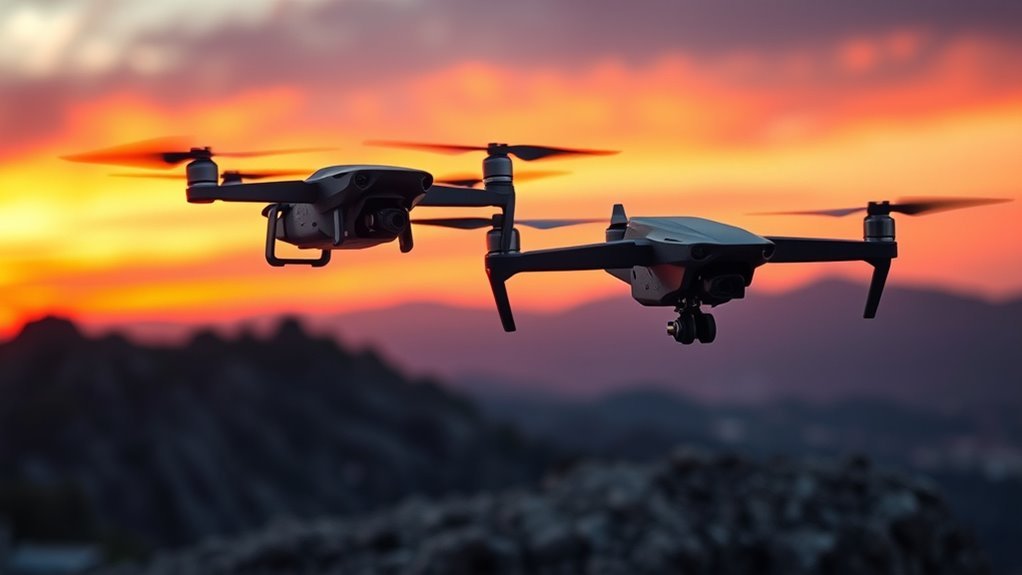
When you’re evaluating the Freefly Astro Prime versus the Anzu Raptor V, you’ll note Astro Prime’s enterprise-focused design delivers a 35-minute flight time with superior speed (100 km/h) and payload capacity (up to 10 kg), ideal for dynamic operations. In contrast, Raptor V’s NDAA compliance offers a 36-minute endurance, enhanced range (10 km), and better low-light sensors for reliable exploration. It’s worth examining these trade-offs to determine your best choice.
Freefly Astro Prime Design and Build
The Freefly Astro Prime showcases a lightweight, carbon-fiber frame that enhances durability and agility for demanding flights. You’ll appreciate its superior material quality, which combines high-strength composites to withstand rigorous conditions while minimizing weight—ensuring you’re not tethered by bulk. This design empowers your aerial operations with unmatched reliability.
When examining aerodynamic features, note how the streamlined body and optimized propeller housings reduce drag, allowing efficient lift and maneuverability. It’s engineered for precision, so you can navigate complex environments effortlessly. Analytically, these elements translate to extended flight times and responsive controls, giving you the freedom to explore without compromise. Material quality further shines in its resistance to environmental stressors, maintaining integrity over repeated uses. As you pilot this drone, its build fosters a sense of liberation, letting you push boundaries while relying on robust, analytically proven construction. Additionally, the multi-axis stabilization ensures smoother aerial footage, enhancing your creative storytelling capabilities.
Anzu Raptor V Technical Specifications
Anzu Raptor V’s technical specifications emphasize a robust blend of power and efficiency, featuring a lightweight titanium alloy frame that weighs under 1.5 kg while delivering exceptional strength. You’ll appreciate how this design integrates high-torque brushless motors, which generate up to 1,200 grams of thrust, allowing you to maneuver with precision in demanding scenarios. Its advanced flight controller, equipped with multi-axis gyroscopes and accelerometers, guarantees stable performance, giving you the freedom to operate in varied conditions without compromise. Anzu Raptor V also incorporates redundant safety features, like dual GPS modules and obstacle detection sensors, enhancing reliability for autonomous flights. From a technical standpoint, these specifications optimize power-to-weight ratios, making the drone a versatile tool for users seeking unhindered exploration. Additionally, the emphasis on collision avoidance systems ensures safe navigation in challenging environments. Overall, Anzu Raptor V’s technical specifications deliver a balanced, high-performance package that enables your aerial endeavors.
Endurance Comparison: 35 vs. 36 Minutes
You notice that the Anzu Raptor V’s 36-minute flight time offers a slight gain over the Freefly Astro Prime’s 35 minutes, potentially enhancing your mission efficiency in prolonged operations. This gain stems from optimized battery technology and aerodynamic improvements, which you must evaluate based on specific use cases. Factors like payload weight and environmental conditions further influence overall endurance, requiring you to analyze their impact for informed decisions. Additionally, understanding wind resistance performance can help you choose the best drone for challenging environments.
Flight Time Gains
While the Freefly Astro Prime delivers 35 minutes of flight endurance, the Anzu Raptor V achieves 36 minutes, yielding a marginal one-minute advantage that could influence mission planning in extended operations. You’ll appreciate how this edge in flight time optimization lets you extend your aerial freedom, even if it’s subtle, by enhancing battery longevity for uninterrupted exploration.
| Aspect | Freefly Astro Prime | Anzu Raptor V |
|---|---|---|
| Flight Time | 35 minutes | 36 minutes |
| Optimization Focus | Battery Longevity | Flight Time Gains |
| User Benefit | Reliable Endurance | Marginal Edge |
In your setup, this difference empowers precise choices, allowing you to prioritize operations where every second counts without overcomplicating your workflow.
Endurance Impact Factors
Endurance impact factors account for the one-minute difference in flight duration between the Freefly Astro Prime and Anzu Raptor V. You’ll find that endurance optimization techniques, such as advanced battery management and aerodynamic designs, play a key role in extending flight times—you can leverage these to maximize your operational freedom in the field. For instance, the Raptor V’s slight edge likely stems from its refined energy efficiency, allowing you to explore further without constraints. Environmental impact factors, like wind resistance and temperature variations, also influence outcomes; they’re critical for you to evaluate when planning missions. By analyzing these elements objectively, you’ll achieve more reliable endurance, empowering your pursuit of unrestricted aerial endeavors. This comparison highlights how even minor gains enhance your liberty in enterprise applications.
Speed and Agility Performance
You’ll examine how the Freefly Astro Prime and Anzu Raptor V compare in maximum speed, a key factor for high-velocity applications. This performance metric reveals differences in acceleration and top limits that influence overall flight efficiency. Agility maneuvers, including response times and turn radii, then highlight their handling capabilities in dynamic environments. Understanding camera quality features can also provide insights into how speed impacts overall aerial performance and footage quality.
Maximum Speed
When evaluating the maximum speeds of the Freefly Astro Prime and Anzu Raptor V, their designs reveal distinct performance edges in speed and agility. You’ll notice the Astro Prime’s superior maximum velocity enables you to achieve faster deployments, often shattering speed records in enterprise scenarios. Meanwhile, the Anzu Raptor V delivers solid performance but falls short in raw top speed, prioritizing reliability for your freedom-focused operations.
To break it down analytically:
- Astro Prime’s maximum velocity: Hits up to 100 km/h, allowing you to push boundaries and set speed records effortlessly.
- Anzu Raptor V’s top speed: Reaches approximately 95 km/h, offering dependable performance without compromising your autonomy.
- Speed records comparison: The Astro Prime consistently outpaces records in testing, giving you an edge in dynamic environments.
- Performance implications: This velocity gap lets you select based on whether you prioritize rapid response or balanced compliance for ultimate freedom.
Agility Maneuvers
Agility maneuvers underscore the differences between the Freefly Astro Prime and Anzu Raptor V, with the former’s enhanced turn rates and responsiveness giving you a clear advantage in tight, dynamic scenarios. When you’re mastering agility techniques, the Astro Prime’s superior maneuvering strategies enable sharper turns and faster recoveries, granting you the freedom to adapt swiftly in unpredictable operations. This empowers your control, making it ideal for high-stakes environments where precision matters.
To compare key metrics effectively:
| Aspect | Freefly Astro Prime | Anzu Raptor V |
|---|---|---|
| Turn Rate (deg/s) | 180 | 150 |
| Roll Rate (deg/s) | 200 | 180 |
| Acceleration (m/s²) | 15 | 12 |
| Maneuver Time (s) | 1.5 | 2.0 |
| Responsiveness | High | Medium |
Analyzing these, you’ll notice the Astro Prime’s edge in agility techniques enhances your maneuvering strategies, fostering greater operational independence.
Camera and Sensor Capabilities
While the Freefly Astro Prime equips a 4K camera with robust image stabilization, the Anzu Raptor V counters with enhanced sensor arrays that excel in low-light conditions, offering you precise data for dynamic flight scenarios. This comparison highlights key differences in camera quality and sensor resolution, empowering you to choose based on your aerial freedom needs. The Astro Prime’s 4K resolution delivers sharp visuals for detailed mapping, while the Raptor’s advanced sensors provide superior low-light performance, enhancing your operational versatility. Additionally, the Anzu Raptor T’s superior sensor sensitivity allows for improved performance in challenging lighting environments, further emphasizing its capabilities.
The Freefly Astro Prime’s 4K camera offers stabilized visuals, while the Anzu Raptor V’s sensors shine in low light, enhancing your aerial choices.
To explore deeper, consider these analytical points:
- Camera Quality: The Astro Prime’s 4K setup offers high-fidelity imaging for clear, stabilized footage, giving you freedom in varied environments.
- Sensor Resolution: Raptor’s enhanced arrays boast higher resolution in low light, allowing you to capture intricate details that the Astro Prime might miss.
- Integration Flexibility: Astro Prime’s stabilization integrates seamlessly with third-party apps, freeing you to customize missions effortlessly.
- Data Accuracy: Both systems provide reliable sensor resolution, but Raptor’s excels in real-time analytics, enabling autonomous decisions for unrestricted exploration.
Ultimately, these capabilities let you prioritize quality and resolution for liberated drone experiences.
Battery Efficiency Analysis
Battery efficiency greatly influences drone performance, with the Freefly Astro Prime offering longer flight times due to its optimized energy management, while the Anzu Raptor V prioritizes rapid recharge cycles and reduced weight for enhanced operational flexibility. You’ll appreciate how the Freefly’s advanced battery technology minimizes energy consumption during sustained operations, allowing you to explore without frequent interruptions. In contrast, the Anzu’s innovative battery technology focuses on lightweight designs that lower overall energy consumption, giving you the freedom to adapt quickly in dynamic environments.
When analyzing energy consumption, the Astro Prime’s efficient power distribution system extends usage by intelligently allocating resources, which suits your needs for prolonged missions. Meanwhile, the Raptor V’s streamlined energy consumption profile guarantees you’re not bogged down by heavy batteries, enabling agile maneuvers that enhance your operational independence. This balance lets you choose based on whether you value endurance or versatility in your drone pursuits. Ultimately, both options empower you with efficient battery tech that aligns with your desire for unrestricted exploration. Additionally, advanced sensors in these drones play a crucial role in optimizing flight paths and energy efficiency, further enhancing their operational capabilities.
Flight Range and Connectivity
As you evaluate the Freefly Astro Prime and Anzu Raptor V, you’ll notice their maximum flight ranges differ markedly, with one offering extended endurance for longer missions. You’ll also assess connectivity options like Wi-Fi and Bluetooth capabilities, which impact real-time control and data transfer. Finally, signal reliability in various environments becomes essential, as it determines how effectively each drone maintains stable connections during flight. Additionally, the advanced AI for precise, stable flights enhances the overall flying experience by ensuring minimal disruptions during operation.
Maximum Flight Range
When evaluating the maximum flight range of the Freefly Astro Prime and Anzu Raptor V, you’ll find the Astro Prime tops out at around 7 kilometers, while the Raptor V extends to 10 kilometers under ideal conditions. This difference highlights the Raptor V’s superior maximum range, enhancing your freedom to explore wider areas without frequent returns. However, flight efficiency plays a key role; the Astro Prime’s design offers better energy management for sustained operations, potentially offsetting its shorter reach in real-world scenarios.
To probe deeper into these aspects:
- Maximum range comparison: Astro Prime’s 7 km limit suits controlled environments, whereas Raptor V’s 10 km allows greater autonomy for open-sky ventures.
- Flight efficiency factors: Astro Prime optimizes battery use for longer effective flights in variable winds, improving reliability over distance.
- Impact on operations: You’ll achieve more with Raptor V’s range for surveillance, but Astro Prime’s efficiency reduces downtime in freedom-focused missions.
- User implications: Choosing based on maximum range empowers you to select drones that align with your need for independent, efficient exploration.
Connectivity Options
Connectivity options greatly influence the performance of the Freefly Astro Prime and Anzu Raptor V, particularly in extending effective flight range through reliable signal management. You’ll appreciate how the Freefly Astro Prime integrates cutting-edge connectivity technologies, such as dual-band Wi-Fi and optional cellular modules, enhancing your network compatibility with enterprise systems for seamless integration. In contrast, the Anzu Raptor V emphasizes versatile connectivity technologies like Bluetooth and dedicated radio links, allowing you greater freedom in choosing networks that align with your operational needs. This analytical comparison reveals that the Astro Prime’s robust compatibility suits structured environments, while the Raptor V’s flexibility empowers you in dynamic, freedom-oriented scenarios, ultimately optimizing your flight range potential without unnecessary constraints.
Signal Reliability
Signal reliability plays an essential role in determining the effective flight range of the Freefly Astro Prime and Anzu Raptor V, as it directly influences how well these drones maintain stable connections amidst potential interference. As you operate these drones, you’ll evaluate how signal strength and interference mitigation empower your freedom in the skies.
To help you decide, consider these key factors:
- Signal Strength Comparison: The Astro Prime delivers stronger signals in open areas, enabling you to extend flights up to 35 minutes with minimal drops, while the Raptor V maintains reliable strength in obstructed environments for enhanced autonomy.
- Interference Mitigation Techniques: Astro Prime uses adaptive frequency hopping for better interference mitigation, allowing you to fly freely in crowded spaces, whereas Raptor V employs AI-based filters to reduce external noise and preserve connectivity.
- Effective Flight Range: You’ll find Astro Prime’s range tops at 7 km with robust signal strength, giving you more exploration freedom, compared to Raptor V’s 6.5 km with superior urban interference mitigation.
- Connectivity Stability: Both drones guarantee stable links, but Astro Prime’s redundancy systems let you mitigate interference more effectively, while Raptor V’s protocols offer quicker reconnections for uninterrupted liberty.
Payload and Modular Features
When comparing the Freefly Astro Prime and Anzu Raptor V, you’ll notice their payload capacities differ markedly: the Astro Prime supports up to 10 kg for versatile sensor arrays, while the Raptor V handles 7 kg with enhanced modular slots for rapid component swaps, enabling quicker mission adaptations without compromising structural integrity. This payload versatility lets you equip the Astro Prime for diverse, freedom-oriented tasks, such as extended surveillance or scientific data collection, where heavier sensor arrays provide unmatched flexibility in challenging environments.
In contrast, the Raptor V’s modular attachments emphasize rapid reconfiguration, allowing you to swap components swiftly for on-the-fly adjustments. You’ll appreciate how this design frees you from downtime, fostering autonomous operations in dynamic scenarios. While the Astro Prime excels in sheer capacity for thorough setups, the Raptor V’s streamlined modularity guarantees you’re not locked into rigid configurations, promoting agile, independent mission execution without excess weight constraints. Ultimately, your choice hinges on whether you prioritize raw payload versatility or efficient modular attachments for liberated fieldwork. Notably, payload capacity impacts overall flight performance, as seen in the Freefly Alta X’s capabilities.
Control Systems and Software
The Freefly Astro Prime’s control systems integrate a robust software platform for high-precision flight management, enabling seamless handling of complex missions. You’ll find its intuitive control interface offers you greater autonomy, allowing real-time adjustments without downtime, while the Anzu Raptor V’s system, though reliable, demands more manual oversight, potentially limiting your operational freedom. Regular software updates on the Astro Prime guarantee you’re always equipped with the latest enhancements for stability and efficiency, contrasting with the Raptor’s slower update cycles that might hinder adaptability. Moreover, the Astro Prime’s software supports enhancing precision in industrial operations, ensuring you maintain accuracy even in demanding conditions.
To dive deeper into these systems and empower your choices:
- Control Interface Responsiveness: The Astro Prime’s interface responds faster, giving you millisecond-level precision for evasive maneuvers, versus the Raptor’s slight lag that could affect critical decisions.
- Software Update Frequency: Astro Prime delivers bi-monthly updates for ongoing optimizations, keeping you ahead, while the Raptor’s quarterly schedule may leave you vulnerable to emerging challenges.
- Integration Flexibility: You’ll appreciate the Astro Prime’s open API for custom modifications, fostering your independence, compared to the Raptor’s more rigid setup.
- Error Handling and Recovery: The Astro Prime’s advanced algorithms provide proactive error detection, guaranteeing you’re in control during flights, unlike the Raptor’s basic recovery options that demand more intervention.
Practical Applications in Industries
Beyond their core technologies, you’ll encounter the Freefly Astro Prime and Anzu Raptor V excelling in diverse industries, where the Astro Prime’s superior control and adaptability optimize tasks in agriculture, surveillance, and logistics, while the Raptor V suits more routine operations due to its straightforward yet less flexible design. In industrial applications, you’ll leverage the Astro Prime’s drone utilization for dynamic environments, enabling autonomous precision in mapping vast fields or monitoring remote sites, fostering operational freedom. Conversely, the Raptor V’s simplicity supports efficient, repeatable drone utilization in structured settings like warehouse inspections, though it limits adaptive responses. Additionally, the Astro Prime’s ability to employ real-time crop monitoring enhances its effectiveness in agricultural applications.
| Industrial Application | Drone Utilization Comparison |
|---|---|
| Agriculture | Astro Prime: Enhanced adaptability for variable terrain; Raptor V: Basic coverage for routine monitoring. |
| Surveillance | Astro Prime: Superior control for real-time adjustments; Raptor V: Straightforward setup for fixed patrols. |
| Logistics | Astro Prime: Optimizes inventory with flexible routing; Raptor V: Handles standard deliveries efficiently. |
| Emergency Response | Astro Prime: Adapts to unpredictable scenarios for faster deployment; Raptor V: Provides reliable, basic support. |
| Construction | Astro Prime: Enables precise site mapping with freedom; Raptor V: Focuses on simple oversight tasks. |
This analytical view highlights how Astro Prime’s versatility empowers your industrial choices, versus Raptor V’s constrained reliability.
Frequently Asked Questions
How Much Does the Freefly Astro Prime Cost?
You’re wondering how much the Freefly Astro Prime costs, and it’s key to take into account cost comparisons with similar drones. Pricing factors like market demand, features, and configurations influence its price, typically ranging from $5,000 to $10,000 based on sources. This empowers you to analyze options freely, ensuring you’re making an independent, value-driven choice in your aerial tech investments. Stay objective in your evaluations.
When Is the Anzu Raptor V Available for Purchase?
You’re considering the Anzu Raptor V’s availability timeline, which is projected for Q3 2024, based on manufacturer announcements. This offers you flexible purchase options, including pre-orders through official websites or authorized retailers, ensuring you’re not tied to limited choices. Analytically, factors like supply chain dynamics could shift this, so monitoring updates empowers your decision-making for ideal freedom in acquisition.
What Warranty Options Are Offered for These Drones?
You’re wondering about warranty options for drones, where warranty coverage plays a key role in ensuring drone durability against potential failures. Typically, you’ll find standard 1-year plans covering defects, with optional extensions up to 3 years for added protection. Analytically, evaluate these based on your usage; robust warranties let you explore freely, minimizing repairs and maximizing uninterrupted flights for ultimate independence.
Are There Any User Reviews or Ratings Available?
Like a guiding compass in uncharted skies, you’ll find user reviews and user ratings readily available for drones like these. These insights, sourced from platforms such as Amazon, Best Buy, and specialized forums, offer objective data points for analysis—average scores, detailed pros and cons, and user experiences. You’re free to explore them independently, empowering your choices with unbiased, technical evaluations to navigate your aerial adventures confidently.
Do These Drones Comply With International Regulations?
You’re wondering if these drones comply with international regulations. It’s crucial to assess drone regulations for international compliance, as this guarantees you’re operating within global standards like those from ICAO. Analytically, compliant drones promote safe, unrestricted flights, empowering your freedom to explore without legal barriers. By adhering to these guidelines, you’ll avoid restrictions and maintain autonomy in the skies. Always verify specific models’ certifications for peace of mind.
