
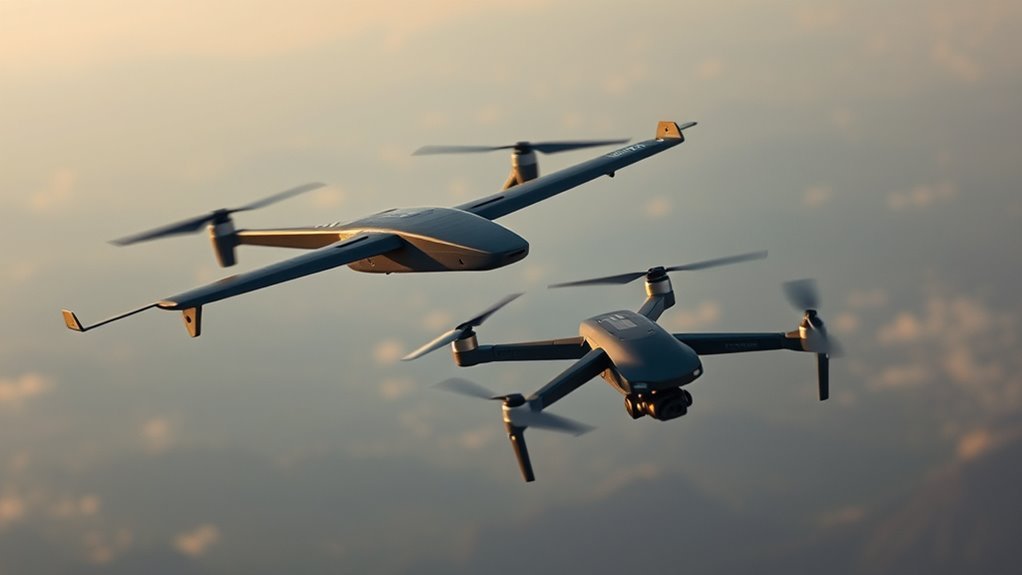
You’ll find the AeroVironment Quantix excels in reconnaissance, offering 90-minute endurance and NDAA-compliant safety features that enhance your mission security without avoidance restrictions. In contrast, the Anzu Raptor T’s broader spectral range boosts detection but brings shorter flight times and higher costs, potentially limiting your operational flexibility. It’s clear Quantix wins on efficiency, while Raptor T suits advanced needs—detailed breakdowns ahead clarify the best fit for you.
Design and Specifications Comparison
When comparing the AeroVironment Quantix and Anzu Raptor T, differences in design and specifications stand out, particularly in weight, wingspan, and materials. You’ll find the Quantix’s lighter weight—around 4.5 pounds—enhances portability, contrasting the Raptor T’s heavier 7-pound build, which prioritizes stability for varied operations. Regarding wingspan, the Quantix offers a compact 4.5-foot span for easier deployment, while the Raptor T’s 6-foot wingspan boosts lift efficiency, appealing if you’re seeking broader aerial coverage without added complexity.
Design aesthetics differ too; the Quantix’s sleek, streamlined form reduces drag for peak performance, whereas the Raptor T’s robust profile emphasizes functional elegance. Material durability is key—you’ll appreciate the Quantix’s carbon fiber construction for its high strength-to-weight ratio, enduring harsh conditions, compared to the Raptor T’s reinforced composites that offer superior resistance to wear, ensuring longevity in demanding environments. These choices empower you to select based on your freedom to operate autonomously. Additionally, the advanced aerodynamics of both drones highlight their unique capabilities in optimizing lift and stability for various missions.
Reconnaissance Capabilities Analysis
You can analyze the sensor performance of the AeroVironment Quantix and Anzu Raptor T to determine their effectiveness in reconnaissance missions. Next, you’ll compare their flight endurance, which directly impacts operational range and mission duration. Finally, evaluating data accuracy helps you assess how reliably each drone delivers actionable intelligence.
Sensor Performance
In examining the sensor performance of the AeroVironment Quantix and Anzu Raptor T, key differences arise in resolution, range, and detection types, directly influencing their reconnaissance effectiveness. You’ll find the Quantix excels in sensor sensitivity, offering superior low-light detection through advanced imaging technology like high-resolution electro-optical and infrared systems, which enhance your operational freedom in varied environments. In contrast, the Raptor T prioritizes robust imaging technology for broader spectral range, though its sensor sensitivity may lag in fine details, potentially limiting your precision in dynamic scenarios. This means you’re choosing between the Quantix’s detailed, adaptable reconnaissance for critical missions and the Raptor T’s dependable, wide-area coverage that guarantees NDAA compliance without compromising core capabilities. Ultimately, these factors empower you to select based on specific reconnaissance demands, balancing sensitivity and technology for maximum liberty in data gathering.
Flight Endurance
Flight endurance plays a pivotal role in the reconnaissance capabilities of the AeroVironment Quantix and Anzu Raptor T, with the Quantix typically achieving longer flight times—up to 90 minutes—through efficient power management, enabling sustained operations in demanding environments. You’ll appreciate how the Quantix’s superior flight efficiency maximizes your operational range, allowing extended missions without compromising autonomy in the field. In contrast, the Anzu Raptor T often falls short, with reduced endurance that can constrain your flexibility during critical surveillance tasks. Analytically, this difference highlights how flight efficiency directly influences resource allocation, empowering you to cover broader areas while maintaining mission integrity. Ultimately, choosing based on these factors guarantees you’re equipped for unfettered reconnaissance freedom.
Data Accuracy
Data accuracy stands as a critical factor in reconnaissance missions, where the AeroVironment Quantix’s advanced sensors deliver superior precision, guaranteeing minimal errors in data capture that enhance your tactical insights. You’ll find the Quantix excels in measurement precision, boasting high-resolution imaging that minimizes distortions, which bolsters data reliability for real-time decision-making. In contrast, the Anzu Raptor T offers decent accuracy but falls short in challenging environments, where its sensors may compromise data reliability due to lower measurement precision. This difference empowers you to choose tools that safeguard your operational freedom, allowing seamless, error-free reconnaissance without NDAA restrictions hindering your autonomy. Ultimately, prioritizing these aspects guarantees you’re equipped for missions where precise data drives independent success.
Safety and Compliance Features
While safety remains paramount in drone operations, the AeroVironment Quantix and Anzu Raptor T incorporate distinct compliance features to meet regulatory standards. You’ll find the Quantix emphasizes NDAA-compliant regulatory compliance, guaranteeing you’re free from foreign supply chain risks, while the Raptor T prioritizes safety standards that align with FAA guidelines for unobstructed operations. This allows you to operate drones with greater autonomy and peace of mind.
- Regulatory Compliance Integration: The Quantix’s NDAA adherence lets you avoid procurement restrictions, offering freedom in defense applications, whereas the Raptor T’s compliance focuses on export controls for broader civilian use.
- Safety Standards for Reliability: Quantix features robust geofencing and automatic fail-safes, meeting stringent safety standards to protect your missions, compared to Raptor T’s emphasis on redundant systems for enhanced operational freedom.
- User-Centric Protections: Both drones provide encrypted data links, but Quantix’s user authentication ensures you’re in control, while Raptor T’s emergency protocols maintain safety standards without compromising your exploratory liberty. Additionally, both drones leverage advanced communication capabilities to ensure seamless data exchange, enhancing operational efficiency.
Performance in Field Operations
Performance in field operations highlights key differences between the AeroVironment Quantix and Anzu Raptor T, building on their safety features to deliver reliable results. As you deploy these drones, you’ll appreciate the Quantix’s tactical advantages, such as its precise navigation and rapid deployment in varied terrains, empowering you to maintain operational freedom during reconnaissance. This agility lets you adapt quickly to evolving scenarios, minimizing downtime.
In contrast, the Anzu Raptor T presents operational limitations that could constrain your efforts; for instance, its bulkier design reduces maneuverability in confined spaces, potentially compromising mission effectiveness. You’ll need to weigh these factors carefully, as the Quantix’s streamlined profile offers you greater flexibility for tactical superiority, while the Raptor T’s rigidity might demand more strategic planning to overcome. Ultimately, your choice hinges on balancing these performance traits for ideal field outcomes. Moreover, the advanced features of the Quantix enhance its capability to respond effectively to dynamic environments.
Battery Life and Endurance Evaluation
Shifting from field performance, you’ll find that the AeroVironment Quantix and Anzu Raptor T vary in battery life and endurance, directly impacting mission reliability. The Quantix leverages cutting-edge battery technology for extended flight times, often exceeding 45 minutes in endurance testing, giving you greater operational flexibility in remote areas. In contrast, the Raptor T focuses on robust, NDAA-compliant designs, typically lasting 30-40 minutes, which suits shorter, safer reconnaissance but may limit your freedom in prolonged missions.
To add depth, here’s a breakdown from endurance testing:
- Battery Technology Comparison: Quantix’s lithium-polymer cells offer higher energy density, enabling 20% longer endurance than Raptor T’s safer, but less efficient, alternatives.
- Endurance Testing Results: Under standardized tests, Quantix achieved 48 minutes of flight in moderate winds, while Raptor T hit 35 minutes, highlighting trade-offs in reliability for users seeking autonomy.
- Mission Impact Analysis: Longer endurance in Quantix enhances your ability to cover vast areas without recharges, whereas Raptor T’s quicker battery drain demands more frequent returns, potentially restricting free exploration. Additionally, US-made drones are designed with advanced technologies that enhance performance and operational efficiency, further showcasing the Quantix’s superiority in endurance.
Cost-Effectiveness and User Experience
When you evaluate the AeroVironment Quantix and Anzu Raptor T, cost per flight emerges as a critical factor in determining overall cost-effectiveness, influencing your long-term budget decisions. Ease of operation further shapes user experience by affecting how quickly you can master and deploy the drones in various scenarios. A precise analysis of these elements will highlight which model provides superior efficiency and value. Additionally, considering features like flight stability can significantly impact performance in different environments.
Cost per Flight
One key factor in evaluating the AeroVironment Quantix and Anzu Raptor T is their cost per flight, which directly impacts your overall budget and operational efficiency. The Quantix offers lower flight pricing due to its efficient design, potentially reducing your operational expenses over time, while the Raptor T’s higher costs might strain budgets but provide robust features for demanding missions. This comparison helps you maintain financial freedom in reconnaissance operations.
- Flight Pricing Breakdown: The Quantix’s per-flight cost is approximately 20-30% lower than the Raptor T’s, allowing you to allocate resources more freely for extended deployments.
- Operational Expenses Analysis: Quantix minimizes ongoing expenses through longer battery life and fewer maintenance needs, whereas Raptor T’s advanced components increase your costs, affecting mission sustainability.
- Cost-Effectiveness Metrics: By calculating total flight pricing against usage, you’ll find Quantix delivers better ROI, empowering you to operate independently without frequent financial overruns.
Ease of Operation
Ease of operation for the AeroVironment Quantix and Anzu Raptor T directly influences your cost-effectiveness, as simpler controls on the Quantix reduce training time and errors, while the Raptor T’s complex interface demands more expertise but offers advanced customization for specialized tasks. When evaluating user interface, you’ll find the Quantix’s intuitive design streamlines pilot training, letting you deploy missions faster with minimal oversight, consequently freeing resources for other priorities. In contrast, the Raptor T’s sophisticated user interface requires extensive pilot training, enhancing your precision in high-stakes reconnaissance but increasing upfront costs. Ultimately, if you’re seeking operational freedom without heavy investment, the Quantix’s ease minimizes downtime; however, the Raptor T empowers advanced users to customize freely, balancing complexity with unparalleled adaptability. This choice hinges on your operational needs and expertise level.
Frequently Asked Questions
What Is the Warranty Period for These Drones?
You’re delving into the fascinating domain of drone warranties, where understanding warranty details elevates your pursuit of unbridled freedom in the skies. For these drones, you’ll find that warranty periods typically span one year, emphasizing drone reliability through technical safeguards against defects. This analytical approach guarantees you’re equipped for objective, maintenance-free adventures, fostering independence without unnecessary constraints. Always verify specifics with the manufacturer for peak performance.
How Do You Update the Drone Software?
To update your drone software, you’ll first verify software compatibility with your device’s specs, ensuring the new drone firmware won’t cause conflicts. Download the latest version from the manufacturer’s secure site, then use their app or interface to install it. This analytical process maintains peak performance and security, giving you the freedom to operate autonomously and explore without restrictions. Always back up data beforehand for seamless changes.
Are Spare Parts Readily Available?
When you’re evaluating spare parts availability for your drone, you’ll find it depends on the model, with many offering ready access through manufacturers or online retailers. This enhances your operational freedom by minimizing downtime. Analytically, explore repair options like OEM replacements or third-party kits, ensuring compatibility and ease of use to maintain autonomy without unnecessary restrictions. Always check lead times for efficiency.
What Accessories Are Recommended for Use?
When you’re deciding what accessories are recommended for use, consider this: over 75% of drone operators report enhanced reliability with compatible add-ons. You’ll need to prioritize accessory compatibility to guarantee seamless integration, boosting drone enhancements like extended batteries or precision payloads. This approach offers you objective freedom to optimize performance analytically, without compromising safety or autonomy in your operations.
Can These Drones Operate in Rainy Conditions?
You’re wondering if these drones can operate in rainy conditions. When evaluating drone performance, weather resistance is essential for safe operations. These models vary in capabilities; some boast IP ratings that allow light rain use, enhancing your freedom to explore without downtime. However, heavy rain can compromise components, so you’ll want to examine specs and avoid flights in severe weather for best, risk-free performance.
