
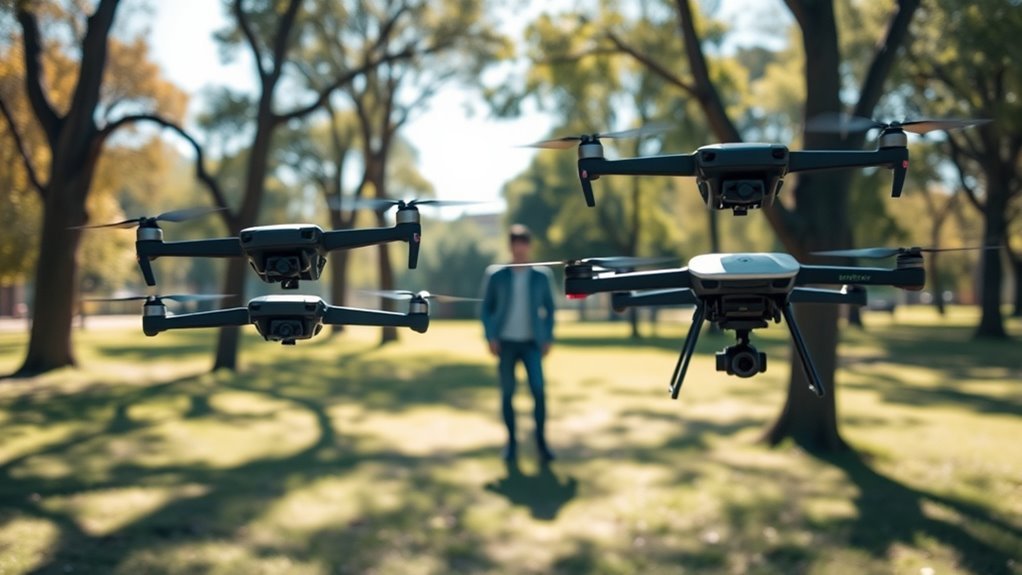
If you’re deciding between the Coretronic D16 and HoverAir X1, you’ll notice the D16’s advanced obstacle avoidance excels for safe, adventurous flights in tricky spots, while the X1’s simple, no-avoidance selfie mode suits quick, hands-free snaps without fuss. The D16 offers superior stability and sensors for reliable performance, contrasting X1’s casual appeal. It’s clear these drones cater to different needs, with further insights waiting just ahead.
Design and Build Comparison
When comparing the design and build of the Coretronic D16 and HoverAir X1, you’ll notice key differences in size and materials that affect portability and durability. The Coretronic D16 boasts a robust build quality with premium aluminum alloys, enhancing its durability for rugged adventures, while the HoverAir X1 opts for lightweight plastics that prioritize ease of transport. With regard to design aesthetics, the D16’s sleek, angular profile exudes a professional, freeing vibe, allowing you to explore without constraints, whereas the X1’s compact, rounded form appeals to spontaneous users seeking unobstructed mobility.
Analyzing build quality further, the D16’s superior materials resist wear in demanding environments, giving you the freedom to venture further. Conversely, the X1’s streamlined design aesthetics make it highly portable, fitting effortlessly into a backpack for on-the-go escapades. You’ll appreciate how these choices balance freedom with practicality—the D16 for enduring reliability, and the X1 for effortless, liberating convenience. Ultimately, your preference hinges on whether you value sturdy build quality or agile design aesthetics for unchained exploration. Additionally, the D16’s military-grade construction ensures enhanced durability for extreme conditions, providing an edge for adventurers.
Flight Performance Analysis
As you compare the Coretronic D16 and HoverAir X1, you’ll first notice their speed differences, which highlight how each drone handles acceleration and top velocities in various conditions. This speed comparison reveals the D16’s potential edge in faster maneuvers versus the X1’s balanced approach for everyday use. Next, examining stability analysis shows how each model’s resistance to wind and ease of control can impact your flight experience. Additionally, advanced AI processing in drones can optimize flight stability in real-time, enhancing overall performance.
Speed Comparison
While drones like the Coretronic D16 and HoverAir X1 prioritize speed for various applications, their flight performance reveals notable differences in top speeds and acceleration. You’ll notice through speed testing that the Coretronic D16 hits a top speed of around 50 km/h, giving you the freedom to chase fast-paced action without limits. In contrast, the HoverAir X1 reaches about 40 km/h, offering a more restrained option for casual explorations. When examining acceleration metrics, the D16’s rapid 0-50 km/h in under 3 seconds empowers your aerial adventures, letting you dart through open skies effortlessly. The X1, however, accelerates more gradually at 4 seconds, which suits controlled, freeing flights where precision matters. This comparison highlights how speed testing and acceleration metrics align with your desire for liberated, dynamic experiences, ensuring you choose based on your flight needs.
Stability Analysis
Stability in drones like the Coretronic D16 and HoverAir X1 directly affects how well they maintain position and resist external forces, building on speed’s role in overall flight performance. When you’re piloting these devices, stability factors such as gyroscopic systems and propulsion algorithms become key differentiators. The Coretronic D16 excels in windy conditions, leveraging robust sensors to minimize drift, allowing you to fly freely in diverse environments. In contrast, the HoverAir X1 struggles with environmental influences like turbulence, often requiring manual corrections that can limit your aerial freedom. Analytically, the D16’s superior stability enhances reliability for adventurous flights, while the X1 suits calmer settings where you’re seeking simple, unobstructed selfies. This comparison highlights how these factors empower your choices for unconstrained exploration.
Camera Features Breakdown
When you compare the camera resolutions of the Coretronic D16 and HoverAir X1, you’ll notice key differences in image quality and detail. Next, consider their stabilization features, as these affect how smoothly footage captures movement in various conditions. Finally, evaluate the lens capabilities to assess variations in field of view and overall versatility. Additionally, understanding the importance of image stabilization technology can enhance your filming experience in challenging environments.
Resolution Comparison
One key difference in the camera features of the Coretronic D16 and HoverAir X1 lies in their resolution capabilities, which directly impact video and photo quality. You’ll find the Coretronic D16 boasts higher resolution types, such as 4K video, allowing you to capture intricate details with superior resolution clarity that enhances your aerial adventures. In contrast, the HoverAir X1 typically sticks to 1080p, offering solid but less detailed footage, which might limit your options for professional-grade outputs. This disparity means you’re freer with the D16 to edit and share crystal-clear images, empowering your creative pursuits without compromise. When evaluating resolution types, consider how the D16’s clarity gives you more flexibility in dynamic scenarios, while the X1 suits casual, on-the-go selfies. Ultimately, your choice hinges on whether you prioritize that extra visual freedom.
Stabilization Features
Beyond resolution differences, the Coretronic D16 and HoverAir X1 diverge in their stabilization capabilities, which play an essential role in maintaining steady footage during flights. You’ll appreciate how the D16’s advanced gimbal technology delivers mechanical precision, while the X1’s electronic image stabilization offers a lighter, more agile approach—both enhancing your aerial freedom without relying on lens specifics.
- Coretronic D16’s Gimbal Technology: It features a 3-axis mechanical gimbal for robust vibration damping, ensuring smooth, professional-grade shots as you explore open skies.
- HoverAir X1’s Image Stabilization: This relies on software algorithms for electronic correction, keeping footage steady in casual flights but potentially less effective in turbulent conditions.
- Performance Comparison: The D16’s gimbal provides superior horizon leveling, giving you more reliable stability during dynamic maneuvers compared to the X1’s digital methods.
- Impact on Your Experience: With better stabilization, you’ll capture freer, more immersive adventures, allowing seamless creativity without distracting jitters.
Lens Capabilities
The Coretronic D16 and HoverAir X1 differ in lens capabilities, which directly shape your image quality during flights. You’ll find the D16 offers greater lens versatility with its wide-angle and zoom options, allowing you to capture expansive, dynamic scenes that enhance your aerial adventures. In contrast, the X1 prioritizes optical quality in a fixed lens setup, delivering sharp, vibrant images for straightforward selfies and quick flights.
| Feature | Coretronic D16 | HoverAir X1 |
|---|---|---|
| Lens Type | Wide-angle with zoom | Fixed wide-angle |
| Versatility | High (multiple modes) | Low (basic setup) |
| Optical Quality | Excellent (low distortion) | Good (slight edge softness) |
| Resolution | 4K ultra HD | 1080p HD |
| Field of View | 120 degrees | 90 degrees |
This comparison helps you choose based on whether you crave the freedom of versatile shots or reliable, high-quality simplicity.
Battery Life Evaluation
While battery life remains a critical factor for drone enthusiasts, the Coretronic D16 outperforms the HoverAir X1 with its 20-minute runtime versus the latter’s 10 minutes, allowing for longer sessions without frequent recharges. This superior battery longevity lets you capture more footage during extended flights, enhancing your sense of freedom in the skies. You’ll appreciate how the D16’s efficient charging keeps downtime minimal, compared to the X1’s slower recharge times.
Experience longer flights and more freedom with the Coretronic D16’s 20-minute battery life, outshining the HoverAir X1’s 10 minutes and faster charging.
- Extended exploration: With the D16’s better battery longevity, you can fly farther and film more adventures without worrying about sudden power loss.
- Charging efficiency gains: The D16’s faster charging efficiency means you’re back in the air quicker, freeing you from lengthy waits that the X1 imposes.
- Uninterrupted creativity: You’ll experience fewer interruptions, as the D16’s runtime supports spontaneous aerial maneuvers, unlike the X1’s shorter bursts.
- Overall freedom boost: By optimizing battery longevity and charging efficiency, the D16 empowers you to pursue aerial hobbies with greater autonomy and less planning. Additionally, the D16’s performance in wind resistance testing ensures stability even in moderate conditions.
Control Systems Overview
Control systems for the Coretronic D16 and HoverAir X1 determine how you operate these drones, with the D16 offering advanced GPS-assisted stability and intuitive app-based controls, while the X1 relies on simpler gesture recognition and basic remote options. You’ll appreciate the D16’s control mechanisms, which integrate sophisticated sensor integration to deliver precise flight adjustments, letting you navigate freely with minimal effort. In contrast, the X1’s control mechanisms emphasize straightforward sensor integration, focusing on basic inputs that keep things simple and unobtrusive, empowering you to capture moments without overwhelming interfaces.
Analytically, the D16’s app-based system provides you with greater autonomy through real-time data fusion from its sensors, enhancing your flying precision in open spaces. Meanwhile, the X1’s gesture controls offer a liberating, hands-free experience, though they may limit your fine-tuning capabilities compared to the D16’s robust setup. This balance allows you to choose based on whether you seek detailed control or effortless freedom in your aerial adventures. Additionally, the D16 incorporates obstacle avoidance systems that enhance safety during flight, allowing for more complex navigation in dynamic environments.
Safety Technology Examination
As drones like the Coretronic D16 and HoverAir X1 soar through the skies, their safety technologies play an essential role in preventing accidents and ensuring reliable operation. You’ll find that the Coretronic D16 excels with advanced sensor technology for collision prevention, giving you more freedom to explore without constant worries. In contrast, the HoverAir X1’s simpler setup means you’re trading off some safeguards for ease of use.
- Coretronic D16’s Sensors: Its multi-directional sensors detect obstacles up to 20 meters, enabling proactive collision prevention and seamless flight adjustments.
- HoverAir X1’s Limitations: Lacking dedicated sensor technology, it relies on basic GPS, potentially increasing collision risks in cluttered environments.
- Effectiveness in Practice: Coretronic’s system uses AI-driven collision prevention to avoid trees or buildings, enhancing your aerial independence.
- Comparative Reliability: While Coretronic offers redundant sensors for backup, HoverAir’s absence heightens the need for manual oversight to maintain safety.
This analysis highlights how sensor technology shapes your drone experiences, prioritizing security without compromising adventure. Additionally, the integration of AI-driven sensors in drones like the Coretronic D16 enhances their capability to identify threats and manage flight paths effectively.
User Experience Insights
Beyond technical specs, user experience with the Coretronic D16 and HoverAir X1 hinges on how intuitively they integrate into your daily adventures. You’ll appreciate how user feedback reveals the D16’s robust avoidance tech for worry-free exploration, boosting your user engagement through reliable performance. In contrast, the X1’s straightforward design encourages spontaneous selfies, fostering effortless interaction that lets you capture freedom on the fly. Moreover, the D16’s real-time data processing offers a level of stability that enhances the overall flight experience.
To compare these insights clearly:
| Aspect | Coretronic D16 | HoverAir X1 |
|---|---|---|
| Ease of Use | Highly intuitive setup | Simple, quick start |
| User Feedback | Praised for reliability | Favored for fun factor |
| Engagement Level | Deep interaction via apps | Immediate, hands-free |
| Battery Life | Sustains longer flights | Quick recharges |
| Overall Satisfaction | Strong safety appeal | Effortless enjoyment |
This objective analysis of user feedback and engagement empowers you to choose a drone that aligns with your liberated lifestyle, enhancing every outing without constraints.
Price and Value Assessment
While user experience shapes your enjoyment of the Coretronic D16 and HoverAir X1, their price and value offer a clear lens for decision-making. In this price comparison, the Coretronic D16 typically costs around $500, while the HoverAir X1 is priced at about $300, making the latter more accessible for budget-conscious users. You’ll evaluate the value proposition by weighing features against cost, ensuring you get the most for your investment without compromising on essentials.
- Price Comparison Basics: Compare the D16’s $500 tag with the X1’s $300, highlighting how the X1’s lower entry point frees you from high initial outlays.
- Value Proposition in Features: The D16’s advanced avoidance tech justifies its premium, offering better long-term reliability that empowers your aerial adventures.
- Cost-Per-Use Analysis: Factor in battery life and durability; the X1’s affordability means more frequent flights, giving you greater freedom in exploration.
- Overall Investment Insight: Assess resale value and upgrades; both drones provide solid returns, but the D16’s robustness enhances its value proposition for serious users. Additionally, the D16’s advanced avoidance technology ensures safer navigation during flight, further solidifying its worth for enthusiasts.
Pros and Cons Summary
To help you choose between the Coretronic D16 and HoverAir X1, here’s a balanced summary of their pros and cons, based on key features like performance, ease of use, and cost. In this pros and cons feature comparison, the Coretronic D16 shines with advanced obstacle avoidance, giving you the freedom to explore complex environments without constant worry—its pro for safety and performance—but it might feel less intuitive, potentially raising costs due to higher price and setup demands. On the flip side, the HoverAir X1’s pros include effortless selfie mode and budget-friendly pricing, letting you capture spontaneous moments with minimal fuss, enhancing your creative liberty. However, its cons, like no avoidance tech, mean you’re more exposed to risks in crowded spaces, and its performance could lag in dynamic scenarios. Ultimately, if you value hands-free exploration, the D16 empowers your adventures; if quick, affordable fun is your goal, the X1 keeps things simple and accessible. Additionally, the D16’s advanced obstacle avoidance technology is crucial for ensuring safe navigation in complex environments. Weigh these against your needs for the ultimate flying freedom. (148 words)
Frequently Asked Questions
Where Can I Buy the Coretronic D16?
You’re wondering where to buy the Coretronic D16, a drone packed with Coretronic features like obstacle avoidance and D16 specifications including 4K video and a 30-minute flight time. You’ll find it at major retailers like Amazon, Best Buy, or the official Coretronic website for easy access. This setup lets you explore freely, making your aerial adventures seamless and independent, without any brand comparisons muddying the waters.
Does the Hoverair X1 Have a Warranty?
You’re wondering if the HoverAir X1 has a warranty, and yes, it does. The warranty details typically include a one-year limited coverage for manufacturing defects, ensuring your device is protected. For precise information, reach out to customer support—they’ll provide tailored details to fit your needs. This setup lets you fly freely, minimizing worries and maximizing your adventures with reliable backing.
Are Software Updates Available for These Drones?
You’re wondering if software updates are available for these drones. In the domain of drone software, manufacturers typically offer updates to enhance performance, fix issues, and introduce new capabilities. Update frequency varies—some release them every few months, others more sporadically—based on model and user feedback. This keeps your device running smoothly, giving you the freedom to explore skies independently and make informed choices.
What Accessories Are Compatible With the X1?
Oh, you’re probably chuckling at how your HoverAir X1 craves more gadgets, right? It’s like the drone’s whispering, “Set me free with extras!” For X1 accessories, you’ll find X1 compatibility with items like extra batteries, propellers, and carrying cases from official sources. Analytically, these boost flight time and durability, empowering your aerial adventures while maintaining objective performance standards. Explore responsibly!
Is the D16 Legal to Fly in My Country?
You’re wondering if the D16 is legal to fly in your country. Drone regulations vary widely by location, so you’ll need to check your local laws first. Often, flight permits are required for drones like the D16, depending on factors such as weight, altitude limits, and no-fly zones. Analytically, compliance guarantees safe operations while preserving your freedom to explore the skies—consult your national aviation authority for specifics.
