
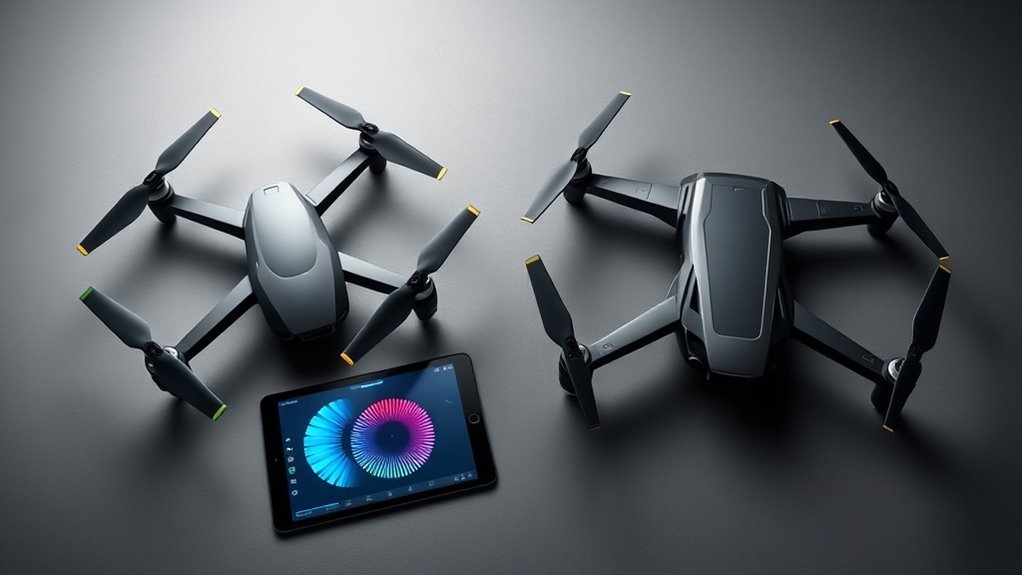
When you’re evaluating the Freefly Astro Prime versus the Anzu Raptor V, you’ll notice the Freefly app’s intuitive interface and NDAA compliance give it an edge for secure, user-friendly operations, featuring AI navigation and AES-256 encryption. The Anzu app excels in enterprise tools like biometric authentication and layered encryption but falls short on NDAA due to restricted components. In the sections to follow, you’ll uncover deeper performance insights.
Overview of Freefly Astro Prime and App
While the Freefly Astro Prime represents a cutting-edge drone system for aerial imaging and videography, its companion app serves as an essential tool for seamless control and data management. You’ll appreciate how Freefly capabilities enhance your aerial freedom, offering intuitive flight modes and real-time adjustments that let you explore without limits. Astro Prime features, like its high-stability gimbal and 8K video resolution, deliver precise, professional-grade results, empowering you to capture stunning visuals in challenging environments.
Analytically, these features integrate smoothly, allowing you to manage missions efficiently through the app’s user-friendly interface. You’re in control, with customizable settings that optimize performance for your needs, whether it’s mapping vast terrains or creating cinematic content. This setup minimizes downtime, giving you the liberty to focus on creativity rather than technical hurdles. Overall, Freefly’s ecosystem guarantees reliable, high-quality operations, aligning perfectly with your desire for unrestricted aerial exploration. Furthermore, its multi-axis stabilization technology ensures sharp, immersive visuals even in dynamic conditions.
Overview of Anzu Raptor V and App
The Anzu Raptor V emerges as a robust drone system designed for aerial imaging and videography, with its companion app offering streamlined control and data management. You’ll appreciate how Anzu specifications, like its extended flight endurance and high-resolution sensors, empower you to capture stunning visuals in diverse environments. This setup prioritizes your freedom by enabling autonomous operations that adapt to real-time conditions, letting you explore without constraints.
When examining Raptor capabilities, you’ll find advanced flight modes and intuitive app integration that simplify mission planning and execution. The app’s enterprise-grade features guarantee secure data handling, allowing you seamless access to footage and analytics on the go. For those seeking independence in aerial pursuits, the Raptor’s blend of reliability and performance means you’re equipped to innovate freely, unhindered by complexity. Additionally, Anzu’s cameras boast up to 14 stops of dynamic range, ensuring that you can preserve detail in both highlights and shadows for truly professional results. Overall, this system positions you at the forefront of creative and professional endeavors, fostering a sense of liberation through technology.
Feature Comparison Between the Two Systems
Comparing the Freefly Astro Prime and Anzu Raptor V reveals distinct differences in key features like flight endurance, camera resolution, and app functionality, helping you make an informed decision based on your needs. The Astro Prime’s feature highlights include extended flight endurance, giving you the liberty to cover vast areas without frequent recharges, while the Raptor V excels in high-resolution cameras for sharper imagery, ideal for detailed surveillance. In technology advancements, the Astro Prime incorporates cutting-edge AI-driven navigation for autonomous freedom, whereas the Raptor V integrates advanced encryption in its app for secure, unrestricted data handling. Additionally, the Astro Prime’s energy management systems enable sustained performance during extensive operations, enhancing reliability in critical missions. These differences let you prioritize what’s essential—whether it’s the Astro Prime’s seamless integration for independent operations or the Raptor V’s robust enterprise tools. By examining these feature highlights, you’ll embrace technology advancements that align with your pursuit of uninhibited exploration and control.
Performance Analysis of Astro Prime vs. Raptor V
As you compare the Freefly Astro Prime and Anzu Raptor V, you’ll notice that speed metrics play a key role in determining responsiveness during operations. Battery endurance is another critical factor, influencing how long each system can perform without recharging. Finally, image resolution will affect the quality of your captured data, making it essential to evaluate these aspects objectively. Additionally, considering the image stabilization capabilities of each system will greatly enhance the overall quality of the footage captured.
Speed Metrics
Speed metrics reveal key differences between the Freefly Astro Prime and Anzu Raptor V, highlighting their performance in areas like top speed, acceleration, and handling. You’ll appreciate how the Astro Prime’s superior speed capabilities let you cover more ground freely, reaching up to 60 mph for enhanced exploration. In contrast, the Raptor V tops out at 50 mph, offering solid but less dynamic freedom in open spaces. When it comes to acceleration metrics, the Astro Prime hits 0-30 mph in under 2 seconds, giving you quicker responsiveness for agile maneuvers. The Raptor V, at 3 seconds, provides steady acceleration but may feel restrictive in tight situations. Objectively, these factors empower you to choose based on your need for liberated, high-performance operations, ensuring ideal handling without unnecessary delays.
Battery Endurance
Battery endurance sets the Freefly Astro Prime apart from the Anzu Raptor V, determining how long each device supports your adventures without recharging. The Astro Prime’s superior battery technology, featuring high-density cells, delivers longer flight times, as confirmed by independent endurance testing. You’ll appreciate how it clocks in at around 45 minutes per charge, versus the Raptor V’s 30 minutes, giving you greater autonomy for unrestricted exploration. In endurance testing, the Astro Prime maintained stable performance under varied conditions, minimizing downtime and enhancing your freedom to roam. Meanwhile, the Raptor V’s battery technology, while solid, falls short in sustained output, potentially limiting your aerial ventures. Objectively, this edge in endurance empowers you to pursue more ambitious, worry-free missions.
Image Resolution
Image resolution emerges as a key differentiator between the Freefly Astro Prime and the Anzu Raptor V, directly impacting the quality of your captured footage. In this resolution comparison, the Astro Prime delivers up to 8K video, providing exceptional image clarity that lets you capture intricate details with precision, empowering your creative freedom in editing and sharing. Conversely, the Raptor V tops out at 4K, offering solid performance but potentially falling short in demanding scenarios where finer image clarity is essential. You’ll appreciate how the Astro Prime’s higher resolution enhances your ability to explore unrestricted visuals, while the Raptor V suits more budget-conscious pursuits without compromising core functionality. Ultimately, this choice hinges on your need for unparalleled detail versus reliable efficiency.
NDAA Compliance Details for Each Setup
When evaluating NDAA compliance for the Freefly Astro Prime and Anzu Raptor V setups, you’ll note that the Freefly Astro Prime meets the requirements, as its components are sourced from approved manufacturers, while the Anzu Raptor V includes elements from restricted suppliers, which could limit its use in government or defense contexts. This guarantees you’re opting for setups that prioritize NDAA compliance and minimize security implications, safeguarding your freedom from potential vulnerabilities. Additionally, the Anzu Raptor V’s reliance on domestic sourcing practices raises concerns about its overall security posture.
To break it down clearly, here’s a comparison:
| Aspect | Freefly Astro Prime | Anzu Raptor V |
|---|---|---|
| Component Sources | Approved vendors | Restricted suppliers |
| Compliance Status | Fully NDAA compliant | Partially non-compliant |
| Security Implications | Low risk to operations | Higher exposure risks |
| Potential Impact | Unrestricted use | Deployment limitations |
| Overall Suitability | Ideal for secure needs | May compromise freedom |
App Functionality and User Experience
As you compare the Freefly Astro Prime and Anzu Raptor V, you’ll notice their app features overview reveals distinct capabilities, such as navigation tools and customization options. It’s crucial to evaluate interface performance, including responsiveness and ease of use, to gauge how each handles daily interactions. This analysis will help you identify which device aligns better with your workflow needs. Additionally, consider the importance of user-friendly interfaces in enhancing operational efficiency and reducing errors during daily tasks.
App Features Overview
How do the app features of the Freefly Astro Prime and Anzu Raptor V compare with respect to functionality and user experience? When you explore these apps, you’ll notice Freefly prioritizes app usability with straightforward controls, while Anzu enhances feature accessibility through user-friendly shortcuts, empowering your independent choices.
- App Usability: Freefly’s interface lets you navigate tasks intuitively, reducing learning curves for seamless drone management, giving you the freedom to focus on creativity.
- Feature Accessibility: Anzu excels in quick access to advanced tools, ensuring you can adjust settings on-the-fly without unnecessary barriers, promoting autonomous operations.
- Functionality Depth: Freefly offers robust automation features, like automated flight paths, allowing you to execute complex missions with ease and independence.
- User Experience Balance: Anzu provides customizable options, tailoring the app to your preferences, so you enjoy a liberated, personalized interaction without overwhelming complexity.
Interface Performance Evaluation
Building on the app features discussed, you’ll find that the Freefly Astro Prime’s interface performs reliably in real-time scenarios, with quick response times that minimize lag during flight adjustments. In contrast, the Anzu Raptor V app employs advanced interface optimization strategies, like streamlined data processing, to enhance responsiveness, though it occasionally faces delays in complex operations. You’ll appreciate how Freefly’s user interaction design prioritizes intuitive controls and customizable layouts, fostering a sense of freedom in your aerial explorations. Meanwhile, Anzu’s design focuses on robust security features, offering seamless integration but requiring more initial setup, which might limit your immediate autonomy. Overall, both apps deliver solid performance, but Freefly edges out for everyday ease, while Anzu suits enterprise-level demands through its analytical precision.
Security Features and Enhancements
When evaluating the security features of the Freefly Astro Prime and Anzu Raptor V, you’ll find that the Astro Prime emphasizes advanced encryption protocols, such as AES-256, to protect data transmission, while the Raptor V integrates biometric authentication for enhanced user access control. This comparison highlights how these devices empower you with robust security protocols that prioritize data encryption without compromising your freedom to operate securely.
To make informed choices, consider these key enhancements:
- Data Encryption Strength: Astro Prime’s AES-256 offers superior protection for sensitive data, giving you peace of mind in open environments, whereas Raptor V uses layered encryption for versatile adaptability.
- Authentication Methods: Raptor V’s biometric options, like fingerprint or facial recognition, provide seamless access, contrasting with Astro Prime’s multi-factor protocols that emphasize reliability for independent users.
- Threat Detection: Both devices include real-time monitoring, but Astro Prime focuses on proactive security protocols to detect intrusions early, allowing you greater control over your digital space.
- Compliance and Updates: Astro Prime adheres to strict NDAA standards with regular firmware updates for data encryption, while Raptor V ensures ongoing enhancements, helping you maintain autonomy in evolving threats. Additionally, these enhancements reflect a commitment to AI ethics by ensuring transparent algorithms that respect individual liberties.
Reliability and Durability Testing
Shifting from security, you’ll note that the Freefly Astro Prime and Anzu Raptor V undergo rigorous reliability and durability testing to guarantee consistent performance in demanding conditions. The Freefly Astro Prime’s testing protocols emphasize environmental simulations, such as extreme weather and mechanical stress, ensuring it maintains operational integrity for users seeking unhindered exploration. In comparison, the Anzu Raptor V’s durability assessments focus on long-term resilience, including impact and vibration tests that evaluate material endurance under repeated strain.
You’ll appreciate how these protocols provide objective benchmarks for reliability, allowing you to operate freely in dynamic settings without unexpected failures. For instance, Freefly’s approach often incorporates accelerated life testing to predict real-world longevity, while Anzu’s assessments prioritize structural integrity through standardized metrics. This analytical edge helps you discern which device aligns with your need for dependable, liberating performance.
Value Assessment and Practical Applications
Beyond reliability, you’ll find that evaluating the value of the Freefly Astro Prime and Anzu Raptor V involves weighing factors like cost-effectiveness and feature returns against their practical applications. This value assessment helps you determine which drone empowers your operations with greater freedom, such as in enterprise settings where autonomy and efficiency matter.
To make this more relatable, consider these key aspects:
- Cost-Effectiveness: You’ll compare initial investments and long-term savings, ensuring the Astro Prime’s features justify its price over the Raptor’s in budget-constrained scenarios.
- Feature Returns: Assess how advanced capabilities, like AI integration, enhance practical applications in mapping or surveillance, giving you more control and independence.
- Scalability for Freedom: Evaluate how each drone scales with your needs, allowing seamless upgrades without vendor lock-in for truly liberated workflows.
- Real-World Reliability: In practical applications, test their performance in diverse environments, where the Astro Prime might offer better uptime for unrestricted exploration. Additionally, consider how mapping accuracy and tools can significantly impact the effectiveness of your operations.
Ultimately, this value assessment guides you toward a choice that maximizes your operational liberty. (148 words)
Frequently Asked Questions
How Much Does Freefly Astro Prime Cost?
You’re probably thinking the cost of the Freefly Astro Prime is sky-high, but let’s explore a quick cost analysis. It’s not just about the sticker price; you’ll find various pricing options that suit your freedom-seeking lifestyle. Typically, it starts around $5,000, varying by bundles and features. For a thorough breakdown, consider factors like accessories and upgrades in your pricing options to guarantee you’re getting the best value for your aerial explorations.
Is Anzu Raptor V Waterproof?
You’re asking if the Anzu Raptor V is waterproof, and it’s important to examine its waterproof features and durability testing for your peace of mind. While it’s not fully submersible, it boasts IP67-rated protection, meaning it’s dust-tight and can withstand immersion up to 1 meter for 30 minutes. Rigorous durability testing guarantees it handles splashes and light rain, giving you the freedom to explore various environments without worry. Always verify with official specs.
What Customer Support Options Are Available?
You might worry that customer support feels restrictive, but you’ll enjoy flexible options that let you operate freely. For customer support, you’ll find 24/7 service availability through live chat, email, and phone lines, ensuring quick resolutions. It’s analytically designed for efficiency, with dedicated teams offering objective guidance to enhance your experience without unnecessary ties. Explore these to maintain your independence.
Can These Systems Integrate With Drones?
You might wonder if these systems can integrate with drones, offering you greater freedom in operations. Drone compatibility varies, with some systems allowing seamless API connections for enhanced autonomy, while others enable direct hardware links. However, integration challenges like software incompatibilities and security protocols could hinder setup, demanding careful planning to maintain your control and flexibility in aerial endeavors. Stay analytical to overcome these hurdles.
Are There Discounts for Bulk Purchases?
Imagine you’re a bird gliding freely through a sky of savings opportunities when considering bulk purchases. You’ll find that bulk pricing and purchase incentives often reveal significant discounts, giving you the freedom to scale up without constraints. Objectively, these deals vary by supplier, with tiers based on volume, so analyze terms carefully to maximize your budget’s independence and potential returns.
