
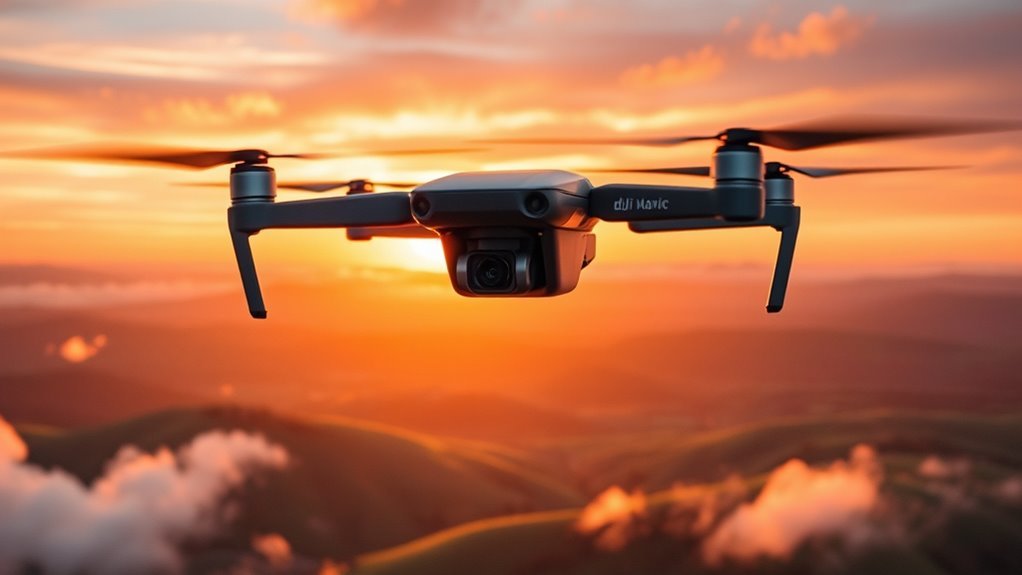
You’ll find the DJI Mavic drone combines compact, foldable design with professional-grade features like a 12MP camera stabilized by a 3-axis gimbal, delivering sharp 4K footage. Its 31-minute flight time is powered by an intelligent battery system, while multi-directional sensors enable precise obstacle avoidance and safe automated return. The ergonomic controller offers smooth, customizable handling, and the lightweight, durable build supports easy transport. Exploring further reveals more on its advanced tech and value.
Overview of the DJI Mavic Series
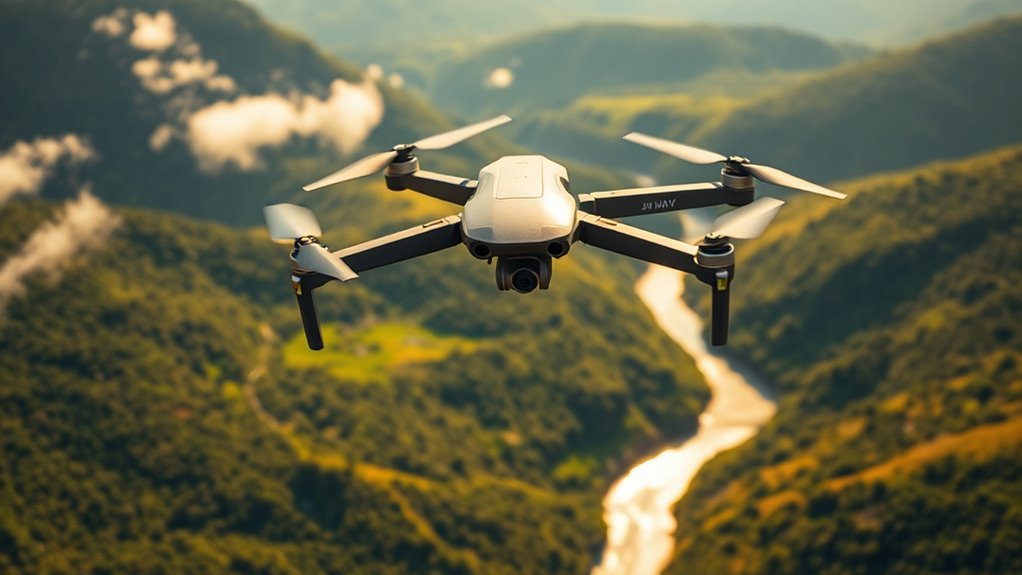
The DJI Mavic series represents a significant advancement in consumer drone technology, combining compact design with professional-grade features. As you explore the Mavic series evolution, you’ll notice how each model refines flight stability, camera capabilities, and user interface. This progression delivers enhanced autonomy and creative control, empowering you to capture aerial perspectives with unprecedented freedom. When conducting a Mavic series comparison, you’ll find improvements in sensor precision, obstacle avoidance, and battery efficiency, all critical for extended and safer flights. The integration of intelligent flight modes across models simplifies complex maneuvers, enabling you to focus on your artistic vision rather than technical constraints. Understanding these advancements helps you choose the ideal drone that balances portability with performance, matching your desire for unrestricted exploration and high-quality aerial imaging.
Design and Build Quality
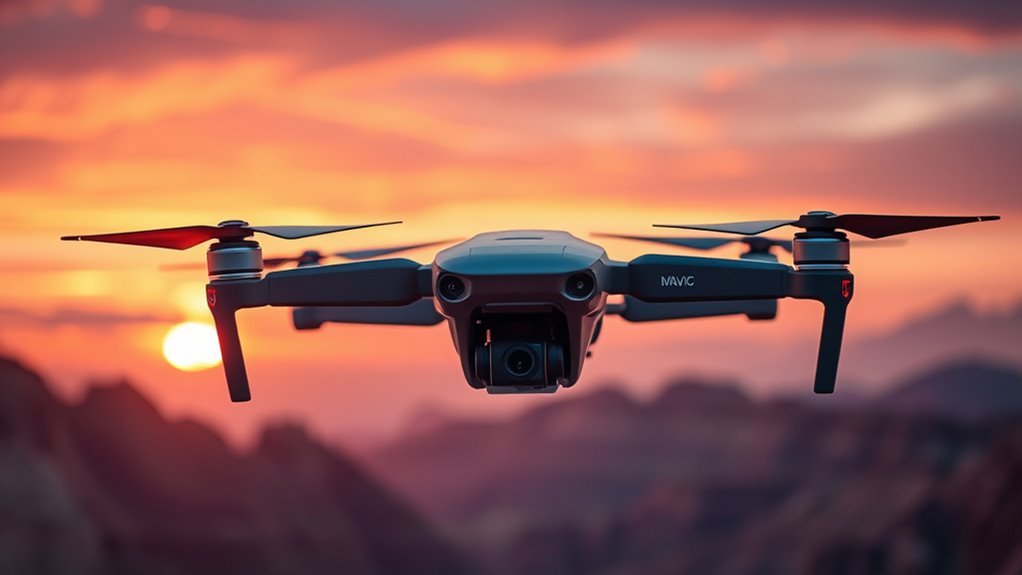
Craftsmanship plays an essential role in how the DJI Mavic drone performs and endures various flight conditions. You’ll immediately notice the ergonomic design that balances portability with operational control, allowing extended flights without fatigue. The drone’s chassis is crafted from high-grade composite materials, ensuring superior material quality that withstands impacts and environmental stressors. This combination results in a lightweight yet robust frame, ideal for users seeking freedom in diverse environments. Every joint and hinge reflects precision engineering, reducing mechanical wear over time. The thoughtful placement of components optimizes weight distribution, enhancing stability and maneuverability. Ultimately, the Mavic’s design philosophy merges durability with user-centric ergonomics, empowering you to explore without compromise.
Camera Specifications and Performance
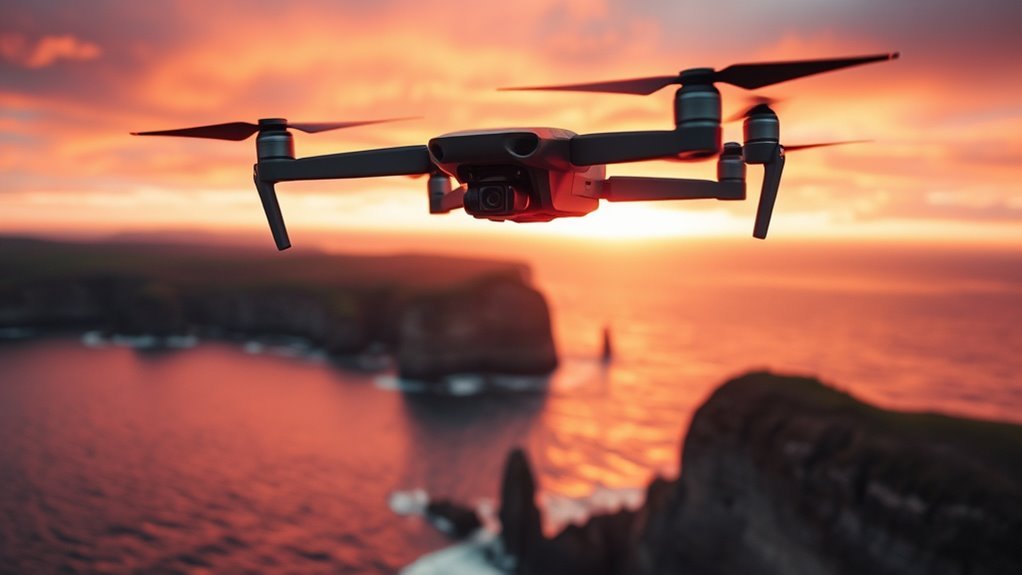
Alongside its well-engineered frame, the DJI Mavic’s camera system stands out as a key performance driver. You get a 1/2.3-inch CMOS sensor capable of capturing 12MP stills and 4K video at 30fps, ensuring high-resolution imagery. The three-axis gimbal provides advanced image stabilization, minimizing vibrations and delivering smooth footage even in windy conditions or rapid maneuvers. This stabilization is essential for maintaining clarity and sharpness, especially when you’re in motion. Low light performance is enhanced by a wide aperture of f/2.8 and intelligent noise reduction algorithms, allowing you to capture detailed images with less grain in dim environments. For those seeking creative freedom, the camera supports various color profiles and manual controls, empowering you to tailor exposure and focus precisely to your needs.
Flight Time and Battery Life
You’ll get up to 31 minutes of flight time on a single battery charge with the DJI Mavic, a figure that balances power consumption and weight efficiency. This optimized battery performance grants you the freedom to explore expansive areas without frequent interruptions. Key aspects include:
- Intelligent Flight Battery design that maximizes energy density while minimizing weight.
- Advanced power management algorithms enhancing flight efficiency during varied maneuvers.
- Real-time battery status monitoring, ensuring precise flight time estimations.
- Rapid charging capabilities reducing downtime between flights.
Understanding these factors lets you plan missions confidently, maximizing aerial coverage and creative potential. The Mavic’s battery system is engineered to deliver consistent performance, adapting dynamically to flight conditions, giving you reliable autonomy to push boundaries without compromising safety or endurance.
Control Options and User Interface
You’ll find the Mavic’s remote controller equipped with customizable buttons and a precise joystick layout, enhancing maneuverability. The seamless mobile app integration allows real-time telemetry and camera control, streamlining your flight experience. Its user interface is intuitively designed, minimizing setup time while maximizing operational efficiency.
Remote Controller Features
The remote controller of the DJI Mavic drone offers a sophisticated blend of control options and an intuitive user interface designed to enhance flight precision and ease of use. Its remote controller functionality is engineered to provide advanced control features, giving you effortless command over the drone’s movements. You’ll appreciate:
- Responsive joysticks calibrated for smooth, precise navigation.
- Customizable buttons that let you tailor controls to your flying style.
- An integrated display providing real-time telemetry and flight status.
- Ergonomic design ensuring comfort during prolonged use.
These elements combine to grant you unparalleled freedom, enabling intricate maneuvers and confident flight in varied environments. The controller’s interface is both minimalistic and feature-rich, ensuring you maintain focus on piloting without distraction. This balance of functionality and ease empowers you to fully exploit the Mavic’s capabilities.
Mobile App Integration
Three key aspects define the DJI Mavic’s mobile app integration: seamless control options, real-time data visualization, and a user-friendly interface. The app functionality allows you to switch effortlessly between manual control and intelligent flight modes, enhancing your operational freedom. You gain access to telemetry data—altitude, speed, battery status—in real time, empowering you to make informed decisions mid-flight. The app’s design optimizes user experience by prioritizing responsiveness and minimal latency, ensuring precise command inputs. Additionally, customizable control layouts let you tailor the interface to your preferences, freeing you from rigid setups. This integration bridges the gap between hardware and software, delivering a versatile control ecosystem that meets the demands of both novice pilots and seasoned professionals seeking autonomy in aerial navigation.
User-Friendly Interface Design
While mastering complex drone controls can be challenging, DJI’s Mavic interface simplifies this through intuitive layouts and responsive feedback mechanisms. Your user experience is enhanced by seamless interface navigation, allowing you to focus on flight freedom rather than control complexity. The interface design integrates:
- Customizable control mappings for personalized operation.
- Real-time telemetry display optimizing situational awareness.
- Gesture controls that reduce dependency on physical inputs.
- Context-sensitive menus that minimize screen clutter.
This combination guarantees you don’t get bogged down in technicalities, enabling fluid control and quick adjustments mid-flight. The meticulous design balances advanced functionality with accessibility, catering to both novice pilots and seasoned users craving liberation in the air. Ultimately, DJI’s user-friendly interface design empowers you to explore with precision and confidence.
Intelligent Flight Modes
Intelligent flight modes transform how you control the DJI Mavic drone, offering automated maneuvers that enhance both safety and creativity. With waypoint navigation, you can predefine a flight path by setting GPS coordinates, allowing the drone to autonomously follow complex routes with precision. This frees you from manual piloting, enabling you to focus on capturing dynamic footage. Active tracking further elevates your experience by locking onto subjects and maintaining smooth, consistent framing, even during rapid movement. These modes rely on advanced algorithms and sensor fusion to interpret environmental data, ensuring accurate execution. By integrating waypoint navigation and active tracking, the Mavic provides you with a versatile toolkit that balances autonomy and control, empowering you to explore aerial possibilities without sacrificing reliability or artistic intent.
Obstacle Avoidance and Safety Features
When flying your DJI Mavic, the obstacle avoidance system relies on an array of ultrasonic, infrared, and vision sensors to detect hazards in real time. These sensors feed data into the flight controller, enabling precise navigation around obstacles with minimal pilot input. Additionally, emergency response mechanisms like automatic return-to-home and precision landing activate under signal loss or low battery conditions to enhance flight safety.
Sensor Technology Overview
Advanced sensor technology forms the backbone of the DJI Mavic’s obstacle avoidance and safety systems, enabling precise environmental awareness during flight. You rely on a combination of sensor types and sophisticated image processing algorithms to navigate complex surroundings. The drone’s ability to interpret real-time data guarantees it maintains safe distances while granting you freedom to focus on your mission.
Key elements include:
- Dual vision sensors for stereoscopic depth perception.
- Infrared sensors to detect obstacles in low light.
- Ultrasonic sensors measuring proximity with high accuracy.
- Real-time image processing chip optimizing flight adjustments.
This sensor fusion grants you enhanced situational awareness, reducing collision risk and expanding your operational confidence in diverse environments.
Emergency Response Mechanisms
Building on the sophisticated sensor array that continuously monitors your drone’s surroundings, the DJI Mavic employs a suite of emergency response mechanisms designed to react instantly to potential hazards. Its advanced obstacle avoidance system uses multi-directional sensors to detect and map obstacles in real-time, triggering automated maneuvers to prevent collisions. These emergency protocols are seamlessly integrated into the flight control system, ensuring rapid and precise crisis management without interrupting your flight experience. When unexpected interference or signal loss occurs, the Mavic initiates Return-to-Home (RTH) protocols, autonomously guiding back to its takeoff point while avoiding obstacles. This combination of proactive detection and reactive safety features empowers you with the freedom to explore confidently, knowing the drone actively protects itself and your investment during complex flight scenarios.
Portability and Ease of Transport
One of the standout features of the DJI Mavic series is its compact design, which greatly enhances portability and ease of transport. This design allows you to carry the drone effortlessly, providing unmatched travel convenience for those who value freedom and mobility. Here’s why it stands out:
The DJI Mavic’s compact design offers exceptional portability and travel convenience for on-the-go adventurers.
- Foldable arms reduce the drone’s footprint, enabling easy storage in backpacks or carry cases.
- Lightweight materials minimize fatigue during transport without compromising structural integrity.
- Integrated protective casing guarantees durability, safeguarding internal components during travel.
- Quick setup mechanisms let you deploy the drone rapidly, maximizing your flight time and efficiency.
Together, these elements make the DJI Mavic an ideal companion for remote explorations where transportability is essential.
Compatibility With Accessories and Upgrades
When considering the DJI Mavic, you’ll find it supports a range of accessories like propeller guards, extra batteries, and intelligent flight batteries that enhance flight time and safety. The drone’s modular design also allows for firmware and hardware upgrades, including improved camera gimbals and enhanced remote controllers. Understanding these compatibility options guarantees you can tailor the drone’s performance to your specific needs.
Accessory Compatibility Overview
Several key accessories and upgrades enhance the functionality of the DJI Mavic drone, expanding its capabilities for various professional and recreational uses. Understanding the accessory types and referencing the compatibility list is essential to guarantee seamless integration and peak performance. You’ll find that DJI provides a well-documented compatibility list, making it easier to select appropriate add-ons without risking functionality loss.
- Propeller guards and replacement blades tailored for specific Mavic models
- Intelligent flight batteries with smart charging compatibility
- Remote controller extensions and signal boosters enhancing range
- Camera filters and lens attachments designed for Mavic’s gimbal system
Upgrade Options Available
Although the DJI Mavic drone comes well-equipped out of the box, understanding the range of upgrade options available is vital to maximize its performance and adaptability. You can enhance flight endurance considerably through battery enhancements, opting for higher-capacity or intelligent batteries that extend operational time without adding excessive weight. Additionally, camera upgrades allow you to push the limits of aerial imaging; swapping lenses or integrating advanced gimbal stabilizers improves resolution and stability, essential for professional-quality footage. Compatibility with third-party accessories also plays a role, enabling tailored modifications such as enhanced propellers or sensor modules, which refine flight dynamics and obstacle avoidance. By selectively upgrading components, you maintain the drone’s compact form factor while expanding its capabilities, granting you the freedom to customize performance and capture precision to suit your specific aerial ambitions.
Price and Value for Money
The pricing structure of the DJI Mavic drone positions it competitively within the mid-to-high-end consumer drone market, balancing advanced features with accessibility. When you evaluate affordability comparison, the Mavic stands out by offering cutting-edge technology without the exorbitant cost of professional-grade drones. Consider this a long term investment, as its durability and firmware updates extend usability.
- Competitive price relative to similar specs in its class
- Advanced camera and flight features justify the cost
- Modular upgrade options enhance value over time
- Strong resale value supports long term financial sense
If you crave the freedom to explore without compromise, the Mavic’s pricing aligns well with the robust capabilities it delivers, making it an intelligent choice for both hobbyists and pros.
