
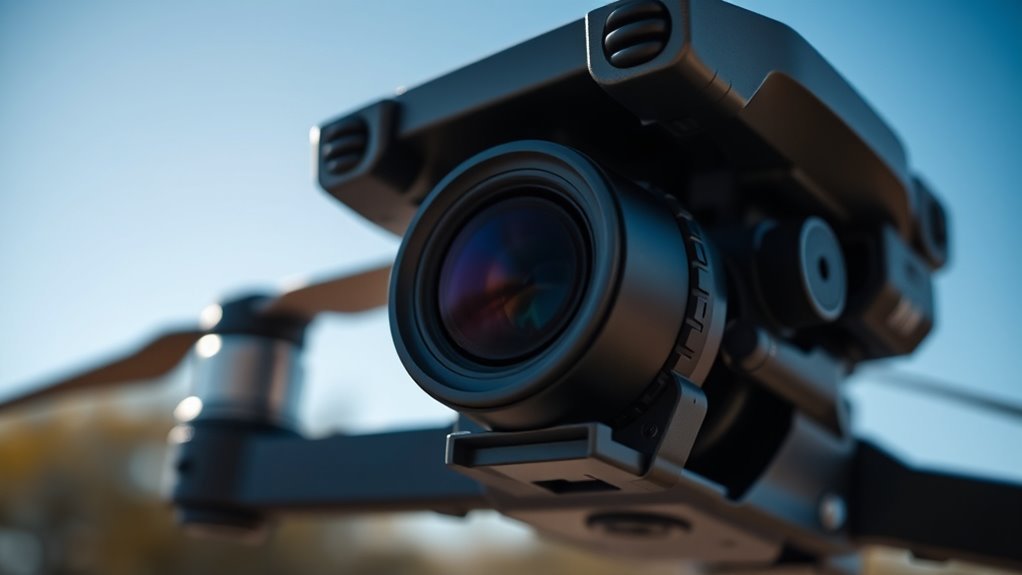
You rely on your drone’s gimbal to mechanically stabilize your camera by counteracting movements across pitch, roll, and yaw axes. Using motorized mechanisms and sensors like gyroscopes and IMUs, it detects vibrations and adjusts instantly to keep footage smooth and steady. Whether you have a single- or three-axis gimbal, this technology prevents blurring and guarantees sharp images during flight. For a deeper grasp of types, benefits, and upkeep, there’s more to explore.
What Is a Drone Gimbal?

A drone gimbal is a mechanical stabilizer designed to keep your camera steady during flight. It operates through precise gimbal mechanics, utilizing motors and sensors to counteract unwanted movements. Understanding gimbal types is essential: single-axis gimbals control one plane, typically tilt; two-axis gimbals add roll stabilization; and three-axis gimbals manage yaw, pitch, and roll simultaneously for maximum stability. Each type offers varying degrees of freedom, allowing you to capture smooth, professional-quality footage even in turbulent conditions. By mastering the technical aspects of gimbal mechanics and selecting the appropriate gimbal type, you gain the freedom to maneuver your drone confidently while maintaining crisp, stable visuals. This knowledge empowers you to maximize your drone’s potential in diverse environments.
How Does a Gimbal Stabilize Your Camera?
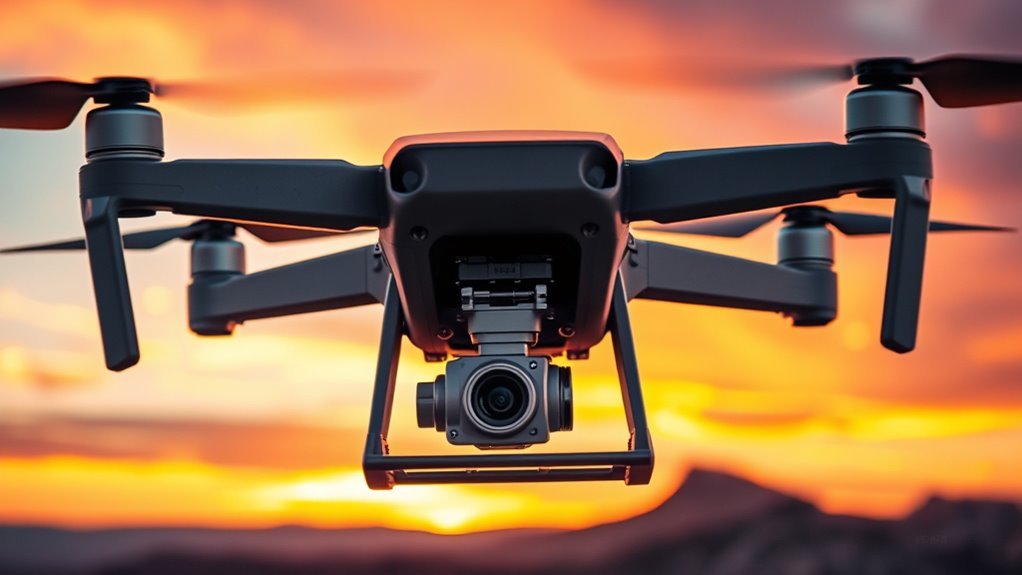
Even though your drone might experience sudden movements or vibrations, the gimbal keeps your camera steady by actively compensating for these disruptions. It achieves this through advanced gimbal mechanics involving multiple motorized axes—typically three—that detect and counteract motion in real time. Using inertial measurement units (IMUs) and gyroscopes, the gimbal senses angular velocity and orientation changes, instantly adjusting the motors to maintain a fixed camera position. These stabilization techniques isolate the camera from drone vibrations and abrupt shifts, ensuring smooth, blur-free footage. By mechanically decoupling the camera’s orientation from the drone’s unstable movements, the gimbal grants you the freedom to capture crisp, professional-quality images even in challenging flight conditions. This precise control is essential for maintaining visual clarity during dynamic aerial maneuvers.
Types of Gimbals Used in Drones
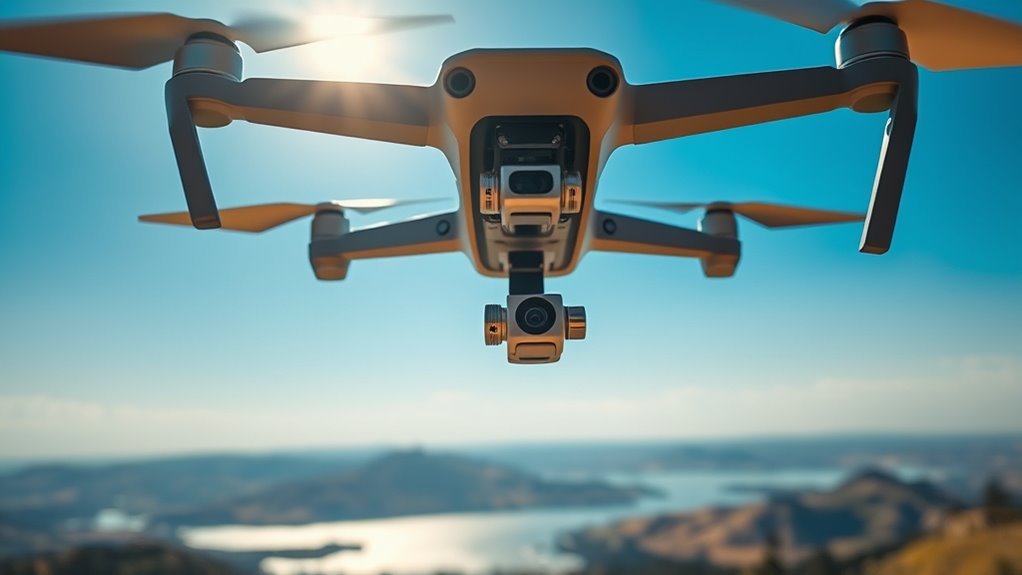
Gimbals come in several types, each designed to meet specific stabilization needs and drone configurations. You’ll primarily encounter mechanical gimbals and electronic gimbals. Mechanical gimbals use motorized joints to physically counteract drone movements, offering precise, real-time stabilization. Electronic gimbals rely on software algorithms and digital image processing to smooth out motion. Understanding these distinctions helps you choose the right system for your aerial freedom.
| Type | Description |
|---|---|
| Mechanical Gimbals | Motor-driven, multi-axis stabilization |
| Electronic Gimbals | Software-based digital stabilization |
| 1-Axis Gimbals | Stabilizes pitch or roll on a single axis |
| 3-Axis Gimbals | Stabilizes pitch, roll, and yaw simultaneously |
Benefits of Using a Gimbal for Aerial Photography
When you’re capturing aerial footage, maintaining stability is vital to achieving sharp, professional-quality images. A gimbal provides precise motion control, counteracting the drone’s movements caused by wind or sudden directional changes. This stabilization greatly enhances image quality by reducing blurring and jitter, allowing you to capture smooth, steady shots even in dynamic environments. With a gimbal, you gain freedom to maneuver your drone creatively without compromising footage clarity. It also enables consistent framing and horizon leveling, fundamental for professional aerial photography. By isolating your camera from drone vibrations, the gimbal guarantees every photo and video is crisp and visually appealing. Ultimately, using a gimbal elevates your aerial captures, granting you technical control and artistic flexibility that’s essential for high-quality results.
Tips for Maintaining and Optimizing Your Drone Gimbal
Proper maintenance and optimization of your drone gimbal are essential for ensuring consistent performance and longevity. Start by regularly performing gimbal calibration to maintain precise stabilization and prevent drift during flight. Calibration aligns the sensors and motors, which is vital after firmware updates or impacts. Additionally, practice routine gimbal cleaning to remove dust, dirt, and debris that can impair motor function and sensor accuracy. Use a soft brush and compressed air carefully to avoid damage. Store your drone in a protective case to minimize exposure to contaminants and mechanical shocks. Finally, inspect the gimbal’s mechanical parts for wear or looseness, tightening screws as needed. By following these steps, you’ll preserve your gimbal’s reliability, enabling you to capture smooth, stable footage that frees your creative vision.
