

First, know your local laws to avoid legal trouble when disabling a drone. Next, identify the drone type and assess its flight behavior and location using detection technology. If safe, try contacting the pilot. Employ net guns or capture tools carefully, considering drone speed and wind, or use physical barriers to disrupt flight paths. Always document the incident and notify authorities for support. Understanding these targeted steps sets the foundation for effective, lawful drone handling.
Understand the Legal Implications
Before attempting to disable a drone, you need to fully understand the legal implications involved. Different legal jurisdictions impose specific drone regulations that govern the use, interference, and disabling of unmanned aerial vehicles. You must research the applicable laws in your area, as unauthorized disabling can lead to severe penalties, including fines or criminal charges. These regulations often distinguish between commercial, recreational, and government-operated drones, each with distinct protections. Ensuring compliance safeguards your freedom while respecting property and privacy rights. Always verify whether disabling a drone is permissible under local statutes or requires explicit authorization. By methodically reviewing relevant drone regulations within your legal jurisdiction, you protect yourself from legal repercussions and act responsibly in exercising your right to freedom.
Identify the Drone Model and Capabilities
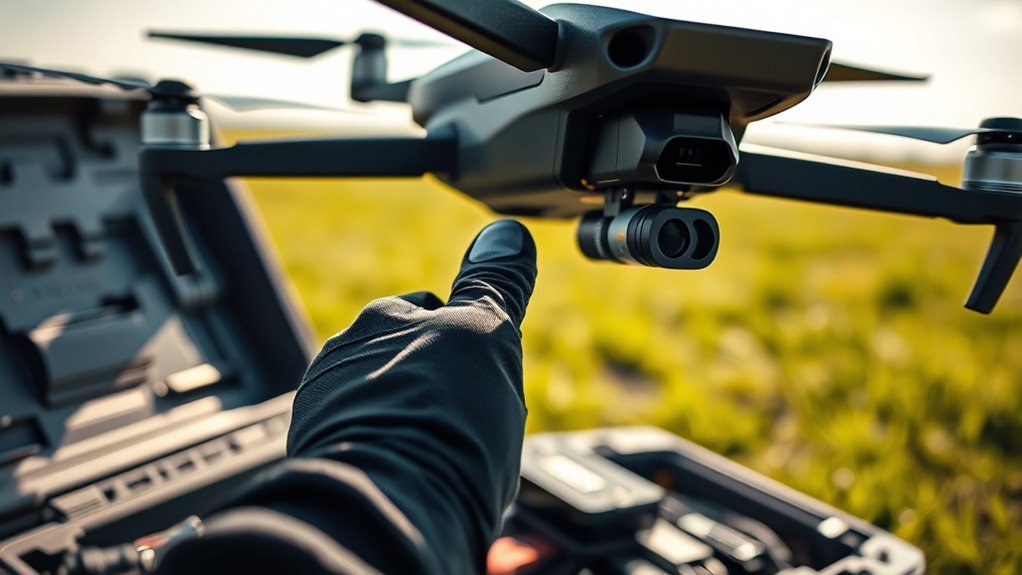
You’ll need to identify the drone model by recognizing its type—quadcopter, fixed-wing, or hybrid. Next, assess its flight features such as range, speed, and maneuverability to understand operational limits. Finally, determine the payload capacity to evaluate potential threats or attached equipment.
Recognize Drone Types
Identifying the drone model accurately is essential for evaluating its capabilities and determining the appropriate disabling method. Begin by categorizing the drone according to standardized drone classifications: micro, mini, tactical, or commercial. Each classification reflects size, payload, and operational range, directly influencing countermeasures. Analyze drone technology features such as propulsion type—rotary or fixed-wing—sensor arrays, and communication protocols. These technical details reveal vulnerabilities and potential resistance to jamming or capture techniques. Utilize visual inspection and, if available, electronic identification tools to ascertain the make and model. Knowing whether the drone employs autonomous navigation or manual control further refines your approach. Mastering these distinctions empowers you to defend your freedom effectively, ensuring your disabling strategy matches the drone’s design and operational intent without unnecessary risk or collateral disruption.
Assess Flight Features
Once you’ve pinpointed the drone’s classification and model, focus on its flight features to understand its operational capabilities. This step is essential for anticipating its behavior and effectively disabling it. Analyze the drone’s:
- Flight modes: Determine if it operates via manual control, GPS waypoint navigation, or autonomous missions.
- Navigation systems: Identify whether it uses GPS, GLONASS, or inertial navigation to maintain stability and course.
- Range and speed parameters: Assess how far and fast it can fly, influencing interception strategies.
Determine Payload Capacity
Payload capacity is a critical factor in analyzing a drone’s potential threat and functionality. To determine this, start by identifying the drone model, then review its payload specifications. This includes maximum weight the drone can carry without compromising stability or flight time. Understanding weight distribution is equally important, as improper balance affects maneuverability and control. Use manufacturer data or technical databases for precise figures.
| Drone Model | Max Payload (kg) | Notes on Weight Distribution |
|---|---|---|
| Model A | 2.5 | Evenly distributed for stability |
| Model B | 1.8 | Front-heavy, reduces agility |
| Model C | 3.0 | Adjustable for varied payloads |
Accurately analyzing these factors guarantees effective countermeasures while preserving your operational freedom.
Assess the Situation and Location
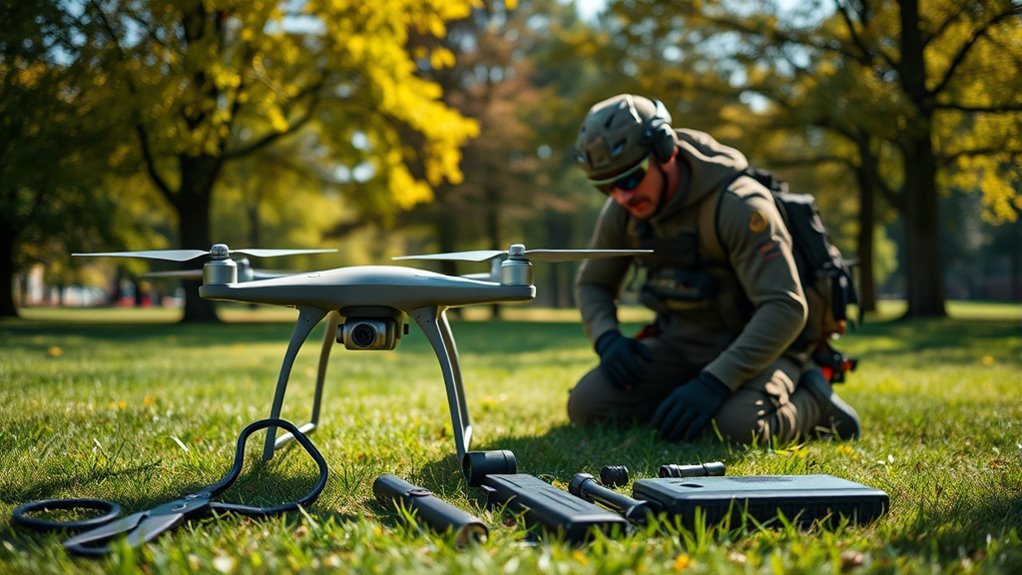
You’ll first need to identify the drone’s exact proximity to determine your effective range for intervention. Next, evaluate any legal restrictions governing drone disablement in your location to guarantee compliance. Finally, assess the potential threats posed by the drone to prioritize your response strategy.
Identify Drone Proximity
Although drones can be difficult to detect at a distance, accurately identifying their proximity is critical before taking any disabling action. You need to rely on precise drone detection methods and carefully observe flight patterns to gauge their location. Use these techniques to assess proximity effectively:
- Track the drone’s altitude and speed visually or with radar tools, noting any erratic flight patterns.
- Listen for characteristic buzzing sounds, which increase in volume as the drone approaches.
- Use directional antennas or signal detectors to estimate distance by measuring signal strength and direction.
Evaluate Legal Restrictions
Once you’ve determined the drone’s proximity, the next step is to carefully review the legal restrictions that apply to your specific situation and location. You need to consult local drone regulations, which vary greatly by jurisdiction. Review federal, state, and municipal laws governing drone operation, no-fly zones, and property rights. Ignoring these can lead to severe legal consequences, including fines or criminal charges. Understand whether you’re on private property or public land, as rights differ. Be aware that some areas, such as near airports, government buildings, or critical infrastructure, have stricter rules. Accurately evaluating these legal boundaries guarantees you act within your rights while protecting your freedom. Proceed methodically—document relevant statutes and confirm your compliance before taking any disabling actions.
Determine Potential Threats
How can you accurately assess the potential threats posed by a drone in your vicinity? Begin with a systematic threat assessment, focusing on both the drone’s behavior and your environment. Conduct a thorough risk analysis by examining:
- The drone’s flight pattern: erratic or hovering over sensitive areas.
- Payload or attachments that could indicate surveillance or weaponization.
- Proximity to critical infrastructure or private property.
Use Drone Detection Tools
A reliable drone detection tool is essential for identifying unauthorized UAVs in your airspace. Leveraging advanced drone detection technology combined with sophisticated tracking algorithms, these tools provide real-time alerts, enabling you to monitor and neutralize potential threats effectively. Here’s a quick comparison of popular detection tools:
| Tool Name | Detection Range | Key Feature |
|---|---|---|
| AeroScope | 10 km | Real-time telemetry |
| Dedrone | 5 km | AI-based tracking |
| DroneShield | 8 km | RF signal analysis |
Communicate With the Drone Operator if Possible
Why attempt communication with the drone operator? Establishing drone communication can de-escalate potential conflicts and protect your freedom before taking drastic measures. Engaging in operator dialogue allows you to clarify intentions and possibly negotiate drone withdrawal.
To effectively initiate communication:
- Identify the operator’s location using detection tools or visual cues.
- Use a clear, authoritative tone when addressing concerns about privacy or safety.
- Provide concise instructions or requests, ensuring your message is unambiguous.
Maintaining direct operator dialogue respects legal boundaries and minimizes escalation risks. This method prioritizes resolution through communication, preserving your rights while addressing unauthorized drone presence. Always document the interaction for accountability and potential legal follow-up.
Employ Signal Jamming Techniques
When communication with the drone operator isn’t possible or fails to resolve the issue, signal jamming techniques can be employed to interrupt the drone’s control and navigation signals. You need to deploy precise signal interference methods targeting the frequencies used by the drone’s remote control and GPS modules. This involves generating radio frequency noise or spoofing signals that override legitimate commands, forcing the drone to lose control or initiate a failsafe landing. However, you must be acutely aware of jamming regulations in your jurisdiction, as unauthorized use of signal jamming devices is often illegal and subject to severe penalties. Before proceeding, verify compliance with local laws and consider the potential risks to other communications. Employing these techniques demands technical expertise and responsible application to safeguard your freedom without infringing on legal boundaries.
Utilize Net Guns or Capture Devices
You’ll need to understand the mechanics of net guns, which deploy a weighted mesh to entangle drone rotors effectively. Position yourself to maximize accuracy and consider wind and drone speed when firing to guarantee a successful capture. Mastering precise timing and trajectory adjustments will increase your chances of immobilizing the drone without causing damage.
Net Gun Mechanics
A net gun operates by rapidly deploying a mesh designed to entangle a drone’s rotors and body, effectively restricting its movement. Understanding net gun mechanics is crucial for precise capture techniques. When you activate the trigger, a compressed gas or spring mechanism propels the net forward at high velocity, aiming to intercept the drone’s flight path. The net’s design includes:
- Weighted edges to guarantee the mesh wraps tightly around the drone.
- Interwoven fibers that resist tearing upon impact.
- A compact deployment system for quick readiness and minimal recoil.
Mastering these mechanics allows you to efficiently immobilize drones without damaging them or risking collateral interference. This method preserves your freedom while neutralizing unwanted aerial devices with surgical precision.
Effective Capture Techniques
Although net guns and capture devices rely on different mechanisms, both require careful timing and targeting to guarantee effective drone immobilization. You’ll want to master drone defense strategies by anticipating drone trajectory and speed, key to successful aerial surveillance tactics. Precision in deployment minimizes collateral damage and maximizes capture efficiency.
| Device Type | Deployment Range | Key Advantage |
|---|---|---|
| Net Gun | 10-20 meters | Rapid entanglement |
| Capture Drone | 30-50 meters | Remote interception |
| Tethered Net | 5-15 meters | Controlled retrieval |
| Bola Device | 8-18 meters | Multi-point capture |
Use this data to select the ideal tool for your specific scenario, ensuring you maintain freedom from unwanted surveillance.
Consider Physical Barriers or Obstacles
When attempting to disable a drone, considering physical barriers or obstacles can effectively disrupt its flight path or signal reception. Employing physical deterrents and environmental obstacles forces the drone to alter course, lose stability, or even crash. You can strategically use:
- Dense tree clusters or thick foliage that interfere with flight control and visual line-of-sight.
- Man-made barriers like tall fences or netting designed to entangle rotors.
- Urban infrastructure such as power lines or narrow alleyways that limit maneuverability.
Contact Authorities for Assistance
If you suspect a drone poses a security risk or violates regulations, you should contact the appropriate authorities promptly. This guarantees you uphold your legal responsibilities while respecting drone regulations designed to protect public safety and privacy. Begin by identifying the relevant agency—often local law enforcement, aviation authorities, or specialized drone units. Provide clear, factual details: drone location, behavior, and any observed violations. Avoid attempting to disable the drone yourself beyond safe, non-invasive measures; improper action may breach laws or escalate risks. Authorities are equipped to assess threats and enforce regulations without compromising your rights. Prompt reporting supports a balanced approach between maintaining personal freedoms and adhering to established drone regulations, guaranteeing community safety without unnecessary confrontation or legal complication.
Document the Incident for Future Reference
After notifying the authorities, you should systematically document the incident to create an accurate record. Proper incident documentation guarantees you have detailed, reliable information for future reference, aiding investigations or legal actions. Focus on capturing precise data without speculation.
Systematically document the incident with precise, reliable details to support future investigations or legal actions.
Record the following:
- Exact time, date, and location of the drone encounter, including GPS coordinates if possible.
- A detailed description of the drone’s appearance, behavior, and any identifying markings or signals.
- Photographic or video evidence, guaranteeing timestamps and clarity to validate the event.
Maintain this documentation in a secure, organized format accessible for future scrutiny. By doing so, you protect your rights and contribute valuable information that supports freedom and responsible drone regulation.
