
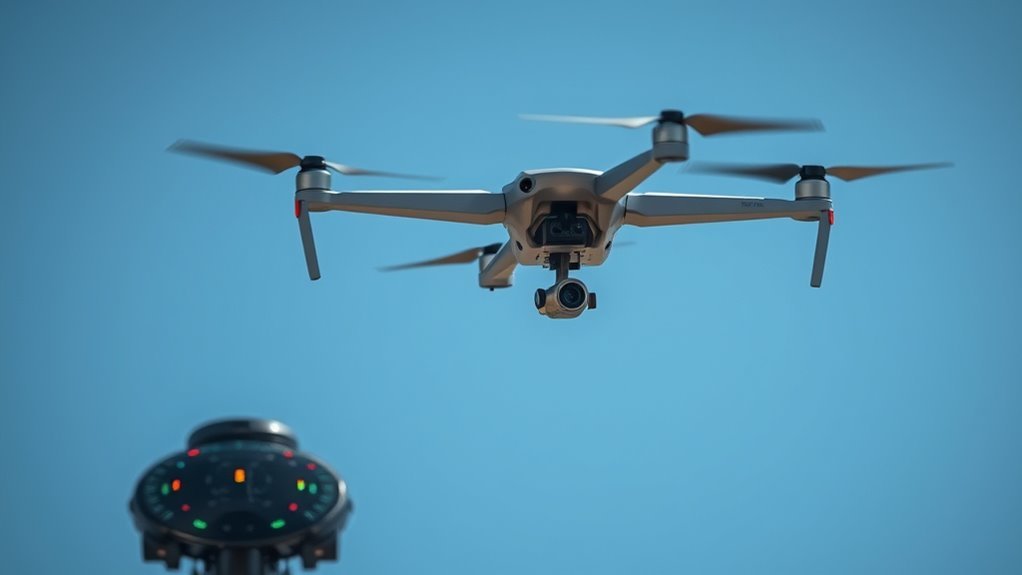
You’ll find drones detectable by radar mainly due to their radar cross section (RCS), influenced by size, shape, and materials. Metallic parts reflect strongly, increasing RCS, while composites can absorb or scatter radar waves to lower it. Larger or rounded shapes enhance radar visibility, while erratic flight patterns complicate tracking but don’t make you invisible. Advanced radar systems use sophisticated processing to detect even low-RCS drones. To understand how these factors interplay and affect detection, consider the following detailed insights.
Radar Cross Section and Its Impact on Detection
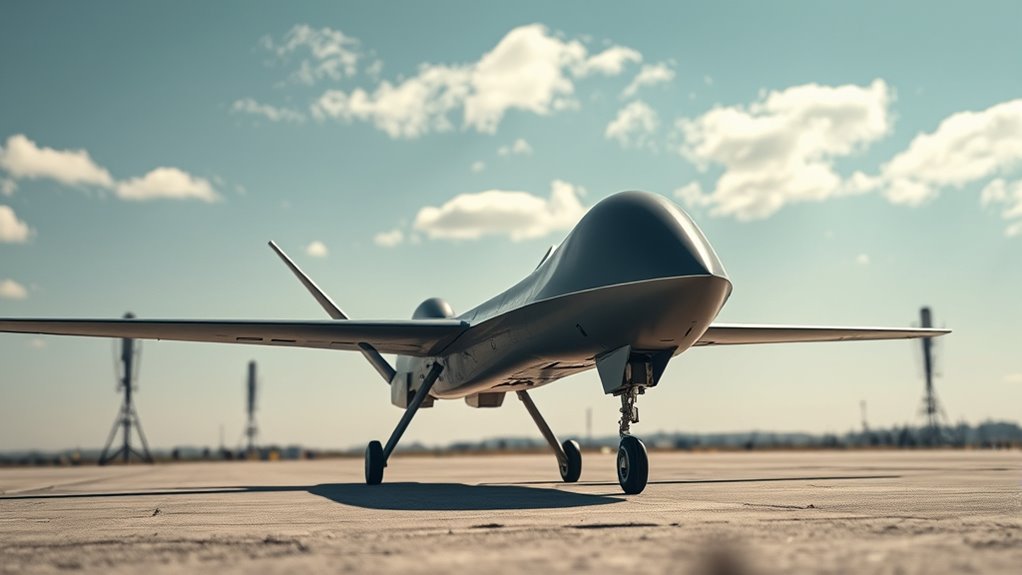
Although you might not notice it, the radar cross section (RCS) is an essential factor determining how easily a drone can be detected by radar systems. The RCS quantifies the strength of the radar signatures a drone reflects back to the radar receiver. A larger RCS means the drone is more visible, while a smaller RCS enhances evasiveness. Stealth technologies aim to minimize RCS by manipulating shape, surface geometry, and radar-absorbing coatings to reduce reflected signals. If you want freedom from detection, understanding how RCS influences radar detectability is vital. By reducing radar signatures, drones can operate with increased autonomy and reduced risk of interception. Mastering RCS management empowers you to design or choose drones that maximize operational freedom against sophisticated radar surveillance.
Material Composition and Radar Wave Reflection
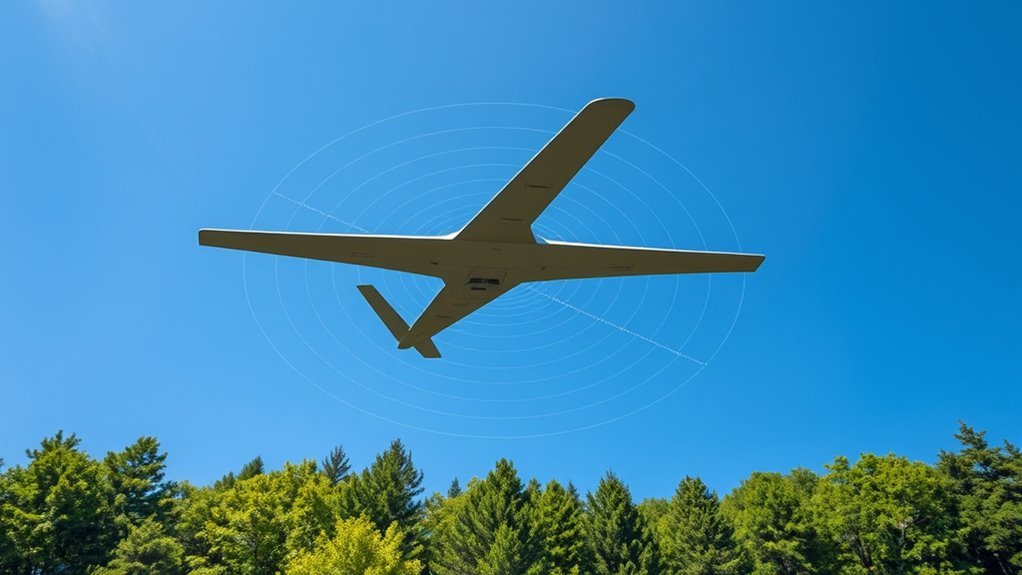
Understanding how radar cross section (RCS) affects detection naturally leads to examining the materials that influence radar wave behavior. When you consider metallic surfaces, their high electrical conductivity causes strong radar wave reflection, greatly increasing detectability. In contrast, composite materials, often used in drone construction, can absorb or scatter radar waves due to their dielectric properties, reducing reflected signals and lowering RCS. However, the specific layering, thickness, and dielectric constants of these composites critically determine their effectiveness in radar wave attenuation. As someone seeking operational freedom, recognizing how material choices alter radar visibility empowers you to optimize drone design for stealth or detectability. Consequently, material composition directly governs radar wave interaction, shaping the drone’s radar signature and influencing detection probability.
Influence of Drone Size and Shape on Radar Visibility
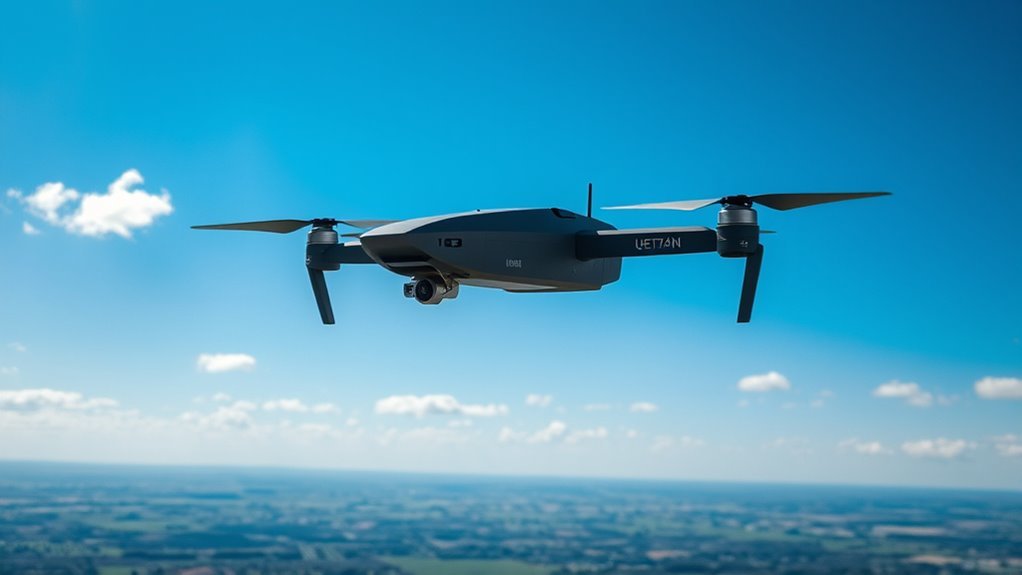
Since radar systems rely on reflected signals to identify objects, the size and shape of a drone play critical roles in its radar visibility. In drone design, shape optimization minimizes radar cross-section (RCS), directly influencing detectability. Smaller drones with angular, faceted shapes scatter radar waves more effectively, reducing visibility. Conversely, larger or rounded drones present greater surfaces, increasing radar reflections. Understanding these parameters lets you tailor drone profiles for stealth or exposure, depending on mission needs.
| Drone Size | Shape Type | Radar Visibility |
|---|---|---|
| Small | Angular | Low |
| Medium | Rounded | Medium |
| Large | Flat Surfaces | High |
Optimizing these factors empowers you to control radar detection with precision, enhancing operational freedom.
Flight Patterns and Their Effect on Radar Tracking
Three common flight patterns—straight-line, circular, and erratic—significantly influence how radar systems track drones. When you operate in a straight-line pattern, radar tracking tends to be more consistent, as predictable flight maneuvers create stable Doppler shifts and radar returns. Circular flight patterns introduce continuous changes in azimuth, challenging radar systems to maintain lock, though altitude variation can either aid or hinder detection depending on the radar’s vertical resolution. Erratic flight maneuvers, characterized by rapid directional and altitude changes, complicate radar tracking further by generating unpredictable signal patterns and reducing the radar’s ability to maintain continuous tracking. By understanding these dynamics, you can optimize flight behavior to either increase detectability for safety or minimize radar signature when seeking operational freedom. Altitude variation plays an essential role in radar cross-section fluctuation during these maneuvers.
Advanced Radar Technologies for Enhanced Drone Detection
Modern radar systems employ multiple advanced technologies to enhance drone detection capabilities beyond traditional methods. You’ll find that cutting-edge signal processing techniques and adaptive detection algorithms play pivotal roles in distinguishing drones from clutter and other airborne objects. These technologies improve sensitivity and reduce false alarms, giving you a clearer operational picture.
| Technology | Function | Benefit |
|---|---|---|
| Adaptive Filtering | Removes background noise | Improves signal clarity |
| Doppler Processing | Detects velocity changes | Differentiates drones by speed |
| Machine Learning | Enhances detection algorithms | Adapts to new drone signatures |
| MIMO Radar | Uses multiple antennas | Increases spatial resolution |
| Pulse Compression | Improves range resolution | Detects smaller targets |
With these advancements, you gain superior situational awareness and greater control over airspace freedom.
