
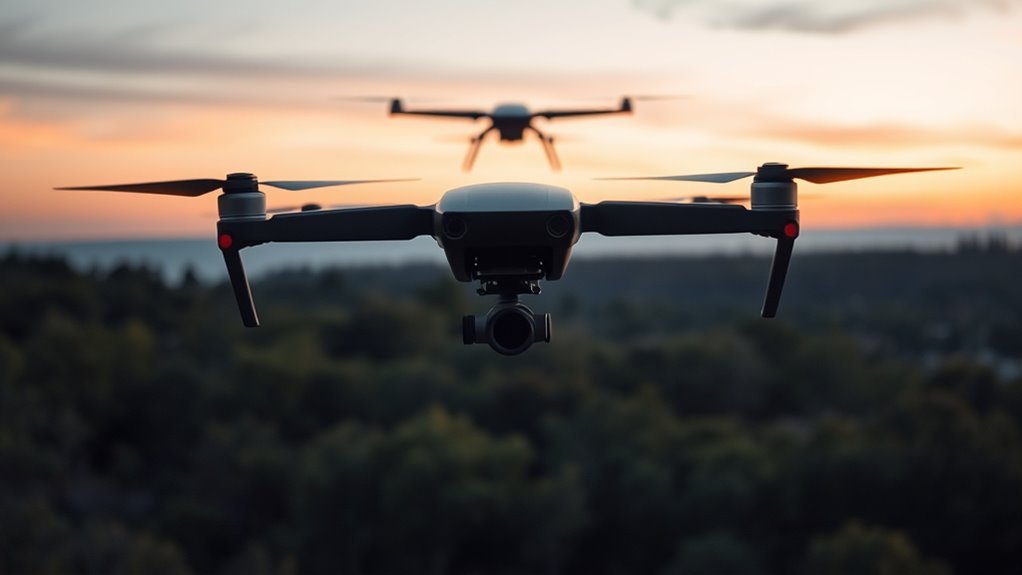
You’ll find several types of silent drones today, including fixed-wing models designed for long flights with reduced noise, multi-rotor drones optimized for maneuverability and stability, hybrids that blend endurance and agility using dual propulsion systems, and nano or micro drones built for stealthy indoor or tactical operations. All employ advanced electric propulsion and stealth materials to minimize acoustic and radar signatures. Understanding their unique features helps you appreciate their varied applications and benefits in quiet drone technology.
Fixed-Wing Silent Drones
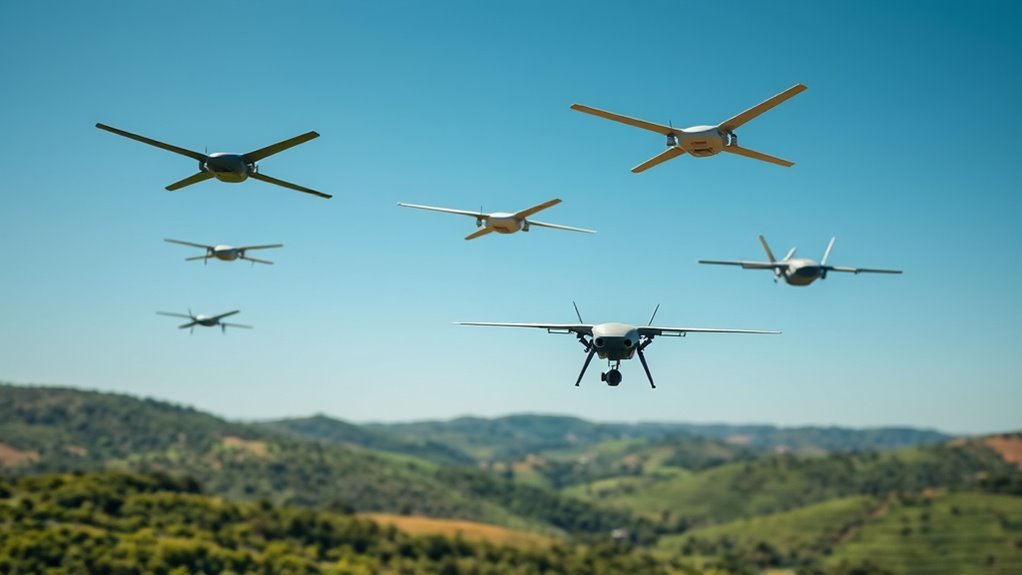
Although fixed-wing silent drones have been around for some time, their design principles continue to evolve to maximize stealth and endurance. You’ll notice these drones utilize aerodynamic shapes and advanced composite materials to reduce radar and acoustic signatures, enabling discreet operation. Design innovations, such as optimized wing profiles and quieter propulsion systems, extend flight duration and minimize noise emissions. These enhancements allow you to access diverse applications—from long-range surveillance to environmental monitoring—without compromising your freedom to operate undetected. By focusing on efficient power management and low-observable technologies, fixed-wing silent drones provide a balance between endurance and stealth, essential for sensitive missions. As you explore these platforms, understanding their technical evolution will help you appreciate how they empower you to maintain operational freedom while achieving precise, reliable results.
Multi-Rotor Silent Drones
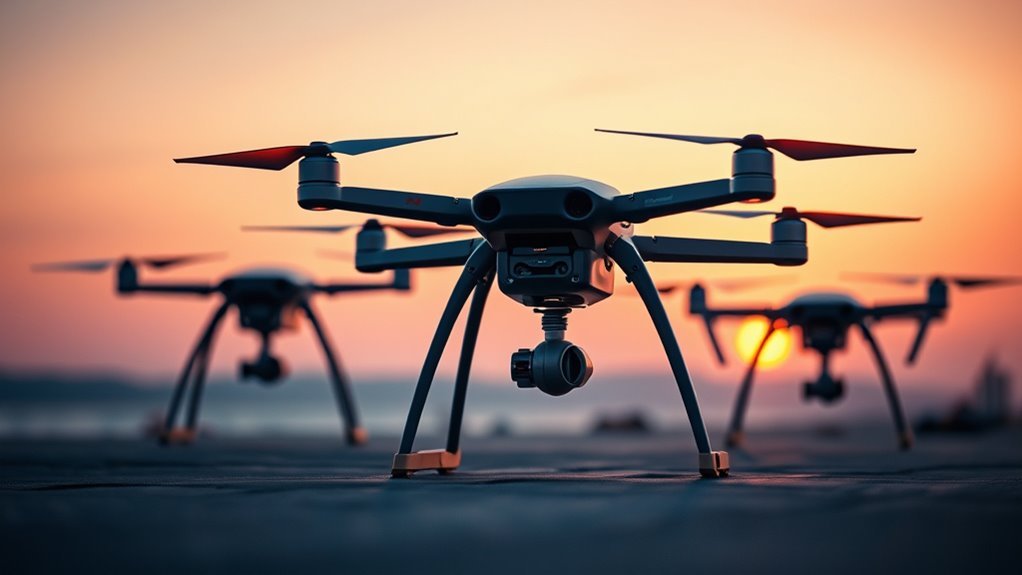
When you consider multi-rotor silent drones, their design prioritizes maneuverability and stability while minimizing acoustic signatures through advanced rotor blade geometry and low-noise motor technology. These drones excel in multi rotor applications requiring precise hovering and agile directional changes, all while complying with silent drone regulations to guarantee legal operation in noise-sensitive environments. You’ll notice their compact frame and optimized power distribution further reduce noise without sacrificing performance. Key features include:Multi-rotor silent drones combine agility and stability with advanced noise-reducing technology for quiet, precise operation.
- Enhanced rotor blade shapes that disrupt airflow noise
- Brushless motors engineered for minimal sound emission
- Flight controllers calibrated for smooth, quiet maneuvers
Hybrid Silent Drones
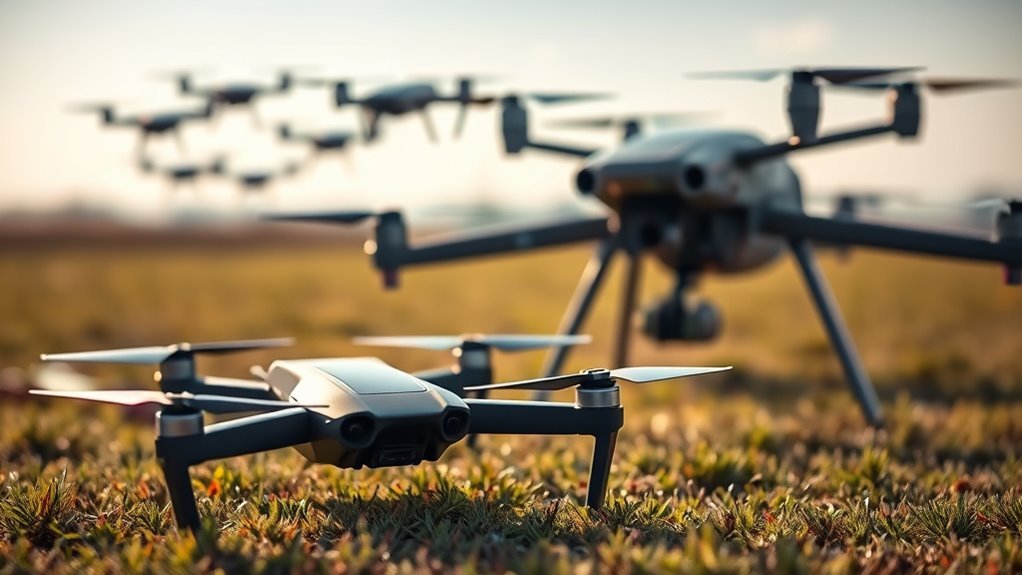
You’ll find hybrid silent drones combine the endurance of fixed-wing designs with the maneuverability of multi-rotors, optimizing both flight time and stealth. These drones often outperform traditional models in energy efficiency and noise reduction due to their dual propulsion systems. Popular hybrid models incorporate advanced materials and aerodynamic structures to minimize acoustic signatures while maximizing operational range.
Definition and Features
Because hybrid silent drones combine multiple propulsion systems, they offer a unique balance between endurance and noise reduction. You’ll find these drones integrate electric motors with combustion engines or fuel cells, enabling extended flight times without compromising stealth. Their design leverages silent drone technology to minimize acoustic signatures, essential in covert silent drone applications.
Key features include:
- Dual propulsion systems for optimized performance and reduced noise
- Advanced noise-dampening materials and aerodynamic structures
- Intelligent power management for seamless switching between propulsion modes
Advantages Over Traditional Drones
Hybrid silent drones, with their dual propulsion systems and noise-reducing designs, offer significant advantages over traditional drones that rely solely on combustion or electric motors. You’ll appreciate the silent drone benefits such as enhanced stealth and extended flight time due to optimized energy use. Noise reduction isn’t just about comfort; it improves operational security and minimizes wildlife disturbance. These drones give you a tactical edge by blending power with discretion, allowing more flexible missions without drawing attention.
| Feature | Hybrid Silent Drones | Traditional Drones |
|---|---|---|
| Noise Level | Minimal, thanks to noise reduction | Higher, combustion/electric noise |
| Flight Efficiency | Optimized dual propulsion | Single propulsion system |
| Operational Range | Extended due to energy efficiency | Limited by battery/fuel |
| Stealth Capability | High, silent operation | Low, noisy motors |
Common Hybrid Drone Models
While silent drone technology continues to evolve, several hybrid models have emerged as industry leaders due to their advanced noise reduction and propulsion integration. Hybrid drone technology combines electric and combustion power sources, optimizing flight duration and minimizing acoustic signatures. If you value operational freedom without compromising stealth, these models excel in diverse hybrid drone applications, from surveillance to environmental monitoring.
Key hybrid drone models include:
- DJI Mavic 3 Hybrid: Integrates electric motors with fuel-efficient engines, extending flight time while reducing noise.
- Parrot Anafi Hybrid: Utilizes hybrid propulsion to balance endurance and low acoustic impact.
- Quantum Systems Trinity F90+: Employs a hybrid system designed for long-range missions with silent takeoff and landing.
These models exemplify how hybrid drone technology grants you enhanced performance and discretion in the field.
Nano and Micro Silent Drones
Nano and micro silent drones represent the smallest class of unmanned aerial vehicles, designed for operations where stealth and minimal acoustic signature are critical. You’ll find their compact size ideal for confined environments, while nano drone applications often include covert surveillance and environmental monitoring. Micro drone advantages lie in enhanced maneuverability and reduced detection risk.
| Feature | Nano Drones | Micro Drones |
|---|---|---|
| Size | < 10 cm | 10–30 cm |
| Primary Use | Indoor reconnaissance | Tactical outdoor operations |
| Noise Level | Extremely low | Very low |
| Flight Duration | Limited (5-10 minutes) | Moderate (10-25 minutes) |
Choosing these drones grants you freedom in stealthy, precise missions where noise discipline is paramount.
Electric Propulsion Systems for Noise Reduction
You’ll find that quiet motor technologies are essential for reducing acoustic signatures in electric propulsion systems. Battery efficiency directly influences motor performance and operational duration, impacting noise levels. Additionally, optimizing propeller design plays a key role in minimizing aerodynamic noise generated during flight.
Quiet Motor Technologies
Although drone noise often stems from multiple sources, the electric propulsion system plays a pivotal role in overall sound levels. You’ll find that quiet motor technologies leverage electric motor advancements to minimize acoustic signatures, enabling near-silent flight. These innovations are essential if you want true freedom in drone operation without noise pollution.
Key features include:
- Brushless DC motors with optimized winding to reduce electromagnetic noise
- Direct drive systems that eliminate gear noise and mechanical vibrations
- Advanced magnet materials improving torque efficiency while lowering operational noise
Battery Efficiency Impact
Since battery efficiency directly influences the power delivery to electric motors, it plays an essential role in reducing drone noise. Efficient batteries guarantee stable voltage and current, preventing motor strain and erratic noise spikes. Advances in energy storage advancements and battery life optimization enable quieter, longer flights, granting you more operational freedom without compromising stealth.
| Battery Technology | Energy Density (Wh/kg) | Impact on Noise Levels |
|---|---|---|
| Lithium-ion (Li-ion) | 150-250 | Moderate noise reduction |
| Solid-state | 300-400 | Significant noise drop |
| Lithium-polymer | 200-260 | Balanced noise control |
| Graphene-enhanced | 250-350 | Enhanced quiet operation |
| Sodium-ion | 100-150 | Limited noise improvement |
Optimizing battery efficiency directly reduces motor workload, minimizing acoustic signatures.
Propeller Noise Minimization
When you focus on electric propulsion systems, minimizing propeller noise becomes a critical factor in enhancing drone stealth. Achieving near-silent operation hinges on optimizing propeller design and integrating advanced sound insulation techniques. You’ll want to contemplate:
- Blade geometry refinement: Altering pitch and curvature reduces vortex formation, cutting aerodynamic noise.
- Material selection: Using composites dampens vibrations that contribute to sound emission.
- Sound insulation integration: Strategic placement of acoustic dampers around the motor housing absorbs residual noise.
Biomimetic Silent Drones
Biomimetic silent drones replicate the flight mechanisms of birds and insects to achieve minimal noise output. By employing biomimetic designs, these drones harness animal inspired mechanisms like flapping wings and flexible joints, greatly reducing acoustic signatures. You’ll notice they mimic natural aerodynamics, allowing for quieter operation and enhanced maneuverability. This approach grants you freedom to operate discreetly in sensitive environments.
| Feature | Mechanism Type | Noise Reduction Level |
|---|---|---|
| Flapping Wing | Bird-inspired | High |
| Flexible Wing Joints | Insect-inspired | Moderate |
| Wingtip Vortices | Bird-inspired | Low |
Understanding these mechanisms helps you select drones optimized for stealth without sacrificing performance or control.
VTOL Silent Drones
Although VTOL silent drones rely on vertical takeoff and landing capabilities, they incorporate specialized noise-reduction technologies to minimize acoustic signatures during operation. You’ll appreciate how recent vtol drone advancements enhance maneuverability while maintaining low noise levels, vital for covert or recreational use demanding freedom of movement. These drones leverage aerodynamic designs and advanced motor controls to reduce sound without sacrificing performance. Key vtol drone applications include:
- Precision surveillance in urban or rugged terrains where stealth is vital
- Environmental monitoring requiring minimal disturbance to wildlife
- Delivery systems that need quiet operation to avoid public disruption
Stealth Technology in Silent Drones
When you examine stealth technology in silent drones, you’ll find that specialized materials play a critical role in minimizing detectability. Noise reduction techniques are engineered not only to suppress sound but also to reduce mechanical vibrations that could reveal a drone’s presence. Additionally, advanced radar evasion capabilities integrate shape design and electromagnetic-absorbing coatings to lower radar cross-section effectively.
Materials Used in Stealth
Since reducing detectability is essential for silent drones, the choice of materials plays a pivotal role in their stealth capabilities. You’ll find that material properties directly influence radar absorption, thermal signature, and structural weight, all critical for maintaining freedom in covert operations. Stealth coatings further enhance these properties by minimizing radar reflection and infrared emissions. When selecting materials, consider:
- Radar-absorbent composites: Reduce electromagnetic signature effectively.
- Lightweight alloys: Maintain maneuverability without compromising durability.
- Advanced stealth coatings: Provide surface treatments that absorb or scatter detection signals.
Understanding these factors allows you to optimize drone design for minimal detectability, ensuring operational freedom without sacrificing performance. The synergy between material properties and stealth coatings is what grants silent drones their elusive edge.
Noise Reduction Techniques
Because noise is a primary factor in drone detectability, mastering noise reduction techniques is vital for silent drone design. You need to focus on minimizing acoustic signatures through advanced methods like active noise cancellation, which generates anti-phase sound waves to neutralize propeller noise in real time. This precise sound wave manipulation reduces the drone’s audible footprint without compromising performance. Additionally, optimizing blade geometry and motor speed can lower mechanical noise. Incorporating vibration dampening materials further mitigates structural sound transmission. By applying these technologies, you guarantee your drone remains discreet, granting you operational freedom in sensitive environments. Integrating these noise reduction strategies requires a balanced approach, combining hardware design and software algorithms, to achieve stealth without sacrificing control or endurance. Ultimately, mastering these techniques is essential for effective silent drone deployment.
Radar Evasion Capabilities
Although silent drones prioritize acoustic stealth, their radar signature remains a critical vulnerability that you must address through advanced evasion capabilities. Effective radar evasion strategies rely on minimizing the drone’s radar cross-section (RCS) and disrupting enemy detection systems. Stealth technology advancements have introduced innovative materials and design techniques that absorb or deflect radar waves, enhancing your drone’s invisibility.
Key radar evasion strategies include:
- Shaping and materials: Employing angular, radar-absorbent composites to reduce reflectivity.
- Active cancellation: Using electronic countermeasures to interfere with radar signals.
- Flight path optimization: Maneuvering low-altitude or terrain-masked routes to avoid radar exposure.
Applications of Silent Drones in Wildlife Monitoring
How can silent drones revolutionize wildlife monitoring? By minimizing acoustic disturbance, these drones allow you to observe wildlife behavior with unprecedented accuracy. Their near-silent operation reduces stress responses in animals, enabling more authentic data collection. You gain the freedom to study delicate ecosystems without altering natural patterns, which is vital for evaluating ecological impact. Silent drones equipped with high-resolution sensors capture real-time movements and interactions, helping you analyze species dynamics and habitat usage efficiently. This technology empowers you to monitor endangered species discreetly, enhancing conservation efforts. Overall, silent drones grant you the ability to conduct non-invasive, precise ecological evaluations, preserving the integrity of natural environments while expanding your research capabilities. This balance between technological advancement and environmental sensitivity is key to modern wildlife monitoring.
Use of Silent Drones in Security and Surveillance
Silent drones’ ability to operate with minimal noise isn’t just transforming wildlife monitoring—it’s also reshaping security and surveillance practices. When you integrate silent drones into security applications, you gain discreet, real-time observation capabilities that conventional systems often lack. These drones leverage advanced surveillance technologies to enhance situational awareness without alerting subjects, preserving operational freedom and effectiveness.
Key advantages include:
- Stealth monitoring in sensitive or high-risk environments
- Enhanced perimeter security with reduced detection risk
- Efficient crowd and traffic surveillance minimizing noise pollution
