
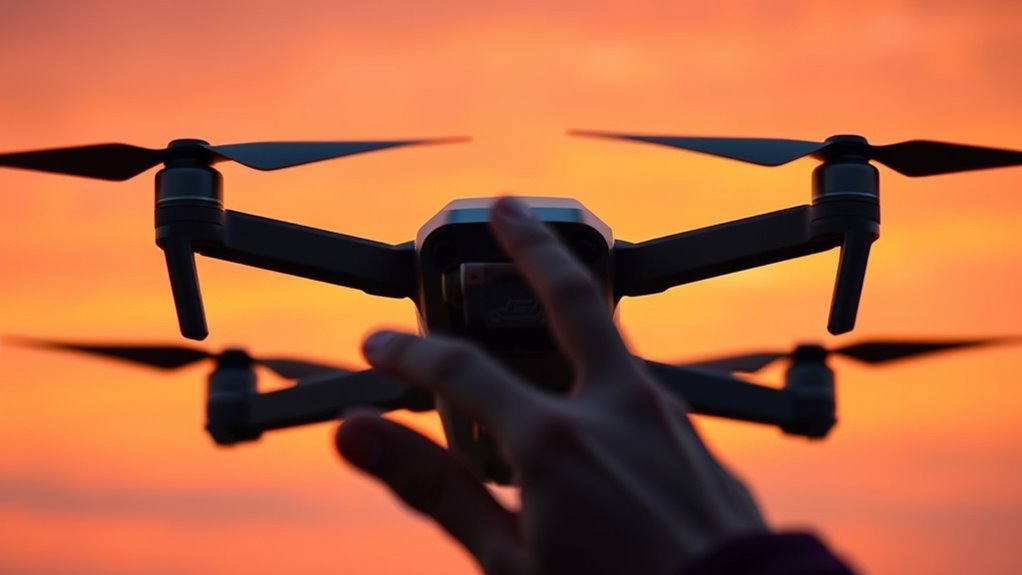
Headless mode for drones simplifies control by aligning the drone’s movements with your perspective. It allows you to navigate without constantly tracking the drone’s orientation, making intuitive flying easier, especially for beginners. When you push the control stick forward, the drone moves away from you regardless of its heading. This reduces disorientation and enhances confidence in flying. To explore further, you might discover more advantages and applications that headless mode offers.
Understanding Headless Mode: A Basic Overview
When flying a drone, understanding headless mode can greatly enhance your control and navigation experience. This mode simplifies piloting techniques by aligning the drone’s forward direction with your remote control’s orientation. Fundamentally, it removes the complexity of tracking the drone’s front, allowing you to focus on your flight path instead. One of the notable headless mode benefits is that it’s particularly useful for beginners who may struggle with orientation. By enabling intuitive maneuvering, you can make quicker decisions and execute more dynamic movements without fear of disorientation. This freedom to pilot confidently opens up new creative possibilities, letting you explore the skies with less stress. Ultimately, mastering headless mode can elevate your drone flying experience greatly.
How Headless Mode Works
In headless mode, your drone’s directional control becomes independent of its orientation, allowing for simplified navigation. This means that regardless of which way the drone is facing, the forward, backward, left, and right commands remain consistent with your perspective. Understanding this mechanism can greatly enhance your control experience and minimize confusion during flight.
Directional Control Simplified
Although steering a drone can be challenging, particularly for beginners, headless mode simplifies directional control by aligning the drone’s movements with your perspective. In this mode, the drone’s front is irrelevant; instead, it responds to your commands based solely on your orientation. When you push the control stick forward, the drone moves away from you, regardless of its physical heading. This enhances directional stability, allowing you to focus on flying rather than constantly recalibrating your understanding of the drone’s position. Control responsiveness is optimized, giving you the freedom to maneuver confidently. As a result, headless mode empowers you to explore aerial landscapes without the steep learning curve typically associated with traditional drone operation.
Orientation Independence Explained
Headless mode operates on the principle of orientation independence, allowing you to control the drone without needing to take into account its physical heading. This functionality relies on advanced orientation mechanics, which calibrate the drone’s front direction to your remote control’s perspective. When you push forward, the drone flies away from you, regardless of its actual orientation. This is vital for maintaining flight stability, especially in complex environments where traditional navigation may falter. By eliminating the need to reorient based on the drone’s heading, you gain a sense of freedom, allowing you to focus on the flight experience rather than the mechanics. Ultimately, headless mode enhances your ability to maneuver with precision and ease, making drone operation more intuitive.
Advantages of Using Headless Mode
Many drone operators find that using headless mode greatly enhances their flying experience. This mode simplifies control by aligning the drone’s movements with the operator’s perspective, reducing disorientation. For beginners, it serves as an effective tool for user training, allowing you to focus on mastering flight without worrying about orientation. Furthermore, it incorporates essential safety features, like preventing crashes caused by sudden directional confusion. By enabling intuitive control, headless mode empowers you to explore with confidence, enhancing your sense of freedom in the skies. As you develop your skills, you’ll find that this mode can bridge the gap between novice and advanced flying, making it a valuable asset in your drone toolkit.
Comparing Headless Mode to Traditional Controls
While traditional controls require a solid understanding of the drone’s orientation and direction, headless mode streamlines this process by decoupling the drone’s front from the pilot’s perspective. With headless advantages, you can maneuver your drone without worrying about its actual heading. This means that regardless of the drone’s orientation, pulling the stick back always brings it toward you, making control intuitive. In a control comparison, traditional methods often lead to confusion, especially for beginners, as they need to constantly adjust their inputs based on the drone’s position. In contrast, headless mode simplifies the flying experience, allowing for greater freedom and focus on capturing stunning aerial footage or steering through complex environments without the added cognitive load of orientation management.
Common Misconceptions About Headless Mode
Although headless mode offers an intuitive flying experience, several misconceptions persist about its functionality and limitations. Many users misunderstand its functionality, believing it eliminates the need for spatial awareness. In reality, while headless mode simplifies control by aligning the drone’s orientation with the remote, it doesn’t negate the importance of understanding your surroundings. This can lead to compromised user performance, especially in complex environments. Additionally, some think headless mode is suited for all flying conditions; however, it may hinder maneuverability in tight spaces. The drone’s advanced camera capabilities can help capture precise visuals even in challenging environments, enhancing your flying experience. Ultimately, recognizing these misconceptions can empower you to utilize headless mode effectively, enhancing your flying experience while maintaining the necessary awareness for safe operation. Furthermore, understanding signal penetration challenges can help improve your ability to navigate difficult environments while flying. Embrace the freedom that accurate knowledge affords in drone flying.
Future Developments in Drone Technology and Headless Mode
As drone technology evolves, you can expect significant enhancements in user experience, particularly with headless mode. Advanced navigation systems are being integrated to provide real-time data and improved control, making it easier for you to operate drones in complex environments. These developments aim to streamline operations while increasing safety and efficiency in aerial tasks. Furthermore, the integration of AI-enhanced obstacle avoidance will allow drones to navigate safely, reducing the risk of collisions during flight. Additionally, the incorporation of proactive vulnerability identification measures will ensure that drone systems remain secure against emerging threats.
Enhanced User Experience
With advancements in drone technology, the integration of headless mode is set to greatly enhance user experience. This mode simplifies control by aligning the drone’s orientation with the pilot’s perspective, eliminating confusion and promoting intuitive handling. When utilizing user-friendly interfaces, you’ll find it easier to engage with your drone, resulting in increased confidence during flight. As headless mode minimizes the learning curve, even novice pilots can focus on the creative aspects of flying, fostering deeper user engagement. Future developments may include customizable settings that allow you to tailor the experience further, ensuring that each flight is not only enjoyable but also liberating. Embracing these features means you’ll have more freedom to explore the skies without technical constraints.
Advanced Navigation Systems
While advancing technology continually reshapes the landscape of drone capabilities, the integration of advanced navigation systems stands out as a pivotal enhancement, particularly when combined with headless mode. These systems leverage sophisticated navigation algorithms and precise positioning systems, enabling you to operate drones with unmatched accuracy and ease. With headless mode, you can pilot without needing to orient yourself based on the drone’s front, which is especially beneficial in complex environments. The fusion of these technologies allows for real-time adjustments to flight paths, enhancing maneuverability and safety. As developers innovate, you can expect future drones to feature even more refined navigation capabilities, granting you greater freedom and control in various applications, from aerial photography to search and rescue missions.
Frequently Asked Questions
Can Headless Mode Improve Drone Flight Stability in Windy Conditions?
Headless mode can enhance your drone’s flight control in windy conditions by simplifying navigation. It reduces the impact of wind resistance, allowing you to focus on direction without worrying about the drone’s orientation.
Is Headless Mode Suitable for Advanced Drone Racing?
In drone racing, where precision’s your compass, headless mode might not be ideal. Advanced pilots rely on racing techniques honed through experience, needing full control rather than the simplicity headless mode offers, which can hinder performance.
How Does Headless Mode Affect Battery Life During Flight?
Headless mode can impact battery efficiency by potentially reducing flight duration. Since it simplifies navigation, you might engage in longer flights; however, increased control demands could lead to quicker energy consumption, affecting overall battery performance.
Are There Specific Drone Models Best for Headless Mode?
When it comes to drone features, “you get what you pay for.” Models like DJI Mini and Holy Stone offer reliable headless mode among diverse flight modes, ensuring you experience freedom and control during your flights.
Can I Use Headless Mode for Aerial Photography and Videography?
You can use headless mode for aerial photography and videography, but its limitations might affect your aerial composition and camera angles. Mastering orientation control is essential for achieving the results you desire in your shots.
