
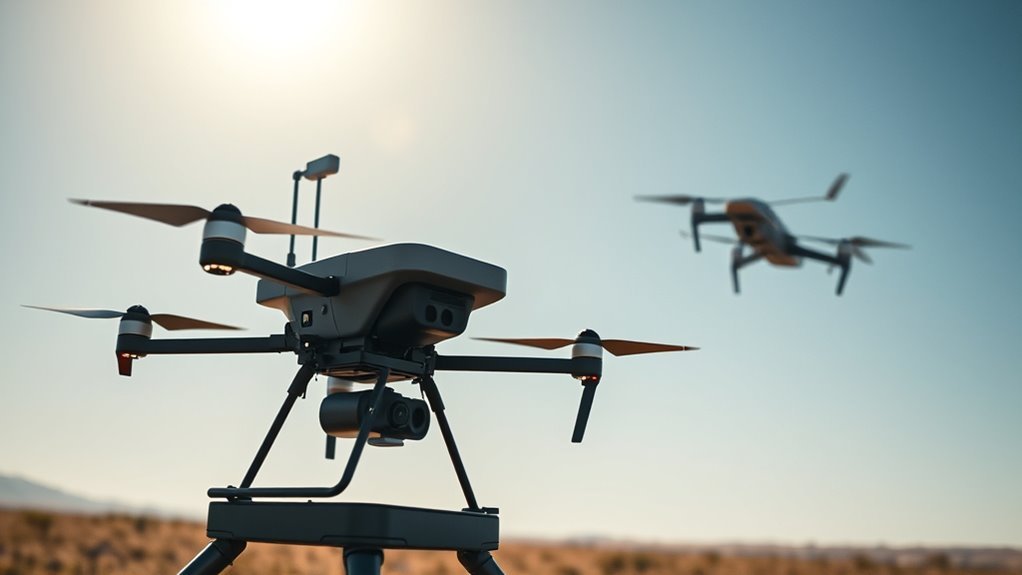
You’re comparing the AeroVironment Quantix’s 1km radio range, which restricts reconnaissance to nearby areas and limits beyond-line-of-sight capabilities, against the Wingtra One Gen II’s 10km LTE connectivity for extended, remote missions. Quantix offers hybrid VTOL agility with a 60 mph top speed and 500g payload, while Wingtra provides 59 minutes of flight time and high-precision sensors for detailed analysis. This connectivity gap influences mission effectiveness, revealing key trade-offs in your operational choices and beyond.
Key Features of AeroVironment Quantix
The AeroVironment Quantix features a hybrid VTOL design that enables vertical takeoff and landing, making it ideal for remote operations without runways. You’ll find its payload capacity offers you the flexibility to carry up to 500 grams of equipment, empowering independent missions where weight constraints could otherwise limit your freedom. This capability allows seamless integration of sensors, optimizing performance in diverse environments without needing ground support.
Analytically, the Quantix’s camera options provide you with adaptable choices, including high-resolution RGB or multispectral units, which enhance data accuracy for aerial surveys. You can select configurations based on your operational needs, ensuring precise imaging that supports autonomous exploration. By balancing these features, the drone delivers reliable, objective performance, giving you the autonomy to operate effectively in unrestricted settings, all while maintaining efficiency and reducing dependency on traditional infrastructure. This setup underscores its value for users seeking unhindered reconnaissance capabilities. Furthermore, the integration of advanced GPS systems ensures precise positioning and stability during operations, significantly enhancing mission success rates.
Key Features of Wingtra One Gen II
As you evaluate the Wingtra One Gen II, you’ll encounter its VTOL capabilities, which enable seamless vertical takeoff and landing for diverse operational environments. The drone’s advanced imaging systems deliver high-resolution data, allowing precise analysis of captured imagery. Its flight duration extends mission times, providing you with enhanced endurance for thorough surveys. Additionally, the Wingtra One Gen II achieves millimeter-level precision with high-resolution sensors and RTK GPS, ensuring accurate mapping results.
VTOL Capabilities
Wingtra One Gen II excels in VTOL operations through its innovative hybrid design, blending quadcopter-style rotors for vertical lift with fixed-wing efficiency for forward flight. You’ll appreciate its vtol efficiency, which optimizes energy use during vertical takeoff, allowing seamless launches from tight spaces without needing runways. This capability enhances your operational freedom, letting you deploy the drone in remote or challenging environments where traditional aircraft falter. Analytically, the system’s precise rotor control minimizes power consumption, extending flight times while maintaining stability—key for reconnaissance missions. By integrating advanced sensors with this hybrid setup, you gain reliable, autonomous changes that prioritize safety and precision, empowering you to explore with minimal setup and maximum mobility. Overall, its vertical takeoff prowess guarantees you’re not limited by terrain, fostering independent aerial strategies.
Advanced Imaging
Beyond VTOL prowess, advanced imaging on this drone equips you with a suite of high-resolution sensors, including multispectral and thermal cameras, that deliver precise data for applications like precision agriculture and surveying. You’ll benefit from advanced imaging techniques that process multispectral data for accurate environmental insights, while imaging sensor capabilities guarantee high-fidelity thermal detection, empowering your autonomous operations with reliable, actionable intelligence.
- Advanced Imaging Techniques: Employ sophisticated algorithms for spectral analysis, enabling you to differentiate crop health variations with precision and minimal interference.
- Imaging Sensor Capabilities: Feature high-resolution multispectral and thermal sensors that capture detailed data in diverse lighting, providing you the freedom to analyze terrain autonomously.
- Data Integration Benefits: Seamlessly blend sensor outputs for thorough mapping, allowing you to make objective decisions without external dependencies.
Flight Duration
With its extended flight duration, you’ll cover vast areas efficiently, as the Wingtra One Gen II supports up to 59 minutes of operation on a single charge, allowing precise, uninterrupted data gathering in demanding scenarios. This superior flight endurance empowers you to explore remote territories with minimal interruptions, optimizing your missions for maximum autonomy. By leveraging advanced battery efficiency, the drone minimizes energy waste, ensuring reliable performance even in challenging conditions. You’ll appreciate how this design enhances your freedom to conduct thorough surveys without the constraints of frequent battery swaps. Analytically, the Wingtra’s efficient power management extends operational reach, making it ideal for users seeking dependable, long-haul reconnaissance. This objective edge in flight endurance underscores its value for professionals prioritizing efficiency and exploration.
Range and Connectivity Comparison
When comparing the range and connectivity of the AeroVironment Quantix and Wingtra One Gen II, you’ll notice that the Quantix achieves up to 30 miles with its hybrid propulsion, whereas the Wingtra One Gen II tops out at 25 miles, relying on efficient electric motors. However, you’ll encounter range limitations in environments with obstacles, where the Quantix’s hybrid system might underperform due to fuel constraints, while the Wingtra’s electric setup demands precise battery management. Connectivity challenges also arise; the Quantix’s 1km radio link can suffer from interference in urban settings, contrasting with the Wingtra’s 10km LTE capability, which offers greater autonomy for remote operations.
- Range limitations: The Quantix’s 30-mile potential is curtailed by wind and terrain, making it less reliable in variable conditions compared to the Wingtra’s consistent 25 miles.
- Connectivity challenges: Quantix faces radio signal dropouts in forested areas, while Wingtra’s LTE reduces these risks, enhancing your freedom to operate beyond line-of-sight.
- Operational impact: These factors mean you’ll achieve more independent missions with Wingtra’s robust connectivity, though Quantix’s range gives you broader exploration options when conditions are ideal. Additionally, military applications may benefit from the long-range capabilities of the Quantix, making it suitable for extensive reconnaissance missions.
Flight Performance Analysis
Shifting focus to flight performance analysis, you’ll note that the AeroVironment Quantix excels in speed and acceleration due to its hybrid propulsion, achieving up to 60 mph, while the Wingtra One Gen II emphasizes stability and endurance for precise aerial tasks, with a top speed of 45 mph and enhanced wind resistance. You’ll appreciate how flight stability varies: the Quantix offers agile handling for dynamic flights, but the Wingtra One Gen II delivers superior wind resistance, ensuring steady operations in challenging environments. Regarding payload capacity, the Quantix supports up to 6.8 kg for versatile missions, empowering you to explore freely, whereas the Wingtra One Gen II handles 3.5 kg with optimized balance for precision work. The difference in flight stability features enhances the choice between agility and control based on mission requirements.
| Aspect | Comparison |
|---|---|
| Top Speed | Quantix: 60 mph; Wingtra: 45 mph |
| Flight Stability | Quantix: Good for speed; Wingtra: Enhanced resistance |
| Payload Capacity | Quantix: 6.8 kg; Wingtra: 3.5 kg |
| Acceleration | Quantix: High via hybrid; Wingtra: Moderate for stability |
Reconnaissance Mission Effectiveness
As you evaluate the reconnaissance mission effectiveness of the AeroVironment Quantix and Wingtra One Gen II, you’ll first consider how signal range impact limits or extends operational reach. Next, analyze data transmission quality to gauge its influence on real-time information accuracy. Finally, assess mission success factors that integrate these elements to enhance overall reliability.
Signal Range Impact
Signal range critically influences reconnaissance mission effectiveness, particularly for drones like the AeroVironment Quantix and Wingtra One Gen II, as it’s the key factor determining operational distance and data reliability. You’ll find that limited range can restrict your ability to conduct missions in remote areas, where signal interference from electronic sources or terrain obstacles like mountains and forests degrade performance. This directly affects how freely you operate, forcing strategic adjustments to maintain control.
- Signal Interference Effects: Urban environments introduce interference that shortens the Quantix’s 1km radio range, compelling you to adapt for reliable reconnaissance in contested spaces.
- Terrain Obstacles Challenges: For the Wingtra One Gen II’s 10km LTE, hilly or forested areas block signals, reducing your effective reach and necessitating line-of-sight planning to preserve mission autonomy.
- Operational Freedom Trade-offs: Both drones demand you account for range limitations, where interference and obstacles could compromise your reconnaissance scope, emphasizing the need for robust contingency measures.
Data Transmission Quality
Data transmission quality profoundly affects reconnaissance mission effectiveness, as it determines the clarity, latency, and reliability of real-time data from drones like the AeroVironment Quantix and Wingtra One Gen II. You’ll notice that the Quantix’s 1km radio link prioritizes data integrity in close-range scenarios, minimizing errors through robust error correction, though its transmission speed may lag under interference. In contrast, the Wingtra One Gen II’s 10km LTE connectivity delivers superior transmission speed, enabling you to stream high-resolution feeds with minimal latency for broader operations. This guarantees you’re equipped for autonomous decision-making, where data integrity safeguards against corruption and transmission speed supports timely insights. Ultimately, these factors empower your reconnaissance efforts, granting the freedom to operate drones independently in dynamic environments.
Mission Success Factors
Mission success in reconnaissance missions relies on factors like endurance, payload versatility, and autonomous navigation, which determine how effectively drones such as the AeroVironment Quantix and Wingtra One Gen II perform in dynamic environments. You’ll assess their effectiveness through mission planning, where the Quantix’s quick deployment suits rapid scenarios, boosting your operational freedom, while the Wingtra One Gen II’s precision mapping enhances long-range efficiency.
- Mission Planning Integration: The Quantix’s user-friendly interface streamlines your mission planning, allowing adaptive routes in contested areas for greater autonomy.
- Operational Efficiency Gains: Wingtra One Gen II optimizes battery use and flight paths, improving your reconnaissance yield per sortie and reducing downtime for independent operations.
- Comparative Payload Adaptability: Both drones’ versatile payloads support real-time data fusion, but Quantix’s lighter design offers you faster redeployment, elevating overall mission success in freedom-demanding contexts.
Practical Deployment Scenarios
When evaluating practical deployment scenarios for the AeroVironment Quantix and Wingtra One Gen II, you’ll note their differing strengths in real-world applications. The Quantix’s 1km radio range suits urban monitoring, where you’re dealing with obstacles and confined spaces that demand quick, autonomous maneuvers for enhanced situational awareness and freedom from wired constraints. Its compact design lets you operate independently in densely built environments, minimizing interference and maximizing efficiency.
In contrast, the Wingtra One Gen II’s 10km LTE capability excels in agricultural assessment, allowing you to cover vast fields with extended reach and real-time data transmission. You’ll appreciate how this drone frees you from line-of-sight limitations, enabling thorough mapping and precision farming without compromising on reliability. Ultimately, your choice hinges on whether you prioritize close-range agility or long-distance autonomy, ensuring ideal performance in diverse operational contexts. (148 words)
Frequently Asked Questions
How Much Does the Aerovironment Quantix Cost?
You’re wondering about the cost of the AeroVironment Quantix, so let’s explore Quantix pricing. It’s typically around $10,000 for the base model, varying by features and dealers. For a cost comparison, you’ll find it’s more affordable than premium rivals, giving you the freedom to choose based on your budget and operational needs. This analytical view helps you decide objectively, ensuring you’re equipped for independent reconnaissance without overpaying.
What Is the Maintenance Schedule for Wingtra One Gen II?
Imagine your Wingtra One Gen II soaring freely through vast skies, juxtaposed against the essential grounding of drone upkeep. To guarantee its peak performance, you’ll follow structured maintenance intervals: inspect every 50 flights or monthly, checking battery health, propellers, and sensors. This routine keeps it reliable, empowering you with uninterrupted aerial freedom while minimizing downtime through analytical, objective care.
Is Pilot Training Required for These Drones?
When you’re considering whether pilot training is required for these drones, it’s crucial to evaluate training requirements and pilot proficiency. Regulations often mandate certified programs to guarantee safe operation, allowing you to maintain freedom in the skies. Analytical data shows that such training enhances your control, reduces risks, and boosts efficiency, making it a key step for both recreational and professional pilots. You’ll find it’s not just about compliance—it’s about empowering your flights.
Do These Drones Comply With FAA Regulations?
You’re evaluating whether these drones comply with FAA regulations. FAA compliance means adhering to drone regulations, including registration, weight limits, and airspace rules. This guarantees you’re operating legally, granting freedom to fly safely without unnecessary restrictions. Analytically, both models are designed to meet these standards, but you’ll need to verify current guidelines for full compliance and maintain your aerial autonomy.
What Warranty Is Offered for the Wingtra One Gen II?
Imagine you’re exploring vast, unrestricted skies with your Wingtra One Gen II and a component fails mid-flight; that’s where Wingtra warranty provides essential protection. You’ll find Wingtra warranty coverage includes a one-year standard plan for parts and labor, covering defects in materials and workmanship. Analytically, this guarantees your drone’s reliability, offering you the freedom to innovate without undue risks, backed by objective support options.
