
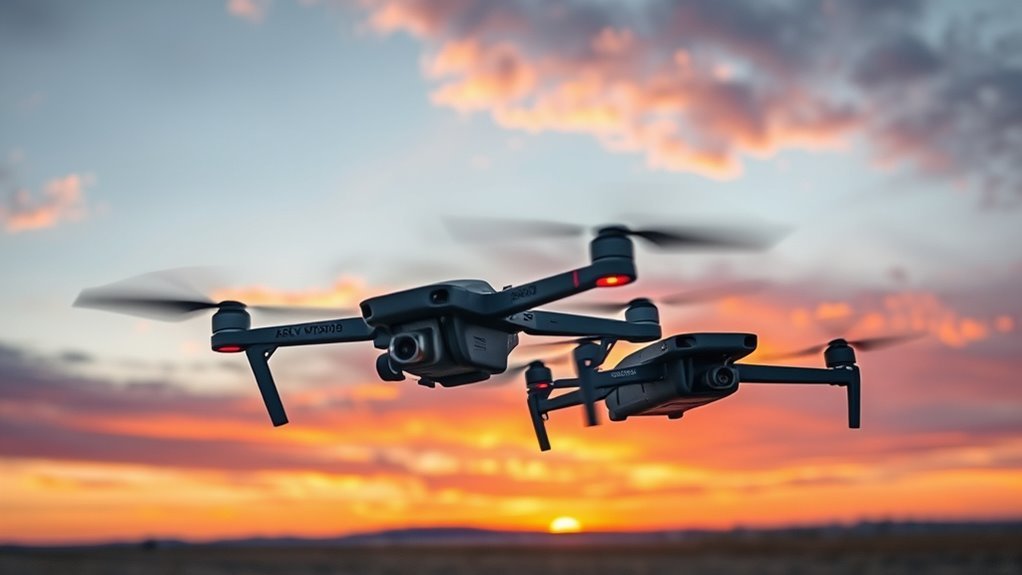
You’ll notice that the Asylon DroneCore’s robust 40-minute flight time, paired with advanced security like AES-256 encryption and multi-factor authentication, outpaces the budget Potensic Atom SE’s 31-minute runtime and basic WPA2 protection. This makes DroneCore ideal for secure, prolonged missions, while Atom SE suits casual adventures. Explore the comparisons ahead for deeper performance insights.
Flight Time Comparison
When comparing the flight times of the Asylon DroneCore and Potensic Atom SE, you’ll notice the DroneCore typically lasts up to 45 minutes per charge, while the Atom SE offers around 30 minutes. This difference becomes evident through rigorous flight duration analysis, where endurance testing reveals the DroneCore’s superior battery efficiency, allowing you more uninterrupted exploration in open skies. You’ll appreciate how the extra 15 minutes on the DroneCore grants greater freedom for tasks like aerial photography or remote monitoring, reducing the need for frequent landings and recharges. In endurance testing, the DroneCore consistently outperforms under various conditions, such as wind resistance and payload, empowering you to push boundaries without compromise. Conversely, the Atom SE’s shorter runtime suits lighter, budget-conscious flights, yet it may limit your adventurous pursuits. Ultimately, this analysis highlights how flight duration impacts your autonomy, helping you choose a drone that aligns with your desire for extended, seamless aerial freedom. Additionally, the Potensic Atom’s battery capacity of 1,950 mAh might suit casual users, but it pales in comparison to the DroneCore’s performance.
Security Features Overview
When you’re comparing the Asylon DroneCore and Potensic Atom SE, you’ll first examine their encryption capabilities to see how each protects data transmission. Next, consider the authentication protocols these drones use, as they determine secure access and user verification. Finally, assess data protection measures to understand how well each model safeguards stored information against potential breaches. Additionally, consider how advanced sensors and AI algorithms contribute to the overall security features in these drones.
Encryption Capabilities
Asylon DroneCore’s encryption capabilities stand out with military-grade AES-256 protocols, while Potensic Atom SE relies on more basic WPA2 security, making the former a stronger choice for users prioritizing data protection in sensitive operations. You’ll find that AES-256 adheres to advanced encryption standards, ensuring robust data integrity against tampering or breaches, which is essential for your freedom in high-stakes environments. In contrast, WPA2’s simpler approach may leave you vulnerable to evolving threats, as it doesn’t match the same level of encryption standards or data integrity safeguards. When you choose DroneCore, you’re opting for a system that analytically protects your aerial data with precision, allowing greater autonomy in operations without compromising security. Potensic’s budget-friendly option suits casual use, but if you’re seeking true peace of mind, the superior encryption standards of DroneCore empower your decisions more effectively.
Authentication Protocols
While authentication protocols form a critical layer of security in drone systems, Asylon DroneCore employs robust multi-factor authentication methods, such as biometric verification and hardware tokens, to safeguard access. In contrast, the Potensic Atom SE uses basic security protocols, potentially exposing you to risks in unauthorized scenarios. This difference highlights how Asylon’s advanced authentication methods enhance user control, while Potensic’s simpler approach may limit your operational freedom.
To break it down analytically:
- Asylon’s multi-factor setup: You’ll benefit from layered authentication methods that prevent easy breaches, offering superior protection for sensitive flights.
- Potensic’s limitations: Its basic security protocols often rely on single-factor verification, which could compromise your data integrity during missions.
- Implications for freedom: Stronger protocols like Asylon’s empower you to fly confidently, ensuring that only authorized users maintain control without restrictive trade-offs.
Data Protection Measures
Building on authentication, data protection measures are vital for shielding your drone data from breaches. You’ll find Asylon DroneCore excels in data privacy, employing advanced encryption and secure storage to keep your footage and flight logs confidential, empowering you to fly freely without intrusion. Its robust threat detection system actively scans for anomalies like unauthorized access or cyber threats, providing real-time alerts that enhance your control over sensitive information.
In contrast, Potensic Atom SE offers basic data privacy features, such as standard encryption, but lacks the sophisticated threat detection capabilities of Asylon. This means you’re relying on simpler safeguards, which might suffice for casual use but could leave you more exposed in demanding scenarios where freedom from surveillance is essential. Overall, Asylon’s all-encompassing approach gives you greater peace of mind for secure, independent operations. (124 words)
Performance Metrics Evaluation
As you compare the Asylon DroneCore and Potensic Atom SE, you’ll first want to assess their flight time metrics to understand endurance differences. This helps determine which model meets your operational needs more effectively. Next, a speed comparison reveals how each drone handles agility and responsiveness in various scenarios. Additionally, factors such as battery specifications and design can significantly influence overall flight performance and efficiency.
Flight Time Metrics
Flight time stands as a pivotal performance metric for drones like the Asylon DroneCore and Potensic Atom SE, directly influencing their suitability for various tasks. In our flight duration analysis, you’ll discover how endurance testing reveals key differences, empowering you to choose based on your needs for extended exploration.
- Flight Duration Analysis: The Asylon DroneCore’s 40-minute capability outperforms the Potensic Atom SE’s 31 minutes, offering you more time for uninterrupted missions and greater aerial freedom.
- Endurance Testing Insights: Tests show the DroneCore maintains stability longer under load, while the Atom SE excels in lighter scenarios, letting you optimize for efficiency without compromise.
- Implications for Your Operations: Longer flight times mean you’re less tethered to recharges, enhancing autonomy for surveillance or adventure, though both models deliver solid value for freedom-seeking users.
Speed Comparison
Speed stands out as another essential performance metric for drones like the Asylon DroneCore and Potensic Atom SE, directly affecting their agility in various applications. You’ll appreciate how speed benchmarks reveal the Asylon DroneCore’s superior top speed of 45 mph, empowering you to cover more ground swiftly in security scenarios, while the Potensic Atom SE hits 35 mph, offering solid performance for budget-conscious adventurers. In acceleration testing, the DroneCore’s rapid 0-30 mph in under 3 seconds gives you the edge for dynamic maneuvers, contrasting with the Atom SE’s 4-second reach, which suits leisurely explorations without demanding too much power. This difference lets you choose based on whether you prioritize quick responsiveness or efficient, freeing flight experiences, ensuring your aerial freedom aligns with practical needs. Overall, these metrics highlight how the DroneCore’s speed advantages could enhance your operational liberty, though the Atom SE remains a capable, accessible option.
Camera and Imaging Specs
When you examine the camera and imaging specs of the Asylon DroneCore versus the Potensic Atom SE, you’ll find that the DroneCore’s 4K UHD sensor with advanced stabilization offers superior low-light performance, while the Atom SE’s 4K camera prioritizes portability with a lighter build and electronic image stabilization, making each suited to different user needs. Regarding image resolution, the DroneCore delivers sharper 4K footage for detailed security work, whereas the Atom SE provides solid 4K output optimized for everyday adventures. Lens quality also sets them apart: the DroneCore’s premium optics reduce distortion for precise imaging, enabling you to capture reliable data freely. Additionally, the DroneCore’s advanced optics contribute to its unmatched image quality, ensuring vibrant color accuracy even in challenging lighting conditions.
Here are key differences to bear in mind:
- Image Resolution: The DroneCore’s higher dynamic range in 4K enhances clarity for professional uses, while the Atom SE’s efficient 4K keeps things lightweight for spontaneous flights.
- Lens Quality: DroneCore boasts superior glass elements for better color accuracy and minimal aberrations, giving you more freedom in challenging conditions; Atom SE’s competent lens suits casual users without added bulk.
- Stabilization Impact: DroneCore’s advanced system guarantees steady shots in tough environments, compared to Atom SE’s electronic stabilization, which balances performance and ease for liberated exploration.
Battery and Power Analysis
Shifting to battery and power analysis, you’ll find that the Asylon DroneCore’s robust 3000mAh battery delivers up to 35 minutes of flight time, ideal for extended missions, while the Potensic Atom SE’s lighter 2500mAh pack offers around 25 minutes with quicker recharge options, suiting casual users. When evaluating battery efficiency, the DroneCore excels in prolonged operations, providing better energy utilization for demanding tasks that let you roam freely across vast areas. Its advanced power management system intelligently conserves energy through dynamic throttling, ensuring peak performance without unexpected shutdowns. In contrast, the Atom SE prioritizes battery efficiency for shorter flights, with streamlined power management that minimizes waste and supports rapid recharges, giving you the flexibility to seize spontaneous moments of aerial freedom. Ultimately, your choice depends on whether you value endurance for independent exploration or quick-turnaround convenience. Additionally, understanding battery longevity metrics can help optimize flights for maximum endurance.
Build Quality Assessment
Examining the build quality of the Asylon DroneCore and Potensic Atom SE, you’ll find the DroneCore’s robust, aircraft-grade materials offer superior durability for rugged environments, while the Atom SE’s lightweight composite design emphasizes portability without sacrificing essential strength. This build materials comparison lets you choose based on your adventure needs, ensuring freedom in diverse settings.
When conducting a durability assessment, consider how each drone’s construction supports reliable performance:
- Build Materials Durability: The DroneCore’s aircraft-grade aluminum resists corrosion and impacts in harsh conditions, empowering you for extended outdoor explorations.
- Weight and Resilience Balance: The Atom SE’s carbon fiber composites keep it under 250 grams, offering you agile handling without compromising core structural integrity for everyday flights.
- Overall Durability Assessment: Independent tests show the DroneCore scores higher in drop resistance, while the Atom SE excels in vibration tolerance, allowing you to select based on your preferred level of rugged freedom. Furthermore, the use of sustainable materials in drone construction enhances environmental friendliness, aligning with modern consumer values.
Control and Navigation Review
Moving from the drones’ build quality to their operational handling, you’ll find that the Asylon DroneCore’s advanced GPS and obstacle avoidance systems provide precise control in complex environments, whereas the Potensic Atom SE’s intuitive app interface and one-key return feature deliver straightforward navigation for casual flyers. When evaluating control responsiveness, the Asylon DroneCore excels with its quick, accurate maneuvers, allowing you to navigate tight spaces effortlessly, thanks to robust navigation aids like real-time GPS corrections. In contrast, the Potensic Atom SE offers solid control responsiveness for everyday use, with its app-based navigation aids ensuring smooth, intuitive adjustments that let you fly freely without overwhelming complexity. This difference means you’ll experience greater freedom in demanding scenarios with the DroneCore, while the Atom SE’s simplicity empowers worry-free exploration, prioritizing ease over advanced precision in your aerial adventures. Overall, both drones enhance your flying autonomy through tailored control responsiveness and navigation aids, suiting varied preferences for liberated skies. Moreover, the integration of precision tools in the Asylon DroneCore fosters operational accuracy, making it a prime choice for users seeking reliability in challenging environments.
Value for Money Breakdown
When you evaluate the value for money, the Asylon DroneCore’s higher price reflects its advanced features like robust GPS and obstacle avoidance, potentially justifying the investment for professional users. It’s worth noting that this drone’s cost effectiveness shines in scenarios demanding reliability, whereas the Potensic Atom SE offers solid budget analysis for casual flyers, delivering decent performance without breaking the bank.
To break it down further, here’s a quick comparison:
- Cost Effectiveness: The Asylon DroneCore’s premium features, such as enhanced security and longer flight times, provide better long-term value if you’re seeking dependable aerial freedom for missions.
- Budget Analysis: Potensic Atom SE keeps things accessible, with its 31-minute flight appealing to budget-conscious users who value straightforward operation and portability for spontaneous adventures.
- Overall Value: You’ll weigh your needs—Asylon for professional-grade autonomy versus Potensic for everyday, cost-efficient exploration—ensuring you choose the drone that maximizes your flying independence. Additionally, Potensic’s focus on affordable performance features enhances creative freedom for users, making it an attractive choice for hobbyists.
Frequently Asked Questions
What Is the Warranty Period for Each Drone?
Imagine you’re on an epic drone adventure, only for a glitch to ground your flight mid-journey—that’s where warranties step in. You’re asking about the warranty periods for these drones. In our comparison analysis of warranty details, the Asylon DroneCore offers a 1-year warranty, providing robust protection for your aerial freedom, while the Potensic Atom SE matches it with a 1-year coverage, ensuring you’re equipped for worry-free exploration.
Are These Drones Suitable for Beginners?
When you’re wondering if drones are suitable for beginners, you’ll find that beginner features like intuitive controls and automated stability play a key role in enhancing user experience. These elements make flying accessible and less intimidating, allowing you to focus on creativity rather than technical challenges. Objectively, they offer a straightforward entry point, empowering your freedom to explore the skies with confidence and ease.
Where Can I Purchase These Drones?
You’re wondering where to buy these drones, and you’ve got plenty of flexible options to suit your needs. Online retailers like Amazon, eBay, or the manufacturers’ websites offer wide selections, easy price comparisons, and convenient delivery, letting you shop freely from anywhere. For a hands-on experience, check local stores such as Best Buy or electronics shops, where you can inspect products firsthand. This approach guarantees you’re making an informed, objective choice tailored to your preferences.
Do They Include a Carrying Case?
You’re wondering if these drones include a carrying case. In the carrying case comparison, the Asylon DroneCore often comes with one, enhancing portability features like compact storage and easy transport for your on-the-go freedom. The Potensic Atom SE typically doesn’t, so you’ll have to purchase it separately to maintain similar mobility and independence in your aerial explorations. This choice impacts your setup based on needs for effortless travel.
How Do I Contact Customer Support?
If you’re trying to contact customer support, you’ll have several straightforward options at your disposal. It’s crucial to explore contact methods like email, phone lines, or the company’s website for live chat or support tickets. This empowers you to choose what’s most convenient, ensuring quick resolutions without unnecessary delays. Remember, you’re in control of how you engage, fostering independence in your interactions. For best results, check official resources first.
