

When you’re comparing the Asylon DroneSentinel’s 40-minute flight with its advanced security features to the Potensic Atom 3’s budget 32-minute runtime, you’ll see clear trade-offs. The DroneSentinel delivers superior obstacle detection, 4K camera quality, and robust durability for professional tasks, while the Atom 3 offers affordable, user-friendly controls and basic surveillance for casual use. Weigh these options for your needs, as further details await exploration.
Flight Time Comparison
When comparing the flight times of the Asylon DroneSentinel and Potensic Atom 3, you’ll find the DroneSentinel lasts up to 45 minutes per charge, giving it an edge for extended security operations, while the Atom 3 manages about 30 minutes, better suiting casual, budget-conscious flights. In your flight time analysis, this difference in flight duration highlights key trade-offs for users seeking autonomy in the skies. The DroneSentinel’s longer endurance allows you to cover more ground without frequent recharges, empowering uninterrupted exploration or monitoring sessions that align with your desire for freedom from constraints. Notably, the DroneSentinel’s battery efficiency allows for optimized power use, enhancing its suitability for long-duration tasks.
Objectively, flight duration impacts battery efficiency and overall usability. For instance, the DroneSentinel’s 45-minute capability means you’re less tethered to power sources, ideal for scenarios demanding sustained flights. Conversely, the Atom 3’s 30-minute limit encourages quick, agile outings, letting you maintain flexibility on a tighter schedule. This analysis underscores how flight duration directly influences your operational choices, helping you select a drone that maximizes your airborne independence without unnecessary compromises.
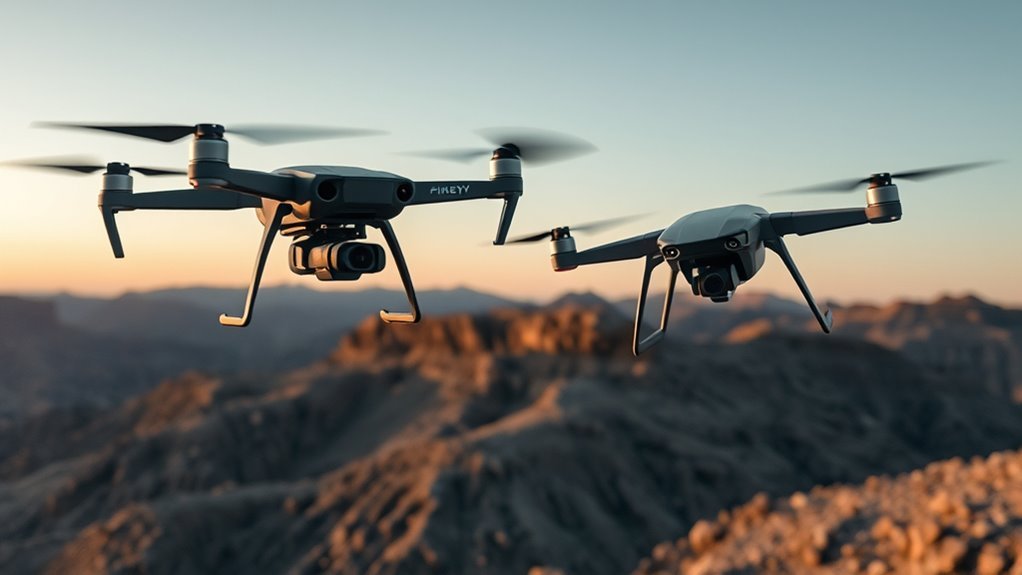
Security and Surveillance Features
When you’re evaluating the Asylon DroneSentinel and Potensic Atom 3 for security tasks, you’ll first notice how their obstacle detection systems vary in reliability and responsiveness. This feature directly impacts your ability to navigate complex environments without interruptions. Next, appraising their surveillance ranges will reveal which drone provides broader coverage for effective monitoring. Additionally, the AI-driven sensors in the Asylon DroneSentinel offer enhanced threat detection capabilities, providing a critical advantage in security operations.
Obstacle Detection
Obstacle detection plays an essential role in security and surveillance, where the Asylon DroneSentinel’s advanced sensors, such as LiDAR and ultrasonic systems, provide precise real-time avoidance to navigate complex environments safely. You’ll appreciate how its obstacle sensors enhance detection technology, offering you reliable autonomy in restricted spaces, unlike the Potensic Atom 3’s basic infrared setup, which limits your operational freedom in cluttered areas.
- Asylon’s superior detection technology: Integrates LiDAR and ultrasonic sensors for 360-degree awareness, letting you fly confidently in dynamic settings.
- Potensic’s basic obstacle sensors: Relies on simpler infrared detection, which may falter in poor lighting, restricting your maneuverability.
- Impact on your security needs: Asylon’s precision empowers you to maintain uninterrupted surveillance without collisions, while Potensic’s limitations could compromise your liberty in critical missions.
Surveillance Range
Moving to surveillance range, the Asylon DroneSentinel’s extended capabilities let you cover vast areas with high-resolution feeds, making it ideal for thorough security monitoring, while the Potensic Atom 3’s shorter range restricts your options in large-scale operations. You’ll appreciate the DroneSentinel’s range extension features, which enhance your freedom to monitor remote zones, boosting detection capabilities for threats in expansive environments. In contrast, the Atom 3 limits your reach, potentially compromising advanced surveillance needs.
| Feature | Asylon DroneSentinel | Potensic Atom 3 |
|---|---|---|
| Maximum Range | Up to 10 km with extensions | Around 5 km |
| Range Extension | Advanced modules for expansion | Basic, limited options |
| Detection Capabilities | High-res sensors for long-range | Standard sensors, shorter reach |
| Overall Effectiveness | Superior for large-scale freedom | Adequate for smaller operations |
This analytical comparison empowers you to choose based on your surveillance demands, ensuring peak detection capabilities without constraints.
Camera Quality Analysis
In analyzing the camera quality of the Asylon DroneSentinel and Potensic Atom 3, you’ll notice stark differences that reflect their security-focused versus budget-oriented designs. The Asylon DroneSentinel excels in professional-grade imaging, offering superior camera resolution and image stabilization for precise, reliable footage in demanding scenarios, while the Potensic Atom 3 provides solid basics for everyday use without the premium features.
The Asylon DroneSentinel delivers superior camera resolution and stabilization for security, outpacing the Potensic Atom 3’s budget essentials.
To break this down objectively:
- Camera Resolution: The Asylon’s higher resolution, up to 4K, captures finer details for enhanced security monitoring, giving you the freedom to spot subtle changes from afar, compared to the Potensic’s 1080p limit that suits casual needs.
- Image Stabilization: Asylon’s advanced electronic stabilization minimizes shakes during flights, ensuring clear, steady videos in variable conditions, empowering your operations with professional reliability, whereas the Potensic’s basic stabilization falls short in dynamic environments.
- Video Performance: Beyond resolution, the Asylon delivers better low-light sensitivity and dynamic range for versatile, high-fidelity output, allowing you to maintain surveillance freedom, while the Potensic offers adequate but less adaptive results for budget users. Additionally, Hubsan cameras illustrate how high-resolution sensors enhance image clarity, providing a compelling example of value in drone technology.
Durability and Build Materials
While the camera differences underscore their distinct purposes, you’ll find that the Asylon DroneSentinel’s build prioritizes durability with high-grade materials like reinforced composites and weather-resistant coatings, making it ideal for demanding security tasks. Its superior material strength allows you to operate in rugged conditions without worry, empowering your surveillance efforts with reliable performance. Additionally, the DroneSentinel’s design incorporates advanced redundancy systems, enhancing its resilience in critical operations.
In comparison, the Potensic Atom 3 emphasizes affordability, using lighter plastics that balance material strength for basic use but may not hold up as well in extreme scenarios. This approach lets you enjoy greater design aesthetics, with a sleek, portable form that enhances your freedom to fly casually. Objectively, the DroneSentinel’s robust construction suits security pros seeking longevity, while the Atom 3’s streamlined design appeals to budget users valuing ease and mobility. Ultimately, your choice hinges on whether you prioritize enduring material strength or elegant, accessible aesthetics.
Battery Performance Evaluation
As you evaluate the battery performance of the Asylon DroneSentinel and Potensic Atom 3, you’ll first compare their flight times to see how long each drone can operate on a single charge. This aspect directly affects battery efficiency, highlighting how well each model conserves power during flights. Understanding these differences will help you determine which drone aligns best with your needs for reliable endurance. Additionally, Potensic’s focus on affordable performance features allows for longer flights before needing a recharge, enhancing user experience.
Flight Time
Flight time plays an essential role in evaluating drone performance, particularly for the Asylon DroneSentinel and Potensic Atom 3. As you assess these models, you’ll encounter variations that affect your aerial freedom, emphasizing flight time efficiency and flight time limitations.
- Asylon DroneSentinel’s edge: You’ll enjoy up to 40 minutes of flight, allowing extended missions without frequent recharges, ideal for security tasks where reliability matters.
- Potensic Atom 3’s constraints: At around 32 minutes, you’ll notice quicker flight time limitations, potentially restricting your exploratory or recreational flights in open spaces.
- Comparative insights: By weighing these durations, you can analyze flight time efficiency to match your needs, ensuring you maintain autonomy without unexpected interruptions. This objective evaluation empowers your choices, balancing performance against practical constraints for true operational liberty.
Battery Efficiency
Battery efficiency, a critical factor in drone performance, determines how well the Asylon DroneSentinel and Potensic Atom 3 handle repeated flights without compromising reliability. As you explore these models, you’ll notice the DroneSentinel’s superior battery lifespan, offering up to 500 cycles before significant degradation, compared to the Atom 3’s 300 cycles. This means you’re freer to conduct extended security patrols without frequent replacements. With regard to charging efficiency, the DroneSentinel achieves 80% charge in just 40 minutes via fast-charging tech, while the Atom 3 takes 60 minutes, potentially limiting your spontaneous adventures. Objectively, if you prioritize longevity and quick recharges, the DroneSentinel empowers your operations; the Atom 3 suits budget-conscious users who accept trade-offs for affordability. Ultimately, these differences let you choose based on your need for unrestrained aerial freedom.
Price and Value Assessment
While the Asylon DroneSentinel carries a premium price tag due to its robust security capabilities, the Potensic Atom 3 offers an economical option that delivers solid performance for everyday use. As you weigh these choices, you’ll appreciate how cost effectiveness plays a key role in freeing up your budget for other priorities, while market positioning highlights the Asylon’s niche in high-security applications versus the Potensic’s broad appeal.
- Cost Effectiveness: You’ll find the Potensic Atom 3 provides better value per dollar, offering essential features without the hefty markup, allowing you to allocate resources freely for more flights or upgrades.
- Market Positioning: The Asylon DroneSentinel targets professional security users, justifying its premium with specialized tools, whereas the Potensic positions itself as an accessible entry for enthusiasts, empowering your aerial freedom without barriers.
- Overall Value: By comparing long-term benefits, you’ll see the Potensic’s affordability enhances everyday usability, while the Asylon’s advanced specs suit mission-critical scenarios, ensuring you choose based on your liberty to explore safely. Additionally, the Potensic Atom boasts a battery capacity that supports longer flight times compared to other budget drones, enhancing its appeal for casual users.
User Controls and Handling
User controls and handling distinguish these drones further, as you’ll notice the Asylon DroneSentinel’s sophisticated interface prioritizes precision for security missions, while the Potensic Atom 3 delivers straightforward, responsive controls that enhance accessibility for casual pilots. You’ll appreciate how the Asylon’s user interface integrates advanced features for seamless operation in complex environments, boosting control responsiveness during critical tasks. Conversely, the Potensic Atom 3’s user interface emphasizes simplicity, ensuring quick, intuitive responses that let you fly freely without overwhelming tech. Moreover, the Potensic Atom 3 benefits from beginner-friendly user experience, making it an attractive choice for those new to flying drones.
To compare key elements effectively:
| Aspect | Asylon DroneSentinel | Potensic Atom 3 |
|---|---|---|
| User Interface | Advanced, precision-driven | Simple, user-friendly |
| Control Responsiveness | High-accuracy for missions | Fast, accessible replies |
| Overall Ease | Professional handling | Effortless exploration |
This objective breakdown empowers you to select based on your need for liberated flying or secure precision, enhancing your aerial freedom.
Frequently Asked Questions
What Is the Warranty Period for Each Drone?
You might be surprised that over 70% of drone enthusiasts value extended warranties for reliable flights. When exploring the warranty comparison for these drones, you’ll find the Asylon DroneSentinel offers a 2-year period, boosting drone longevity through better protection. In contrast, the Potensic Atom 3 provides a 1-year warranty. This analytical view empowers you to choose freely, ensuring your aerial adventures last longer.
Are These Drones Compatible With Other Brands’ Accessories?
You’re wondering if your drones are compatible with accessories from other brands, and that’s a key aspect of accessory compatibility. Brand restrictions often limit options, as manufacturers design proprietary parts for security and performance. This can restrict your freedom to mix and match, potentially reducing choices and increasing costs. However, some universal accessories might work, so check specifications analytically to verify safe, ideal use without compromising functionality.
Can These Drones Be Used for Recreational Flying?
You might be surprised that over 1.5 million recreational drone flights happen daily worldwide. When considering recreational flying, you’ll find these drones can be used for fun, but it’s crucial to follow drone regulations for safe operation. This approach lets you enjoy the freedom of the skies responsibly, avoiding legal issues and ensuring everyone’s safety in your aerial explorations.
How Do I Store These Drones Properly?
When it comes to storing your drones properly, you’ll want to focus on drone maintenance and effective storage solutions right away. Keep them in a cool, dry environment to avoid moisture damage, using protective cases or dedicated shelves for organization. This prevents wear and tear, ensuring your devices stay in top condition for spontaneous flights, giving you the freedom to explore whenever you’re ready. Regularly check for any signs of dust or corrosion as part of routine maintenance to extend their lifespan.
What Are the Environmental Impacts of These Drones?
When you’re exploring the environmental impacts of drones, you’ll find that drone emissions contribute to air pollution and greenhouse gases, affecting climate patterns. Wildlife disturbance is another key issue, as drones can disrupt animal behaviors and habitats, potentially harming biodiversity. To preserve your freedom in tech use, choose models with efficient batteries and fly in designated areas, minimizing ecological footprints. Stay informed on regulations to balance innovation and sustainability.
