

Yes, you can fly a drone in Amsterdam, but only within a strict legal framework. Drone use in the Netherlands is regulated under both Dutch aviation rules and European Union drone laws, which means pilots must think beyond simple takeoff and landing. If you plan to fly for recreation, travel photography, or commercial content creation, you need to understand registration requirements, no-fly zones, airspace restrictions, privacy rules, and local safety expectations before launching your aircraft.
📋 About This Article
You can fly a drone in Amsterdam, but only if you follow strict Dutch and European rules and local safety expectations. This article is for hobbyists and creators who want to know what’s allowed in the city and how to plan a compliant flight. It covers how drone rules are set up in the Netherlands, which airspace and no-fly areas you must watch for (especially near Schiphol), and the privacy and registration steps you need to avoid fines or having your drone confiscated.
Amsterdam is a challenging place for drone flying because it combines dense urban neighborhoods, protected public spaces, canals, heavy tourism, and controlled airspace linked to Amsterdam Schiphol Airport. In practice, this means that even if drone ownership is legal, flying in the city center is often limited or prohibited. Careful planning is essential if you want to stay compliant and avoid fines, confiscation, or safety risks.
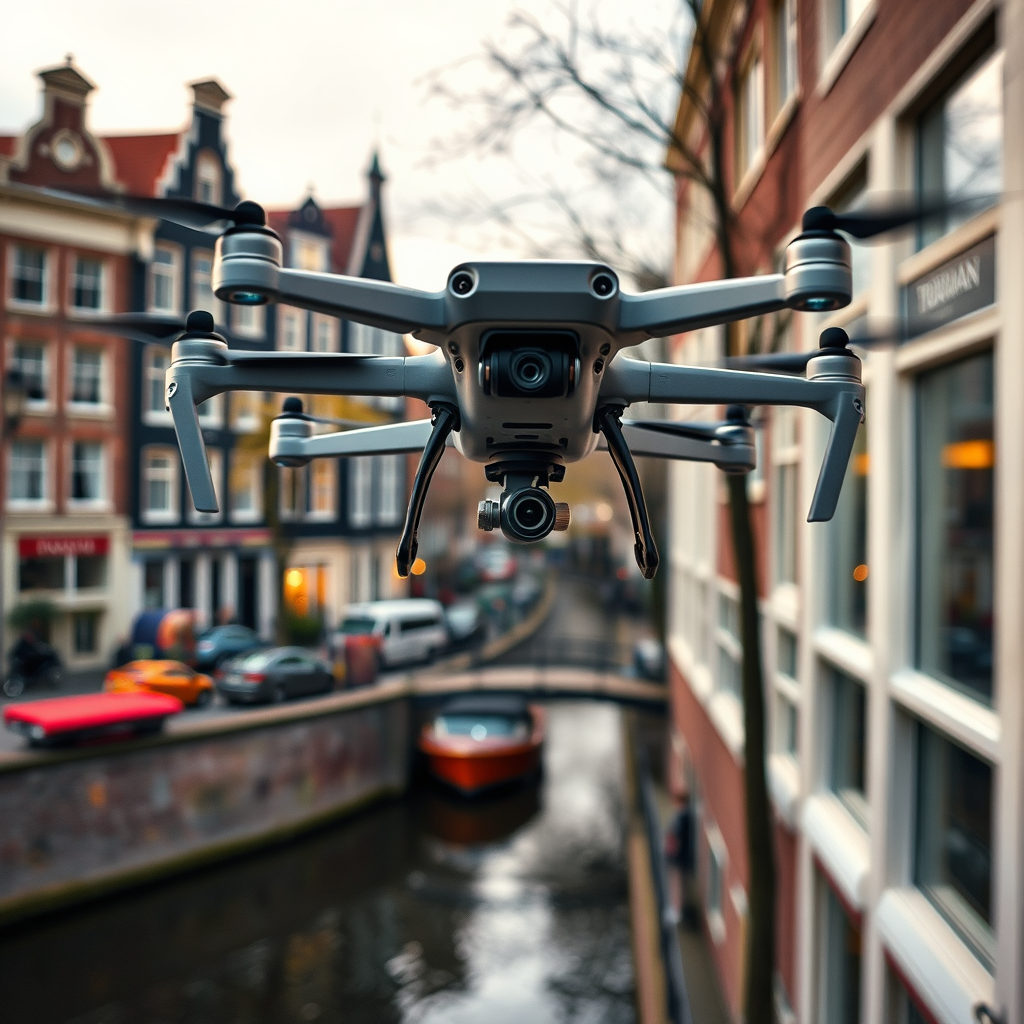
Drone Laws in Amsterdam and the Netherlands
Drone operations in Amsterdam fall under the broader drone regulations of the Netherlands and the European Union Aviation Safety Agency (EASA). These rules divide drone activity into categories based on operational risk rather than only on the purpose of the flight. For most hobby pilots and many low-risk professional users, the relevant category is the Open Category.
The Main EU Drone Categories
The three regulatory categories are:
- Open Category – for low-risk operations, including most recreational drone flights and basic aerial photography.
- Specific Category – for operations that involve higher risk, such as more complex flights or activity in restricted environments.
- Certified Category – for the highest-risk drone operations, typically involving people transport or other advanced aviation-level use cases.
Most visitors and local enthusiasts flying a consumer drone in Amsterdam will be dealing with the Open Category. Even so, “open” does not mean unrestricted. You still need to meet operational limitations related to weight, altitude, line of sight, and proximity to people.
Drone Registration Rules
In the Netherlands, drone operators usually need to register if their drone weighs more than 250 grams or if it has a camera or another sensor capable of capturing personal data. Registration is handled through the relevant Dutch aviation authority framework, and the operator registration number must generally be displayed on the drone.
This registration system helps authorities identify pilots and enforce accountability. If you are visiting Amsterdam from another EU country, your registration from your home member state may already be valid across the EU, but you should still verify that your documents and identification markings meet Dutch requirements.
Online Training and Competency Requirements
Many drone pilots must complete an online training course and pass a basic exam before flying legally. This is especially important for drones over 250 grams and for pilots operating under subcategories with additional safety obligations. The training covers core topics such as:
- airspace awareness
- flight safety
- privacy protection
- operational limitations
- emergency procedures
Even if your drone is lightweight, taking the training seriously is a smart step. Amsterdam’s airspace and urban layout leave little room for error.
Can You Fly a Drone in Amsterdam City Center?
In many parts of central Amsterdam, drone flying is either highly restricted or simply impractical. The city center is densely populated, filled with pedestrians, cyclists, boats, trams, historic buildings, and narrow streets. Under EU drone rules, pilots in the Open Category must avoid unsafe operations over uninvolved people and must maintain visual line of sight at all times. Those conditions are difficult to meet in busy urban districts.
Even where a flight is not explicitly banned, local conditions may make it non-compliant. A legal drone flight requires more than open space on a map. You must also consider crowd density, takeoff safety, emergency landing possibilities, and privacy impact.
No-Fly Zones in Amsterdam
One of the most important parts of planning a drone flight in Amsterdam is identifying no-fly zones and controlled airspace. These restricted areas exist to protect public safety, national security, and manned aviation.
Airports and Controlled Airspace
The biggest restriction affecting Amsterdam is the airspace surrounding Amsterdam Schiphol Airport. Because Schiphol is one of Europe’s busiest airports, drone activity near its flight paths is tightly controlled. Flying a drone in or near airport control zones without authorization can create serious danger for aircraft and may lead to severe penalties.
Depending on your location, other regional airspace restrictions may also apply. That is why you should always check an official airspace map before every flight.
Military Sites and Critical Infrastructure
Drones are also prohibited or heavily restricted near:
- military installations
- government buildings
- critical infrastructure
- security-sensitive facilities
These restrictions are not optional. Flying near sensitive areas can trigger both aviation violations and security concerns.
Parks, Public Spaces, and Urban Recreation Areas
Many travelers assume that a park automatically makes a good drone location. In Amsterdam, that assumption can be misleading. Popular public spaces such as Vondelpark, waterfront areas, and event zones may have municipal rules, crowd-related limitations, or environmental restrictions. A park may look open, but if it is crowded or locally protected, flying there may still be unlawful or unsafe.
Always check whether the municipality, land manager, or local authority has imposed additional rules for that location.
How to Check Where You Can Fly
Before flying a drone in Amsterdam, use official and up-to-date airspace tools. Dutch and European drone regulations can change, and temporary restrictions may be introduced for public events, emergency response activity, or security operations.
Useful pre-flight checks include:
- reviewing official Dutch airspace maps
- checking no-fly zone data from recognized aviation sources
- confirming local municipal restrictions
- reviewing NOTAMs or temporary airspace notices where applicable
- verifying weather, visibility, and wind conditions
Relying only on a consumer drone app is not enough. Use authoritative sources whenever possible.
Permits and Authorizations
Whether you need a permit depends on where you fly, how you fly, and why you fly. Recreational drone pilots operating within standard Open Category limits usually do not need a separate permit for every flight. However, if you plan to fly in restricted airspace, conduct higher-risk operations, or perform commercial work that falls outside standard limits, you may need prior authorization.
When Extra Permission May Be Required
You may need additional approval if you intend to:
- fly in restricted or controlled airspace
- operate closer to people than normally allowed
- carry out complex commercial drone operations
- conduct flights in areas with local prohibitions
- perform missions that exceed Open Category limitations
If your operation does not fit the Open Category, it may fall into the Specific Category, which usually requires a risk assessment and formal authorization.
Do You Need Drone Insurance in Amsterdam?
Drone insurance is strongly recommended and may be mandatory in certain cases, especially for commercial operators or higher-risk activities. Even for a recreational pilot, liability insurance offers important protection. Amsterdam’s urban environment increases the potential for accidental damage to property, vehicles, buildings, or third parties.
A good drone insurance policy may cover:
- third-party liability
- property damage
- accidental injury claims
- equipment loss or damage, depending on the policy
Before flying, check whether your personal liability coverage extends to unmanned aircraft. Many standard policies do not automatically include drone operations.
Privacy Rules and Filming in Public
Privacy is a major issue when flying a camera drone in Amsterdam. The Netherlands takes personal data protection seriously, and drone filming can raise concerns under privacy law, especially in residential neighborhoods or crowded public places. Capturing identifiable people, private homes, balconies, gardens, or windows without a legitimate basis may create legal and ethical problems.
To reduce privacy risk:
- avoid hovering near homes or apartment buildings
- do not film people unnecessarily at close range
- limit data collection to what is needed for your purpose
- avoid publishing footage that invades personal privacy
- respect requests from property owners or local officials
Professional drone photography and aerial videography in urban settings should always be planned with privacy compliance in mind.
Operational Rules Every Drone Pilot Should Follow
Regardless of location, several core drone safety rules apply across the Netherlands. These practical standards are essential for lawful and responsible flying in Amsterdam.
Key Flight Limitations
- Keep the drone within visual line of sight.
- Do not exceed the allowed maximum altitude under applicable EU rules.
- Avoid flying over uninvolved people or dense crowds.
- Do not fly in dangerous weather or poor visibility.
- Keep a safe distance from buildings, roads, water traffic, and infrastructure.
- Never interfere with emergency services, police activity, or manned aircraft.
These rules matter even more in Amsterdam because the city environment changes quickly. A location that looks safe in the early morning may become crowded an hour later.
Best Places Near Amsterdam for Drone Flying
If your goal is to capture Dutch landscapes rather than urban street scenes, areas outside the busiest parts of Amsterdam are often better suited for drone use. Open rural spaces, quieter outskirts, and less congested regions may offer safer and more legally viable conditions, provided they are outside restricted airspace and local prohibitions.
Before traveling to a nearby location, verify:
- airspace classification
- local land-use rules
- nature reserve protections
- crowd levels
- weather and wind exposure
Coastal zones, countryside views, and open polder landscapes can often provide stronger aerial photography opportunities than the historic center of Amsterdam.
Penalties for Breaking Drone Rules
Flying a drone illegally in Amsterdam can lead to fines, enforcement action, and in serious cases, confiscation of equipment or legal liability. Violations involving airport zones, reckless flying, invasion of privacy, or endangerment of the public are treated particularly seriously.
Authorities may respond if you:
- fly in a no-fly zone
- operate without required registration or certification
- endanger people or traffic
- ignore airspace restrictions
- breach privacy laws through filming
Compliance is not just about avoiding penalties. It is also about protecting the reputation of drone pilots and keeping public spaces safe.
Practical Tips for Flying a Drone in Amsterdam
If you want the best chance of a legal and successful drone flight, plan carefully and stay conservative in your decisions.
Pre-Flight Checklist
- Register your drone operator account if required.
- Complete the necessary online training and exam.
- Check the drone’s weight class and operational category.
- Review official no-fly zones and Schiphol airspace restrictions.
- Confirm there are no local municipal bans in your chosen area.
- Inspect the drone, batteries, propellers, and return-to-home settings.
- Choose a low-traffic time with minimal pedestrian activity.
- Respect privacy, property, and public safety at all times.
For most travelers, the safest answer to “Can you fly a drone in Amsterdam?” is: yes, but only selectively and with careful legal checks. In many central areas, restrictions make flying difficult. If you stay informed, use official airspace resources, and choose locations wisely, you can enjoy drone flying in the Netherlands without running into regulatory trouble.
Frequently Asked Questions
Can you legally fly a drone in Amsterdam?
In many cases, flying a drone in Amsterdam is heavily restricted, and in some areas it may not be allowed at all. Amsterdam is a dense urban environment with airports, heliports, historic districts, canals, crowds, and sensitive infrastructure, which means drone operations are subject to strict Dutch and European Union aviation rules. The Netherlands follows the EU drone framework under EASA, and pilots must comply with operational category rules, local airspace restrictions, and municipal limitations.
Before flying, you should always check whether the specific area is inside a no-fly zone, controlled airspace, or a zone with special conditions. Even if drone flying is generally allowed under EU rules, local restrictions in Amsterdam can still prevent takeoff. In practice, recreational drone use in the city center is often difficult or prohibited because of safety, privacy, and airspace concerns.
Do you need to register your drone or get a license to fly in Amsterdam?
Yes, many drone operators need to register before flying in Amsterdam or anywhere else in the Netherlands. Under EU rules, operators usually must register if their drone has a camera or if the drone weighs 250 grams or more. Registration is typically done through the Dutch aviation authority system, and the operator registration number must be displayed on the drone where required.
In addition, the pilot may need to complete online training and pass a basic theory test, depending on the drone and the type of operation. For most leisure flights, this falls under the “open category,” which has clear limits on weight, distance from people, and where the drone can be flown. If your intended flight goes beyond basic open-category rules, such as flying in higher-risk areas or conducting commercial work with additional risk, you may need further authorization.
Where are drones not allowed to fly in Amsterdam?
Drones are generally not allowed in areas where flying would create a risk to aircraft, people, or critical sites. In Amsterdam, this can include zones near airports, helicopter routes, government buildings, emergency response areas, and other restricted airspace. Flying over crowds, busy streets, events, and densely populated areas is also typically prohibited or severely limited under the standard rules.
Because airspace restrictions can change, pilots should always consult an official drone airspace map or authorized flight-planning tool before takeoff. Do not assume that a park, canal area, or open square is automatically legal for drone use. A location may appear suitable on the ground while still falling inside controlled or restricted airspace. Checking the latest map data is one of the most important steps before flying in Amsterdam.
What are the main drone rules you must follow when flying in Amsterdam?
If you are allowed to fly in a specific location, you must still follow the core drone safety rules that apply in the Netherlands under EU law. These generally include keeping the drone within visual line of sight, staying below the maximum permitted altitude, avoiding flights over uninvolved people, and never flying in a way that endangers other aircraft, road users, or the public. You must also respect privacy rules and avoid recording people in situations where they have a reasonable expectation of privacy.
Other important rules can include not flying at night unless your category and setup allow it, not dropping objects from the drone, and maintaining safe distances from buildings, vehicles, and bystanders. If the drone is equipped with a camera, pilots should be especially careful in residential neighborhoods and tourist-heavy areas. Amsterdam is known for its crowded streets and waterways, so even a technically legal flight may still be unsafe if conditions are busy or unpredictable.
What happens if you break drone rules in Amsterdam?
Breaking drone rules in Amsterdam can lead to serious consequences. Depending on the violation, authorities may issue a warning, fine the operator, confiscate equipment, or start an enforcement investigation. Penalties may be higher if the flight took place near restricted airspace, above crowds, or in a way that created danger to manned aviation or public safety.
Beyond official penalties, unlawful drone use can also create liability issues if you cause damage, injury, or privacy violations. For that reason, it is important to verify the legal status of the flight area, ensure your registration and training are up to date, and avoid flying if you are unsure about the rules. When in doubt, do not launch until you have checked the latest Dutch airspace and drone guidance from official sources.
