

Yes, you can fly a drone in Venice, but only if you follow Italian and EU rules, plus city-specific restrictions designed to protect people, historic landmarks, and sensitive public areas. In practice, that means checking airspace rules, registering the aircraft when required, and avoiding the most heavily protected zones around St. Mark’s Basilica, the Grand Canal, and the Rialto area.
Venice drone rules (quick answer)
Drone flights in Venice are allowed in limited circumstances, but they must comply with EASA-based regulations implemented in Italy and any local limitations enforced by authorities. The key difference is that Venice combines national drone compliance with an added layer of heritage and public-safety constraints because it is a UNESCO World Heritage Site.
Which laws apply in Venice?
In Italy, drone operations are governed by the European Union’s aviation framework as implemented for unmanned aircraft by Italian authorities. The widely cited EU rule set is organized through the EASA (European Union Aviation Safety Agency) concept of classifying UAV use by risk, such as open category operations for lower-risk flights and additional requirements for higher-risk operations.
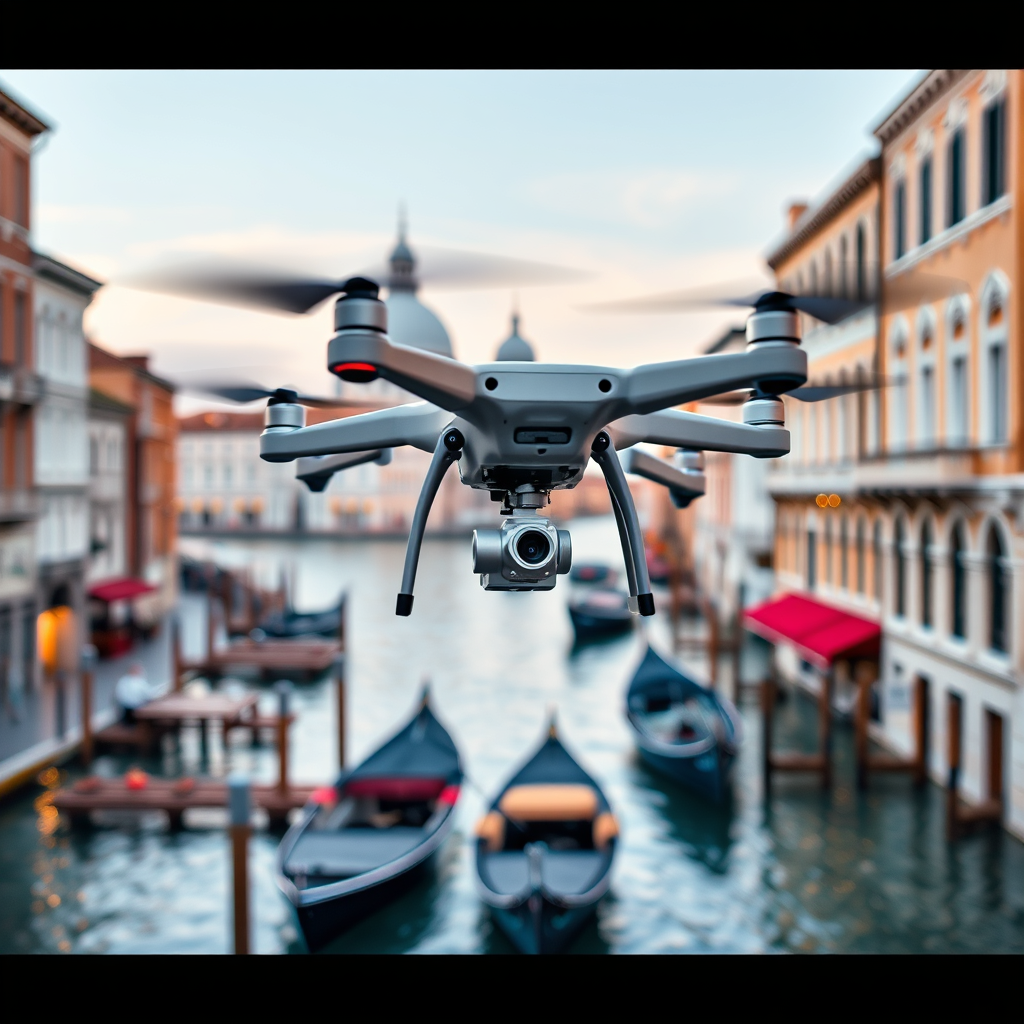
Because drone rules change frequently, you should confirm the current status on official sources such as ENAC (Ente Nazionale per l’Aviazione Civile) and any airspace information provided for Italy. If you are planning to fly in Venice, treat local guidance as mandatory reading, not optional background research.
Do you need to register your drone in Italy?
Registration is required in Italy for many drones, especially when the unmanned aircraft exceeds 250 grams. The key difference is that registration is tied to the drone’s mass and identification requirements, not just whether you fly recreationally or commercially.
ENAC registration threshold and practical meaning
Under the EU framework, if your drone weighs more than 250 g, you generally must register it with the appropriate Italian aviation authority (ENAC). Registration typically involves providing operator details and linking them to the drone’s specifications so authorities can trace responsibility in the event of incidents.
Before takeoff, verify the exact classification and obligations for your specific aircraft weight and planned use. Even if your drone is under 250 g, you may still have operational limits, particularly in crowded or sensitive zones.
Common follow-up: “What if my drone is under 250 grams?”
If your drone is under 250 g, registration obligations may differ depending on your exact setup and applicable category requirements. However, you should still treat Venice airspace and location restrictions as binding; mass does not remove the need to avoid prohibited or tightly controlled areas.
Where you cannot fly: no-fly zones in Venice
Some of Venice’s most iconic landmarks are treated as high-risk areas where drone flights may be restricted or prohibited. The key difference is that “no-fly” does not only mean permanent bans; it can also include temporary restrictions for events and changing safety conditions.
High-sensitivity locations to avoid
When planning a flight, assume that areas around major crowds and critical landmarks are tightly controlled. Operators commonly must avoid drone operation near:
Venice Landmark Areas: Typical Restriction Level & Safety Consequence Risk
| # | Location cluster in Venice | Common operational status | Why it’s tightly controlled | Violation consequence risk |
|---|---|---|---|---|
| 1 | Piazza San Marco / St. Mark’s Square | Usually restricted | Large crowds + heritage perimeter controls | ★★★★☆ |
| 2 | St. Mark’s Basilica area | Often prohibited without special authorization | High-value landmark + dense visitor flow | ★★★★★ |
| 3 | Grand Canal waterfront viewing zones | Restricted (especially near crowds) | Pedestrian density + boat/traffic complexity | ★★★★☆ |
| 4 | Rialto Bridge & immediate Rialto waterfront | Restricted / high enforcement likelihood | Narrow canals + continuous tourist movement | ★★★★☆ |
| 5 | Major canal-side plazas during peak hours | Temporarily restricted at short notice | Event-style crowds + changing safety needs | ★★★☆☆ |
| 6 | Dense central streets (tight lanes & passageways) | Restricted by practice due to safety risk | VLOS difficulty + limited maneuver space | ★★★☆☆ |
| 7 | Corridor-style flight paths near populated quays | Avoid / require clear authorization | People on quays + interaction risk with nearby activity | ★★☆☆☆ |
- St. Mark’s Square (Piazza San Marco)
- St. Mark’s Basilica
- The Grand Canal corridor, especially close to dense public viewing areas
- Rialto Bridge and the immediate Rialto waterfront zones
- Other central Venice areas where pedestrian density is high
Even if a flight seems “small” or “direct,” drones can create serious safety risks through rotor wash, unexpected drops, or signal/control interference near people and infrastructure.
Temporary restrictions during festivals and public events
Venice regularly hosts festivals, commemorations, and large public gatherings. Authorities can impose short-notice restrictions, including temporary geofenced no-fly areas, to protect public safety and event integrity.
If you are flying around holiday periods or major events, check official notices and real-time airspace guidance close to your planned date and time.
Commercial vs. recreational drone flying in Venice
The rules depend heavily on whether you fly for recreation or for commercial purposes. The key difference is that commercial operations often require additional authorization, documentation, and compliance steps beyond recreational flight requirements.
What counts as “commercial use”?
In many jurisdictions, commercial use includes filming content for sale, payment, brand promotion, or use in professional services. In Venice, commercial drone work—such as promotional cinematography, real estate services, or paid event coverage—may require formal permissions depending on the operation and risk level.
If your goal is to monetize your footage or use it for a client, treat it as commercial planning rather than casual hobby flying.
Conversational Q&A: “Can I film for Instagram or YouTube?”
Many creators film for social media without compensation, which may be treated as recreational depending on the circumstances. The safer approach is to evaluate whether there is any sponsorship, paid production, or contractual obligation. When in doubt, confirm the classification with Italian authorities or consult a qualified drone compliance advisor.
Operational requirements: safety, altitude, and airspace awareness
Even where drone flights are permitted, you must fly in a way that protects people, property, and aviation activity. The key difference is that compliance is not only about location (where you fly), but also about how you fly (altitude, distance, and risk management).
Plan with altitude limits and separation
Typical EU-aligned operations in the open category generally impose limits on maximum distance from people and require you to keep the aircraft within safe proximity to maintain control and reaction time. Always apply the most conservative interpretation for Venice’s dense environment.
In practical terms, Venice is compact, with narrow streets, constant foot traffic, and heavy tourist movement. That reality often makes “safe separation” difficult, which is why many operators choose to avoid central areas entirely.
Check airspace for flights near airports and approach paths
Venice has nearby aviation activity, including routes supporting regional and international flights. Drone operators must confirm that their planned takeoff area is not inside controlled airspace or otherwise restricted zones.
Use official Italian airspace information and reputable planning tools that reflect current restrictions. If your route crosses multiple zones, you may need to redesign your plan or choose a different launch point.
Permissions and how to prepare them
If you want to fly in restricted or sensitive contexts, you may need permissions from local authorities in addition to meeting national and EU requirements. The key difference is that permissions are often tied to purpose, location, and operational risk.
What approvals might be needed?
Permissions can vary by use case, such as whether you plan to capture footage for a client, film in public spaces, or operate under a category that requires additional oversight. In Venice, public heritage considerations can also increase scrutiny for flights near protected sites.
- Commercial permissions (where applicable)
- Local authorization for operations in sensitive public areas
- Operational compliance documentation aligned with your chosen operational category
Conversational Q&A: “Where do I check the latest permissions?”
Start with ENAC resources and any local government or civil aviation notices that apply to Venice. Because restrictions can change for safety reasons, verify close to your planned flight date rather than relying only on older guidance.
Best practices for drone safety in Venice
Even when regulations technically allow flight, Venice’s environment often demands a stricter safety approach. The key difference is that “legal to fly” is not the same as “responsible to fly” in a crowded, historic city.
Practical steps before you take off
- Do a pre-flight compliance check for registration status, category obligations, and required IDs or markings.
- Verify the exact coordinates of your intended launch and landing points, not just landmark names like “Rialto” or “St. Mark’s.”
- Use a geo-aware planning workflow and re-check close to takeoff to account for temporary restrictions.
- Reduce risk over people by choosing routes that avoid crowds and by maintaining clear visual line of sight where required.
- Prepare for wind and water-adjacent conditions near canals, which can affect stability and controllability.
Expert consensus: why Venice is treated as high sensitivity
Drone regulators and public-safety professionals consistently emphasize that dense urban environments elevate operational risk. Venice intensifies that risk because of high pedestrian density, narrow canal-side spaces, and the presence of landmark sites where an incident would be both dangerous and difficult to mitigate.
That is why compliance advice for major cities typically stresses avoidance of crowded areas and strict adherence to airspace restrictions, especially around heritage monuments and public gathering points.
Penalties and enforcement considerations
Failing to comply with drone regulations in Italy can lead to enforcement actions, including administrative sanctions and potential legal consequences. The key difference is that enforcement risk increases when flights occur in restricted locations or when operations endanger people or interfere with public order.
What typically increases consequences?
- Flying in prohibited zones near major landmarks such as Piazza San Marco or the Grand Canal
- Ignoring registration or operator identification requirements
- Operating in a way that reduces safety margins in crowded areas
- Continuing flight despite temporary event restrictions
If you plan to drone in Venice, treat compliance as a core part of the project—not a checklist you finish after you arrive.
Quick FAQ: Can you fly a drone in Venice?
Is it legal to fly a drone in Venice for sightseeing?
It can be legal, but only if you meet the applicable EU/Italian requirements and you avoid restricted areas. Venice’s central zones around major attractions are often the most problematic for legal and safety reasons.
Do I need a permit to fly near St. Mark’s Square?
Many operations near St. Mark’s Square are restricted and may be prohibited or require special authorization depending on the specific location and timing. Always treat landmark-adjacent flights as high-risk and confirm the current airspace status before planning.
Can I fly a small camera drone?
A small camera drone may still be subject to Italian and EU drone obligations, including registration (if above 250 g) and operational limits in specific airspace. In Venice, “small” does not eliminate restrictions around crowds and heritage sites.
What should I do the day I fly?
Re-check real-time restrictions, confirm your operator and drone compliance, select a safe launch point away from crowds, and ensure your flight plan respects any temporary event zones. If rules are unclear, postpone or seek clarification rather than attempting a marginally compliant flight.
📋 About This Article
Yes, you can fly a drone in Venice, but only in limited situations and only if you follow EU and Italian drone rules plus local safety and heritage limits. This article is for drone owners and visitors who want clear guidance before taking off in and around Venice’s most protected landmarks. It explains which laws apply, what you need to check about airspace and permissions, and where you should avoid flying—especially near St. Mark’s Basilica, the Grand Canal, and the Rialto area.
Frequently Asked Questions: Can You Fly a Drone in Venice?
Is it legal to fly a drone in Venice, Italy?
In many cases, you can fly a drone in Venice, but it’s not “automatically allowed.” Drone flights in Italy must comply with EU-wide rules (EASA) and Italy’s national requirements, including registering the drone/operator, following operational limitations, and respecting airspace restrictions. Venice is heavily controlled due to the airport, heliports, sensitive infrastructure, and dense urban areas, so you may need to obtain specific authorizations or avoid restricted zones entirely. Before each flight, check the drone airspace and any local rules that apply to the exact location and time you intend to fly.
Do I need to register my drone before flying in Venice?
Yes—registration is generally required under EU drone regulations, based on the drone/operator classification and your status as an operator. If your drone falls under the rules that require operator registration, you must register as an operator and ensure you can comply with labeling/marking requirements. You may also need to pass an online knowledge test (depending on your circumstances and the type of operation you plan). Keep in mind that even with registration, you still must follow airspace authorizations and any additional restrictions that apply in Venice.
Where can I fly a drone in Venice without breaking airspace rules?
Because Venice is surrounded by controlled airspace and includes critical infrastructure and populated areas, you cannot assume you can fly anywhere. You must verify the specific flight location using official airspace tools (such as the appropriate Italian/European authorization portals) and confirm whether you are in a restricted, controlled, or otherwise limited zone. In practice, many areas around Venice (including near the airport approach paths and other sensitive sites) may require prior authorization or may be prohibited. If a zone is marked as restricted or you cannot confirm an active authorization, do not fly there.
Are there height limits and distance restrictions when flying a drone in Venice?
Yes. Drone operations are governed by EU/EASA operating rules that typically include limits such as maintaining safe distances from people, staying within required visual line of sight (VLOS) or operating limits (depending on the category/authorization), and not exceeding permitted altitude for the operation type. In dense cities like Venice, the practical restrictions are often tighter: even if a rule allows a certain altitude in general, you may still need to keep well clear of crowds, buildings, vessels, and other risk factors. If you operate in or near areas requiring authorization, the authorization conditions may specify additional constraints such as maximum height, time windows, or exact flight corridors.
What are the penalties or risks if I fly a drone illegally in Venice?
Flying illegally can result in fines, enforcement actions, drone seizure, and broader legal consequences—especially if you violate airspace restrictions near airports, heliports, or other sensitive areas. Beyond legal penalties, there are safety and liability risks: drones can endanger aircraft, pedestrians, boat traffic, and property, particularly in Venice’s busy tourist environment and narrow waterways. Even if you think you are “only taking photos,” an unauthorized flight can create serious risks. The safest approach is to check airspace status, obtain any required authorizations, follow operational rules (altitude, distance, visual line of sight), and avoid flight when conditions are unsafe or rules are unclear.
References
- A comparative global analysis of drone laws: Best practices and policies Google Scholar
https://link.springer.com/chapter/10.1007/978-94-6265-132-6_16 - Drones in Venice: Exploring business model applications for disruptive mobility and stakeholders’… Google Scholar
https://www.sciencedirect.com/science/article/pii/S0959652623029220 - Aviation law Google Scholar
https://www.aviationspacejournal.com/wp-content/uploads/2021/08/Italy.pdf - [B] The law of unmanned aircraft systems: an introduction to the current and future regulation un… Google Scholar
https://books.google.com/books?hl=en&lr=&id=vIuWDwAAQBAJ&oi=fnd&pg=PT29&dq=Can+You+Fly+a+Drone+in+Venice%3F+Important+Regulations+to+Know&ots=GcWVglL7hB&sig=klU5DSyG-y-xXI50iV-hAQ9fIFI - Google Scholar Search: Italy ENAC drone regulations Google Scholar
https://scholar.google.com/scholar?q=Italy+ENAC+drone+regulations - Google Scholar Search: EASA drone regulations open category Google Scholar
https://scholar.google.com/scholar?q=EASA+drone+regulations+open+category - Recreational Flyers — Know Before You Fly
https://www.faa.gov/uas/recreational_flyers - UAS for Commercial Operators (Part 107)
https://www.faa.gov/uas/commercial_operators - Drone
https://en.wikipedia.org/wiki/Drone - European Union Aviation Safety Agency (EASA)
https://en.wikipedia.org/wiki/European_Aviation_Safety_Agency
📅 Last Updated: July 03, 2026 | Topic: Can You Fly a Drone in Venice? Important Regulations to Know | Content verified for accuracy and freshness.
