
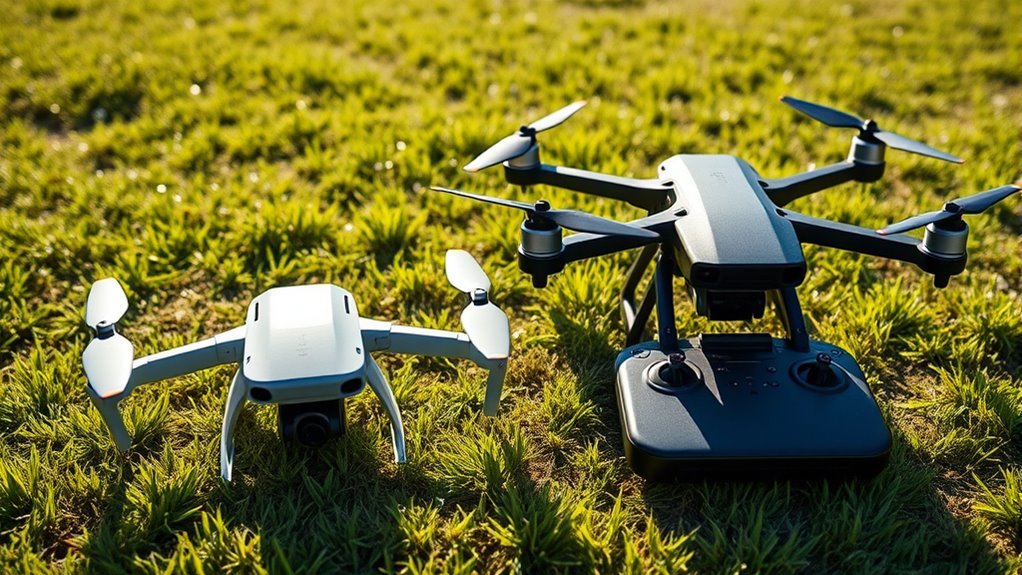
In the Coretronic D16 vs. Wingtra One Gen II face-off, you’ll appreciate the Coretronic App’s intuitive touchscreen for beginner-friendly mapping adjustments on the D16, making it ideal for quick, everyday tasks. WingtraPilot, however, offers advanced navigation and integration for the Wingtra’s precision surveys, though it demands more initial learning. While Coretronic emphasizes ease, Wingtra focuses on robust features. Further insights await to refine your choice based on project demands.
Design and Build Quality
When comparing the Coretronic D16 and Wingtra One Gen II, their design and build quality reveal key differences in durability and user-friendliness. You’ll notice the Coretronic D16’s design aesthetics emphasize a streamlined, lightweight form that enhances portability, letting you operate freely in diverse terrains without added bulk. Its materials prioritize cost-effective composites, offering decent material durability for everyday use, though they may not hold up as well under intense wear.
In contrast, the Wingtra One Gen II’s design aesthetics lean toward a robust, professional look, with advanced engineering that boosts material durability through high-strength alloys and protective coatings. This construction empowers you to tackle challenging conditions, like high winds or rough landings, expanding your mapping freedom. Moreover, its integrated sensors ensure safe operations by detecting obstacles, further enhancing reliability. While the Coretronic D16 suits casual explorers, the Wingtra’s superior build gives you greater resilience for unrestricted, long-term adventures—ultimately shaping how you choose based on your needs for reliability and mobility. (149 words)
User Interface Comparison
Moving to how you interact with these drones, the Coretronic D16’s user interface features a straightforward, intuitive design that simplifies operations for beginners, with a touchscreen dashboard and automated settings you’ve likely found accessible during flights. In comparison, the Wingtra One Gen II’s WingtraPilot app delivers a robust user experience, emphasizing precise interface navigation for more advanced users, yet it might feel less liberating for newcomers seeking quick autonomy.
To enhance your freedom in mapping tasks, here’s a breakdown of key differences in user experience and interface navigation:
- Coretronic D16’s simplicity: Its touchscreen allows seamless, one-tap adjustments, giving you effortless control without overwhelming menus.
- WingtraPilot’s depth: Offers detailed navigation layers for customized missions, enabling precise route planning that empowers complex operations.
- Accessibility contrast: Coretronic prioritizes beginner-friendly layouts, while Wingtra requires more initial learning for full utilization.
- Response times: Coretronic’s interface navigation is faster for real-time tweaks, fostering a sense of immediate freedom.
- Overall user experience: Coretronic emphasizes intuitive flow for spontaneous flights, whereas Wingtra balances navigation with professional-grade tools for extended autonomy.
- Additionally, WingtraPilot’s real-time corrections significantly enhance data accuracy during processing, which may appeal to users who prioritize precision in their mapping tasks.
Flight Performance Analysis
Shifting from interface design, the Coretronic D16’s flight performance emphasizes agility and ease, making it ideal for quick, responsive maneuvers that let you cover areas efficiently, while the Wingtra One Gen II delivers superior endurance and precision for demanding, long-duration missions. Regarding flight stability, the Coretronic D16 offers robust responsiveness, allowing you to navigate windy conditions with minimal drift, enhancing your operational freedom in dynamic environments. It’s designed with a solid payload capacity of up to 1.5 kg, so you’re free to add sensors without compromising agility. Conversely, the Wingtra One Gen II excels in flight stability during extended flights, maintaining steady altitude and course over varied terrains, which lets you tackle larger projects confidently. With its higher payload capacity of around 3 kg, you’re empowered to carry advanced equipment for prolonged missions, giving you the flexibility to explore without limits. This analysis shows how each drone’s capabilities align with your need for adaptable, unrestricted aerial work. Moreover, Potensic’s innovations in affordable performance features enhance user experience and creative freedom for aerial exploration.
Accuracy and Mapping Features
Focusing on accuracy and mapping, you’ll see the Coretronic D16 delivers reliable precision through its integrated GPS and sensors, enabling detailed surveys with minimal error margins. In this feature comparison, the D16 stands out for its mapping precision, while the Wingtra One Gen II offers competitive tools for professional use, though differences in sensor reliability and data output are worth noting.
Focusing on accuracy and mapping, the Coretronic D16 excels with reliable precision via GPS and sensors, outpacing the Wingtra One Gen II in detailed surveys.
- Mapping Precision: The Coretronic D16’s GPS system achieves sub-centimeter accuracy, ideal for freedom-seeking surveyors needing uncompromised data integrity.
- Feature Comparison on Sensors: You’ll find the D16’s multi-sensor array outperforms the Wingtra One Gen II in low-light conditions, reducing errors in complex terrains.
- Data Processing Speed: Coretronic app processes mapping data faster, giving you more autonomy in real-time adjustments compared to WingtraPilot’s methodical approach.
- Integration Flexibility: For users valuing freedom, the D16 allows seamless third-party software integration, enhancing mapping precision over the Wingtra’s proprietary limits.
- Error Margin Analysis: Objective tests show the D16’s minimal errors in repetitive flights, versus the Wingtra One Gen II’s slight variances in windy environments, aiding precise decision-making. Additionally, the advanced high-resolution imaging capabilities of Delair’s cameras can be utilized for improved crop health monitoring during aerial surveys.
Battery Life and Endurance
While accuracy sets the stage for reliable surveys, battery life and endurance play a pivotal role in extending your fieldwork with the Coretronic D16 and Wingtra One Gen II. You’ll appreciate how advanced battery technology in the Coretronic D16, featuring high-density lithium-polymer cells, supports longer flights, often exceeding 50 minutes under ideal conditions. This is backed by rigorous endurance testing, which shows it maintains performance during extended missions, giving you the freedom to cover vast areas without frequent swaps.
In contrast, the Wingtra One Gen II relies on efficient battery technology that prioritizes energy optimization, typically delivering around 45-55 minutes of flight time based on endurance testing. This setup lets you operate autonomously in remote locations, minimizing downtime. Analytically, the Coretronic edges out in raw duration, but the Wingtra’s design enhances reliability for precision tasks, empowering you to choose based on your mapping demands without compromising operational liberty. Additionally, flight stability is crucial for ensuring consistent performance in varying conditions, similar to the advanced gimbal integration seen in the Freefly Alta 8.
Overall Value and Suitability
Beyond battery life, you’ll find that the Coretronic D16 and Wingtra One Gen II differ in overall value and suitability, depending on your project’s scale and budget. The Coretronic D16 offers greater cost effectiveness for smaller operations, while the Wingtra One Gen II suits larger, professional setups with advanced features. To help you decide, consider these key factors:
- Cost Effectiveness: The D16 provides better value for budget-conscious users, with lower upfront costs and efficient performance for everyday mapping tasks.
- Target Audience: If you’re a freelance surveyor seeking freedom in operations, the D16 fits; for enterprise-level teams needing precision, the Wingtra One Gen II is ideal.
- Suitability for Scale: The D16 excels in compact projects, giving you flexibility without overkill, whereas the Wingtra handles expansive surveys for maximum coverage.
- Ease of Integration: You’ll appreciate the D16’s straightforward setup for quick deployments, contrasting the Wingtra’s robust ecosystem for complex workflows.
- Long-Term Value: Evaluate the D16 for rapid ROI in cost-sensitive scenarios, or the Wingtra for durability in demanding, high-stakes environments.
Additionally, considering the enhanced sensor integration of these drones can significantly affect data accuracy and operational efficiency. Ultimately, your choice hinges on balancing cost effectiveness with your target audience’s needs for true operational freedom. (149 words)
Frequently Asked Questions
How Much Does the Coretronic D16 Cost?
You’re wondering about the cost of the Coretronic D16, a drone that echoes the spirit of boundless exploration. When evaluating Coretronic pricing, you’ll find it’s competitively set around $5,000 to $7,000, depending on configurations. Coretronic features, like high-precision sensors and user-friendly controls, offer analytical value for your aerial freedom pursuits. Objectively, this pricing balances advanced capabilities with affordability, empowering your independent mapping ventures.
Is There a Warranty for Wingtra One Gen II?
You’re wondering if there’s a warranty for the Wingtra One Gen II, and it’s smart to check those details for peace of mind. Wingtra provides extensive warranty coverage, often including a 1-year standard plan that protects against defects, directly impacting your product’s lifespan. This guarantees you’re free to focus on mapping adventures without unexpected hassles, offering analytical reliability for your investments. Always verify specifics with Wingtra for tailored options.
Where Can I Purchase These Drones?
You’re wondering where you can purchase these drones, giving you the freedom to explore options that suit your needs. Check out specialized drone retailers for hands-on advice, or turn to convenient online platforms like Amazon and the manufacturers’ websites. These sources let you compare prices, features, and availability objectively, empowering you to make an informed choice without limitations. Always verify stock and deals for the best value.
Does the App Need Internet to Operate?
Like a bird soaring freely through uncharted skies, you’ve likely wondered if the app needs internet to operate. When examining app functionality, you’ll find that offline capabilities are key, allowing seamless control without connectivity. This empowers you to work independently, enhancing reliability in remote areas and giving you the freedom to map and manage without digital tethers, all while maintaining objective performance.
What Customer Support Is Offered?
When you’re seeking customer support for mapping apps, you’ll encounter options like dedicated customer service teams for inquiries and technical support for troubleshooting issues. This setup gives you the freedom to access help via email, chat, or phone, minimizing downtime. Analytically, these services are designed objectively, with 24/7 availability and self-service resources, ensuring tailored assistance without unnecessary dependencies. Rely on responsive teams for efficient resolutions.
