

To detect drones effectively, start by visually identifying drone types and flight patterns. Use RF detection to monitor typical 2.4–5.8 GHz control signals, complemented by acoustic sensors that analyze drone-specific sounds within 200 Hz–5 kHz. Employ radar for long-range tracking and Doppler-based movement differentiation. Integrate thermal imaging to spot heat signatures regardless of light conditions. Combining these sensors offers thorough situational awareness and reduces false positives. You’ll uncover more on optimizing this multi-layered detection approach ahead.
Understanding Different Types of Drones

Although drones come in various forms and sizes, understanding their classifications is essential for effective detection and identification. You need to categorize drones based on design, weight, range, and intended use to accurately assess potential risks and freedoms involved. Common drone categories include micro, mini, tactical, and strategic, each suited for distinct drone applications such as recreational photography, commercial delivery, surveillance, or military operations. Recognizing these categories allows you to anticipate a drone’s capabilities and limitations, which is vital for deploying appropriate countermeasures or coexistence strategies. By mastering drone categories and applications, you empower yourself to make informed decisions that balance security with your right to operate freely within shared airspace. This foundational knowledge is the first step in effective drone detection protocols.
Visual Identification Techniques
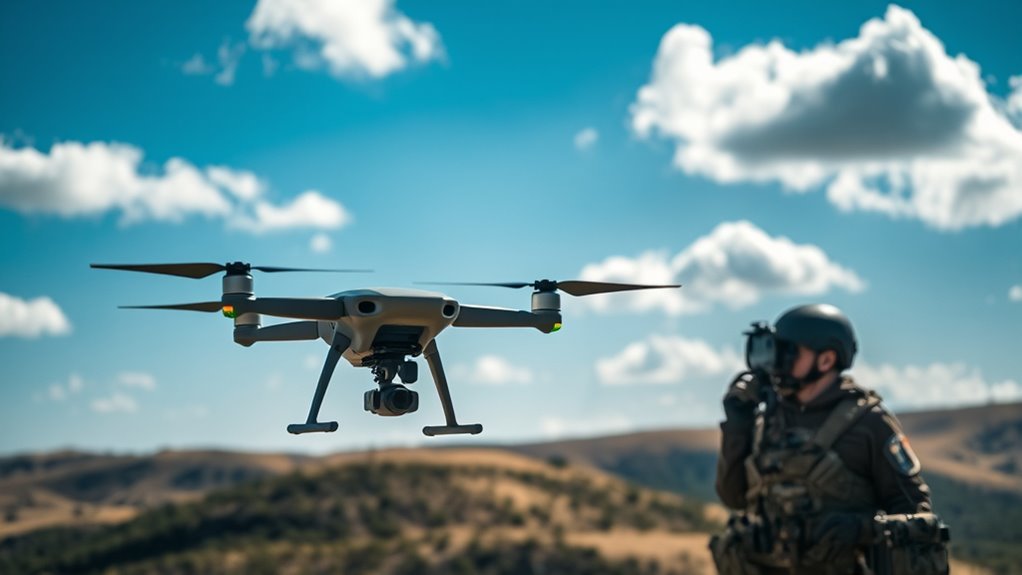
Visual identification techniques form a critical component of drone detection, enabling you to quickly and accurately recognize drone types and their operational intent. By analyzing visual cues and drone silhouettes, you can discern friend from foe while preserving your operational freedom. Focus on these four key elements:
Visual identification is essential for quickly recognizing drone types and discerning friend from foe.
- Shape Recognition: Identify distinct drone silhouettes such as quadcopters, hexacopters, or fixed-wing models.
- Movement Patterns: Observe flight behavior—hovering, rapid directional changes, or steady cruising.
- Size Estimation: Compare drone size relative to known objects to assess potential threat levels.
- Color and Markings: Note unique color schemes or markings that may reveal manufacturer or operator identity.
Mastering these visual identification techniques sharpens your situational awareness and enhances your ability to respond effectively.
Using Radio Frequency (RF) Detection
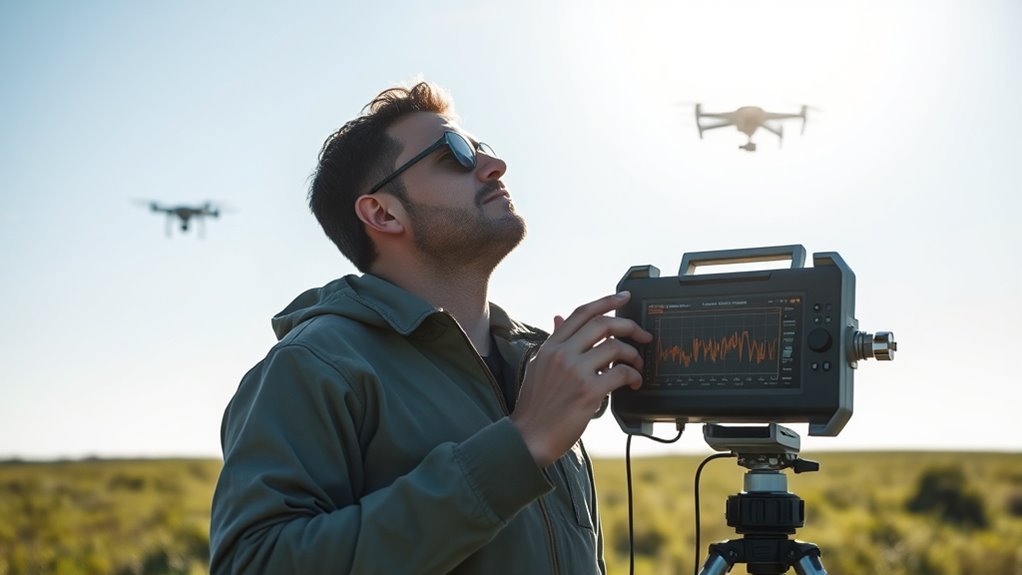
You’ll need to focus on RF signal identification to accurately detect drone communications. Monitoring the appropriate frequency ranges, typically between 2.4 GHz and 5.8 GHz, is critical for capturing drone transmissions. By analyzing these signals, you can distinguish drones from other RF sources in the environment.
RF Signal Identification
When you’re tasked with identifying drones through their radio frequency (RF) signals, you need to rely on specialized detection equipment that captures and analyzes the unique RF signatures emitted by drone controllers and drones themselves. Precision in rf interference analysis is essential to distinguish legitimate drone signals from background noise or other wireless devices. Understanding signal modulation techniques allows you to decode the transmission patterns unique to drones.
Key steps include:
- Capturing raw RF data with wideband receivers
- Filtering out noise using advanced rf interference analysis
- Identifying signal modulation schemes like frequency hopping or spread spectrum
- Matching observed patterns to known drone communication protocols
Frequency Range Monitoring
Building on the identification of drone-specific RF signatures, monitoring the frequency ranges where these signals operate sharpens detection accuracy. You’ll focus on the typical bands drones use, often between 2.4 GHz and 5.8 GHz, ensuring your detection system scans these with high resolution. Be aware of frequency interference from other devices, which can obscure or mimic drone signals, complicating identification. You need to analyze real-time frequency spectra to distinguish legitimate drone transmissions from noise. Signal attenuation caused by distance, obstacles, or environmental factors also affects detection reliability, so calibrate your system to compensate accordingly. By systematically monitoring these frequency ranges and accounting for interference and attenuation, you’ll enhance your capability to detect unauthorized drones, thereby protecting your airspace freedom without unnecessary disruptions.
Employing Radar Systems for Drone Detection
When employing radar systems for drone detection, you’ll need to focus on optimizing signal processing algorithms to accurately distinguish drones from other objects. Selecting the appropriate frequency band is critical for balancing range and resolution in various environments. Additionally, advanced target identification techniques help guarantee reliable classification and reduce false positives.
Radar Signal Processing
Although drones can be small and agile, radar signal processing techniques enable you to identify their unique motion patterns and radar cross-sections amidst cluttered environments. To confidently detect drones, focus on:
- Radar waveform analysis – Examine returned signals for specific drone signatures, separating them from birds or other objects.
- Signal to noise ratio (SNR) optimization – Enhance detection by maximizing SNR, critical for spotting low radar cross-section targets.
- Doppler processing – Differentiate moving drones from stationary clutter by analyzing frequency shifts caused by drone velocity.
- Clutter suppression algorithms – Implement adaptive filtering to reduce background noise and false alarms.
Frequency Band Selection
Radar signal processing sharpens your ability to distinguish drones from clutter, but selecting the appropriate frequency band lays the foundation for effective detection. You’ll want to choose bands where frequency modulation techniques minimize signal interference, enhancing target visibility. Higher frequency bands, like X or Ku, offer finer resolution, critical for detecting small drones, yet they’re more susceptible to atmospheric attenuation. Lower bands provide better range but may struggle with resolution and clutter. Balancing these trade-offs depends on your operational environment and freedom requirements. Employing adaptive frequency modulation reduces interference from other RF sources, preserving signal integrity. By carefully selecting frequency bands attuned to your detection goals, you enhance radar sensitivity and reliability, empowering you to maintain situational awareness and freedom from aerial threats.
Target Identification Techniques
Effective target identification techniques are essential for distinguishing drones from other aerial objects within radar data. To accurately detect drones, you need robust target recognition methods combined with advanced drone classification strategies. Here’s what to focus on:
- Radar Signature Analysis: Examine unique radar cross-section patterns to differentiate drones from birds or aircraft.
- Doppler Shift Evaluation: Use velocity data to identify typical drone flight speed and maneuvering characteristics.
- Micro-Doppler Signatures: Detect rotor blade movements, a distinct feature in drone radar returns.
- Multi-Sensor Fusion: Integrate radar data with infrared or acoustic sensors for enhanced classification accuracy.
Employing these precise techniques provides you the freedom to effectively monitor and respond to drone activities, ensuring reliable target identification in complex airspaces.
Acoustic Sensors and Sound Analysis
When you need to identify drones in complex environments, acoustic sensors offer a unique advantage by capturing the distinct sound signatures of drone motors and propellers. These sensors analyze acoustic signatures through sound frequency patterns, enabling detection even in visually obstructed areas. By isolating these frequencies, you can differentiate drones from other ambient noises, granting you freedom to monitor airspace covertly and effectively.
| Parameter | Description | Typical Range |
|---|---|---|
| Sound Frequency | Frequency of drone propeller noise | 200 Hz – 5 kHz |
| Sensor Type | Microphones or arrays | Directional & Omni |
| Signal Processing | FFT, filtering, noise reduction | Real-time algorithms |
| Detection Range | Maximum effective distance | 100 – 300 meters |
| Identification | Acoustic signature matching | Database-driven |
This precise analysis guarantees accurate drone detection without visual dependency.
Integrating Thermal Imaging Cameras
How can thermal imaging cameras enhance your drone detection capabilities? By capturing infrared radiation, these cameras reveal heat signatures invisible to the naked eye, allowing detection regardless of lighting or weather conditions. To optimize integration, focus on:
- Selecting cameras with high thermal resolution for detailed heat pattern differentiation.
- Performing rigorous camera calibration to maintain accuracy across varying environmental factors.
- Positioning cameras strategically to cover probable drone flight paths without blind spots.
- Utilizing real-time thermal data processing algorithms to distinguish drones from other heat sources.
This approach grants you precise, reliable detection freedom, even in challenging environments. Proper calibration and thermal resolution guarantee your system identifies drones swiftly, minimizing false positives and maximizing response effectiveness.
Combining Multiple Detection Technologies for Accuracy
Thermal imaging cameras provide valuable data by detecting heat signatures, but relying on a single technology can leave gaps in detection accuracy. To achieve reliable drone detection, you need multi sensor integration, combining radar, RF scanners, acoustic sensors, and thermal imaging. This technology fusion creates a thorough detection network, compensating for individual sensor weaknesses. For example, radar excels at long-range tracking, while acoustic sensors detect unique drone sounds at close range. Integrating these data streams allows you to cross-verify detections, reducing false positives and enhancing situational awareness. By fusing multiple technologies, you maintain operational freedom without blind spots, ensuring drones are consistently identified regardless of environmental conditions or stealth tactics. This layered approach is essential for robust and accurate drone detection systems.
