

If you’re looking at the DJI FPV drone, you’ll appreciate its aerodynamic design and stable, responsive flight controls that support sharp turns and smooth hovering. Its camera offers high-resolution 4K video at 60fps with effective image stabilization, perfect for crisp footage. Battery life stands around 20 minutes with fast charging options, while the ergonomic controller delivers precise handling and customizable settings. DJI’s robust software and accessories enhance usability and durability. Keep exploring to understand how it matches up with competitors and its value proposition.
Design and Build Quality
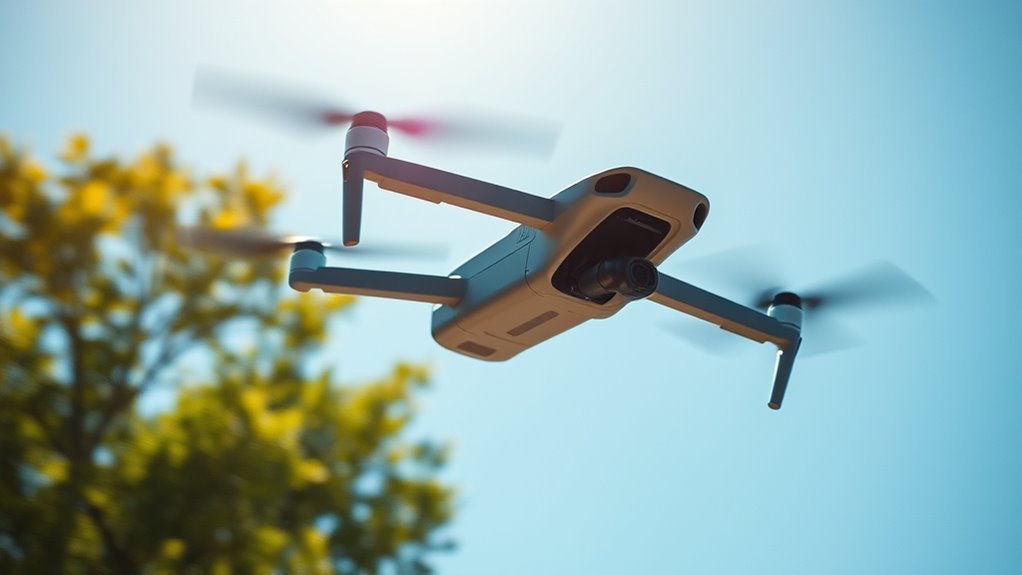
The design of the DJI FPV drone prioritizes aerodynamic efficiency and durability, featuring a compact frame constructed from reinforced composite materials. You’ll notice the material quality is carefully selected to withstand impacts while maintaining a lightweight profile essential for agile flight. The drone’s ergonomic design guarantees comfortable handling during transport and setup, with intuitive placement of components aiding quick maintenance and battery swaps. Its streamlined shape reduces air resistance, enhancing stability without compromising strength. This balance between toughness and weight allows you to experience freedom in flight without worrying about structural fragility. Every element, from the reinforced arms to the protective canopy, contributes to a build that supports aggressive maneuvers and enduring use, making the DJI FPV a reliable platform for your aerial adventures.
Flight Performance and Handling
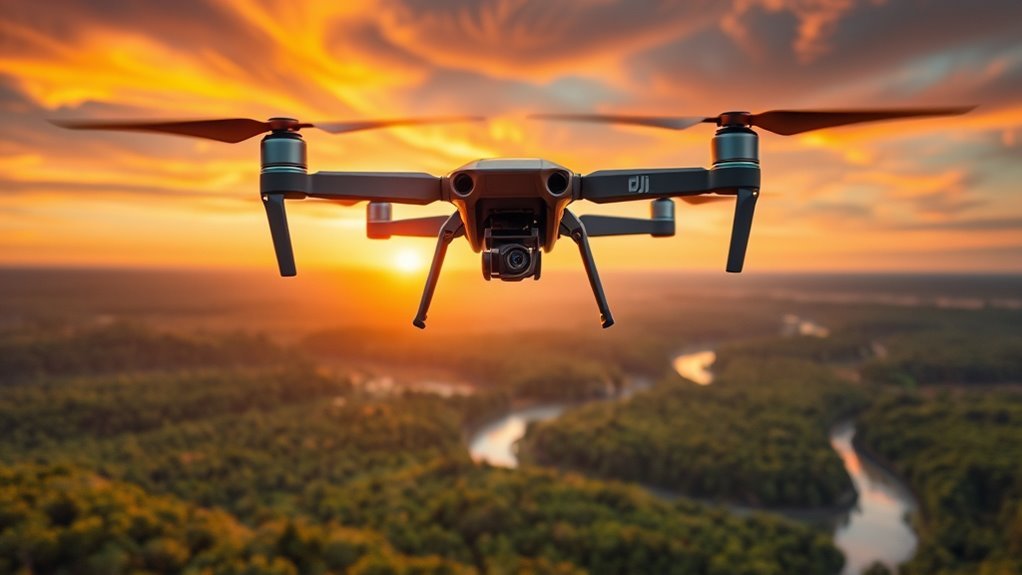
Although mastering the DJI FPV drone’s controls may require some practice, you’ll find its flight performance impressively responsive and stable. Agility testing shows rapid acceleration and precise turns, while maneuverability analysis highlights smooth shifts between flight modes. This balance offers you freedom to explore dynamic aerial paths confidently.
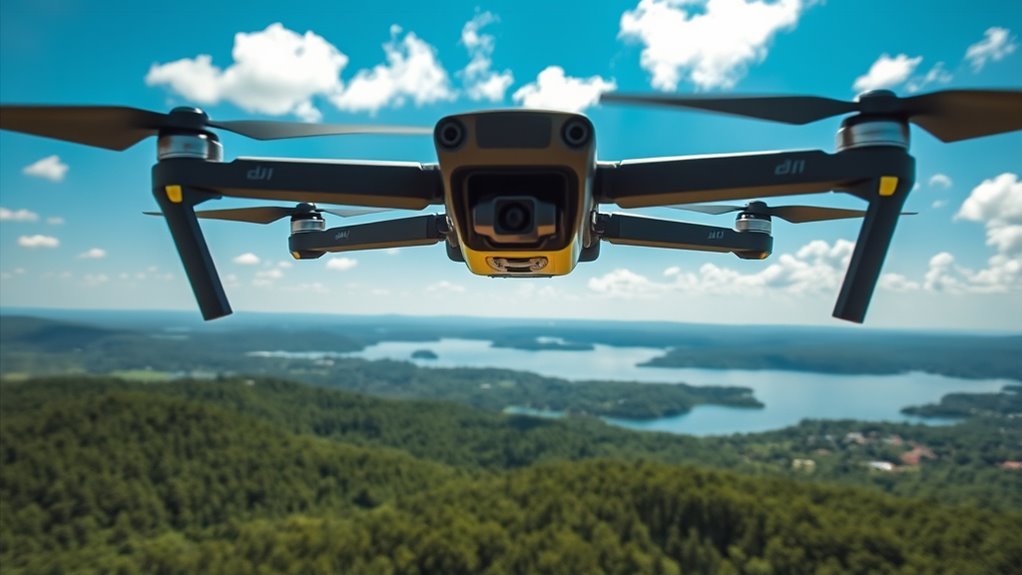
| Flight Aspect | Performance Outcome |
|---|---|
| Agility Testing | Sharp turns, quick responsiveness |
| Maneuverability Analysis | Smooth mode shifts, controlled hovering |
| Stability | Consistent hover, minimal drift |
The drone’s handling caters to both enthusiasts seeking thrilling maneuvers and those prioritizing steady flight. You’ll appreciate the intuitive control layout that supports complex flight dynamics without overwhelming you.
Camera Specifications and Video Quality
You’ll want to examine the sensor type and resolution to understand the image quality the DJI FPV drone can deliver. Pay close attention to the frame rate capabilities, as they determine how smoothly motion is captured in various shooting scenarios. Additionally, consider the image stabilization features, which play an essential role in minimizing blur and maintaining video clarity during flight.
Sensor Type and Resolution
When choosing a DJI FPV drone, understanding the sensor type and resolution is essential because these factors directly affect image clarity and video quality. The sensor specifications determine how much light the camera can capture, influencing performance in various lighting conditions. DJI FPV drones typically use CMOS sensors, known for their efficiency and dynamic range. Resolution impacts the level of detail recorded; higher resolution sensors capture finer details and allow for more flexibility in post-production cropping without noticeable degradation. However, ultra-high resolution can increase file sizes and processing demands. Balancing sensor size and resolution guarantees you get sharp, vibrant footage while maintaining smooth operation. Knowing these technical details helps you make an informed choice, giving you the freedom to capture immersive aerial content with precision and clarity.
Frame Rate Capabilities
Frame rate capabilities play an essential role in defining the smoothness and quality of video footage captured by DJI FPV drones. When evaluating frame rate comparison, you’ll find that DJI FPV models typically support 60fps at 4K resolution and up to 120fps at 1080p. This flexibility lets you choose higher frame rates for capturing fast-moving scenes with clarity or lower rates for cinematic effects. If you want to emphasize detailed motion, slow motion footage becomes possible by recording at 120fps and playing back at standard 30fps, enhancing your creative freedom. Understanding these frame rate options is vital because they directly impact how fluid and immersive your aerial videos appear, letting you tailor the output precisely to your shooting style and desired video quality.
Image Stabilization Features
Although DJI FPV drones are designed for high-speed flight, their image stabilization features guarantee that your footage remains steady and clear even during rapid maneuvers. The drones employ advanced image stabilization technology that combines electronic stabilization with gyro based stabilization to counteract vibrations and sudden movements. This dual approach guarantees minimal blur and jitter, capturing smooth, immersive video even when pushing the drone to its limits. The gyro based stabilization constantly detects angular velocity changes, allowing real-time correction of camera orientation. Meanwhile, electronic stabilization algorithms adjust the image frame to maintain clarity without compromising field of view. For pilots who crave freedom and dynamic flight, these stabilization features facilitate professional-grade video quality without restricting aggressive flying styles.
Battery Life and Charging Options
Since battery performance directly impacts your flight experience, understanding the DJI FPV drone’s battery life and charging options is vital. The drone’s 2000mAh LiPo battery provides around 20 minutes of flight, balancing weight and power density for peak freedom. Charging speed is essential—you’ll appreciate the included fast charger that refuels the battery in about 1 hour, minimizing downtime. For extended sessions, you can use multiple batteries with the dedicated charging hub.
| Feature | Specification |
|---|---|
| Battery Capacity | 2000mAh LiPo |
| Flight Time | Approx. 20 minutes |
| Charging Speed | ~1 hour (fast charger) |
| Charging Hub | Supports 3 batteries |
This combination guarantees efficient battery management, letting you focus on the thrill of flight without frequent interruptions.
Controller Features and Connectivity
Battery performance sets the foundation for your flight duration, but how you control the DJI FPV drone is equally important. The controller layout is thoughtfully designed with an ergonomic design, guaranteeing comfort during extended flights. You’ll appreciate the customizable settings that let you tailor button functions and sensitivity to your preferences. Connectivity options include robust Wi-Fi and proprietary transmission protocols, providing a wireless range that supports dynamic maneuvering without latency issues. Control responsiveness remains sharp, essential for real-time adjustments and immersive piloting. Compatibility features guarantee the controller works seamlessly with various DJI FPV models and accessories, enhancing versatility. Overall, the controller’s technical attributes maximize your operational freedom, allowing precise, uninterrupted control while you push the drone’s limits in diverse environments.
Safety Features and Flight Modes
Several advanced safety features and flight modes are integrated into the DJI FPV drone to enhance pilot control and protect your investment. These systems balance your desire for freedom with essential safeguards to guarantee user safety and compliance with flight restrictions. The drone’s GPS accuracy supports precise return home functions, while fail safe mechanisms trigger emergency landing procedures if signal or battery issues arise. Obstacle avoidance sensors help prevent collisions during high-speed maneuvers. Flight speed and altitude limits can be customized, giving you control without compromising safety. Battery protection monitors power levels to avoid sudden drops.
DJI FPV integrates advanced safety features and flight modes for enhanced control, protection, and compliance during every flight.
- Emergency landing triggers during critical failures
- Obstacle avoidance for dynamic in-flight hazard detection
- Return home with GPS precision and auto-navigation
- Adjustable flight speed and altitude limits per user preference
- Fail safe mechanisms and battery protection for reliable operation
Software and App Integration
When you connect your DJI FPV drone to its dedicated app, you gain access to an extensive suite of flight controls, real-time telemetry, and customizable settings. The app usability is designed for intuitive navigation, allowing you to adjust parameters like flight modes, camera settings, and gimbal control with ease. It provides live video streaming and detailed battery and signal status, enabling precise situational awareness. Regular software updates are pushed through the app, ensuring your drone’s firmware stays current with performance enhancements and bug fixes. These updates also expand functionality, granting you ongoing improvements without hardware changes. Overall, the seamless integration between the drone and its app offers you freedom to tailor your flight experience while maintaining excellent operational control and safety.
Accessories and Customization
A variety of accessories are available to enhance the functionality and versatility of your DJI FPV drone, allowing you to customize it according to specific flight needs and preferences. When exploring FPV customization options, you’ll find custom drone accessories that can optimize performance and flight experience. Consider these enhancements:
- Replacement propellers for varied flight dynamics
- Upgraded batteries for extended flight time
- Protective canopies and guards for durability
- Custom gimbals or mounts for camera stability
- Signal boosters to maintain strong video transmission
These components allow you to tailor your drone precisely, offering the freedom to adapt to diverse environments and flying styles. By selecting the right accessories, you maximize your drone’s potential without compromising its technical integrity or flight safety.
Comparison With Other FPV Drones
Although DJI FPV drones offer a well-rounded combination of speed, camera quality, and ease of use, you might want to compare their specifications and features against other popular FPV models to determine which best fits your flying style and technical requirements. User feedback highlights DJI’s intuitive controls and integrated safety features, contrasting with the more modular designs favored by traditional FPV racers. Design comparisons reveal DJI’s emphasis on aerodynamic stability and cinematic shots, whereas competitors prioritize customizable frames and raw agility. A thorough competitive analysis shows DJI’s strength in seamless user experience and out-of-the-box readiness, while other brands excel in customization and extended flight times. Understanding these nuances helps you select an FPV drone that aligns with your freedom to explore and technical expectations.
Pricing and Value for Money
When evaluating the DJI FPV drone, you’ll want to compare its cost against similar models to understand its market position. Assess how the included features justify the price, especially regarding camera quality, flight performance, and safety systems. Additionally, consider potential long-term benefits like durability and software updates that might enhance your overall investment.
Cost Comparison Overview
Three primary Dji FPV drone models stand out regarding cost, each offering distinct features that influence their price points and overall value. When you evaluate the cost breakdown, you’ll notice varying budget considerations depending on your needs and flying style.
Here’s what you should consider:
- Base model prices reflect core FPV capabilities suitable for beginners.
- Advanced kits include extra accessories, increasing upfront costs.
- Replacement parts and firmware updates impact long-term expenses.
- Battery life and charging solutions influence ongoing investment.
- Warranty and customer support add intangible value to your purchase.
Features vs. Price
Understanding the cost breakdown of DJI FPV drones sets the stage for evaluating how their features align with price points. When conducting a price comparison, you’ll notice the DJI FPV balances advanced flight capabilities with integrated safety features, such as obstacle sensing and multiple flight modes. The feature analysis reveals a robust 4K/60fps camera, low-latency video transmission, and customizable controls that justify the premium. While the initial price might seem steep compared to entry-level drones, the technology-packed design offers substantial value for enthusiasts seeking precision and freedom in flight. If you prioritize responsive handling and immersive FPV experience, the DJI FPV’s cost is aligned with its high-performance components and user-centric innovations, making it a compelling option in its category.
Long-Term Investment Benefits
Although the upfront cost of a DJI FPV drone may be considerable, its long-term investment benefits often outweigh the initial expense for serious users. When evaluating value for money, consider these factors that contribute to overall cost-efficiency and user freedom:
- Resale value: DJI drones maintain strong resale prices due to brand reputation and demand.
- Long term durability: Robust build quality reduces frequency of replacements.
- Maintenance costs & repair options: Accessible repair services and readily available parts minimize downtime and expenses.
- Software updates & upgrade potential: Regular firmware improvements and modular upgrades extend device lifespan.
- User community: An active global user base offers support, sharing insights to optimize performance and troubleshooting.
These aspects guarantee your investment remains viable and adaptable, delivering sustained value beyond initial purchase.
