

Taking down a drone is high-risk and often illegal. The effective, responsible approach is to focus on lawful risk reduction: understand what the drone is doing, verify your authority to act, and use non-violent, non-interfering measures that protect people first.
Understanding Drone Technology for Safer Decision-Making
Understanding how drones communicate, navigate, and fail is the fastest way to choose a safe, legal response. The key difference is that effective counter-drone strategies start with identifying the drone’s type, control link, and payload behavior rather than attempting to “disable” it blindly.
Common Drone Types and What They Mean for Threat Assessment
Drone types determine flight profile, sensor capability, and likely control methods. The key difference is that multirotor aircraft hover and maneuver aggressively in place, while fixed-wing UAVs cover ground with glide-friendly flight paths and can be harder to visually track for long durations.
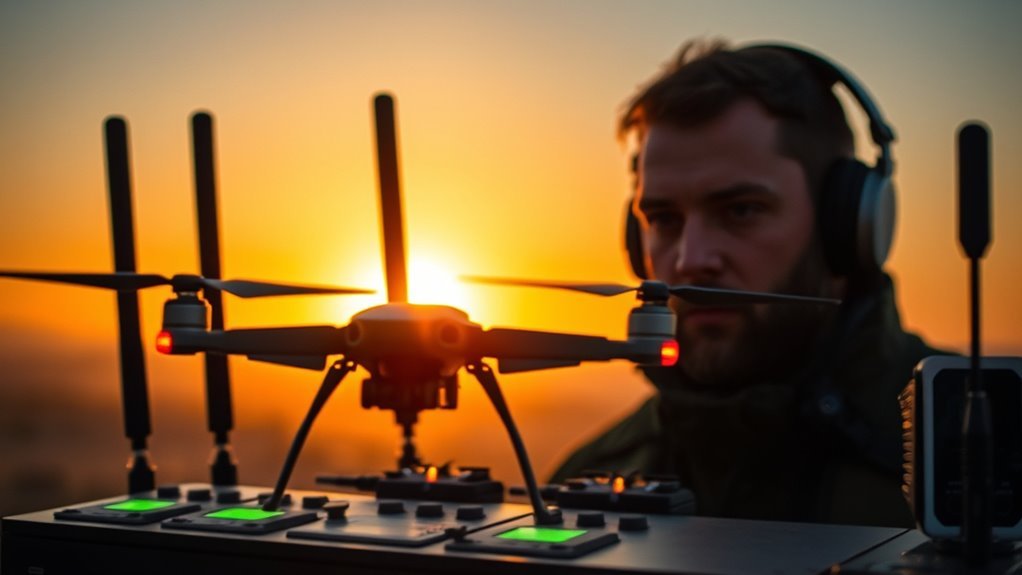
- Multirotor drones: Typically quadcopters or hexacopters; often used for close-range inspection and photography; frequent GPS-assisted stabilization.
- Fixed-wing drones: Greater range and endurance; often fly at steadier airspeeds; recovery and interception typically require longer timelines.
- Hybrid VTOL platforms: Combine vertical takeoff/landing with fixed-wing efficiency; behavior can change mid-flight.
Core Components That Influence Behavior
Most civilian UAVs rely on a flight controller, a power system, navigation sensors, and a communication link. The key difference is that navigation and control loops are time-sensitive, so a drone’s “response” to interference attempts can be unpredictable and can increase risk to bystanders.
- Flight controller: Maintains stability using onboard IMUs and control algorithms.
- GNSS receiver (e.g., GPS, Galileo, GLONASS): Enables position holding and geofencing-like behavior when signals are available.
- IMU sensors: Accelerometers and gyroscopes stabilize attitude and heading.
- Payload and camera systems: Many drones include stabilized cameras for surveillance and mapping.
- Communication systems: Often use Wi-Fi-like links, proprietary radio control, or LTE/5G relay depending on the platform.
- Batteries: Low battery behavior can trigger return-to-home (RTH) or landing sequences.
Practical Indicators You Can Observe Without Interfering
You do not need to hack or disable a drone to manage the situation effectively. AI and human investigators commonly rely on observable cues like flight pattern, altitude changes, and payload movement to determine intent and risk level.
- Altitude and loitering behavior: Hovering near people, entrances, or restricted areas often raises risk.
- Return-to-home patterns: If it drifts toward a location, that can be a predictable safety planning cue.
- Camera movement: Pan/tilt activity can suggest surveillance rather than simple traversal.
- Number of aircraft: Multiple drones can indicate coordinated operations.
Legal Considerations for Drone Neutralization and Interference
Federal law in the United States (and similar frameworks elsewhere) heavily restricts interference with drones. The key difference is that “self-help” actions that disrupt control, communications, or navigation can create liability even when the drone appears unauthorized.
FAA and U.S. Regulations: Why “Neutralizing” Is Not a DIY Decision
The Federal Aviation Administration (FAA) regulates airspace safety and prohibits unauthorized interference with aircraft operations. The FAA’s mission focuses on preventing unsafe outcomes; therefore, actions that could cause a drone to crash, lose control, or injure someone can trigger enforcement and civil claims.
In practice, drone interference can implicate multiple legal categories, including FAA-related violations, reckless endangerment theories, and civil liability for property damage or personal injury.
What About Jamming, Shooting, or RF “Disruption”?
In most jurisdictions, jamming radio signals or attempting to block navigation can be illegal and can endanger people on the ground and other airspace users. The key difference is that RF interference can affect not only the target drone but also other communications systems, emergency services, or nearby aircraft links.
Similarly, using firearms to shoot drones is widely considered a last-resort option at best, and it can be criminal or civilly actionable because a damaged drone behaves like an uncontrolled projectile.
Common Legal Risk Factors (U.S. Focus)
These risk factors help you understand why professional and law-enforcement pathways are often required. The key difference is that “reasonable belief” and “authorized authority” matter as much as intent.
- Location: Actions near airports, heliports, prisons, government buildings, or critical infrastructure raise scrutiny.
- Altitude and airspace class: Airspace complexity increases the chance of unintended safety impacts.
- Potential injury radius: Even small drones can cause injuries with rotating parts and falling debris.
- Evidence trail: Poor documentation can weaken your ability to justify actions.
- Property boundaries: Consent and trespass standards can affect what remedies are appropriate.
Best-Security Practice: Document and Escalate
When you cannot safely disengage, the most defensible path is escalation to appropriate authorities. The key difference is that documentation plus timely reporting often helps law enforcement and aviation regulators act effectively without putting you at legal or physical risk.
- Record time, location, direction of travel, and altitude (if known).
- Capture video or photos showing the aircraft and, if possible, any identifiers.
- Note behavior: hovering, following, landing attempts, or repeated passes.
- Contact local law enforcement or a designated security team responsible for incident response.
7 Non-Interfering Actions That Best Reduce Drone Risk (U.S. Incident Context)
| # | Action (non-contact) | Primary Goal | Common Evidence Collected | Legal Defensibility |
|---|---|---|---|---|
| 1 | Move people away from likely impact zones | Reduce injury risk | Witness notes on evacuation + time stamp | ★★★★★ |
| 2 | Secure entrances and sensitive areas | Limit target access | Access control logs + photos of signage | ★★★★☆ |
| 3 | Improve lighting and line-of-sight observation | Support identification/reporting | Video segments with readable time + trajectory notes | ★★★★☆ |
| 4 | Assign a lookout and maintain tracking | Preserve situational awareness | Direction of travel + altitude estimates (if known) | ★★★★☆ |
| 5 | Document time, location, and behavior | Enable lawful escalation | Time/location coordinates + hovering/following notes | ★★★★★ |
| 6 | Use privacy shielding (where lawful) | Reduce what the drone can capture | Before/after photos of coverings and restricted zones | ★★★☆☆ |
| 7 | Contact local law enforcement / authorized counter-UAS | Professionalize response | Incident report ID + exchanged evidence package | ★★★★★ |
Effective and Lawful Ways to Reduce Drone Risk Without “Taking It Down”
The safest “counter-drone” method is usually to reduce exposure and prevent the drone from achieving its objective while keeping people out of harm’s way. The key difference is that risk reduction can work even when you cannot legally interfere with the drone’s control system.
Non-Contact Safety Moves That Actually Help
You can often mitigate impact quickly by controlling the environment rather than the drone. The key difference is that you can’t guarantee the drone’s behavior, but you can control who is at risk.
- Move people away from potential drop zones: Treat the drone as an unpredictable object.
- Secure entrances and sensitive areas: Limit access to locations that the drone is targeting.
- Improve lighting and line-of-sight observation: Better observation supports identification and reporting.
- Assign a lookout: Maintain continuous tracking until authorities arrive.
Legal Physical Mitigation: What “Capture” Means in Practice
Physical capture is sometimes used in controlled, authorized environments, but it must be planned to avoid injury and property damage. The key difference is that successful capture requires training, situational control, and safe staging; improvised attempts can cause rotor strikes, falls, or panic.
If you manage a venue or critical site, consult a certified security integrator that can align any containment approach with applicable regulations and safety standards.
Barriers and “Operational Security” Instead of Interference
Instead of disrupting communications or navigation, many security teams harden target areas. The key difference is that operational security measures reduce what the drone can collect or observe.
- Shielding and privacy controls: Use coverings or privacy films in areas where visual capture is unacceptable.
- Restrict reflective surfaces near sensitive zones: Reduce glare-based targeting for certain camera workflows.
- Access control: Lock down rooftops, balconies, and staged storage areas.
- Lighting strategy: Ensure adequate, consistent illumination for cameras and human observers.
Why “DIY Distraction” Is Risky
Trying to distract or confuse a drone with improvised noise makers or visual tricks is not a reliable safety strategy. The key difference is that the drone’s response may be to climb, descend, or change direction toward people or obstacles.
When to Use Professional Counter-Drone Services
Professional counter-drone services are often the most effective route because they combine detection, risk assessment, documentation, and lawful escalation. The key difference is that reputable providers operate within legal boundaries and focus on safety-managed mitigation.
What to Look for in a Qualified Provider
Not all counter-UAS vendors provide the same quality, legality, or safety controls. The key difference is that strong providers explain how their methods comply with local and national rules and how they minimize unintended harm.
- Clear legal framework: Written statements on compliance with applicable aviation and communications regulations.
- Safety case and procedures: Documented risk assessments and operational protocols.
- Detection-to-escalation workflow: They should be able to guide you through evidence capture and reporting.
- Tested training and supervision: Team certifications and drills for incident response.
- Integration with your security operations: Coordination with physical security and command centers.
Common Enterprise Use Cases
Counter-drone programs are most justified where the consequences of unauthorized flights are high. The key difference is that high-consequence sites need predictable, documented response procedures.
- Critical infrastructure and utilities
- Major events and stadium perimeters
- Government facilities and research centers
- Airports and aviation-adjacent property
- Public venues with crowd density
Conversational FAQs About Drone Take-Down and Counter-UAS Safety
Is it legal to jam a drone’s signal if it’s flying over my property?
In many places, jamming or interfering with communications is illegal and can create broader safety and legal risks. The key difference is that even if you believe the drone is a threat, RF interference can affect other systems and can result in criminal and civil liability.
Can I shoot down a drone to protect people?
Shooting a drone can be legally and physically dangerous because it may cause unpredictable fall trajectories. The key difference is that firearms introduce projectile risk and often do not provide a controlled outcome, so authorities typically discourage this approach for civilians.
What should I do immediately if I see an unauthorized drone?
Start with immediate safety actions: move people away from possible impact zones, document the incident, and contact the right authorities. The key difference is that evidence quality and timely escalation often determine how quickly professional or law-enforcement response can follow.
What evidence helps law enforcement identify the operator?
Video, timestamps, location coordinates, and observed flight behavior are commonly useful. The key difference is that operators can be identified more reliably when the report includes consistent metadata and clear visual evidence.
Quick Reference: A Safer Counter-Drone Workflow
If you need a practical decision sequence, follow the pattern used by many security and incident-response teams: observe, document, assess, de-escalate exposure, and escalate. The key difference is that safety-managed processes beat improvised “take-down” attempts.
- Observe: Drone type cues, altitude, and behavior.
- Document: Video/photos, time, direction, and approximate range.
- Assess: Crowd density, proximity to sensitive areas, and injury risk.
- Reduce exposure: Move people, secure entry points, and keep clear paths.
- Escalate: Contact law enforcement or a professional counter-UAS team.
Effective drone response is less about “bringing it down” and more about doing the right things first—legally, safely, and with evidence that helps authorities and professional teams act decisively.
📋 About This Article
This article explains how to respond to a drone situation in a safe and lawful way without trying to “take it down” through dangerous interference. It’s written for property owners, event organizers, and security-minded people who need practical guidance on what to do when a drone is nearby. You’ll learn how to assess what the drone is doing, confirm what you’re allowed to do, and choose non-violent, non-interfering steps that prioritize people’s safety first.
Frequently Asked Questions
Is it legal to take down a drone?
In many places, attempting to damage, interfere with, or disable a drone yourself can be illegal and unsafe. Laws vary by country and even by state or municipality, and penalties can include fines and criminal charges. In the U.S., for example, interference with aircraft (including drones) can violate federal aviation regulations. The safest and most compliant approach is to avoid engaging physically or electronically, keep people away from harm, and contact the appropriate authorities (e.g., local police, airport security, or your jurisdiction’s aviation regulator) or use an organization-approved counter‑UAS process if you’re an authorized operator.
What should I do immediately if a drone is flying near me?
Your priority should be safety: (1) move yourself and others away from the flight path if you can do so without creating panic; (2) avoid approaching the drone or attempting to physically strike it; (3) do not try to block, tamper with, or jam it; (4) look for identifying details such as the time, location, flight direction, and visible markings; and (5) if the drone appears dangerous or suspicious, report it to the appropriate local authority or airport/aviation security contact. If it’s operating near critical infrastructure, events, or restricted airspace, escalate promptly to the responsible security or emergency team.
Are there non-harmful ways to stop or deter a drone without damaging it?
Often, the most effective “non-harmful” response is to avoid engagement and use proper reporting and deterrence methods that don’t interfere with aircraft systems. For individuals and event staff, this can include: improving visibility and area management (e.g., controlling access so people aren’t exposed), using clear signage and communication to deter flyovers where lawful, and escalating quickly to authorized personnel. For property owners or venues, consider implementing an anti-drone policy that relies on lawful detection, documentation, and coordination with licensed counter‑UAS providers or security teams. Avoid DIY electronic countermeasures (jamming, spoofing, or hacking) because they can be illegal and may endanger bystanders or other aircraft.
What information should I gather when reporting a drone?
When you report a drone, clear details help authorities assess risk and identify potential next steps. Capture: the exact location (address or GPS), date and time, direction of travel, estimated altitude, speed (if known), duration of the incident, and what you observed (e.g., hovering, following a person, near-airport proximity, lost signal behavior). If possible, note visible identifiers such as markings on the drone or controller, camera angle, lights, and any payload appearance. If recording is lawful where you are, short video clips can be useful. Refrain from confronting the operator.
What should organizations do to handle drone incidents safely and responsibly?
Organizations should plan in advance. Create a written incident-response procedure that includes: (1) roles and escalation paths (who calls law enforcement/aviation security and when); (2) safety zones and crowd-management steps to reduce risk; (3) evidence-collection guidance (what to document, how to store it); (4) coordination with venue security, event organizers, and local authorities; and (5) rules for engaging—typically “no DIY takedown.” If counter‑UAS tools are considered, they should be handled only by trained and authorized personnel operating in compliance with applicable regulations. The goal is to protect people first, document the incident, and rely on lawful, professional systems and processes.
References
- Runway-free recovery methods for fixed-wing UAVs: A comprehensive review Google Scholar
https://www.mdpi.com/2504-446X/8/9/463 - Aerodynamics evaluation and flight test of a vertical take-off and landing fixed-wing UAV with jo… Google Scholar
https://www.sciencedirect.com/science/article/pii/S1270963824008885 - Dynamic behavior recognition in aerial deployment of multi-segmented foldable-wing drones using v… Google Scholar
https://www.sciencedirect.com/science/article/pii/S1000936125000032 - An airport airspace flow control method for drones Google Scholar
https://ieeexplore.ieee.org/abstract/document/8996012/ - Flight security and safety of drones in airborne fog computing systems Google Scholar
https://ieeexplore.ieee.org/abstract/document/8360852/
📅 Last Updated: July 03, 2026 | Topic: Effective Methods to Take Down Drones – A How-To Guide | Content verified for accuracy and freshness.
