

Your drone’s flight range hinges on its model, battery capacity, and advanced power management, all affecting endurance and signal strength. Transmission frequency and antenna design shape connectivity, with environmental obstacles and weather conditions weakening signals. Controller quality and regulatory limits further constrain how far you can fly. Signal boosters can help extend this range within legal boundaries. Understanding these factors in detail reveals how to optimize your drone’s operational distance and reliability effectively.
Impact of Drone Model and Technology
Drone model and technology are critical determinants of flight distance, directly affecting performance metrics such as battery efficiency, aerodynamics, and signal range. When you select a drone, understanding how drone innovation shapes these factors is essential. Technological advancements in lightweight materials and streamlined designs reduce drag, allowing your drone to maximize energy use. Additionally, improvements in battery chemistry boost capacity and discharge rates, extending flight duration without increasing weight. Advanced flight controllers optimize power management and stabilize navigation, ensuring efficient route execution. You’ll find models equipped with high-performance motors that sustain longer flights under various environmental conditions. Embracing these technological advancements gives you the freedom to explore greater distances confidently, as your drone’s capabilities align precisely with your need for extended operational range and reliable performance in diverse scenarios.
Role of Transmission Frequency and Signal Strength
Although advanced drone models can enhance flight distance, the effectiveness of transmission frequency and signal strength plays an equally vital role in maintaining control and data link integrity over long ranges. To maximize your drone’s operational freedom, consider these significant factors:
- Frequency bands: Lower frequency bands (e.g., 900 MHz) offer better penetration through obstacles but limited bandwidth, while higher bands (e.g., 5.8 GHz) provide higher data rates with reduced range.
- Transmission modulation: Efficient modulation schemes like QAM or OFDM improve data throughput and resistance to interference.
- Signal strength: Stronger signals reduce packet loss and latency, essential for stable long-distance control.
- Environmental interference: Urban or congested RF environments degrade signal quality, limiting effective range despite high transmission power.
Optimizing these parameters guarantees you maintain robust communication, granting you the freedom to explore farther.
Influence of Battery Life and Power Management
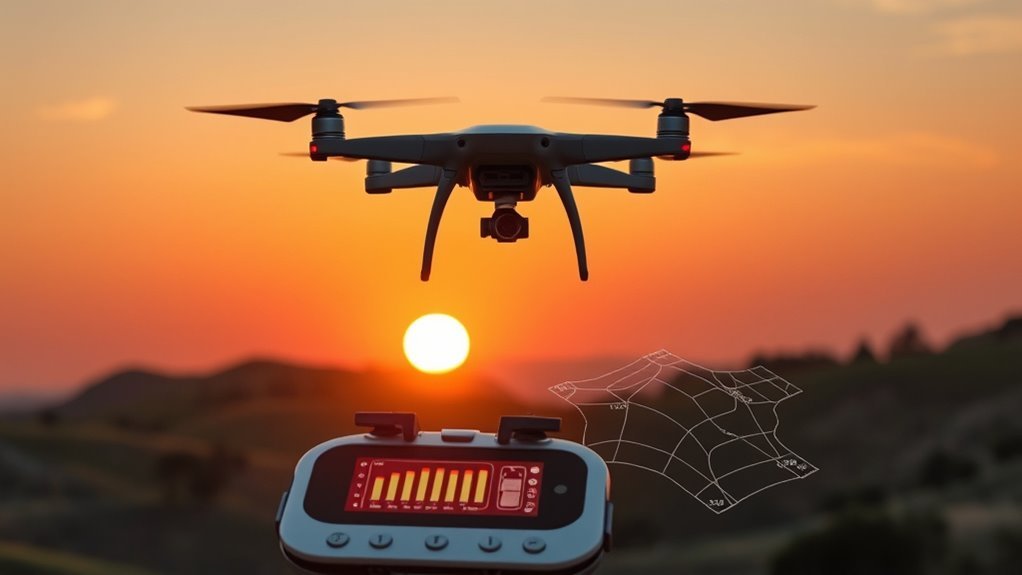
You need to evaluate how battery capacity directly limits your drone’s maximum flight distance by defining the total available energy. Efficient power management strategies can optimize energy consumption, extending operational time without increasing battery size. Understanding these factors is essential to balance weight, performance, and endurance in your drone design.
Battery Capacity Impact
Battery capacity fundamentally determines how far a drone can travel before requiring a recharge, as it directly influences flight duration and power availability. When you’re aiming for extended range, understanding how battery types and power management intersect is essential. Consider these factors:
- Battery Types: Lithium Polymer (LiPo) batteries offer high energy density, enabling longer flights compared to older NiMH batteries.
- Capacity Rating: Measured in milliampere-hours (mAh), higher capacity means more stored energy but often adds weight.
- Weight vs. Energy Trade-off: Increasing capacity improves range but may reduce efficiency due to added mass.
- Power Management Systems: Effective regulation optimizes energy use, prolonging flight time without compromising performance.
Efficient Power Usage
While maximizing battery life is essential, efficient power usage hinges on how well the drone’s systems manage energy consumption throughout flight. You need to understand that power efficiency directly affects the drone’s operational range. Advanced energy management protocols optimize motor output, sensor activity, and communication systems to minimize unnecessary power drain. For example, adaptive throttle control balances thrust and energy use, extending flight time without sacrificing performance. Additionally, intelligent routing algorithms can reduce power consumption by adjusting flight paths in real time. Efficient power usage isn’t just about having a large battery; it’s about how your drone’s onboard systems allocate energy. By prioritizing power efficiency and implementing precise energy management strategies, you’ll gain greater freedom to fly farther, longer, and with confidence in your drone’s endurance.
Effects of Environmental Obstacles and Terrain
You’ll need to account for signal interference caused by buildings, trees, and other obstacles that disrupt communication between the drone and controller. Terrain elevation changes can also affect flight distance by requiring additional power for altitude adjustments. Comparing urban and rural settings reveals distinct challenges in obstacle density and signal clarity that impact overall performance.
Signal Interference Sources
Although drones rely on radio signals for communication and control, their flight distance can be considerably limited by signal interference caused by environmental obstacles and terrain features. Understanding key interference sources is essential when aiming for maximum operational range:
- Physical Barriers: Buildings, trees, and terrain cause signal obstruction, weakening radio frequency transmission between controller and drone.
- Urban Infrastructure: Dense urban environments produce multipath interference as signals reflect off surfaces, causing degradation.
- Electromagnetic Interference: Nearby electronic devices emit electromagnetic noise, disrupting clean signal reception.
- Natural Obstacles: Hills, forests, and weather conditions absorb or scatter radio waves, further limiting effective range.
Terrain Elevation Impact
Signal interference caused by environmental obstacles naturally leads to contemplating how terrain elevation affects drone flight distance. When you operate a drone, varying terrain types—such as hills, valleys, and plateaus—can obstruct or reflect signal paths, reducing effective control range. Altitude variations play a critical role: flying over elevated terrain may temporarily block line-of-sight communication, forcing signal degradation or loss. Conversely, maintaining an altitude above surrounding terrain can enhance signal strength and extend range. Understanding these elevation dynamics enables you to optimize flight paths, ensuring uninterrupted connectivity. By analyzing topographic maps and planning routes that consider terrain elevation, you minimize signal disruptions caused by environmental obstacles, granting your drone greater freedom to explore expansive areas while maintaining reliable control throughout the mission.
Urban vs. Rural Settings
When operating drones, the environmental obstacles and terrain differences between urban and rural settings directly influence flight distance and signal reliability. Urban obstacles such as buildings, power lines, and dense infrastructure create signal interference and physical barriers, limiting how far your drone can fly from the controller. Conversely, rural openness offers fewer obstructions, enabling extended flight ranges and clearer communication.
Consider these factors:
- Signal attenuation due to urban obstacles increases with building density.
- Multipath interference caused by reflective surfaces disrupts control signals.
- Rural openness minimizes signal loss, promoting stable connectivity.
- Terrain variations in rural areas can still impact line-of-sight but generally less so than urban clutter.
Understanding these contrasts helps you maximize drone freedom by selecting environments that optimize flight distance and control reliability.
Importance of Controller Quality and Antenna Design
Because the controller serves as the primary interface between you and the drone, its quality directly affects flight distance and responsiveness. High controller durability guarantees consistent performance during extended flights and in varying environments, preventing signal degradation due to hardware failure. Equally critical is antenna placement on the controller; ideal positioning maximizes signal strength and reduces interference, extending your drone’s operational range. Controllers with adjustable or high-gain antennas allow you to fine-tune signal directionality, granting you greater control freedom. When these elements are engineered precisely, you experience fewer signal dropouts and improved latency, enabling your drone to maintain a stable link even at maximum distances. Prioritizing controller quality and antenna design is essential for accessing the full potential of your drone’s flight range and guaranteeing reliable communication.
Impact of Weather Conditions on Signal Range
Although drone technology has advanced considerably, environmental factors like weather conditions still play a critical role in limiting your drone’s communication range. The weather impact on signal degradation is multifaceted and can severely restrict how far your drone can fly from its controller. Consider these key weather-related influences:
- Rain and fog increase attenuation, weakening signal strength.
- High humidity causes signal scattering, reducing effective range.
- Wind can physically displace the drone, complicating line-of-sight maintenance.
- Temperature inversions create atmospheric layers that refract or block radio waves.
Understanding these factors helps you anticipate and mitigate signal loss, ensuring you maintain control and freedom during flight. Weather impact isn’t just a nuisance—it’s a primary constraint on your drone’s operational envelope.
Legal and Regulatory Restrictions on Flight Distance
While technological capabilities may allow your drone to fly considerable distances, legal and regulatory frameworks often impose strict limits on how far you’re allowed to operate it. Drone regulations vary by country and region, typically restricting flight distances to maintain safety, privacy, and airspace integrity. You must adhere to these regulations, which often require obtaining specific flight permissions for extended range operations. Failure to comply can result in penalties or confiscation of equipment. Additionally, controlled airspace and no-fly zones further constrain your drone’s operational radius. Understanding and maneuvering through these legal boundaries guarantees you maximize your drone’s potential without infringing on regulatory mandates. Staying informed about evolving drone regulations will empower you to fly confidently within lawful limits while exploring the full extent of your drone’s technical capabilities.
Benefits of Using Signal Boosters and Range Extenders
Maneuvering legal limits on drone flight distance often means working within strict boundaries, but you can extend your operational range by enhancing your drone’s communication link. Signal boosters and range extenders provide critical signal enhancements that improve link reliability and enable range optimization beyond default parameters. When you integrate these devices, you benefit from:
- Increased signal strength, reducing data loss and latency.
- Enhanced resistance to interference from environmental obstacles.
- Extended control distance, allowing you to operate farther within legal limits.
- Improved video transmission quality, maintaining real-time situational awareness.
