
You can only legally shoot down a drone if you’re authorized by federal agencies, as the FAA controls airspace and prohibits unauthorized interference. Even if a drone invades your privacy or poses a safety threat, shooting it down without proper authority can lead to serious criminal and civil penalties. Understanding when defensive action might be justified—and the serious risks involved—is essential if you want to protect your rights without breaking the law. Explore further to know your options.
Understanding Drone Laws in Your Area
Before considering any action against a drone, you need to thoroughly understand the specific laws governing drone use in your jurisdiction. Local drone regulations often vary greatly, reflecting community priorities and concerns. State drone laws may impose additional restrictions or permissions that can either broaden or limit your rights regarding drone interference. It’s critical you research both levels to avoid legal repercussions. Ignorance won’t protect you if you damage property or violate privacy laws. Focus on authoritative sources such as government websites or legal advisories to grasp the precise boundaries. Knowing these laws empowers you to safeguard your freedoms responsibly and guarantees any defensive measures you take against drones are compliant. Always prioritize legality to maintain your rights while respecting others’.
Federal Regulations on Disabling Drones
While state and local laws set the groundwork for drone regulation, federal rules strictly govern the disabling of drones nationwide. You need to understand that federal authority supersedes local ordinances when it comes to drone enforcement. The Federal Aviation Administration (FAA) and other federal agencies maintain exclusive rights over airspace management, including prohibitions against unauthorized interference with aircraft—including drones. If you attempt to disable a drone without federal authorization, you could face severe legal consequences, as this constitutes a violation of federal law. The law is clear: only certain government entities have the authority to neutralize drones, typically in response to specific threats. To protect your freedom while staying within the law, you must respect these federal regulations and avoid taking unilateral actions against drones.
Situations That May Justify Shooting Down a Drone
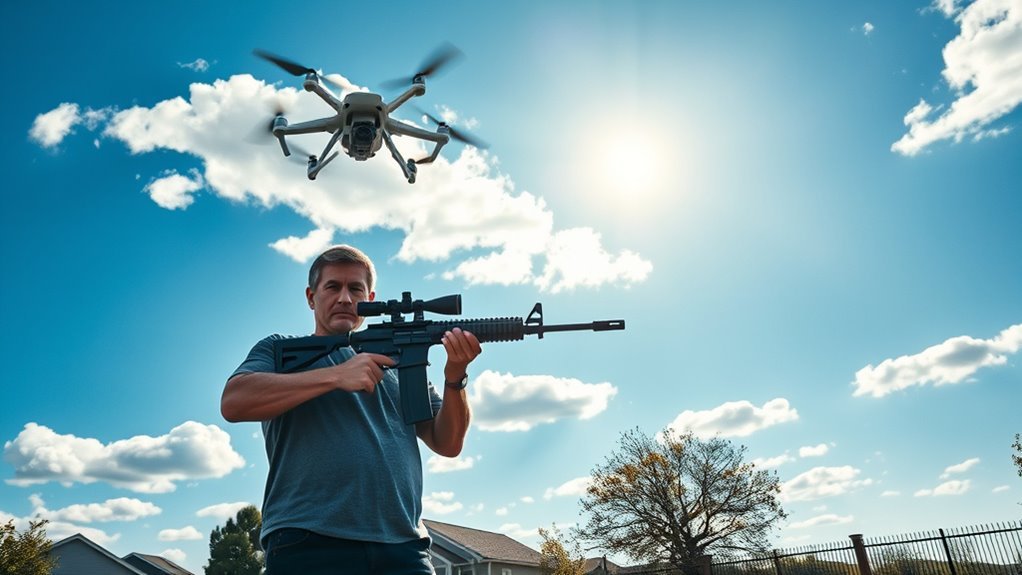
Although federal law generally prohibits shooting down drones, there are narrowly defined situations where doing so may be legally justified. If a drone poses an imminent threat to your personal safety—for instance, if it’s flying dangerously close or appears weaponized—you might have grounds for defensive action. Similarly, when a drone flagrantly violates your privacy, such as capturing intimate moments without consent, the argument for protecting your freedom from invasive surveillance strengthens. However, these scenarios demand careful evaluation; the threat must be immediate and significant, not hypothetical or minor. You must also consider less extreme responses first, like contacting authorities. Understanding these limited circumstances guarantees you protect your rights without overstepping legal boundaries, preserving both your freedom and safety responsibly.
Legal Risks and Consequences of Shooting Down a Drone
If you decide to shoot down a drone, you face significant legal risks that can include criminal charges, civil liability, and federal penalties. Even if the drone intrudes on your property, the legal implications can be severe. Property rights don’t grant you unrestricted authority to destroy aircraft, including drones. Federal laws protect drone operators, and damaging or destroying a drone may be considered destruction of government or private property, depending on ownership. Criminal charges can range from reckless endangerment to violations of aviation laws. Civil lawsuits may also arise from drone owners seeking compensation for damages. Understanding these consequences is essential, as your actions could lead to costly legal battles and penalties that far outweigh the perceived invasion on your property rights.
Alternatives to Shooting Down a Drone Safely and Legally
Since shooting down a drone carries serious legal risks, you should consider safer and lawful alternatives to address unwanted drone activity. Taking control without destruction protects your rights and avoids legal consequences. Here are five effective strategies:
- Drone jamming: Use approved signal disruption devices to safely interfere with drone controls, forcing it to land or return home.
- Net capture: Deploy net launchers designed to entangle drones mid-air, capturing them without damage.
- Alert authorities: Report unauthorized drones to local law enforcement or aviation agencies.
- Physical barriers: Install privacy screens or protective covers to block drone surveillance.
- Geofencing technology: Employ systems that create no-fly zones, preventing drones from entering restricted areas.
These methods respect legal boundaries while maintaining your freedom and security against intrusive drones.
