
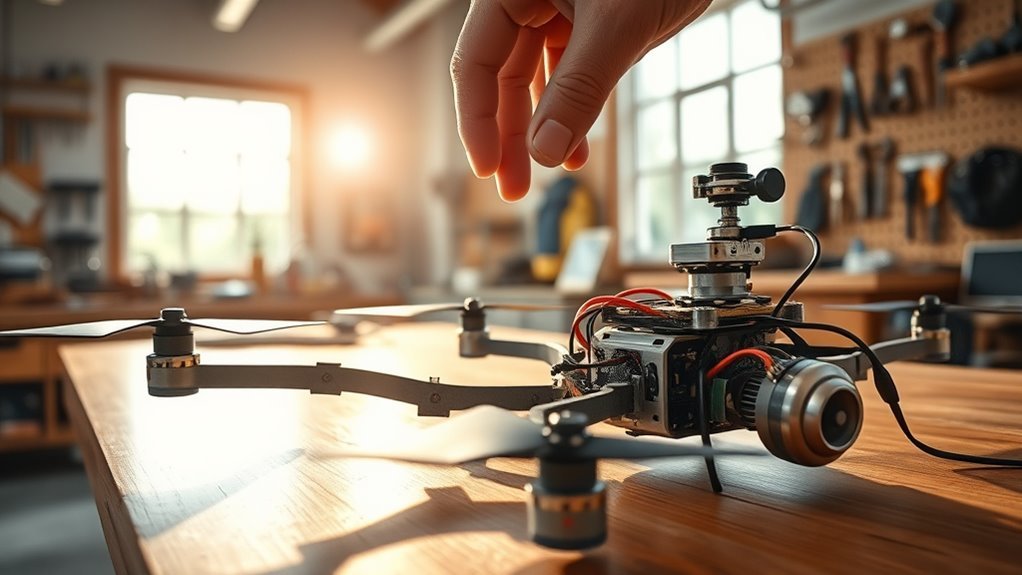
When you make a drone, you start by applying design principles, selecting lightweight materials like carbon fiber for durability and aerodynamics. Then, you optimize the shape for efficient airflow and stability. Next, you integrate advanced electronics, including sensors and a robust flight control system. Propulsion systems, like brushless motors, are chosen for performance. Finally, rigorous testing and compliance checks guarantee reliability. Continue exploring to uncover other nuanced aspects of drone manufacturing and innovation.
Understanding Drone Design Principles
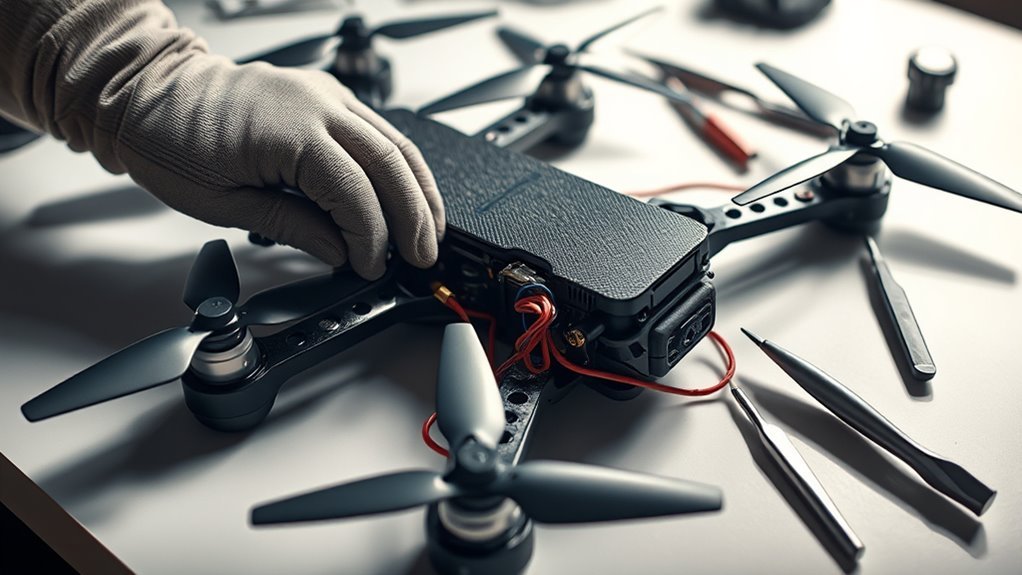
When you explore the world of drone design, it’s vital to grasp the fundamental principles that govern their construction and functionality. Understanding drone aesthetics is important; the visual appeal can enhance user experience markedly. A well-designed drone not only attracts attention but also guarantees aerodynamic efficiency, affecting its stability and maneuverability. The modular design approach in drones allows for customizable missions and adaptability to various operational needs.
The integration of components, such as motors and sensors, must align with the overall design philosophy, balancing weight, performance, and aesthetics. You’ll find that a sleek design often facilitates better airflow, contributing to improved flight dynamics. Each design choice impacts user experience, from handling to maintenance. By considering these principles, you can create drones that not only perform efficiently but also resonate with the freedom-loving spirit of enthusiasts. Additionally, the choice of materials can significantly impact flight stability and control systems, influencing both durability and performance in various conditions.
Selecting the Right Materials
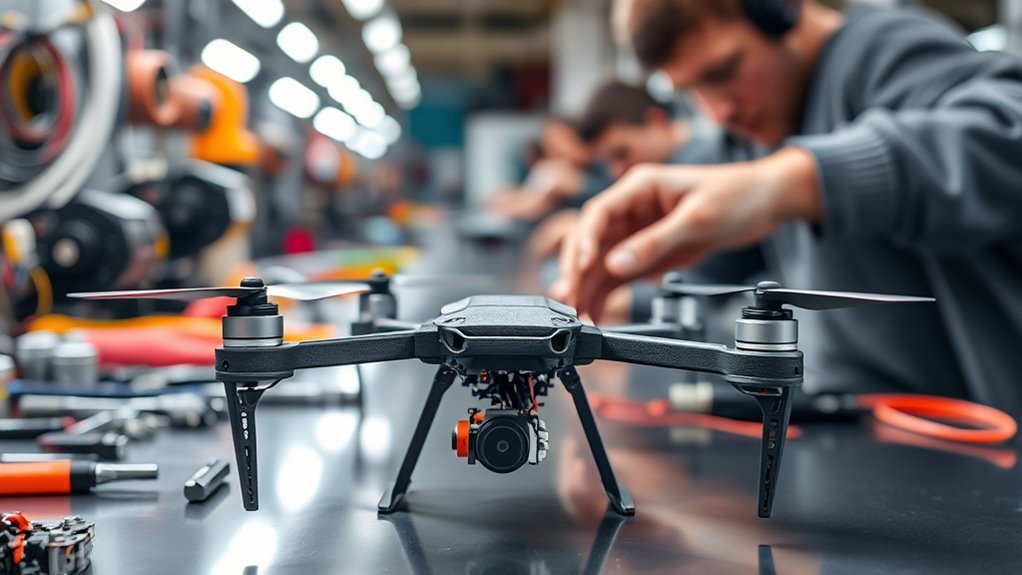
Choosing the right materials is essential in drone manufacturing, as it directly influences the drone’s performance, durability, and weight. You’ll want to focus on materials that offer high material durability, such as carbon fiber or reinforced plastics, which can withstand stress and environmental challenges. Simultaneously, weight optimization is critical; lighter materials enhance flight efficiency and battery life. Consider using aluminum for structural components due to its favorable strength-to-weight ratio, or advanced composites for the body to minimize drag. Ultimately, striking the right balance between durability and weight not only maximizes the drone’s capabilities but also allows you to explore its potential without limitations. Investing in the right materials leads to the freedom of flight and enhanced operational performance. Additionally, using high-quality carbon fiber composites can significantly improve impact resistance and overall durability. For instance, battery performance plays a crucial role in determining how long a drone can stay airborne before needing a recharge.
The Role of Aerodynamics in Drone Construction
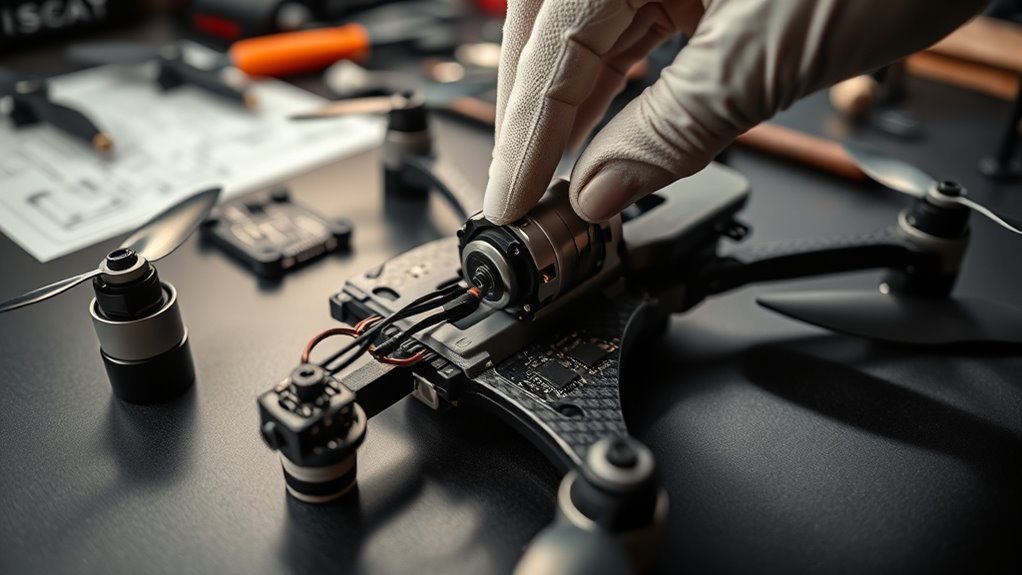
Although the choice of materials is critical, understanding aerodynamics is equally essential in drone construction. You need to optimize aerodynamic efficiency to minimize drag and maximize performance. This involves designing the drone’s shape, ensuring smooth airflow over its surfaces, and utilizing wings or rotors that enhance lift generation. The drone’s weight distribution and center of gravity also play pivotal roles in maintaining stability during flight. By employing computational fluid dynamics, you can analyze airflow patterns and make informed design adjustments. Ultimately, a well-aerodynamically designed drone not only extends flight time but also opens up possibilities for adventurous exploration. Embracing these principles allows you to craft a drone that truly embodies the spirit of freedom in the skies, as aerodynamic design is crucial for reducing energy consumption and maximizing range. Additionally, understanding battery capacity can significantly influence the overall performance and endurance of the drone during flight.
Electronics and Sensor Integration
In the construction of a drone, integrating electronics and sensors is essential for functionality. You’ll need to focus on circuit board design, selecting the appropriate sensor types, and ensuring reliable wiring and connections. Each of these components plays an important role in enhancing the drone’s performance and operational capabilities.
Circuit Board Design
When designing a circuit board for a drone, it is vital to integrate electronics and sensors effectively to guarantee peak performance. You’ll want to focus on circuit functionality, ensuring that each component communicates seamlessly. Selecting the right board materials, like FR-4 or polyimide, is important for durability and thermal management. Pay attention to the layout; minimizing trace lengths can reduce signal interference and enhance reliability. Using vias strategically helps in connecting multiple layers without compromising space. Keep in mind the power distribution, too—properly managing current flow can prevent overheating and optimize efficiency. Ultimately, a well-designed circuit board not only supports the drone’s operational capabilities but also contributes to its overall agility and responsiveness, giving you the freedom to explore the skies.
Sensor Types Explained
Understanding the various sensor types is essential for optimizing a drone’s performance and functionality. For instance, GPS sensors provide accurate positioning, while IMUs (Inertial Measurement Units) enable precise orientation data. To guarantee sensor accuracy, calibration is critical; uncalibrated sensors can yield erroneous data, affecting flight stability and navigation. Lidar and ultrasonic sensors are invaluable for obstacle detection, enhancing safety during autonomous flights. Cameras and thermal sensors can offer visual data for mapping or surveillance. By selecting the right combination of sensors and maintaining them through regular calibration, you can greatly enhance your drone’s operational capabilities. Ultimately, the integration of these components allows for a more autonomous and efficient flying experience, granting you the freedom to explore new aerial possibilities.
Wiring and Connections
While assembling a drone, guaranteeing proper wiring and connections is essential for seamless electronics and sensor integration. You’ll want to focus on effective wiring techniques and connection types that enhance performance and reliability. Here’s a quick overview to guide your choices:
| Connection Type | Wiring Technique | Benefits |
|---|---|---|
| Soldering | Heat Shrink Tubing | Strong, waterproof |
| JST Connectors | Twist and Tape | Easy disassembly |
| Bullet Connectors | Crimping | Secure, quick repair |
These methods guarantee your drone’s electronics communicate effectively, allowing you to experience the freedom of flight without technical hitches. By mastering these elements, you empower your drone to reach its full potential.
Propulsion Systems: Motors and Batteries
When considering propulsion systems, you’ll find that motor types greatly influence a drone’s performance and efficiency. Understanding the characteristics of brushless versus brushed motors can help you optimize your design for specific applications. Additionally, evaluating battery life factors, such as capacity and discharge rates, is essential for achieving the desired flight duration. For instance, drones like the Wingtra One demonstrate how advanced mapping techniques can enhance flight efficiency and operational autonomy through superior battery performance. Moreover, incorporating advanced flight performance features can further improve a drone’s stability and responsiveness during flight.
Motor Types Explained
Motors are the heart of a drone’s propulsion system, directly influencing its performance and efficiency. You’ll find two primary types of motors: brushed and brushless. Brushless motors typically offer higher motor efficiency and durability, making them ideal for performance-driven applications. Meanwhile, brushed motors, while less efficient, can be more cost-effective for simpler designs.
| Motor Type | Key Characteristics |
|---|---|
| Brushed | Lower efficiency, higher wear |
| Brushless | Higher efficiency, greater durability |
Understanding these differences helps you choose the right motor for your drone. You want a system that balances motor efficiency with motor durability, ensuring maximum performance for your flying needs. Selecting the correct motor type can open up new possibilities for your aerial freedom.
Battery Life Factors
Understanding the factors that influence battery life is essential for optimizing your drone’s performance. Several elements come into play, particularly concerning battery chemistry and energy efficiency.
- Battery Chemistry: Different chemistries (LiPo, Li-ion, etc.) affect energy density and discharge rates, impacting flight duration.
- Weight Management: The heavier the drone, the more energy is required for propulsion, reducing overall battery life.
- Flight Conditions: Environmental factors like temperature and wind resistance can greatly affect energy consumption.
The Assembly Process: From Parts to Whole
The assembly process of a drone is a meticulous endeavor that transforms individual components into a fully functional aerial vehicle. You’ll begin by employing various assembly techniques, ensuring component compatibility for maximum functionality. Selecting quality materials is vital, as it directly impacts performance and longevity. Throughout this process, adhering to safety protocols guarantees the well-being of the team and the integrity of the build. Team collaboration is essential; effective communication enhances workflow efficiency. You’ll need to choose the right tools, balancing precision with production effectiveness. Each step requires careful attention to detail, ensuring that every part fits together seamlessly, resulting in a robust drone ready for flight. The culmination of these efforts is an impressive technological achievement.
Software Development and Flight Control Systems
In developing a drone’s software, you’ll need to focus on creating robust flight control algorithms that guarantee stability and responsiveness. Sensor integration techniques are critical, as they allow the drone to interpret data from various sources for real-time decision-making. Additionally, leveraging real-time data processing can enhance the drone’s ability to analyze environmental conditions swiftly and make informed adjustments. Finally, rigorous software testing methods are essential to validate the performance and reliability of the control systems before deployment. Additionally, incorporating advanced AI integration can streamline operations and enhance the drone’s adaptability to dynamic environments.
Flight Control Algorithms
While developing a drone, crafting effective flight control algorithms is essential for ensuring stability and maneuverability. These algorithms govern how your drone interacts with its environment, enabling autonomous navigation and precise stability control. You’ll need to focus on:
- Sensor Fusion: Integrating data from various sensors for improved situational awareness.
- PID Control: Implementing Proportional, Integral, and Derivative control for responsive adjustments.
- Path Planning: Developing algorithms that optimize routes while avoiding obstacles.
Sensor Integration Techniques
Effective flight control algorithms rely heavily on robust sensor integration techniques to maximize a drone’s performance and responsiveness. To achieve this, you’ll need to implement sensor fusion, which combines data from multiple sensors, like accelerometers, gyroscopes, and GPS, to create a thorough understanding of the drone’s environment. This process enhances accuracy and reduces noise, allowing for smoother flight operations. Additionally, sensor calibration is essential; it guarantees that each sensor produces reliable data by compensating for biases and errors. Regular calibration maintains performance integrity, especially in varying conditions. By mastering these integration techniques, you can guarantee that your drone’s flight control systems are agile, responsive, and capable of adapting to real-time challenges, granting you the freedom to explore the skies confidently.
Software Testing Methods
As you develop flight control systems for drones, implementing rigorous software testing methods is essential to guarantee reliability and safety. Automated testing can streamline your processes, allowing for consistent and repeatable evaluations. You should also prioritize gathering user feedback, which provides critical insights into real-world performance. Here are three key methods to contemplate:
- Unit Testing: Focus on individual components to verify each part functions correctly.
- Integration Testing: Evaluate how different modules work together, identifying potential conflicts.
- System Testing: Assess the complete system under various conditions to confirm it meets all requirements.
Quality Assurance and Testing Procedures
Guaranteeing that a drone meets the highest standards of performance and reliability requires rigorous quality assurance and testing procedures throughout the manufacturing process. You’ll engage in various test protocols designed to assess critical components, such as propulsion systems and flight controls. Each protocol involves detailed assessments against predefined quality metrics, guaranteeing every aspect functions flawlessly.
During these tests, data is collected and analyzed to identify any anomalies or potential failures before the drone reaches the market. This attention to detail not only enhances the drone’s operational capabilities but also builds confidence in its performance. Ultimately, your commitment to these stringent quality assurance measures guarantees that the drones you produce are reliable, safe, and aligned with the freedom they provide users in their aerial pursuits. Additionally, advanced data analysis software plays a crucial role in optimizing testing processes to enhance overall quality assurance. Furthermore, the integration of real-time error correction ensures that any discrepancies are addressed immediately, further elevating the standards of reliability.
Regulatory Compliance and Certification
While steering through the complexities of drone manufacturing, understanding regulatory compliance and certification is vital for your operations. Adhering to regulatory standards guarantees that your drones not only meet safety requirements but also gain market acceptance. The certification processes can be intricate, but they’re fundamental for legality and reliability.
Understanding regulatory compliance and certification is essential for drone manufacturing, ensuring safety and market acceptance.
Here are key aspects to evaluate:
- Understanding Local Regulations: Different jurisdictions have unique rules that may affect your design and operation.
- Documentation Compliance: Extensive records are necessary to demonstrate adherence to safety and performance standards.
- Continuous Monitoring: Stay updated on changing regulations to maintain compliance and avoid penalties.
Navigating these elements effectively will empower you to innovate while guaranteeing your drones are certified and ready for the skies.
Innovations in Drone Manufacturing Techniques
Innovative manufacturing techniques are revolutionizing drone production, enhancing efficiency and performance. You’ll find that 3D printing allows for rapid prototyping and custom fabrication, enabling you to create complex geometries with minimal waste. Automation technology streamlines assembly processes, reducing labor costs and time. Modular design offers flexibility, allowing easy upgrades and repairs, which is essential for maintaining performance. By integrating sustainable materials and lightweight composites, manufacturers can improve flight efficiency while minimizing environmental impact. Moreover, European brands are increasingly prioritizing eco-friendly innovations in drone design. Advanced robotics in production lines enhances precision, ensuring each component meets rigorous standards. Smart manufacturing techniques enable real-time monitoring and adjustments, optimizing the production process. Together, these innovations empower you to explore the skies with drones that are not only advanced but also tailored to your specific needs. Additionally, Coretronic’s software can further enhance manufacturing efficiency by reducing processing times by up to 30%.
Frequently Asked Questions
What Are the Different Types of Drones Available on the Market?
When exploring the market, you’ll find commercial drones designed for professional use, featuring advanced technology and payload capacities. In contrast, hobbyist drones cater to enthusiasts, offering user-friendly controls for recreational flying and creative photography.
How Long Does It Take to Manufacture a Drone?
The manufacturing timeline for a drone varies considerably based on production factors like complexity, materials, and technology. Generally, you can expect several weeks to months for complete assembly, testing, and quality assurance before delivery.
What Skills Are Needed to Build a Drone?
To soar above limitations, you’ll need engineering skills in electronics, mechanics, and software. Understanding drone technology is essential, allowing you to design, assemble, and troubleshoot effectively, ensuring your creation takes flight with precision and innovation.
How Much Does It Cost to Produce a Drone?
Producing a drone involves various production costs and manufacturing expenses, which can range from a few hundred to several thousand dollars, depending on features, materials, and technology used. Your budget will greatly influence the final outcome.
Can Drones Be Repaired if Damaged?
Yes, drones can be repaired if damaged. You’ll need effective repair techniques and a thorough damage assessment to identify issues. Understanding the components helps you restore functionality, ensuring your drone’s performance aligns with your adventurous spirit.
