
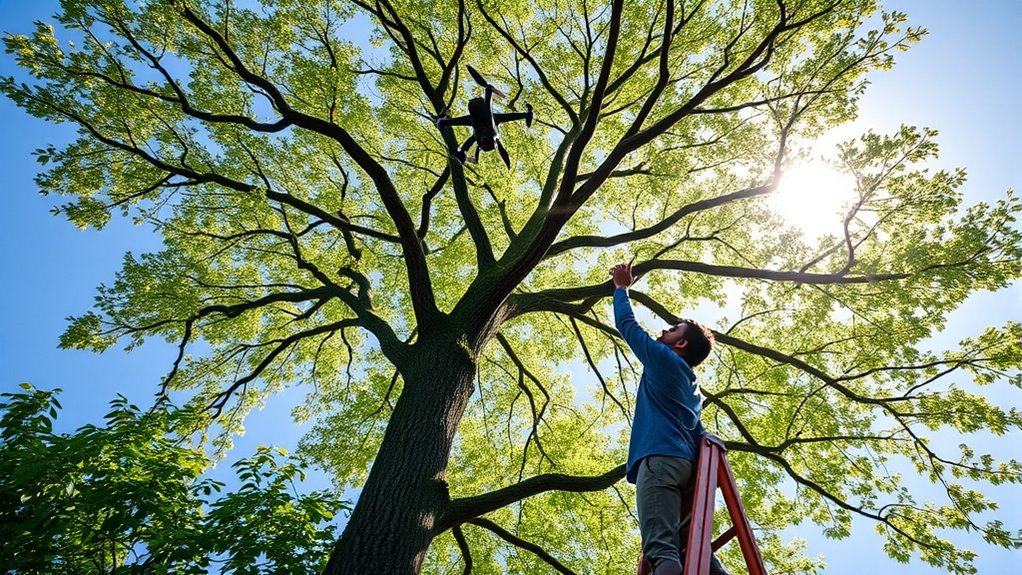
When your drone’s stuck in a tree, first assess the height, branch stability, and nearby hazards to guarantee your safety. Use a long pole or net to gently dislodge it without damaging the drone or tree. For higher branches, safely employ a sturdy ladder or climbing gear, maintaining firm contact. Avoid shaking the tree vigorously, and never jeopardize your safety. If retrieval seems risky, consider professional help. There are also post-retrieval checks and preventive tips you’ll find helpful.
Assess the Situation and Safety Risks
Before attempting to retrieve your drone, you should carefully assess the situation and identify any safety risks involved. Conduct a thorough situation assessment by evaluating the drone’s position in the tree—height, branch density, and stability. Note environmental factors like wind, wet surfaces, or wildlife that could affect your approach. Prioritize safety considerations by guaranteeing the ground beneath the tree is clear of hazards such as uneven terrain or obstructive objects. Avoid climbing if branches appear fragile or if you lack proper equipment. Consider potential electrical hazards if power lines are nearby. This precise evaluation helps prevent injury and equipment damage, preserving your freedom to fly safely. Taking these careful steps guarantees your drone retrieval is both effective and risk-free.
Use a Long Pole or Stick to Reach the Drone
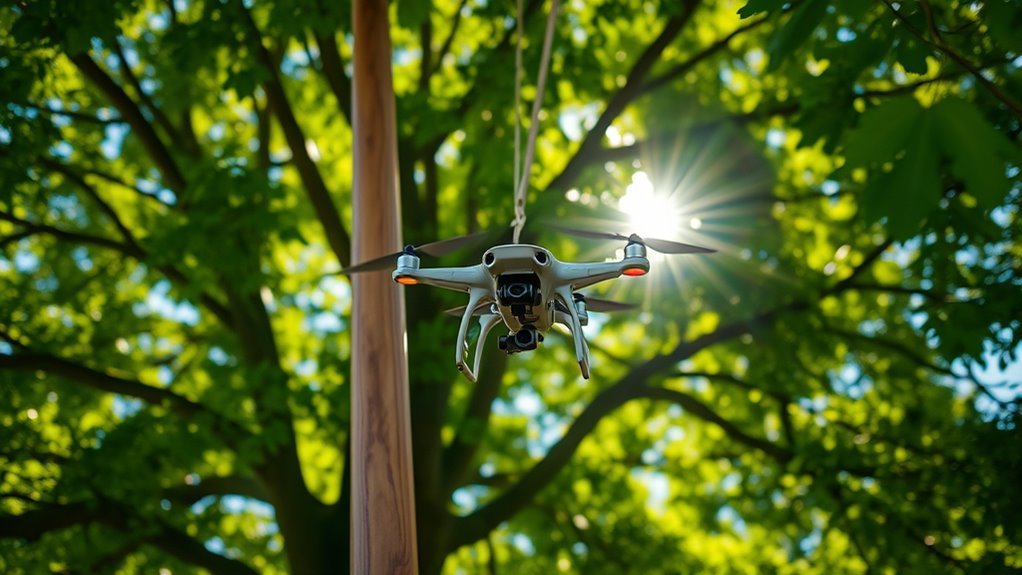
A long pole or sturdy stick can be an effective tool for dislodging your drone from tree branches without climbing. Begin by selecting a pole with sufficient length and rigidity to reach the drone while maintaining control. Employ long pole techniques that focus on gentle, targeted nudges to avoid damaging the drone or surrounding branches. Use stick retrieval strategies such as angling the pole to lever the drone free or carefully pushing the entangled parts. Always prioritize your stability and avoid overreaching to prevent falls. Keep a clear line of sight, and if possible, have a partner assist by stabilizing the pole or spotting. These methods preserve your freedom to recover your drone safely and efficiently without riskier maneuvers.
Try Shaking the Tree Gently
If using a pole doesn’t free your drone, you can try shaking the tree gently to dislodge it. Begin by evaluating the tree’s stability and your footing to guarantee safety. Use gentle techniques—apply slow, controlled movements to the trunk or larger branches near the drone’s location. Avoid aggressive shaking to prevent damage to the drone, the tree, or yourself. Focus on branches that directly support the drone, as indirect shaking reduces effectiveness. If the drone remains stuck after careful tree shaking, avoid escalating force, which risks injury and equipment loss. Always prioritize your safety and the drone’s structural integrity when employing tree shaking. This method offers a straightforward, effective way to regain control and continue enjoying the freedom your drone provides.
Employ a Ladder for Higher Retrieval
When your drone is lodged higher than you can reach safely from the ground, using a ladder becomes necessary for retrieval. First, assess the tree stability; avoid climbing if the branches or trunk appear weak or unstable. Choose a sturdy, appropriate-height ladder and set it on firm, level ground. Always maintain three points of contact and avoid overreaching to preserve ladder safety. Position the ladder so it leans against a solid part of the tree, minimizing sway. Have a spotter hold the ladder base to enhance stability and assist if needed. Wear gloves to protect your hands from rough bark or thorns as you carefully retrieve the drone. Prioritizing safety guarantees you regain your drone without risking injury or further equipment damage.
Utilize a Throwing Object to Dislodge the Drone
You’ll want to select a lightweight, non-damaging object like a foam ball to avoid harming the drone or tree. Aim carefully to target the branch or propeller area with controlled, gentle throws to minimize risk. Always maintain a safe distance and guarantee no bystanders are in the throw zone before attempting.
Choosing Safe Throwing Items
Although dislodging a drone by throwing an object may seem straightforward, selecting the right item is essential to guarantee safety and prevent damage. You should prioritize safe materials that minimize injury risk and avoid damaging the drone or surrounding environment. Soft, pliable items like foam balls or cloth-wrapped weights are ideal, as they absorb impact and reduce ricochet hazards. Weight considerations are significant; the object must be heavy enough to reach and dislodge the drone but light enough to control precisely, avoiding excessive force. Avoid hard or sharp objects that could cause irreparable damage or injury. By carefully choosing throwing items with these factors in mind, you maintain safety, protect your drone, and keep your retrieval efforts effective and responsible, preserving your freedom to fly without incident.
Techniques for Accurate Throws
Since accuracy is critical for safely dislodging a drone from a tree, you should focus on controlled, deliberate throws that minimize risk to both the drone and surrounding environment. Begin by evaluating your throwing distance and trajectory, selecting an angle that targets branches holding the drone without causing damage. Employ throwing techniques such as underhand or sidearm throws for better control and stability. Use accuracy tips like steadying your arm, aligning your eyes with the target, and practicing slow, measured release motions. Avoid excessive force to reduce the chance of breaking drone parts or injuring nearby vegetation. By prioritizing precision and safety in your approach, you’ll increase the likelihood of successfully freeing your drone while preserving your freedom to explore without harm.
Call for Professional Tree Services
A professional tree service can safely retrieve your drone when it’s stuck beyond your reach or in a hazardous position. Utilizing specialized professional equipment, they guarantee minimal damage to both your drone and the tree. Here’s why you should consider their expertise:
Professional tree services use expert equipment to safely retrieve drones stuck in hard-to-reach or hazardous locations.
- Tree Service Benefits: Expert knowledge reduces risk of injury and property damage.
- Access to Professional Equipment: Climbing gear, lifts, and poles designed for safe retrieval.
- Efficient Retrieval: Saves you time and effort compared to DIY attempts.
- Safety Assurance: Professionals follow strict protocols to protect you and the environment.
When freedom to explore meets safety, relying on professionals ensures your drone’s recovery without unnecessary hazards or setbacks.
Prevent Future Incidents With Safe Flying Practices
When you operate your drone with careful attention to environment and controls, you greatly reduce the risk of it becoming entangled in trees. Prioritize thorough flight planning by mapping your route to avoid densely wooded areas and obstacles. Always check local drone regulations to guarantee compliance with altitude limits and no-fly zones, which often include areas near tall trees. Maintain line-of-sight control and adjust your drone’s speed to manage maneuverability precisely. Use real-time telemetry and obstacle avoidance systems if your drone supports them, boosting situational awareness. Conduct pre-flight inspections to verify all controls respond correctly. By integrating these safe flying practices, you protect your drone while preserving your freedom to explore the skies confidently and responsibly, minimizing mishaps and costly retrieval efforts.
Repair and Inspect Your Drone After Retrieval
After successfully retrieving your drone from a tree, your next step is a thorough inspection and necessary repairs to guarantee safe operation. Perform a detailed drone inspection to identify any damage caused by impact or entanglement. Follow these precise repair techniques:Ensure safe flying by thoroughly inspecting and repairing your drone after retrieval from a tree.
- Check propellers for cracks or chips; replace damaged ones immediately.
- Inspect the frame and arms for structural integrity; repair or replace any compromised parts.
- Examine motors and wiring for debris or disconnections; clean and secure connections as needed.
- Test battery health and connectors to prevent power failures during flight.
