

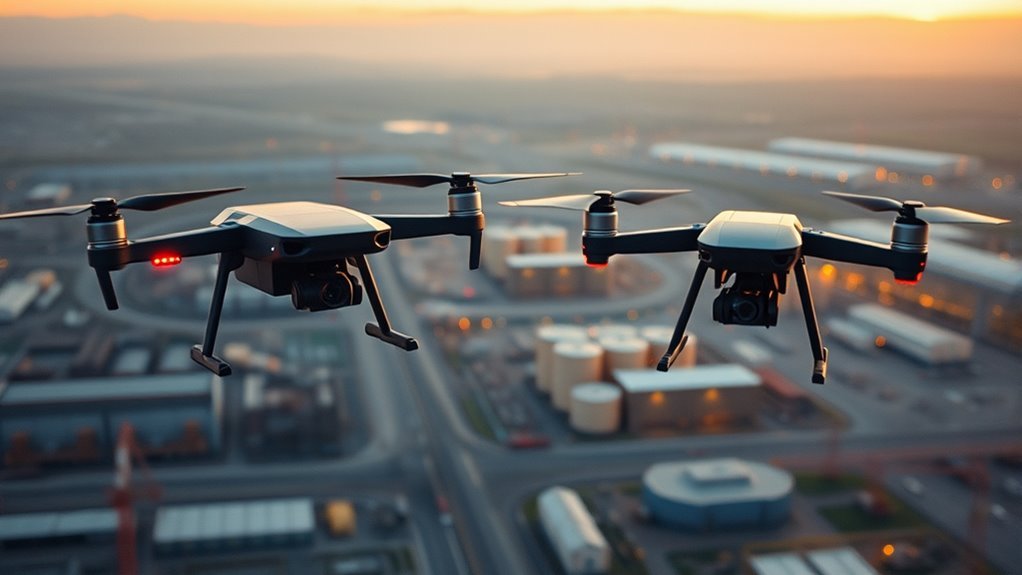
As you compare the Intel Falcon 8+ and Autel EVO II Dual 640T, you’ll find Intel’s rugged 30-minute flight time suits industrial precision and durability, while Autel’s 40-minute endurance enhances thermal imaging for broader tasks. Intel boasts a 4K camera with RTK navigation, contrasting Autel’s portable design and 640×512 thermal sensor for sharper details. These trade-offs in stability and cost could shape your choice, with deeper insights awaiting in the analysis ahead.
Design and Build Quality
When comparing the design and build quality of the Intel Falcon 8+ and Autel EVO II Dual 640T, two key aspects emerge: durability and portability. The Intel Falcon 8+ emphasizes material durability, using high-strength composites that withstand tough conditions, giving you the freedom to operate in demanding environments without frequent repairs. This robust construction guarantees longevity, allowing you to focus on your missions rather than maintenance.
In contrast, the Autel EVO II Dual 640T prioritizes ergonomic design, with a lightweight, user-friendly frame that enhances portability for quick deployment. You’ll appreciate how its balanced ergonomics reduce strain during handling, letting you move freely between locations. Analytically, the Intel’s superior material durability suits stationary, industrial setups, while the Autel’s ergonomic features empower agile users seeking versatility. Overall, both drones deliver reliable builds, but your choice depends on whether you value rugged endurance or effortless mobility in your pursuits. Additionally, Autel’s user-friendly design enhances usability, making it an attractive option for those who prioritize ease of operation.
Flight Time Comparison
As flight times vary considerably between the Intel Falcon 8+ and Autel EVO II Dual 640T, you’ll find the former offers up to 25 minutes of endurance, ideal for shorter industrial tasks, while the latter extends to around 38 minutes, enhancing versatility for extended operations. When evaluating flight duration implications, you’ll appreciate how the Intel’s brevity suits rapid, focused missions, freeing you from frequent landings, whereas the Autel’s longer runtime empowers broader explorations without constraints. Efficiency assessments reveal the Intel excels in scenarios demanding quick setups, minimizing downtime, while the Autel’s stamina boosts productivity in prolonged flights, giving you more liberty to innovate. Additionally, the advanced imaging technology of the Falcon 8+ allows for high-resolution data collection during its operational timeframe.
| Aspect | Intel Falcon 8+ | Autel EVO II Dual 640T |
|---|---|---|
| Max Flight Time | 25 minutes | 38 minutes |
| Flight Duration Implication | Limited for short tasks | Enhanced for long ops |
| Efficiency Assessment | High in quick efficiency | Superior in endurance |
| Operational Freedom | Agile for immediate needs | Versatile for exploration |
| Typical Use Case | Industrial spot checks | Extended thermal surveys |
Ultimately, these differences let you choose based on your quest for efficient, unfettered aerial freedom. (148 words)
Battery Performance Analysis
Battery performance plays a key role in drone reliability, so you’ll find the Intel Falcon 8+ and Autel EVO II Dual 640T differ in aspects like capacity, charging speed, and efficiency. The Intel Falcon 8+ typically features a 30-minute flight time, backed by robust power management that optimizes energy use for industrial tasks, enhancing battery longevity through intelligent throttling. This means you’ll enjoy more consistent performance in demanding environments, giving you the freedom to extend missions without frequent swaps.
In contrast, the Autel EVO II Dual 640T boasts a 40-minute flight capability, thanks to its larger battery capacity and faster charging options, which improve overall efficiency. Its advanced power management systems help maintain battery longevity by minimizing drain during thermal operations. Moreover, the intelligent power management systems integrated into DJI drones also play a significant role in maximizing flight time and reliability. As you weigh these factors, you’ll appreciate how each drone empowers your aerial freedom—whether it’s the Intel’s reliable endurance or the Autel’s extended runtime—tailored to your operational needs.
Camera Specifications Overview
While camera specifications greatly influence drone performance, the Intel Falcon 8+ features a high-resolution 4K sensor with advanced stabilization, delivering crisp imagery for precise industrial inspections. You’ll appreciate how these camera features enhance your operational freedom, allowing seamless captures in demanding environments. The Autel EVO II Dual 640T counters with robust camera features, including high-definition visuals and versatile lens options that let you adapt quickly to various tasks.
To break it down objectively, here’s a comparison of key elements:
| Camera Features | Intel Falcon 8+ | Autel EVO II Dual 640T |
|---|---|---|
| Sensor Resolution | 4K | 8MP |
| Stabilization | Advanced gimbal | 3-axis mechanical |
| Lens Options | Fixed wide-angle | Interchangeable zoom |
As you analyze these specs, you’ll see how they empower your choices for industrial applications, balancing resolution and flexibility without overwhelming complexity. Moreover, the advanced motor and propulsion systems in these drones play a crucial role in maintaining stability during aerial photography and inspections.
Thermal Imaging Capabilities
As you compare the Intel Falcon 8+ and Autel EVO II Dual 640T, you’ll first notice differences in sensor resolution that impact the clarity of thermal images. Next, their thermal sensitivity determines how accurately each drone picks up subtle temperature variations in various environments. Finally, examining detection range helps you assess how far each model can effectively spot and track thermal targets.
Sensor Resolution
The sensor resolution of a drone’s thermal imaging system directly impacts image clarity and detail detection. You’ll encounter different sensor types, such as the Intel Falcon 8+’s 336×256 pixel thermal sensor versus the Autel EVO II Dual 640T’s superior 640×512 resolution. This resolution impact means you’re getting sharper images with the Autel, allowing better identification of fine details in industrial inspections or search operations. For instance, the Falcon 8+ might struggle with distant objects, limiting your operational freedom in challenging environments, while the EVO II’s higher resolution empowers you to detect subtleties more reliably. Analytically, this difference affects data accuracy, giving you enhanced decision-making capabilities without unnecessary bulk. Ultimately, choosing based on sensor types guarantees your drone aligns with demands for precise, liberating thermal insights.
Thermal Sensitivity
Thermal sensitivity, often measured in millikelvins (mK), defines how precisely your drone’s thermal camera detects subtle temperature variations, directly influencing image quality in low-contrast scenarios. In your thermal sensitivity analysis of the Intel Falcon 8+ and Autel EVO II Dual 640T, you’ll find the Falcon 8+ offers around 50 mK, making it reliable for industrial applications where steady performance matters. Conversely, the EVO II Dual 640T boasts a superior 25 mK, enhancing your ability to spot fine details in complex environments. Through thermal performance evaluation, the EVO II edges ahead for users seeking greater precision and flexibility, empowering you to choose based on mission demands without compromise. This difference lets you adapt freely, ensuring ideal results in varied thermal imaging tasks. Ultimately, it boils down to your need for enhanced detail versus robust reliability.
Detection Range
Detection range, measuring the farthest distance your drone’s thermal camera can reliably spot and identify heat-emitting objects, varies considerably between the Intel Falcon 8+ and Autel EVO II Dual 640T. The Intel Falcon 8+ typically offers around 500 meters with its detection methods, limited by environmental factors like humidity, while the Autel EVO II Dual 640T extends to about 1,000 meters, giving you greater flexibility in open skies. You’ll encounter range limitations based on sensor resolution and atmospheric conditions, so choose wisely to maximize your aerial freedom.
- Intel Falcon 8+ Detection: Its shorter range suits controlled industrial settings, where precise, close-range thermal spotting empowers targeted inspections without overwhelming complexity.
- Autel EVO II Dual 640T Advantage: Boasting longer detection, this drone lets you explore vast areas freely, ideal for search and rescue where quick identification matters most.
- Range Limitations Comparison: Both drones’ methods falter in adverse weather; however, the Autel’s superior range reduces constraints, offering you more liberty in dynamic environments.
Navigation and Control Systems
While evaluating the navigation and control systems of the Intel Falcon 8+ and Autel EVO II Dual 640T, you’ll notice the Falcon 8+ excels with advanced GPS and RTK capabilities for precise positioning, whereas the EVO II Dual 640T emphasizes intuitive app-based controls and obstacle avoidance algorithms to enhance user accessibility during flights.
In terms of navigation accuracy, the Falcon 8+’s RTK integration delivers centimeter-level precision, empowering you to explore tight or remote areas without compromise. This level of reliability suits industrial tasks where exactitude is key. Meanwhile, the EVO II Dual 640T’s control responsiveness shines through its seamless app interface, enabling swift command inputs that let you adapt freely in dynamic settings. You’ll appreciate how these features balance precision with ease, giving you the liberty to navigate confidently. Objectively, the Falcon 8+ edges out for accuracy in professional scenarios, while the EVO II offers more intuitive freedom for everyday use, ensuring you maintain control without unnecessary complexity. Additionally, the integration of real-time analytics enhances the ability to detect and respond to potential threats during operation, further boosting overall safety.
Stability and Flight Dynamics
When comparing the stability and flight dynamics of the Intel Falcon 8+ and Autel EVO II Dual 640T, you’ll notice the Falcon 8+ leverages robust inertial measurement units for exceptional resistance to wind gusts, making it ideal for demanding industrial operations. In contrast, the Autel EVO II Dual 640T provides reliable flight stability via its integrated thermal and visual sensors, though its dynamic response can be slightly less agile in turbulent conditions, giving you more options for versatile flights.
To paint a clearer picture of these differences:
- Flight Stability: The Falcon 8+ excels with superior anti-vibration tech, maintaining steady hover in winds up to 50 km/h, whereas the EVO II Dual 640T offers good stability but may drift more in gusts, empowering your control in open environments.
- Dynamic Response: Falcon 8+’s quick adjustments to pilot inputs guarantee precise maneuvering, enhancing your freedom during rapid changes, while the EVO II Dual 640T’s response is competent yet marginally slower, allowing for smoother but less immediate reactions.
- Integrated Dynamics: Both drones balance stability and agility effectively, but the Falcon 8+’s advanced algorithms provide edge in complex scenarios, letting you explore with greater confidence without the EVO II’s occasional lag. Additionally, the advanced algorithms in the Falcon 8+ enhance its performance in challenging conditions, further solidifying its position for industrial applications.
Practical Applications in Industry
In industrial sectors like energy, construction, and agriculture, drones such as the Intel Falcon 8+ and Autel EVO II Dual 640T enhance efficiency through targeted applications. You can deploy the Intel Falcon 8+ for industrial inspections, where its stability supports detailed structural analysis, empowering you to detect flaws autonomously. For infrastructure assessment, it offers precise mapping that frees you from risky manual checks.
Meanwhile, the Autel EVO II Dual 640T excels in emergency response, using thermal imaging to locate individuals quickly during search operations. You’ll find its capabilities invaluable for agricultural monitoring, enabling real-time crop health evaluations that optimize yields without constraints. In environmental studies, both drones facilitate data collection on habitats, giving you the freedom to assess changes objectively and respond proactively. Additionally, the integration of advanced engineering in these flight systems ensures seamless data capture, maximizing their operational effectiveness.
This analytical comparison highlights how each drone’s strengths align with your industrial needs, from rapid emergency interventions to thorough monitoring.
Price and Overall Value
As you evaluate the Intel Falcon 8+ and Autel EVO II Dual 640T, you’ll notice clear price differences that could influence your choice. For instance, the Intel model often carries a higher upfront cost compared to the Autel drone. Beyond just the numbers, you’ll want to assess value metrics such as cost per feature and long-term ROI to gauge which option suits your needs best. Additionally, understanding pricing strategies can provide insight into how each drone aligns with your budget and performance expectations.
Price Differences
The Intel Falcon 8+ typically commands a higher price tag than the Autel EVO II Dual 640T, often exceeding $5,000 versus under $3,000 for the latter. As you immerse yourself in this price comparison, you’ll want to reflect on how these differences align with your budget considerations, giving you the freedom to choose based on your needs without overspending.
When evaluating options, keep in mind:
- Initial investment impact: You’ll notice the Falcon 8+’s higher cost reflects its industrial-grade build, while the EVO II offers more accessible entry for budget-conscious users seeking thermal capabilities.
- Long-term value trade-offs: In your price comparison, factor how the EVO II’s lower price might free up funds for accessories, versus the Falcon 8+’s premium demanding greater upfront commitment.
- Market accessibility: Budget considerations mean you can opt for the EVO II if you’re starting out, empowering you to explore drone tech without financial barriers.
Value Metrics
Although price plays a significant role, you’ll need to evaluate the overall value of the Intel Falcon 8+ and Autel EVO II Dual 640T by comparing their features against costs. In this feature comparison, you’ll assess cost effectiveness by weighing flight duration, thermal imaging, and durability against their price points, empowering you to choose freely based on your needs.
To clarify, here’s a breakdown:
| Aspect | Intel Falcon 8+ | Autel EVO II Dual 640T |
|---|---|---|
| Price | Higher industrial cost | More affordable thermal |
| Key Features | 30-min flight, robust build | 40-min flight, dual camera |
| Cost Effectiveness | Solid for enterprise | Better for enthusiasts |
Ultimately, this feature comparison reveals that the Autel offers superior cost effectiveness for thermal tasks, while the Intel Falcon excels in industrial reliability, letting you decide what’s truly valuable. (124 words)
Frequently Asked Questions
What Is the Warranty Period for These Drones?
You’re wondering about the warranty periods for drones like the Intel Falcon 8+ and Autel EVO II Dual 640T. These models feature warranty differences; the Intel Falcon 8+ typically offers a one-year limited warranty, while the Autel EVO II provides a one-year standard warranty with various coverage options for extensions. This gives you the freedom to select plans that best fit your needs, ensuring reliable protection for your flights.
Are These Drones Waterproof?
You’re wondering if these drones are waterproof, aren’t you? Let’s examine the theory that all drones handle water effortlessly. When it comes to drone durability, water resistance is essential for your freedom in exploration. The Intel Falcon 8+ offers limited protection against splashes but isn’t submersible. Similarly, the Autel EVO II Dual 640T has basic water resistance ratings, yet neither is fully waterproof for tough conditions. Choose based on needs.
Can They Be Used for Recreational Flying?
You’re wondering if you can use drones for recreational flying. Recreational regulations, like those from the FAA, generally allow it, but you’ll have to follow rules to keep your flying experiences safe and legal. This guarantees freedom in the skies while preventing risks. Analytically, these drones offer versatile capabilities, enhancing your adventures, though industrial designs might require some adaptation for pure enjoyment. Always prioritize safety.
What Accessories Are Included With Purchase?
When you bite off more than you can chew, it’s wise to check what’s included first. So, when exploring accessory options for your purchase, you’ll find that included components often vary by model—think batteries, chargers, and carrying cases as standards. This setup lets you soar freely in your adventures, but always verify specifics for ideal, tailored use. Analytical reviews show these essentials enhance functionality without overwhelming extras.
How Do I Register These Drones?
To register your drones, you’ll start by visiting the FAA’s website for the drone registration process. It’s straightforward: provide your drone’s serial number, personal details, and a small fee. This guarantees compliance with flight regulations, letting you fly freely and responsibly. Analytically, it’s a key step to avoid penalties, maintaining your aerial independence while adhering to safety standards. Always check for updates to stay objective and informed.
