
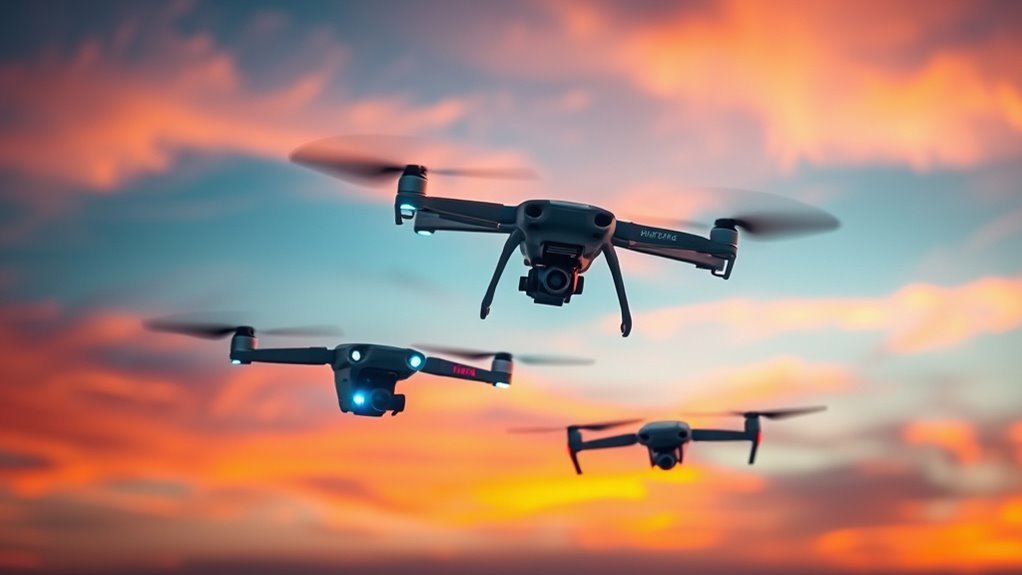
When you’re deciding between the Intel Shooting Star 2’s event-focused 20-minute flight and the DJI Neo’s compact 18-minute option, you’ll notice Shooting Star 2’s modular design excels for customizable adventures, while Neo’s lightweight build enhances portability. Battery-wise, it’s a tight race, but Shooting Star 2 edges out in endurance for structured events, whereas Neo shines in quick, stable flights. Further comparisons on camera and controls await your exploration.
Design and Build Quality
While the Intel Shooting Star 2 emphasizes a lightweight, modular design for portability, the DJI Neo prioritizes a compact, robust build for enhanced durability. You’ll appreciate how the Shooting Star 2’s modular components let you customize setups freely, boosting your creative freedom on the go. In contrast, the DJI Neo’s solid construction guarantees material durability withstands tough conditions, giving you peace of mind during adventures. Additionally, the DJI Neo’s multi-axis stabilization ensures that your footage remains steady and professional, even in dynamic environments.
Analytically, the Shooting Star 2’s aesthetic appeal lies in its sleek, minimalist lines that evoke a sense of open-air exploration, while the Neo’s rounded edges and matte finish offer a more industrial charm, appealing to those seeking reliable, no-fuss performance. You can evaluate material durability by noting the Shooting Star 2’s use of lightweight composites versus the Neo’s reinforced plastics, which better resist impacts. Ultimately, your choice hinges on whether you value portability’s liberating flexibility or the Neo’s enduring build for unfettered exploration.
Battery Life and Endurance
Battery life greatly influences your drone experience, with the Intel Shooting Star 2 delivering up to 25 minutes of flight time through its efficient, lightweight setup, while the DJI Neo extends endurance to around 30 minutes via advanced power optimization. You’ll appreciate how battery technology varies between these models; the Shooting Star 2 relies on streamlined lithium-polymer cells for reliable performance, emphasizing energy efficiency to maximize every joule without added bulk. In contrast, the DJI Neo’s innovative battery technology integrates smart algorithms that enhance energy efficiency, allowing for longer flights and quicker recharges. This difference means you’re freer to explore without frequent interruptions—the Neo’s edge in endurance suits extended adventures, while the Shooting Star 2’s efficiency offers a lightweight option for agile, spontaneous flights. Ultimately, your choice hinges on prioritizing sustained freedom versus portable versatility in energy-efficient designs. Additionally, both models feature advanced battery technology that contributes to their respective flight times and performance.
Camera Features and Performance
When examining the camera features and performance of the Intel Shooting Star 2 and DJI Neo, you’ll notice the Shooting Star 2’s 12MP sensor captures 4K video at 30fps with reliable stabilization, offering solid results for casual users. In comparison, the DJI Neo’s camera emphasizes superior image quality through its advanced sensor, producing sharper details and more accurate colors that enhance your creative freedom. You’ll find the Neo’s low light performance stands out, minimizing noise and maintaining clarity in challenging conditions, which lets you capture stunning footage without constraints.
Analytically, both drones deliver competent image quality, but the Neo’s edge in dynamic range and color accuracy makes it versatile for varied scenarios. For low light performance, the Shooting Star 2 holds up well with its stabilization, yet the Neo’s larger sensor provides better detail retention, empowering you to explore freely. Overall, your choice depends on prioritizing stabilization versus enhanced low-light capabilities. Additionally, DJI’s advanced AI integration in the Neo enhances real-time data processing, allowing for more innovative filming techniques.
Flight Controls and Navigation
Moving to flight controls and navigation, you’ll find the Intel Shooting Star 2’s system emphasizes user-friendly interfaces with GPS-assisted stability, making it straightforward for beginners to maneuver precisely in open spaces. In comparison, the DJI Neo delivers a streamlined user interface that enables rapid tweaks for on-the-fly adventures, though it lacks the same level of GPS precision in varied environments. Both drones support flight path optimization, but Intel’s excels in pre-planned routes for expansive explorations, while DJI’s focuses on intuitive, real-time adjustments.
- User Interface Comparison: Intel’s interface offers detailed customization for thorough control, empowering you to tailor flights freely, whereas DJI’s compact design simplifies quick starts without overwhelming options.
- Flight Path Optimization: The Shooting Star 2 optimizes paths with advanced algorithms, giving you seamless, efficient routes for open-sky freedom, contrasting DJI Neo’s basic tools that prioritize agility over precision.
- Navigation Stability: You’ll appreciate Intel’s robust GPS for stable, hands-off navigation in windy conditions, allowing bolder ventures compared to DJI’s sensor-based system, which handles lighter breezes well.
- Intuitive Controls: Both provide responsive joysticks, but Intel’s haptic feedback enhances your situational awareness during complex maneuvers, fostering a sense of liberated exploration.
- Error Handling: Intel integrates better flight path optimization safeguards against deviations, ensuring you’re in control, while DJI Neo’s user interface alerts you swiftly to maintain your adventurous spirit. Additionally, the adjustable aperture feature available in certain drones can significantly improve low-light shooting capabilities, enhancing overall image quality during flights.
Speed and Maneuverability Testing
Shifting to speed and maneuverability testing, you’ll notice the Intel Shooting Star 2 achieves higher top speeds, reaching up to 50 km/h with stable control, while the DJI Neo tops out at 40 km/h but offers sharper turns for agile navigation in tight spaces. Its aerodynamic design enhances the Shooting Star 2’s straight-line efficiency, allowing you to cover distances swiftly and maintain freedom in open environments. In contrast, the DJI Neo’s aerodynamic design prioritizes compact agility, enabling quicker responses that let you weave through obstacles with ease.
When evaluating agility metrics, such as turn radius and acceleration rates, the Shooting Star 2 scores well for steady performance in wide maneuvers, giving you reliable control during high-speed flights. The DJI Neo excels in rapid directional changes, with superior agility metrics that empower you to explore confined areas without compromise, ultimately expanding your aerial freedom. This comparison highlights how each drone’s strengths align with your preferred style of uninhibited flying. Additionally, both drones excel in multi-drone synchronization, enhancing their ability to create coordinated displays during shows.
Range and Signal Stability
When you’re comparing the Intel Shooting Star 2 and DJI Neo, their maximum flight range becomes a key factor in determining how far you can fly without losing control. You’ll also need to assess signal interference resistance to see which drone maintains a reliable connection in crowded environments. Finally, stability in flight helps evaluate how steadily each performs during extended operations.
Maximum Flight Range
While the Intel Shooting Star 2 is tailored for light shows and has a maximum flight range of about 200 meters with solid signal stability in controlled settings, the DJI Neo extends up to 4 km, offering superior range and signal reliability for broader adventures, making it a more versatile choice for users seeking distance without frequent dropouts. In this maximum flight range comparison, you’ll notice how the DJI Neo empowers you to explore freely under ideal flying conditions like clear skies and minimal wind, while the Shooting Star 2 suits your confined, event-based needs.
- Range Disparity Impact: You gain more freedom with the DJI Neo’s 4 km reach versus the Shooting Star 2’s 200 meters, ideal for expansive outings.
- Ideal Flying Conditions: Under calm weather, the DJI Neo lets you maximize distance, enhancing your adventurous spirit compared to the Shooting Star 2’s limitations.
- Versatility Analysis: You can choose the DJI Neo for unrestricted flights, while the Shooting Star 2 focuses on precision in smaller areas.
- User Freedom Evaluation: The extended range means you’re less tethered, allowing bolder explorations with the DJI Neo.
- Performance in Practice: In ideal conditions, you’ll appreciate the DJI Neo’s reliability for long hauls over the Shooting Star 2’s shorter, stable flights.
Signal Interference Resistance
Moving on to signal interference resistance, which directly impacts range and signal stability, you’ll find that the DJI Neo outperforms the Intel Shooting Star 2 in challenging environments. In areas with common interference sources like urban Wi-Fi or electronic noise, the DJI Neo maintains superior signal strength, ensuring you can fly farther without unexpected drops. Its robust anti-interference tech analyzes and adapts to these sources in real-time, providing reliable stability for your adventures. Conversely, the Intel Shooting Star 2 struggles more, as its signal strength diminishes quicker under similar pressures, limiting your freedom to explore. This edge in the DJI Neo means you’re less likely to face interruptions, empowering you to capture more with confidence in varied settings. Overall, for those seeking uninterrupted flights, the DJI Neo’s resilience offers a clear advantage.
Stability in Flight
Although flight stability plays a pivotal role in drone performance, the DJI Neo generally excels over the Intel Shooting Star 2 in maintaining range and signal stability, offering you more reliable control as you chase aerial freedom.
- Aerodynamic stability: The DJI Neo’s design minimizes drift in windy conditions, ensuring smoother flights compared to the Intel Shooting Star 2’s vulnerability to turbulence.
- Flight pattern stability: You’ll experience fewer deviations during maneuvers with the DJI Neo, which holds patterns more consistently than the Intel model under varying speeds.
- Range maintenance: DJI Neo sustains longer distances without signal loss, empowering your exploratory flights beyond the Intel’s limits.
- Signal stability in motion: It resists interruptions better, letting you fly with confidence in open spaces where the Intel Shooting Star 2 falters.
- Overall impact on freedom: Enhanced aerodynamic and flight pattern stability in the DJI Neo means you’re less restricted, allowing seamless, uninterrupted adventures.
Safety and Collision Avoidance
When you’re comparing the Intel Shooting Star 2 and DJI Neo, you’ll first notice their differing obstacle detection features, such as sensor types and detection ranges. It’s crucial to evaluate how each drone’s collision evasion techniques, like automatic braking or path rerouting, perform under dynamic conditions. Additionally, evaluating the reliability of safety sensors on both models will reveal their ability to consistently prevent accidents. The DJI Neo leverages 360-degree awareness through its advanced obstacle avoidance systems, providing enhanced safety during flight.
Obstacle Detection Features
Obstacle detection features are essential for enhancing safety and preventing collisions in drones like the Intel Shooting Star 2 and DJI Neo. You’ll appreciate how these systems empower your flights by detecting potential hazards early, letting you explore freely without constant worry. The Intel Shooting Star 2 boasts advanced obstacle detection technology with high sensor accuracy, using multiple sensors for precise environmental mapping. In contrast, the DJI Neo offers reliable detection but may lag in complex scenarios due to its compact design.
- Intel Shooting Star 2’s sensor accuracy: Excels in low-light conditions, providing you with detailed real-time data for safer long flights.
- DJI Neo’s obstacle detection technology: Relies on efficient infrared sensors, allowing quick responses in tight spaces while maintaining portability.
- Comparative range effectiveness: Intel’s system detects obstacles up to 30 meters, giving you more freedom in open areas compared to DJI’s 20-meter limit.
- Integration with flight modes: Both drones use sensor accuracy to adapt automatically, but Intel’s offers finer adjustments for varied terrains.
- Reliability in dynamic environments: Intel’s technology handles faster movements with greater precision, whereas DJI Neo prioritizes energy efficiency for compact use.
Collision Evasion Techniques
Effective collision evasion techniques in drones such as the Intel Shooting Star 2 and DJI Neo turn detected hazards into proactive safety measures. You’ll appreciate how these drones integrate sophisticated collision algorithms to anticipate threats, allowing seamless evasive maneuvers that keep you flying freely. For instance, the Intel Shooting Star 2 uses advanced algorithms for precise path predictions during events, executing maneuvers like dynamic rerouting to maintain stability over longer durations. Meanwhile, the DJI Neo prioritizes compact, responsive algorithms, enabling quick evasive actions such as rapid deceleration or obstacle skirting in confined areas. Objectively, both models enhance your autonomy by minimizing intervention, though the Shooting Star 2’s algorithms offer greater predictive depth, while the Neo excels in agility, empowering you to explore with reduced risk.
Safety Sensor Reliability
Reliability of safety sensors in drones like the Intel Shooting Star 2 and DJI Neo directly impacts their ability to detect hazards accurately, giving you the confidence to fly freely without constant worry. As you compare these models, sensor accuracy becomes key to avoiding mid-air mishaps, while reliability testing guarantees consistent performance in real-world scenarios.
- Sensor accuracy in testing: Intel Shooting Star 2’s sensors showed higher precision in low-light conditions, enhancing your freedom to explore diverse environments.
- Reliability testing outcomes: DJI Neo excelled in wind resistance tests, offering dependable avoidance in turbulent flights.
- Comparative failure rates: Shooting Star 2 had fewer false positives, letting you navigate obstacles with greater autonomy.
- Impact on collision avoidance: Both drones’ sensors reduce risks, but Neo’s quicker response times empower spontaneous flights.
- Long-term reliability factors: Ongoing tests reveal Shooting Star 2’s durability, supporting your liberated aerial adventures over time.
Weight and Portability Aspects
When evaluating the Intel Shooting Star 2 and DJI Neo, their weight and portability stand out as key factors that influence ease of transport and everyday use. You’ll appreciate how the Intel Shooting Star 2, at around 1.2 kg, offers balanced weight distribution for stable flight during events, making it feel secure in your hands despite its bulkier build. In contrast, the DJI Neo’s lighter 249g frame enhances your freedom to slip it into a backpack effortlessly, reducing fatigue on adventures.
For a thorough portability comparison, the Shooting Star 2 demands more space due to its larger size and accessories like a carrying case, which might limit your spontaneous outings. Meanwhile, the Neo’s compact design and even weight distribution allow you to launch it quickly without hassle, empowering you to explore freely. Ultimately, if you’re seeking unencumbered mobility, the Neo edges ahead, while the Shooting Star 2 suits structured scenarios where stability trumps lightness. This balance helps you choose based on your lifestyle needs. Additionally, similar to the Hubsan Zino 2+, the Shooting Star 2 is designed for stability, making it ideal for controlled environments.
Accessories and Customization Options
As you compare the Intel Shooting Star 2 and DJI Neo, you’ll notice that available accessories vary, with one offering more specialized attachments for enhanced performance. Customization features let you tailor each drone to your specific needs, such as modular upgrades or software tweaks. Add-on options further expand functionality, so it’s worth evaluating which model provides the most practical extensions.
Available Accessories
While both the Intel Shooting Star 2 and DJI Neo come with basic accessories, you’ll find that the Shooting Star 2 emphasizes modular upgrades like extra batteries and propeller sets for enhanced flight time, whereas the DJI Neo focuses on user-friendly options such as customizable controllers and protective cases to streamline your aerial experiences. This approach underscores the Shooting Star 2’s strong accessory compatibility, letting you freely adapt components, while the DJI Neo offers solid customization potential for effortless tweaks.
- Accessory compatibility for Shooting Star 2: Seamlessly integrates extra batteries, extending your flight freedom without compatibility issues.
- DJI Neo’s user-friendly options: Customizable controllers enhance your control, allowing intuitive aerial exploration.
- Propeller sets comparison: Shooting Star 2’s modular propellers provide quick swaps for varied conditions, boosting reliability.
- Protective cases analyzed: DJI Neo’s durable cases safeguard your device, ensuring portability and peace of mind.
- Customization potential overview: Both drones support add-ons like mounts, but Shooting Star 2 excels in modular flexibility for unrestricted upgrades.
Customization Features
Beyond their standard accessories, both the Intel Shooting Star 2 and DJI Neo offer robust customization features that let you tailor the drones to your needs. With the Intel Shooting Star 2, you’re free to apply custom paint, enabling you to match event themes and express your creativity without limits. Its LED patterns are highly programmable, allowing you to design dynamic light sequences that enhance aerial displays and captivate audiences. For the DJI Neo, custom paint options let you personalize the drone’s look for everyday adventures, giving you the flexibility to stand out. You can also configure LED patterns intuitively, adapting them to various scenarios for a seamless experience. Analytically, the Shooting Star 2 excels in advanced, event-focused customizations, while the Neo provides accessible, user-driven freedom, ensuring you control how your drone reflects your style. Overall, these features empower you to break free from defaults and innovate. (124 words)
Add-on Options
You’ll find that add-on options for the Intel Shooting Star 2 and DJI Neo include a variety of accessories to boost performance and personalization. When evaluating add on features, you’ll appreciate how accessory compatibility varies, empowering you to customize flights for greater freedom and control. The Intel Shooting Star 2 often pairs with robust third-party tools, while DJI Neo emphasizes seamless integration for effortless upgrades.
- Extended Battery Packs: Intel’s options extend flight times beyond 20 minutes, offering you more aerial liberty compared to DJI’s 18-minute compatible packs.
- Camera Mounts: Both drones support advanced mounts, but Intel’s greater accessory compatibility lets you swap lenses freely for creative shots.
- Propeller Guards: DJI Neo’s guards enhance safety with easy attachment, whereas Intel’s add on features provide rugged, customizable protection.
- Carrying Cases: Intel Shooting Star 2’s cases are more modular, giving you flexible storage solutions over DJI’s streamlined designs.
- Software Upgrades: Accessory compatibility for apps differs; Intel’s ecosystem allows independent software additions, freeing you from DJI’s proprietary limits.
User Experience and Reliability
When evaluating the user experience and reliability of the Intel Shooting Star 2 versus the DJI Neo, it’s essential to take into account factors like ease of operation, durability, and maintenance needs. You’ll appreciate how user feedback often praises the Shooting Star 2 for its event-ready reliability, boasting solid build quality that withstands outdoor challenges, though user reviews note its more complex setup demands extra time and expertise. In contrast, the DJI Neo shines in user reviews for its straightforward controls, letting you fly with minimal fuss, which enhances your freedom to capture moments spontaneously. Regarding durability, user feedback indicates the Shooting Star 2 holds up better in demanding conditions, while the Neo’s compact design reduces maintenance hassles, making it a reliable choice for everyday adventures. Objectively, both drones deliver, but your preferences for robust event use or quick, hassle-free flights will guide the decision, empowering you to soar independently. Additionally, the image stabilization capabilities of the DJI Neo enhance its performance during dynamic flights.
Frequently Asked Questions
What Is the Price of Intel Shooting Star 2?
Imagine yourself gliding through the vast, open skies with a drone in hand, where freedom meets innovation. You’re wondering about the price of the Intel Shooting Star 2, a key aspect of Intel pricing in drone comparisons. Typically, it’s around $500 for the base model, though it varies by features and retailers. This analytical insight empowers you to weigh costs objectively, ensuring your aerial adventures align with budget and performance needs.
Where Can I Purchase the DJI Neo?
You’re wondering where to buy the DJI Neo, a drone packed with features like its compact design, 18-minute flight time, and intuitive controls for seamless aerial fun. For purchase options, you’ll find it on DJI’s official website for direct authenticity, or through retailers like Amazon and Best Buy for competitive pricing and quick delivery. This lets you freely choose what’s best for your adventures.
Do These Drones Require FAA Registration?
You’re wondering if your drones require FAA registration. Under drone regulations, if they’re over 0.55 pounds, you’ll need to meet registration requirements for safe operations. This step supports your freedom to fly while minimizing risks. It’s analytical to note that non-compliance could lead to fines, so check the FAA’s site for specifics and stay compliant effortlessly.
What Are the Return Policies for These Models?
When you’re exploring the return policy for these drone models, you’ll need to check with the retailer or manufacturer, as policies vary. Generally, you get a 30-day window for returns if the item is unused and in original packaging. The refund process involves submitting proof of purchase and may require inspection, ensuring you’re free to decide without unnecessary restrictions. Always review terms for specifics to protect your choices.
Are There Any Financing Options Available?
Just imagine stumbling upon financing options that align perfectly with your budget, making high-tech purchases more accessible. When you’re considering payment plans for items like drones, many retailers offer flexible options, such as interest-free installments over 6-24 months or low-interest loans. These give you the freedom to choose what’s best, without upfront burdens. Always verify terms with the seller for analytical peace of mind. (68 words)
