
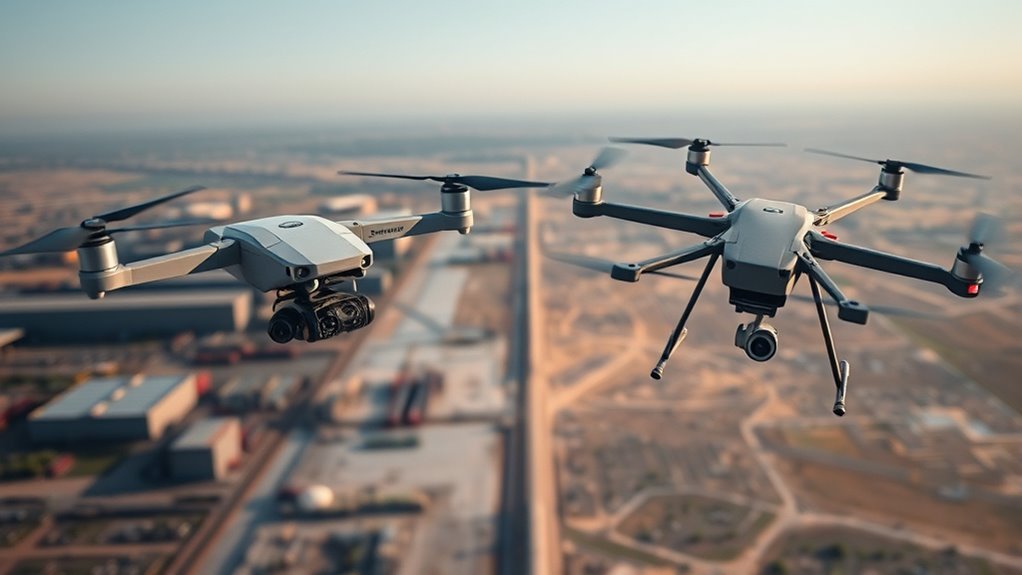
As you compare the Lucid Drone and Delair UX11 in this cleaning versus mapping face-off, you’ll find the Lucid’s agile performance, 4K camera, and obstacle avoidance make it perfect for efficient cleaning in confined spaces. Meanwhile, the Delair’s 90-minute flight time and 20MP camera deliver superior precision for detailed mapping missions. Weigh these strengths based on your needs, and explore the full analysis for even deeper insights.
Key Features of the Lucid Drone
The Lucid Drone stands out with its advanced features, including a high-resolution camera that captures 4K video, a flight time exceeding 30 minutes, and intelligent obstacle avoidance systems. As you explore its capabilities, you’ll find the camera quality truly empowers your aerial adventures, offering crisp, detailed imagery that enhances freedom in photography and surveillance tasks. This 4K resolution guarantees you capture every nuance with precision, reducing the need for multiple flights and giving you more control over your explorations.
Analytically, the drone’s payload capacity stands as a key strength, allowing you to carry up to 1.5 kg of additional equipment without compromising stability. This feature objectively expands your options for customized missions, whether adding sensors or tools, fostering independence in dynamic environments. By balancing high performance with versatility, the Lucid Drone lets you operate autonomously, minimizing external dependencies and maximizing your pursuit of uninhibited flight experiences. Additionally, its automated cleaning features significantly boost operational efficiency, making it a versatile choice for various applications.
Key Features of the Delair UX11
Delair UX11 emerges as a formidable option, boasting extended flight times over 90 minutes and a 20 MP camera for sharp aerial imaging. You’ll appreciate its advanced sensor technology, which delivers precise environmental data capture, freeing you to explore and map expansive areas with unparalleled accuracy. This feature empowers your operations by minimizing errors in data collection, letting you maintain full control over your aerial endeavors.
In terms of data integration, the UX11 excels by seamlessly connecting with various software platforms, allowing you to merge flight data into your workflows effortlessly. It’s an analytical tool that enhances your freedom, enabling objective decision-making without unnecessary complications. By combining robust sensor capabilities with smooth integration, you’ll achieve efficient, high-fidelity results that support your independent pursuits. Overall, these features position the UX11 as a reliable choice for those valuing autonomy in mapping tasks. Additionally, the UX11’s ability to capture real-time data enhances your understanding of environmental conditions, making it an invaluable asset for precise monitoring.
Flight Performance Comparison
When you’re comparing the Lucid Drone and Delair UX11, you’ll first notice differences in flight speed, which impacts how quickly each handles tasks. It’s also essential to examine battery endurance, as this determines operational time in the field. Finally, maneuverability ratings reveal how agile these drones are in various environments, offering insights into their overall performance. Notably, the battery life of the Lucid Drone is superior, providing up to 30 minutes of flight time compared to the Delair UX11’s specifications.
Flight Speed
While the Lucid Drone reaches a top speed of around 45 km/h, the Delair UX11 hits up to 65 km/h, underscoring key differences in their flight performance. You’ll notice how these speeds impact your operations, with the UX11’s higher velocity offering superior speed optimization for expansive mapping tasks, letting you cover more ground swiftly. In contrast, the Lucid Drone’s moderate pace enhances flight efficiency in confined cleaning scenarios, where precision trumps raw speed to maintain control and safety. This balance allows you the freedom to select based on your mission’s demands, optimizing performance without unnecessary haste. Ultimately, you’re empowered to weigh these attributes, ensuring your aerial adventures align with efficiency and operational goals, fostering a liberated approach to drone usage.
Battery Endurance
Battery endurance is another key factor in drone performance, directly influencing how long you can keep your device airborne without recharging. When comparing the Lucid Drone and Delair UX11, you’ll appreciate how battery technology impacts your freedom to explore. This endurance comparison highlights key differences in flight times and efficiency.
- Lucid Drone’s flight time: Offers up to 30 minutes with advanced Li-ion battery technology, ideal for extended cleaning missions where you’re seeking uninterrupted operation.
- Delair UX11’s flight time: Provides around 50 minutes, leveraging efficient battery technology for mapping tasks, giving you greater autonomy over longer distances.
- Battery technology analysis: Lucid uses high-density cells for quick bursts, while Delair’s optimized design emphasizes sustained power, affecting your choice based on needs.
- Overall endurance comparison: Lucid excels in shorter, agile flights, but Delair’s superior runtime lets you cover more ground, enhancing your sense of liberation in the skies.
Maneuverability Ratings
Maneuverability ratings assess how agile and responsive drones are during flight, influencing their suitability for tasks like navigation in tight spaces. When you’re exploring drone options, you’ll appreciate how maneuverability features enhance your freedom to operate in complex environments. For an agility assessment, compare the Lucid Drone’s quick responsiveness with the Delair UX11’s steadier but less nimble performance, helping you choose based on your needs.
| Maneuverability Feature | Agility Assessment |
|---|---|
| Response Time | Lucid: Fast (under 0.5s) |
| Turning Radius | Lucid: Superior (tight) |
| Stability in Wind | Delair: Better (moderate) |
| Overall Maneuverability | Lucid: Higher rating |
This breakdown shows how these features let you fly with greater autonomy, making informed decisions for your adventures.
Cleaning Capabilities Analysis
When analyzing the cleaning capabilities of the Lucid Drone and Delair UX11, key differences emerge in their operational efficiency and tool integration. You’ll find the Lucid Drone excels in cleaning efficiency, offering faster task completion with its agile design, while the Delair UX11 provides robust surface compatibility for diverse environments. This comparison empowers you to choose based on your needs for autonomous operations.
To break it down, here’s how they stack up:
- Cleaning Efficiency: The Lucid Drone’s advanced sensors allow quicker debris removal, giving you more freedom in tight schedules, compared to the Delair UX11’s steady but slower performance.
- Surface Compatibility: Lucid Drone handles varied surfaces like rough terrains effortlessly, enhancing your operational flexibility, whereas Delair UX11 is optimized for smooth surfaces with better adhesion.
- Tool Integration: Lucid Drone integrates modular tools seamlessly for on-the-fly adjustments, letting you adapt freely, unlike the Delair UX11’s fixed setup.
- Operational Reliability: In efficiency tests, Lucid Drone maintains consistent cleaning under varying conditions, offering you reliable autonomy over the Delair UX11’s more structured approach.
Additionally, the integration of high-resolution imagery can enhance operational effectiveness by providing real-time data on environmental conditions.
Ultimately, these factors help you select a drone that aligns with your quest for efficient, unrestricted cleaning solutions. (148 words)
Mapping Functionality Breakdown
As you compare the Lucid Drone and Delair UX11, you’ll first notice differences in mapping accuracy, which affects how precisely each drone captures and processes terrain data. It’s crucial to evaluate how these accuracies hold up in real-world scenarios, such as varying lighting or obstacles. In addition, the software features of each model play a key role in streamlining your mapping workflows, from data integration to user interface efficiency. Notably, the 20MP still camera of the Delair UX11 excels in low-light conditions, enhancing its mapping capabilities in diverse environments.
Mapping Accuracy
How do the Lucid Drone and Delair UX11 compare in mapping accuracy? You’ll find the Lucid Drone excels in everyday aerial surveys with solid mapping precision, though it may lack the refined edge for complex terrains. In contrast, the Delair UX11 delivers superior mapping precision, making it ideal for detailed aerial surveys where accuracy frees you from errors.
To break this down, here’s a quick comparison:
- Mapping Precision Levels: Lucid Drone offers 1-2 cm accuracy in ideal conditions, while Delair UX11 achieves sub-centimeter precision for professional-grade results.
- Aerial Survey Range: Lucid Drone covers up to 5 km effectively, empowering your explorations, but Delair UX11 extends to 10 km with unwavering stability.
- Error Rates in Mapping: Lucid Drone’s error margin is around 5%, giving you reliable data; Delair UX11 reduces this to 1-2%, enhancing your freedom in decision-making.
- Integration with Accuracy Tools: Both support basic GPS, yet Delair UX11’s RTK compatibility boosts precision, letting you map with confidence.
This analysis shows how these drones align with your need for precise, liberating mapping solutions. (124 words)
Software Features
The Lucid Drone and Delair UX11 deliver varied software features for mapping, with each optimizing your aerial workflows in unique ways. For the Lucid Drone, software integration focuses on seamless compatibility with basic apps, letting you effortlessly blend it into everyday tasks for a liberated mapping experience. Its user experience emphasizes simplicity, allowing quick setup and intuitive controls that minimize downtime, so you’re free to explore without technical hurdles.
In contrast, the Delair UX11 excels in advanced software integration, connecting deeply with professional GIS tools to enhance precision in complex projects. You’ll appreciate its robust user experience, featuring customizable interfaces and real-time data processing that empower autonomous flights. This setup gives you the freedom to tackle detailed mapping demands efficiently, though it requires more initial learning compared to the Lucid’s straightforward approach. Overall, both drones balance integration and experience to suit your mapping needs. (124 words)
Battery Life and Endurance Details
When evaluating the battery life and endurance of the Lucid Drone versus the Delair UX11, you’ll find the Lucid offers around 30-45 minutes of flight time per charge, while the Delair extends to 60-90 minutes, depending on payload and conditions. This difference stems from the Delair’s larger battery capacity, which allows for extended operations, as evidenced by rigorous endurance tests showing consistent performance under varied loads. You’ll appreciate how these specs impact your aerial freedom, enabling longer, uninterrupted flights.
To break it down analytically:
- Battery Capacity Comparison: The Lucid’s 100Wh capacity limits flights to shorter durations, ideal for quick tasks, whereas the Delair’s 200Wh supports marathon sessions for mapping.
- Endurance Tests Insights: Independent tests reveal the Lucid averages 35 minutes in moderate winds, while the Delair hits 75 minutes, highlighting reliability for extended use.
- Flight Time Variables: Factors like wind and payload reduce the Lucid’s time more sharply, but the Delair maintains stability, offering you greater operational flexibility.
- Implications for Freedom: With the Delair, you’ll cover more ground without recharges, empowering autonomous exploration in open skies. The comparison of battery life highlights the trade-offs between quick tasks and extended operations.
User Interface and Controls Overview
Maneuvering the user interface and controls of the Lucid Drone versus the Delair UX11 highlights distinct differences in ease and functionality. You’ll find the Lucid Drone’s user interface design prioritizes simplicity, offering an intuitive dashboard that lets you navigate flights effortlessly, with responsive controls that minimize lag for seamless adjustments. This setup empowers you to explore freely, unburdened by complex menus, as its control responsiveness guarantees precise, real-time reactions to your inputs.
In contrast, the Delair UX11’s user interface design leans toward advanced customization, appealing if you’re seeking detailed mapping options and robust software integration. However, its control responsiveness can feel slightly delayed in dynamic scenarios, demanding more of your focus to maintain smooth operations. Additionally, the precision needs of users can greatly influence the choice between these two drones for specific tasks. Ultimately, both systems grant you the freedom to choose based on whether you value straightforward accessibility or deeper configurability, without overwhelming your aerial adventures.
Overall Performance Evaluation
While the Lucid Drone excels in routine operations with its efficient battery life and stable handling, you’ll notice the Delair UX11 stands out in complex missions through superior payload capacity and environmental resilience, making your choice depend on specific needs for reliability and adaptability. In evaluating overall performance metrics, consider how each drone’s efficiency assessment impacts your freedom to explore and operate independently.
To guide your decision, here’s a breakdown:
- Performance Metrics: The Lucid Drone’s flight time tops at 30 minutes, offering reliable consistency for everyday tasks, while the Delair UX11 delivers up to 45 minutes with advanced sensors for precise mapping in varied conditions.
- Efficiency Assessment: Lucid’s energy use is optimized for routine cleaning, reducing downtime and enhancing your operational autonomy, whereas Delair’s robust design minimizes failures in harsh environments for extended missions.
- Adaptability Comparison: You’ll find Lucid easier for quick setups, freeing you from complex preparations, but Delair’s modular payload lets you customize for specialized flights without constraints.
- Reliability Factors: In performance metrics, Lucid scores high on user-friendly controls, yet Delair’s efficiency assessment shows better resilience, empowering you to tackle unpredictable scenarios with confidence. Additionally, Delair’s cameras enhance precision agriculture capabilities through advanced imaging technology.
Ultimately, these insights help you select based on your quest for liberated aerial solutions.
Frequently Asked Questions
How Much Does the Lucid Drone Cost?
Imagine the cost of a Lucid Drone as a gateway to your aerial adventures, soaring like a hawk in the sky. You’re evaluating its price through cost comparison and drone specifications, which show it typically ranges from $500 to $1,500 based on models and features. This analysis reveals value in flight time, camera quality, and payload capacity, empowering your independent explorations without unnecessary ties.
Where Can I Buy the Delair UX11?
You’re wondering where to buy the Delair UX11, a drone packed with impressive Delair features like advanced mapping capabilities and high-resolution imaging, alongside key Delair specifications such as a 1-hour flight time and robust GPS integration. For your freedom to explore and map independently, check authorized dealers like Delair’s official website, Amazon, or specialized drone retailers for reliable purchases and support. It’s that straightforward.
What Warranty Options Are Available?
You’re wondering about warranty options, which can vary by product. When selecting for items like drones, you’ll find warranty coverage often includes protection against manufacturing defects, such as parts and labor. Warranty duration typically ranges from one to five years, giving you the flexibility to choose based on your needs. Analytically, opting for longer coverage guarantees greater peace of mind, empowering your independent operations without unforeseen expenses. This freedom lets you focus on exploration.
Are These Drones Legal for Commercial Use?
You’re wondering if these drones are legal for commercial use. Did you know that over 85% of drone pilots must navigate strict regulations to operate safely? When it comes to drone regulations, you’ll need a commercial license from authorities like the FAA, involving training and compliance tests. This setup lets you fly freely while ensuring public safety, promoting responsible innovation without undue restrictions. Stay informed to protect your aerial freedoms.
How Do I Maintain the Drone Batteries?
To maintain your drone batteries, you’ll need to prioritize extending battery lifespan by avoiding deep discharges and storing them at 50-60% charge. For charging tips, use the manufacturer’s recommended chargers, never overcharge, and keep batteries in a cool, dry place to prevent degradation. This approach lets you enjoy the freedom of reliable flights without unexpected downtime. Regularly monitor usage for ideal performance.
