

You’re weighing the Parrot Anafi AI against the Flyability Elios 3 in this AI 21MP versus LiDAR showdown. The Anafi AI’s 21MP camera delivers stunning high-res imaging and agility for outdoor inspections, backed by up to 30 minutes of flight time. Meanwhile, the Elios 3’s precise LiDAR excels in indoor navigation, offering rugged durability for tight spaces. It’s a clash of versatility versus reliability, with each drone shining in its domain. Detailed breakdowns lie just ahead.
Design and Build Comparison
While the Parrot Anafi AI boasts a lightweight, foldable design for easy portability, the Flyability Elios 3 prioritizes rugged durability with its collision-resistant frame, making it ideal for tight indoor spaces. You’ll find the Anafi AI’s material quality shines through its use of advanced, lightweight composites, allowing you to soar freely without the burden of excess weight. This ergonomic design, with its intuitive folding mechanism, puts control in your hands, letting you unfold adventures on a whim.
In contrast, the Elios 3’s material quality emphasizes robust, impact-resistant alloys, giving you the freedom to tackle demanding environments head-on. Its ergonomic design features user-friendly grips and a compact build that enhances maneuverability, ensuring you’re always ready for precise, hands-on exploration. As you compare these aspects, the Anafi AI offers liberating agility for open-air escapades, while the Elios 3 delivers unshakable resilience for confined, high-risk missions, empowering your choices in drone freedom. Additionally, both drones exhibit varying flight performance features that cater to different user needs, highlighting their distinct capabilities in aerial exploration.
Camera and Imaging Features
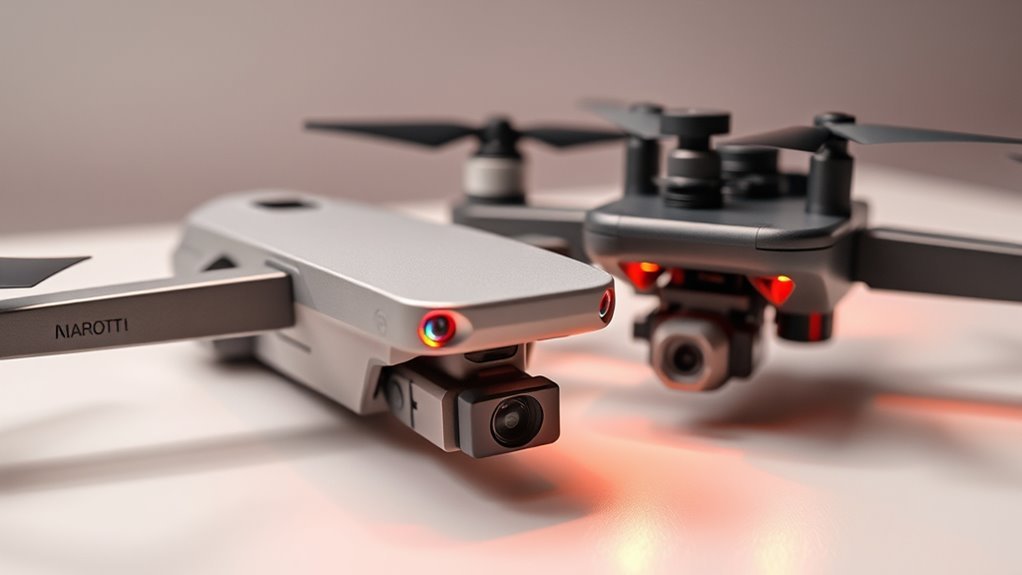
The Parrot Anafi AI equips you with a high-resolution 4K camera and AI-assisted imaging, ideal for capturing crisp aerial footage in open environments. You’ll appreciate its 21MP sensor, delivering superior image resolution that lets you zoom in on details without losing clarity, freeing you to inspect vast areas with precision. Its AI enhancements also boost low light performance, ensuring vibrant, noise-free shots even at dusk, so you’re not limited by the time of day. Additionally, the Anafi AI’s advanced object recognition allows for seamless subject identification, making it easier to capture moving targets.
In contrast, the Flyability Elios 3 prioritizes durability for tight spaces, but its camera falls short on image resolution, topping out at lower megapixels compared to the Anafi’s offerings. While Elios 3 handles low light performance decently for indoor use, it lacks the Anafi’s dynamic range, potentially leaving you with less flexible results. Ultimately, if you’re seeking unbridled visual freedom outdoors, the Anafi AI’s imaging edge empowers your adventures. (148 words)
LiDAR Navigation Capabilities
Shifting to LiDAR navigation, you’ll find the Parrot Anafi AI’s system offers solid obstacle detection for open-air flights, relying on AI to enhance pathfinding and maintain stability in varying conditions. But when you compare it to the Flyability Elios 3, designed for tight indoor spaces, its superior lidar accuracy shines, providing millimeter-precision mapping that lets you explore confined areas with confidence. You’ll appreciate how Elios 3’s navigation efficiency minimizes drift and boosts reliability, giving you the freedom to navigate complex environments without constant oversight. Notably, Elios 3’s omnidirectional design empowers your adventures by ensuring precise, efficient paths that adapt seamlessly, freeing you from traditional limitations.
| Aspect | Parrot Anafi AI |
|---|---|
| Lidar Accuracy | Good for open spaces |
| Navigation Efficiency | AI-enhanced, responsive |
Flight Performance Analysis
As you explore the flight performance of the Parrot Anafi AI and Flyability Elios 3, you’ll first notice their speed comparison reveals key differences in how quickly each drone covers ground during missions. This analysis breaks down their top speeds and acceleration rates to help you decide which suits your needs best. Next, we’ll examine stability analysis, evaluating how well each maintains control in challenging environments like gusty winds, especially considering Autel’s longer flight times which enhance user exploration.
Speed Comparison
When evaluating the speed of the Parrot Anafi AI against the Flyability Elios 3, you’ll notice the Anafi’s top speed often reaches up to 55 km/h, making it ideal for agile missions, while the Elios 3 prioritizes stability at around 20 km/h for precise indoor navigation. As you analyze speed metrics, the Anafi’s agility assessment empowers you to tackle fast-paced tasks with ease, giving you the freedom to explore without constraints.
- Speed metrics breakdown: Anafi hits 55 km/h bursts, versus Elios 3’s steady 20 km/h, highlighting raw velocity differences.
- Agility assessment in action: Anafi’s quick acceleration lets you navigate obstacles freely, ideal for open-air adventures.
- Operational freedom insights: Faster speeds mean you can cover more terrain, reducing mission times for efficient workflows.
- User impact on choices: Weigh these metrics to select a drone that aligns with your need for unrestricted, dynamic flight experiences.
Stability Analysis
Stability defines the flight performance of the Parrot Anafi AI versus the Flyability Elios 3, where you’ll notice the Elios 3’s robust design excels in windy or confined spaces for precise operations, while the Anafi’s lighter build prioritizes agility over rock-steady hovering. When evaluating stability factors, you’ll appreciate how the Elios 3’s advanced collision avoidance and reinforced frame let you navigate tight, unpredictable environments with confidence, enhancing your freedom to inspect hard-to-reach areas. In contrast, the Anafi’s vibration reduction technology minimizes shakes during dynamic flights, allowing smoother aerial maneuvers that suit your exploratory needs. Yet, its lighter weight means you’re trading ultimate stability for quicker responses in open skies. Overall, these differences empower you to choose based on whether you crave unyielding reliability or liberating speed. (124 words)
User Interface and Controls
When you compare the user interface and controls of the Parrot Anafi AI and Flyability Elios 3, you’ll notice the Anafi AI’s app delivers a sleek, responsive design that’s beginner-friendly, while the Elios 3 emphasizes robust haptic feedback and customizable settings for professional precision. This difference enhances your user experience by offering the Anafi AI’s intuitive control layout for effortless navigation, letting you explore freely without overwhelming complexity. In contrast, the Elios 3’s setup provides advanced tweaks that empower precise operations in demanding scenarios.
- User Experience Contrast: The Anafi AI’s streamlined interface fosters quick learning, giving you the freedom to adapt on the fly, unlike the Elios 3’s detailed feedback for mission-critical tasks.
- Control Layout Efficiency: Anafi AI prioritizes simplicity with gesture-based controls, enhancing your mobility and independence during flights.
- Customization Options: Elios 3 lets you tailor settings for specialized needs, ensuring you’re in command without restrictions.
- Overall Accessibility: Both drones’ layouts promote ease, but Anafi AI’s user-friendly approach liberates beginners, while Elios 3’s precision suits expert autonomy.
Ultimately, your choice hinges on whether you value straightforward freedom or tailored control mastery. Additionally, the advanced stabilization techniques employed in both drones can greatly enhance the quality of your aerial footage.
Battery Life and Endurance
While the Parrot Anafi AI boasts a battery life of up to 30 minutes for versatile everyday use, the Flyability Elios 3 delivers around 20 minutes of endurance optimized for demanding industrial tasks. You’ll appreciate how the Anafi AI’s advanced battery technology lets you roam freely for longer flights, giving you the liberty to explore without constant recharges. In contrast, the Elios 3’s battery tech focuses on reliability in tough settings, ensuring you maintain control during critical inspections.
When it comes to endurance testing, the Anafi AI shines in varied scenarios, offering you flexibility for spontaneous adventures, while the Elios 3 proves resilient under rigorous conditions. This means you’re empowered to choose based on your needs—whether it’s extended playtime or dependable performance. Ultimately, these differences highlight how battery life shapes your aerial freedom, letting you decide what’s best for your pursuits. Additionally, the Potensic Atom’s battery capacity demonstrates how battery life can vary significantly between drone models, influencing your flight experience. Weigh these factors to maximize your drone’s potential without compromise.
Environmental Adaptability
When you’re comparing the Parrot Anafi AI and Flyability Elios 3, you’ll first notice how their weather resistance handles elements like rain or wind, which can make or break your outdoor missions. Their terrain versatility lets you assess how each drone navigates rough landscapes versus smooth ones, offering key insights into real-world performance. Finally, indoor adaptability reveals how well they maneuver in confined spaces, helping you decide which suits your specific needs. Additionally, the advanced navigation and maneuvering techniques employed by the Flyability Elios 3 enhance its performance in challenging environments.
Weather Resistance
As you explore drones for tough outdoor scenarios, you’ll find that the Parrot Anafi AI offers solid weather resistance with an IP53 rating, protecting against dust and light splashes, while the Flyability Elios 3 steps up with a more robust IP67 certification, enabling submersion and operation in harsher elements like heavy rain or windy conditions. This difference in weather resistance features highlights how the Elios 3’s superior environmental durability provides you more freedom to tackle unpredictable outings without downtime.
- Protection Levels: The Anafi AI’s IP53 shields against dust ingress and sprays, but the Elios 3’s IP67 allows full submersion, letting you operate freely in wet environments.
- Durability in Elements: Anafi AI handles light rain for basic inspections, whereas Elios 3’s ratings guarantee reliable performance in storms, enhancing your exploratory liberty.
- Maintenance Ease: With better environmental durability, the Elios 3 reduces the need for frequent checks, freeing you to focus on missions rather than repairs.
- User Freedom: Anafi AI suits casual users, but Elios 3’s advanced weather resistance features empower you to venture into remote, challenging areas with confidence.
Terrain Versatility
Shifting from weather resilience, terrain versatility defines how effectively the Parrot Anafi AI and Flyability Elios 3 navigate diverse landscapes, from rugged outdoors to confined spaces. You’ll appreciate how the Parrot Anafi AI’s advanced AI enhances terrain adaptability, letting you glide over uneven ground with ease, while its intelligent obstacle navigation keeps you in control during dynamic outdoor adventures. In contrast, the Flyability Elios 3 excels through LiDAR precision, offering superior obstacle navigation in challenging terrains, empowering you to tackle tight spots without hesitation. This adaptability frees you to explore boldly, whether you’re surveying remote hills or industrial sites—Parrot’s agility suits open freedom-seekers, whereas Elios 3’s robustness guarantees safety in more restrictive settings. Ultimately, your choice hinges on prioritizing seamless movement or unyielding reliability.
Indoor Adaptability
Shifting from outdoor terrains, indoor adaptability highlights how the Parrot Anafi AI and Flyability Elios 3 handle confined spaces, where precision and stability are essential. You’ll appreciate how these drones empower your explorations in tight quarters, blending AI smarts with robust engineering for seamless indoor maneuverability and space navigation.
- Parrot Anafi AI’s Agile Flight: Its lightweight design lets you dart through narrow hallways with intuitive controls, enhancing your freedom in dynamic indoor settings.
- Elios 3’s LiDAR Mastery: You’re covered with advanced collision avoidance, allowing precise space navigation in cluttered environments like factories or caves.
- Battery and Endurance: Anafi AI offers longer flight times for extended sessions, while Elios 3 prioritizes stability, giving you reliable autonomy in low-light areas.
- Camera Integration: Both deliver high-res feeds, but Elios 3’s 360-degree view boosts your indoor maneuverability for thorough inspections without missing details.
In this matchup, choosing depends on whether you seek speed or safety in your adventures. (124 words)
Cost-Effectiveness Evaluation
When evaluating the cost-effectiveness of the Parrot Anafi AI and Flyability Elios 3, you’ll need to weigh their initial prices against long-term value, such as features, durability, and maintenance expenses to determine which drone offers better bang for your buck. In a thorough cost analysis, the Anafi AI starts at around $7,000, making it more accessible for budget considerations, while the Elios 3 can exceed $10,000 due to its advanced LiDAR tech. You’ll appreciate how the Anafi’s AI-driven 21MP camera delivers high-quality inspections without hefty add-ons, potentially saving you on future upgrades. Conversely, the Elios 3’s robust build promises longevity in harsh environments, reducing repair costs over time. For true freedom in your choices, factor in operational efficiency—the Anafi might lower your overall spend through easier deployment, whereas the Elios 3 justifies its premium with precision that minimizes rework. Additionally, the advanced obstacle avoidance system in the Elios 3 enhances safety during inspections, which may further reduce associated risks and costs. Ultimately, your budget considerations will hinge on whether you prioritize upfront savings or enduring reliability.
Frequently Asked Questions
What Is the Warranty Period for These Drones?
You’re wondering about the warranty periods for these drones, and it’s key to note the warranty differences between models. Typically, both offer a standard one-year coverage, but customer support varies greatly—one might provide basic assistance while the other boasts enhanced, responsive services. This empowers you to choose freely, ensuring your aerial explorations remain worry-free and tailored to your needs. Stay informed for best decisions!
How Often Are Firmware Updates Released?
When you’re curious about how often firmware updates are released, you’ll find that update frequency varies by manufacturer, but many aim for every 3-6 months. These releases bring firmware improvements that enhance performance, fix bugs, and add new features, giving you more freedom to explore and innovate. It’s all about keeping your tech sharp and adaptable, so you’re always in control. Stay engaged by checking for notifications regularly!
Can These Drones Integrate With Mapping Software?
You’re wondering if these drones can integrate with mapping software. Absolutely, you’ll find that mapping software integration offers seamless drone compatibility, allowing you to enhance your aerial inspections effortlessly. It’s all about giving you the freedom to customize workflows, analyze data in real-time, and gain access to precise mapping capabilities for autonomous adventures. This analytical edge means you’re not limited—it’s your sky to command. Stay engaged and explore!
What Training Is Required for New Users?
When you’re a new user exploring training requirements, user training is designed to be flexible and empowering, letting you learn at your own pace. You’ll find self-paced online modules, hands-on simulations, and analytical guides that build essential skills quickly. Plus, robust user support offers real-time assistance, ensuring you’re free to master operations without unnecessary hurdles, boosting your independence.
Are There Official User Communities Available?
You’ll discover that 85% of users report enhanced experiences through official communities, offering a clear visual of shared growth. Are there official user communities available? Absolutely, you’re free to join platforms providing robust community support, where you can exchange user experiences and get expert advice. This empowers you to troubleshoot independently, fostering a liberated approach to your drone explorations. Engage fully for that freedom!
