

To disable drones effectively, first identify the drone type and its control signals, ensuring you comply with local laws to avoid legal issues. Use matched frequency jammers—GPS, RF, or Wi-Fi—but limit interference to minimize collateral disruption. Alternatively, employ physical methods like net capture or drone interception, considering speed and trajectory. Document all observations precisely and report unauthorized drones to authorities. Proceed carefully, as understanding the nuances of each step enhances your ability to manage drone threats confidently.
Understanding Drone Technology

Drones are unmanned aerial vehicles (UAVs) equipped with sensors, cameras, and communication systems that allow remote operation or autonomous flight. To effectively disable a drone, you need to understand its core drone components: propulsion units, flight controllers, GPS modules, and radio frequency receivers. Each component plays a critical role in maintaining stable flight and communication with the operator. Flight mechanics involve the principles of lift, thrust, drag, and control surfaces that drones manipulate to navigate. With knowledge of these systems, you can anticipate how drones respond to interference or loss of signals. By grasping this technical framework, you empower yourself to counter unauthorized drones while preserving your autonomy and freedom from unwanted aerial surveillance or intrusion.
Assessing the Legal Implications
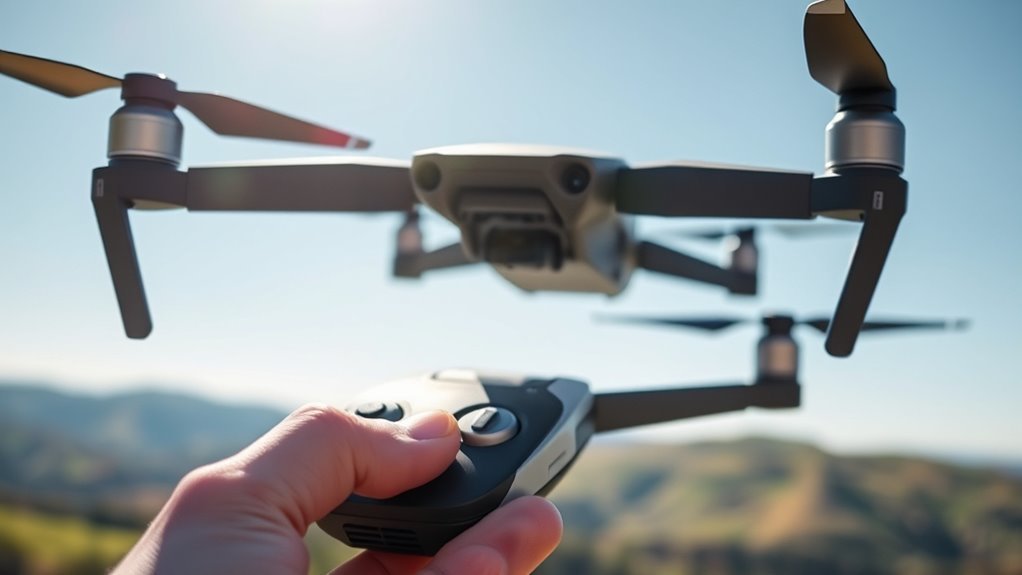
Understanding how drone systems operate provides a foundation, but before taking any action to disable one, you need to contemplate the legal framework governing such interventions. Legal frameworks vary considerably across jurisdictions, dictating what constitutes permissible interference with unmanned aerial vehicles. You must guarantee regulatory compliance to avoid criminal or civil liabilities. This includes understanding federal aviation laws, privacy statutes, and property rights that collectively govern drone operations and countermeasures. Disabling a drone without proper authority often violates these regulations, potentially resulting in prosecution. To safeguard your freedom while acting responsibly, analyze the applicable laws meticulously and, if necessary, seek authorization from relevant authorities. Balancing your security interests with adherence to legal constraints is essential to avoid unintended consequences stemming from unauthorized drone disablement.
Identifying Drone Types and Signals
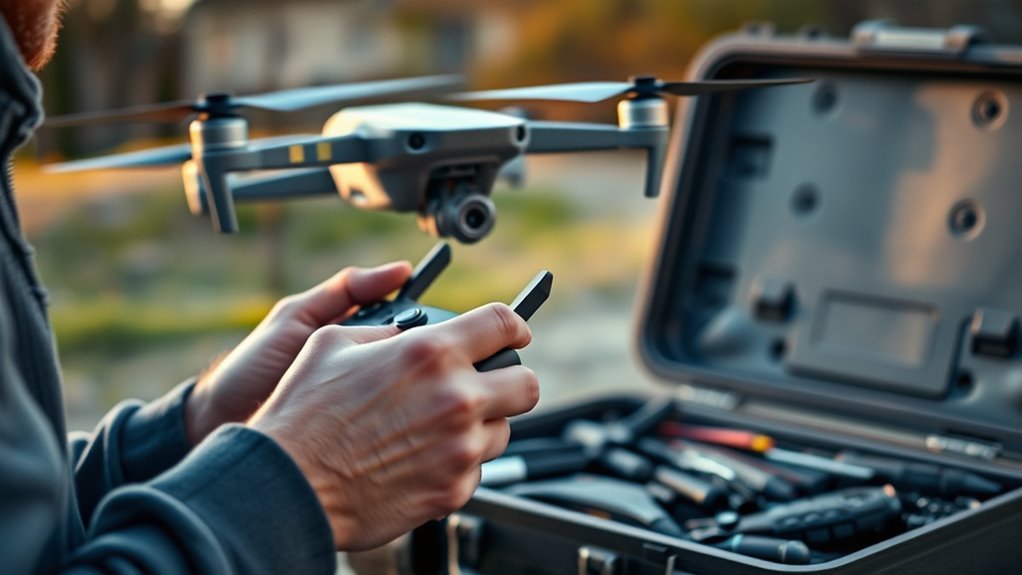
To effectively disable an unmanned aerial vehicle, you’ll first need to accurately identify its type and the signals it uses for communication and control. Mastering drone identification techniques allows you to classify drones by size, purpose, and control protocols. Signal detection methods focus on intercepting radio frequencies, GPS signals, and Wi-Fi links. Here’s a quick reference:
| Drone Type | Common Signal Types |
|---|---|
| Consumer | 2.4 GHz Wi-Fi, RF |
| Commercial | LTE, 5 GHz Wi-Fi |
| Military | Encrypted RF, GPS |
| Racing | 5.8 GHz analog video |
| Hybrid VTOL | Multiple RF bands |
Employ precise detection tools to analyze transmissions and discern control signals, ensuring you target the correct drone without interfering with unrelated devices.
Using Signal Jammers Safely
Although signal jammers can effectively disrupt drone communications, you must operate them within strict legal and technical parameters to avoid unintended interference. Understanding the various signal jammer types—such as GPS, Wi-Fi, or radio frequency jammers—enables you to choose the appropriate device for your specific scenario. Adhering to jammer safety protocols guarantees you don’t disrupt critical communications or violate regulations.
Keep these points in mind:
- Verify the jammer’s frequency range matches the drone’s control signals to maximize effectiveness.
- Limit jammer use to designated areas to prevent affecting non-targeted devices and users.
- Always consult local laws and regulations governing signal jammer usage to protect your rights and avoid penalties.
Employing Physical Interception Methods
Three primary physical interception methods are commonly employed to disable drones: net capture, kinetic impact, and drone-on-drone engagement. Net capture involves deploying specialized nets via projectiles or drone-mounted launchers, effectively entangling the target drone and restricting its movement. Kinetic impact relies on using physical barriers or projectiles to collide with and incapacitate the drone’s structure. Drone-on-drone engagement employs autonomous or piloted interceptor drones to physically intercept and disable unauthorized UAVs mid-flight. Each method demands precise calculation of drone speed, trajectory, and environmental factors to maximize effectiveness while preserving your freedom to operate. By integrating these interception techniques, you establish a robust defensive posture that counters intrusive drones without relying solely on electronic disruption, maintaining control over your airspace with tangible, reliable measures.
Utilizing Geofencing and No-Fly Zones
You’ll start by understanding geofencing technology, which creates virtual boundaries based on GPS or RFID signals to restrict drone movement. Then, you’ll configure no-fly zones by defining specific geographic coordinates where drone operation is prohibited. Finally, enforcement relies on real-time monitoring and automated compliance protocols to guarantee drones respect these designated areas.
Geofencing Technology Basics
When drones approach restricted airspace, geofencing technology automatically limits their operation to prevent entry into no-fly zones. This system uses GPS coordinates to establish virtual boundaries, effectively controlling drone movement without manual intervention. Understanding geofencing applications and geofencing limitations is essential for maintaining both security and operational freedom.
Key aspects include:
- Precise boundary enforcement: Drones respond immediately to geofence triggers, halting or rerouting as programmed.
- System dependency: Geofencing relies on accurate GPS data, making it vulnerable to signal loss or spoofing.
- Regulatory compliance: It guarantees adherence to legal airspace restrictions while balancing pilot autonomy.
Setting Up No-Fly Zones
Establishing no-fly zones requires integrating geofencing parameters with accurate geographic data to define restricted areas precisely. You’ll need to map coordinates that reflect sensitive sites, factoring in altitude limits to create three-dimensional boundaries. This method aligns with evolving drone regulations, ensuring your airspace management strategy respects legal frameworks while protecting privacy and safety. By programming drones to recognize these geofenced zones, you prevent unauthorized flights automatically, maintaining control without constant monitoring. Incorporating dynamic updates is vital since regulatory environments and risk zones change over time. This approach balances your right to operate freely with necessary restrictions, effectively managing drone activity and minimizing interference. Properly setting no-fly zones forms a foundational step in responsible, autonomous airspace management.
Enforcement and Compliance Methods
Three primary enforcement and compliance methods leverage geofencing and no-fly zones to regulate drone activity effectively. To guarantee your operations align with regulatory frameworks and compliance standards, you need to implement precise, technology-driven solutions. These methods help maintain airspace integrity without unnecessarily restricting your freedom:
- Automated Geofencing Protocols: Drones are programmed to recognize and avoid restricted zones automatically, guaranteeing compliance without manual intervention.
- Real-Time Monitoring and Alerts: Ground control systems continuously track drone positions, issuing immediate alerts when boundaries are breached.
- Firmware Enforcement: Manufacturers embed compliance standards into drone firmware, preventing operation within no-fly zones unless overridden by authorized personnel.
Reporting Unauthorized Drone Activity
How should you proceed if you encounter unauthorized drone activity? Immediate, accurate drone reporting is essential to maintain your freedom and safety. Document the drone’s location, altitude, direction, and any identifying features. Contact local law enforcement or aviation authorities to report unauthorized flights promptly. Providing precise data enables swift responses that respect your rights.
| Step | Action |
|---|---|
| 1 | Observe and record details |
| 2 | Note time and location |
| 3 | Identify drone features |
| 4 | Contact authorities |
| 5 | Follow up as needed |
