
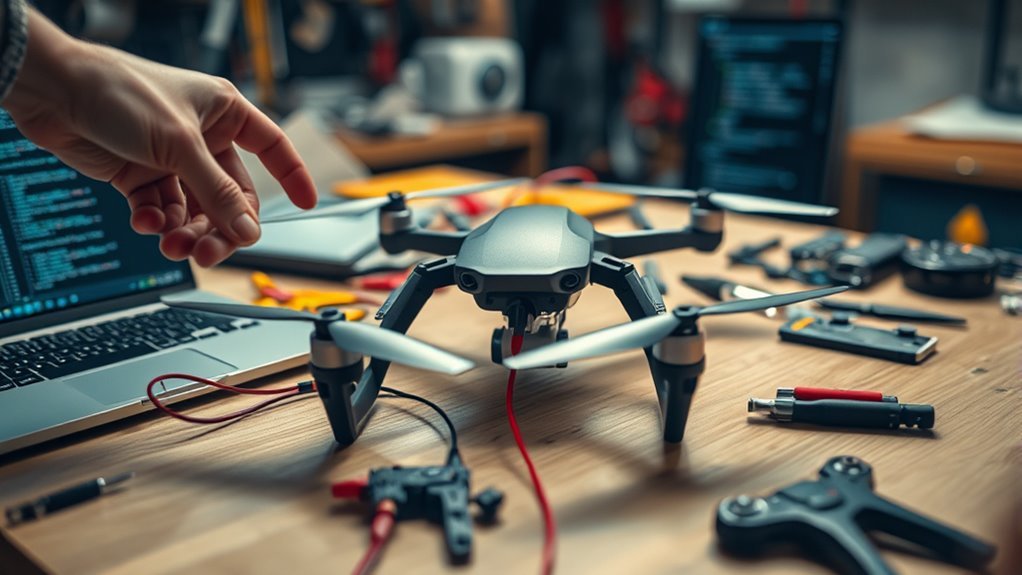
To program a drone, start by understanding key concepts like sensor integration and flight dynamics. Choose compatible software and set up your programming environment by installing necessary libraries. Familiarize yourself with a suitable programming language, often Python, and explore drone SDKs. Write and test your first code, ensuring robust debugging. Execute your flight plan by incorporating real-time data for better navigation. By mastering these elements, you’ll reveal advanced programming techniques and capabilities for your drone.
Understanding Drone Programming Basics

When you’re diving into drone programming, it’s vital to grasp the fundamental concepts that underpin the technology. Understanding drone sensors is significant, as they provide real-time data about the drone’s environment, including altitude, orientation, and obstacle detection. These inputs are instrumental in executing flight dynamics, which refers to how a drone maneuvers through the air. You’ll need to program algorithms that interpret sensor data and make decisions based on it, ensuring stability and responsiveness. By mastering these basics, you’ll reveal the potential to develop advanced flight paths and autonomous behaviors. Your ability to manipulate flight dynamics through effective programming will lead to unrestricted aerial exploration, enhancing both your skills and the drone’s capabilities. Additionally, integrating real-time data processing techniques can significantly improve responsiveness and decision-making during flight. Incorporating AI-driven analytics can also enhance the drone’s ability to detect obstacles and navigate efficiently in complex environments.
Choosing the Right Software for Your Drone
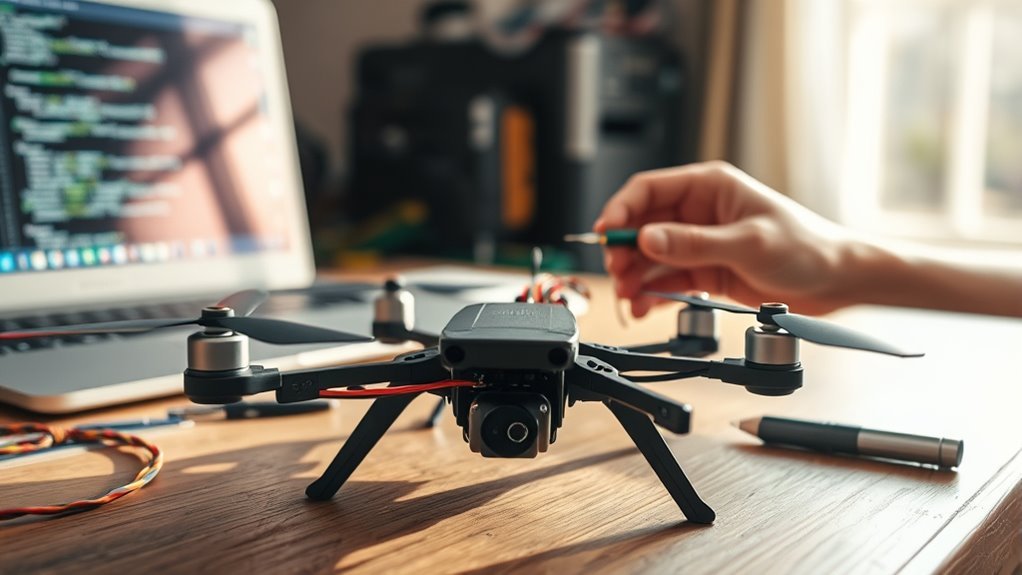
Selecting the right software for your drone is fundamental to maximizing its performance and functionality. You’ll want to evaluate software compatibility with your specific drone model, as using incompatible software can lead to operational issues and limit your drone’s capabilities. Look for platforms that support various programming languages, enabling you to customize functions as needed. The user interface should be intuitive, allowing you to navigate effortlessly while focusing on your programming tasks. A well-designed user interface enhances your coding experience, making it easier to implement complex algorithms and troubleshoot problems. By prioritizing software compatibility and a user-friendly interface, you’ll empower your drone to operate at its full potential, granting you the freedom to explore and innovate. Additionally, ensuring that the software includes advanced AI integration can significantly enhance your drone’s operational efficiency and adaptability. Ultimately, choosing software with real-time updates can help maintain performance and keep you informed of any necessary adjustments.
Setting Up Your Programming Environment
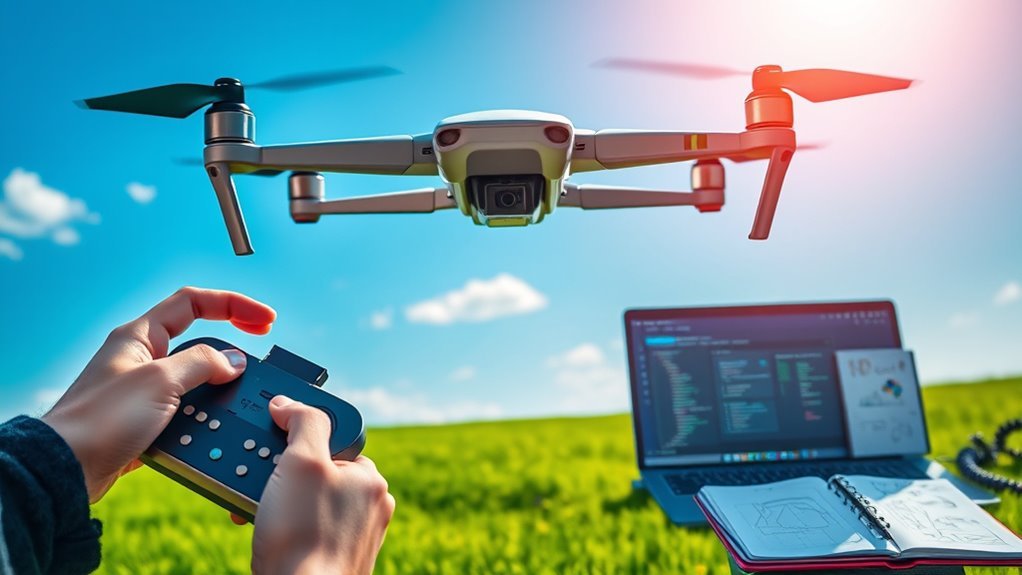
Before diving into programming your drone, it’s essential to establish a robust programming environment that meets your project’s requirements. Start by selecting the appropriate programming tools compatible with your drone’s hardware. Common options include integrated development environments (IDEs) like Arduino IDE or platforms like Python and ROS. Next, focus on environment configuration. This involves installing necessary libraries, setting up API keys, and ensuring all dependencies are correctly aligned. Don’t overlook version control systems like Git; they’re invaluable for tracking changes and collaborating if you’re working with a team. Finally, test your setup by running sample code to verify that everything functions correctly. A well-configured environment lays the foundation for successful drone programming and empowers your creative freedom.
Learning the Programming Language Used
Understanding the programming language used for your drone is essential, as it directly impacts the functionality and capabilities you can achieve. Most drones utilize popular languages like Python, renowned for its simplicity and extensive libraries. Familiarizing yourself with Python libraries designed for drone programming enables you to harness powerful features effortlessly. Furthermore, exploring various Drone SDKs can provide pre-built functionalities, allowing you to focus on crafting unique flight patterns and automating tasks. You’ll want to plunge into resources like the DroneKit or ROS, which offer robust frameworks that simplify drone control. In addition, ensuring NDAA compliance is crucial for maintaining security while programming your drone. By mastering these tools, you not only gain freedom in your programming but also enhance your drone’s performance, paving the way for innovative applications and experiences. Additionally, understanding the advanced camera capabilities of your drone can help you optimize the visual content you create through programming.
Writing Your First Drone Program
Once you’ve grasped the basics of the programming language and its associated libraries, you’re ready to plunge into writing your first drone program. Begin by establishing sensor integration, which is vital for real-time data processing. You’ll need to interface with various sensors like GPS, accelerometers, and gyroscopes to gather essential flight metrics. The navigation system performance of your drone plays a crucial role in ensuring accurate data collection. Next, focus on coding algorithms that enhance flight stability; this involves implementing PID controllers for smooth maneuvering. As you craft your program, make sure you structure your code to allow for easy adjustments and expansions in the future. Testing various scenarios will help you refine your approach, maximizing both responsiveness and stability. Moreover, consider incorporating user control over flight data to enhance privacy and ensure responsible drone operation. This foundation will empower you to explore more complex functionalities as you continue your programming journey.
Testing and Debugging Your Code
As you investigate testing and debugging your drone code, it is crucial to systematically evaluate each component to guarantee peak performance. Start by creating thorough test cases that cover various scenarios, ensuring every aspect of your code is examined. Utilize debugging tools to identify issues swiftly; these can help you pinpoint errors and understand the flow of your program better. Don’t overlook error handling—implement robust mechanisms to manage unexpected situations gracefully. This not only enhances reliability but also aids in code optimization, reducing unnecessary complexity. Refine your code iteratively, testing each modification to verify improvement. By maintaining this disciplined approach, you’ll achieve a more reliable and efficient drone program, allowing you the freedom to explore advanced functionalities confidently.
Executing Your Flight Plan
After ensuring your drone code is thoroughly tested and debugged, the next step involves executing your flight plan. Begin by uploading your code to the drone, ensuring all parameters for waypoint navigation are set correctly. Verify your drone’s GPS signal; a strong signal is essential for accurate flight plan execution. Launch your drone, allowing it to ascend to the initial waypoint while maintaining a stable altitude. It’s important to note that signal strength impacts the reliability of your drone’s communication during the flight. Monitor the flight in real-time, confirming that it adheres to the programmed path. If any adjustments are needed, utilize manual overrides to redirect the drone as required. Once the mission is complete, safely return the drone to its starting point. This process empowers you to explore autonomous flight with precision. Additionally, understanding your drone’s flight time capabilities can significantly enhance your planning and execution.
Advanced Programming Techniques for Drones
While programming a drone, mastering advanced techniques can greatly enhance its functionality and performance. One key area to focus on is autonomous navigation. By implementing algorithms that allow your drone to make real-time decisions based on environmental data, you’ll achieve impressive flight precision. This means your drone can navigate complex terrains without constant manual input.
Additionally, sensor integration is vital. Incorporating various sensors—like LiDAR, GPS, and cameras—enables your drone to perceive its surroundings dynamically. This data can be processed to avoid obstacles or identify targets, further enhancing its autonomous capabilities. For instance, using a camera with 4K video capabilities can significantly improve the drone’s ability to capture detailed images during autonomous missions. By refining these advanced techniques, you’re not just programming a drone; you’re empowering it to operate independently, maximizing its potential for exploration and creative applications.
Frequently Asked Questions
What Tools Do I Need to Build a Drone From Scratch?
To build a drone from scratch, you’ll need essential drone components like motors, flight controllers, and batteries, along with assembly techniques that guarantee stability and performance. These tools will empower your creative freedom in drone design.
Can I Use Any Programming Language for Drone Programming?
You can use various programming languages for drone software, but popular choices like Python and C++ often integrate well with programming frameworks. Make certain your language supports the necessary libraries and protocols for peak performance.
How Do I Ensure My Drone Complies With Local Regulations?
Did you know nearly 90% of drone operators fail to register their devices? To guarantee compliance, familiarize yourself with drone registration requirements and local airspace restrictions, avoiding fines and guaranteeing safe, responsible flying in your community.
What Are the Best Practices for Drone Safety During Programming?
When programming your drone, always conduct thorough pre-flight checks and establish clear emergency protocols. This guarantees peak performance and safeguards against unforeseen issues, allowing you to maintain control and enjoy the freedom of flight safely.
How Can I Improve My Drone’S Battery Life Through Programming?
Just like a well-tuned engine, optimizing your drone’s battery life starts with programming for flight efficiency. Focus on battery optimization techniques, adjusting power settings and flight paths to maximize endurance and enhance your aerial adventures.
