
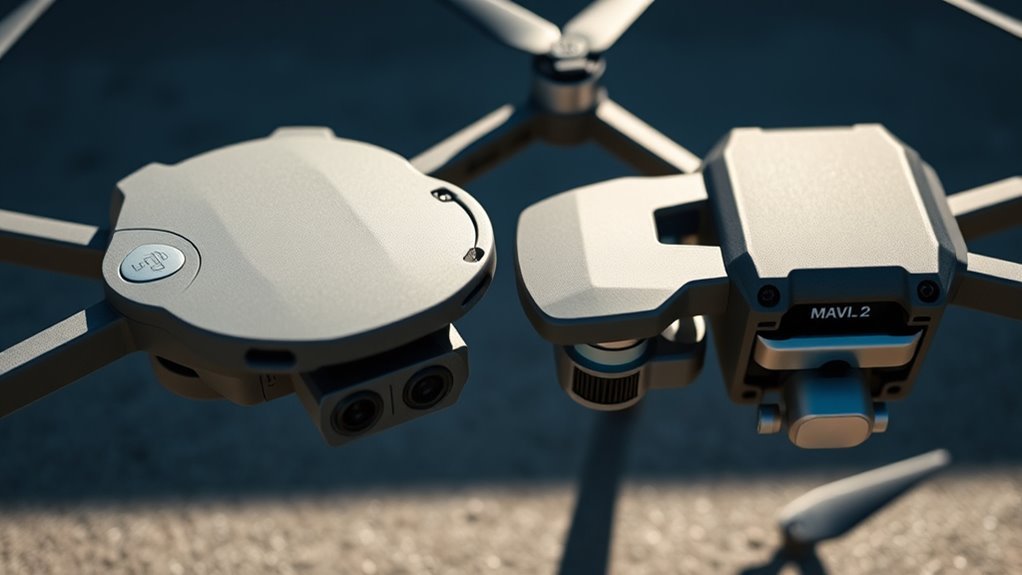
When you’re comparing the Teal 2 and DJI Mavic 3 Enterprise, you’ll notice the Teal 2’s 48MP sensor and rugged build excel in tactical scenarios, delivering solid 4K video with wind resistance up to 20 mph. Meanwhile, the DJI’s 20MP 4/3 CMOS sensor offers superior dynamic range and modular lenses for adaptable enterprise tasks like mapping. It’s a clash of durability versus versatility. Detailed insights will clarify your best choice.
Camera Specifications Overview
When comparing the camera specifications of the Teal 2 and DJI Mavic 3 Enterprise, you’ll notice key differences in resolution and capabilities that suit various enterprise needs. The Teal 2 offers a 48MP sensor with 4K video at 30fps, emphasizing rugged, tactical applications where freedom of operation in challenging environments is key. In contrast, the DJI Mavic 3 Enterprise features a 20MP 4/3 CMOS sensor supporting 5.1K video at 50fps, providing versatile options for detailed mapping and inspections.
Regarding lens compatibility, the Teal 2 supports modular lenses, allowing you to swap for specialized tasks without constraints, enhancing your autonomy in the field. The DJI model, however, integrates a fixed wide-angle lens with accessories like ND filters, offering quick adaptability through its ecosystem. Additionally, the Mavic 3 Enterprise’s advanced shake reduction techniques ensure that your footage remains stable even in dynamic settings.
Camera accessories further differentiate them; the Teal 2 accommodates third-party mounts for expanded functionality, freeing you from proprietary limitations, while the DJI includes a speaker and spotlight for immediate, integrated use. These specs empower you to choose based on your operational freedom and requirements.
Image Quality Comparison
While the Teal 2’s 48MP sensor captures highly detailed still images, the DJI Mavic 3 Enterprise’s 20MP 4/3 CMOS offers enhanced dynamic range and color accuracy, making it better suited for professional inspections. You’ll appreciate how the Mavic’s superior dynamic range handles high-contrast scenes, preserving details in shadows and highlights without clipping, which frees you to tackle diverse environments with confidence. In contrast, the Teal 2’s higher resolution might appeal if you’re seeking intricate details for tactical mapping, but its dynamic range falls short in challenging lighting, potentially limiting your operational flexibility.
When evaluating color accuracy, the Mavic 3 Enterprise excels with its precise reproduction of hues, ensuring your images remain true-to-life for critical analysis. This precision empowers you to make informed decisions in fields like surveying or search and rescue. Meanwhile, the Teal 2 delivers vibrant colors yet struggles with consistency in varied conditions, so you’ll weigh this against your need for reliability. Ultimately, dynamic range and color accuracy define your choice, granting the freedom to select based on mission demands. Additionally, the integration of advanced surveillance solutions helps enhance operational safety in various environments.
Video Recording Capabilities
Moving to video recording, you’ll find the Teal 2 delivers 4K at 30fps with solid electronic stabilization, making it suitable for basic surveillance tasks. In contrast, the DJI Mavic 3 Enterprise steps up with 4K capabilities at varied frame rates, including 60fps, giving you more options for capturing fast-paced action while maintaining smooth playback.
When examining recording formats, the Teal 2 relies on efficient standards like H.264, which keeps things simple and accessible for users valuing operational freedom without unnecessary complexity. The Mavic 3, however, supports advanced formats such as H.265, enabling higher compression and better quality in limited storage scenarios.
Analytically, higher frame rates on the Mavic 3 enhance your ability to document dynamic environments objectively, but the Teal 2’s straightforward approach guarantees reliability for essential tasks, letting you focus on what matters most in pursuit of autonomy. Notably, image stabilization plays a crucial role in ensuring minimal distortion during high-energy scenarios, a feature that both drones aim to optimize for effective performance.
Sensor and Lens Features
The Teal 2’s sensor and lens system features a 1/2.3-inch CMOS with a fixed wide-angle lens, providing solid performance for basic surveillance. You’ll find its sensor resolution hits around 12 megapixels, delivering clear imagery for straightforward tasks without overwhelming complexity. This setup keeps things simple, empowering you to focus on mission essentials rather than technical tweaks.
In contrast, the DJI Mavic 3 Enterprise boasts a larger 4/3 CMOS sensor, yielding higher sensor resolution up to 20 megapixels, which gives you finer detail and better low-light capabilities for demanding operations. When it comes to lens versatility, the Teal 2’s fixed lens restricts your adaptability, limiting quick changes for varied scenarios. Meanwhile, the DJI’s modular lens system offers you greater flexibility, allowing seamless swaps to suit evolving needs and enhance your freedom in tactical applications. This difference means you’re choosing between reliability and expansive options, based on your priorities. Additionally, DJI’s superior image stabilization minimizes shake during maneuvers, further enhancing operational effectiveness.
Flight Stability and Performance
When you’re comparing the Teal 2 and DJI Mavic 3 Enterprise, you’ll notice their wind resistance plays a vital role in maintaining stability during flights in varying conditions. The Teal 2’s design might offer better performance in high winds compared to the Mavic 3, which prioritizes agility but could be more affected by gusts. Meanwhile, flight speed differences between the two drones can impact your operational efficiency, with the Mavic 3 often reaching higher top speeds for time-sensitive tasks. Furthermore, both drones benefit from advanced navigation and stability features that enhance their flight performance in challenging environments.
Wind Resistance
While wind resistance plays an essential role in maintaining flight stability and performance, you’ll notice that the Teal 2 excels in moderate winds up to 20 mph due to its robust design, whereas the DJI Mavic 3 Enterprise handles gusts beyond 25 mph more effectively with advanced stabilization algorithms, making each drone’s capabilities distinct for different operational scenarios. In wind testing, the Teal 2’s aerodynamic design minimizes drag, letting you operate freely in varied environments without compromising control. Conversely, the DJI Mavic 3 Enterprise’s refined aerodynamic features and sophisticated algorithms guarantee steady performance in harsher conditions, empowering you to explore unrestricted aerial paths. This difference means you’ll choose based on your need for reliable stability—Teal 2 for everyday freedom, DJI for demanding ventures—enhancing your tactical options without speed considerations.
Flight Speed
Beyond wind resistance, flight speed directly impacts your drone’s stability and performance, with the Teal 2 reaching up to 40 mph in ideal conditions for agile maneuvers, while the DJI Mavic 3 Enterprise tops out at 45 mph with superior algorithms that maintain precise control, allowing you to select based on whether you prioritize quick responses or sustained stability in dynamic operations.
When conducting speed comparisons, the Teal 2’s 40 mph limit excels in tight flight maneuvers, offering you the freedom to navigate confined spaces swiftly without compromising core agility. In contrast, the DJI Mavic 3 Enterprise’s 45 mph capability guarantees better handling in variable winds, providing enhanced stability for extended missions. This difference lets you choose based on your needs—whether you’re seeking rapid, unrestricted movement or reliable precision in demanding scenarios, empowering your aerial operations with tailored performance.
Battery Life and Endurance
One key factor in drone selection is battery life and endurance, which directly impacts mission duration. You’ll find the Teal 2’s advanced battery technology shines in endurance testing, offering up to 30 minutes of flight time under typical conditions, ideal for prolonged tactical operations. This setup empowers you to maintain aerial freedom without frequent recharges, as its efficient cells handle demanding scenarios with minimal degradation.
In contrast, the DJI Mavic 3 Enterprise boasts around 45 minutes of flight per battery, thanks to its optimized battery technology that excels in endurance testing for modular versatility. However, you’re trading off the Teal 2’s rugged reliability for the Mavic’s lighter weight, which might limit you in harsh environments. Analytically, if your missions demand extended liberty in remote areas, the Teal 2’s performance could give you an edge, while the Mavic suits shorter, agile outings—helping you choose based on your operational needs.
Software and Control Systems
Software and control systems are essential for seamless drone operations, where the Teal 2’s military-grade interface delivers enhanced security and reliability through encrypted communications and customizable flight modes. You’ll appreciate how its advanced control algorithms prioritize precision and stability, empowering you with greater autonomy in challenging environments. In comparison, the DJI Mavic 3 Enterprise provides a streamlined user interface that’s user-friendly for everyday tasks, but its control algorithms might not match the Teal 2’s fortified design for high-stakes scenarios.
Here’s a deeper look at key differences:
- User Interface Security: Teal 2’s encrypted interface guarantees your data remains protected, fostering freedom from cyber threats, unlike DJI’s more open system.
- Control Algorithms Efficiency: Teal 2 optimizes algorithms for rapid response in dynamic conditions, giving you reliable control, while DJI focuses on simplicity over advanced adaptability.
- Customization Levels: With Teal 2, you can tailor flight modes extensively for personalized operations, enhancing your operational liberty compared to DJI’s preset options.
- Reliability Features: Teal 2 integrates robust error-handling in its algorithms, minimizing downtime and supporting your pursuit of unrestricted aerial exploration. Furthermore, the Teal 2’s software includes automated compliance audits that ensure operational adherence to security standards, reinforcing its commitment to safeguarding data integrity.
Practical Applications and Use Cases
Practical applications and use cases highlight how the Teal 2 and DJI Mavic 3 Enterprise cater to distinct operational needs, with the Teal 2’s robust design making it ideal for military and high-risk environments like surveillance or search-and-rescue missions, while the DJI Mavic 3 Enterprise suits commercial tasks such as mapping or inspections due to its portability and ease of use. You might find the Teal 2 empowering for search operations in rugged terrains, where its durability guarantees freedom in critical scenarios. For mapping missions, the DJI Mavic 3 Enterprise lets you capture precise data efficiently, offering the flexibility to explore without constraints.
| Use Case | Best Suited Drone |
|---|---|
| Search Operations | Teal 2 |
| Mapping Missions | DJI Mavic 3 Enterprise |
| Surveillance | Teal 2 |
| Inspections | DJI Mavic 3 Enterprise |
| Rescue Missions | Teal 2 |
Analytically, this comparison shows how you can choose based on your need for ruggedness versus agility, enhancing your operational freedom. (148 words)
Frequently Asked Questions
What Is the Price of the Teal 2 Drone?
As you chart your course through the vast skies of drone technology, you’re probably wondering about the Teal 2 drone’s price. With its impressive Teal 2 features like 4K tactical imaging and robust Teal 2 specifications including long endurance and modular design, it’s typically priced around $4,999. This investment offers you analytical precision and objective performance, empowering freedom in your aerial pursuits without corporate ties.
Where Can I Buy the DJI Mavic 3 Enterprise?
You’re wondering where to buy the DJI Mavic 3 Enterprise, a top-tier option for professional use. Check DJI’s official website, authorized retailers like Best Buy or Amazon, or certified dealers for the best deals. When making a DJI features comparison, you’ll appreciate the Enterprise drone specifications, including its modular camera system and thermal imaging, giving you the freedom to adapt for various missions with precision and autonomy.
Do These Drones Come With a Warranty?
Like a steadfast guardian in the skies, you’ll find that most drones, including the DJI Mavic 3 Enterprise, come equipped with a standard drone warranty for peace of mind during your aerial explorations. It’s typically a one-year coverage against defects, but always check the specifics on DJI’s site. For added reassurance, their customer support team is readily available to assist with claims, ensuring you’re free to soar without worries. This analytical approach highlights reliability for independent users.
Are There Any Recommended Accessories?
When you’re exploring accessory recommendations for your drone, you’ll find essential gear like extra batteries for extended flights, ND filters for better video quality, and a sturdy carrying case for protection on the go. These items enhance your operational freedom, allowing you to fly longer and capture ideal footage without interruptions. Analytically, they’re cost-effective investments that boost reliability and adaptability in various environments. Always check compatibility for seamless integration.
What Are the Shipping Options Available?
When you’re exploring shipping options for your purchase, you’ll find a range of choices that prioritize your freedom to select what’s best for your needs. Standard shipping offers cost-effective delivery, while expedited delivery gets your items faster, often within days. For international shipping, options include reliable carriers like DHL or FedEx, ensuring global reach with tracking for peace of mind. Always check for any customs fees to maintain control over costs. This analytical approach helps you decide objectively, balancing speed and affordability.
