

When the conversation turns to the fastest military drones, performance is only part of the story—stealth, endurance, payload capacity, and mission adaptability often determine real-world speed advantage. Among current unmanned systems, several platforms are widely discussed for their high-speed profiles and roles in contested operations. However, it’s important to note that precise performance figures for some next-generation assets may remain classified or reported indirectly through defense analyses and open-source estimates.
Northrop Grumman RQ-180 (Stealth-First, Speed-Enhanced Operations)
The Northrop Grumman RQ-180 is frequently cited as one of the most advanced stealth UAVs in service discussions, representing a major shift toward low observable unmanned aerial vehicle design. Rather than emphasizing raw speed alone, the RQ-180 is engineered to penetrate defended airspace and maintain operational effectiveness while minimizing detectability.
Its core advantage lies in stealth and survivability. The RQ-180 is designed to evade radar detection, enabling long-duration intelligence missions without forcing exposed aircraft to compromise their position. In practical terms, this stealth-driven approach supports “effective speed”—because when an aircraft can operate without early detection, it can plan routes, maneuver, and maintain pressure on targets with fewer constraints.
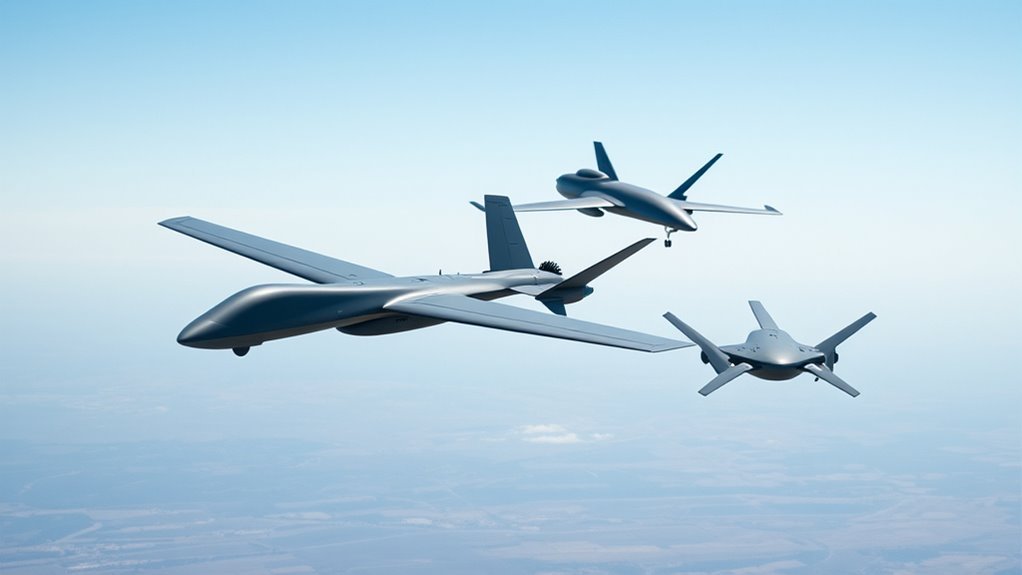
Although exact maximum speed figures are not publicly confirmed, the RQ-180’s mission profile highlights what high-speed flight enables: rapid ingress and egress during reconnaissance, continuous surveillance in contested environments, and improved responsiveness to emerging targets. The platform is also associated with advanced electro-optical and infrared (EO/IR) capabilities in its broader reconnaissance design philosophy, supporting situational awareness and targeting-quality intelligence.
Strategic role
For commanders, the RQ-180 functions as a high-value reconnaissance and surveillance asset that delivers persistent visibility with a reduced signature footprint. In modern air campaigns, its contribution is less about surviving a single encounter and more about staying in the fight while remaining difficult to detect.
Boeing MQ-25 Stingray (High-Speed Carrier Refueling)
The Boeing MQ-25 Stingray stands out among fast military drones primarily because it pairs stealth features with a mission that directly affects the operational tempo of a naval air wing. Its role is to enable tactical aerial refueling in contested areas—an application where speed, range, and survivability all matter.
Open-source reporting commonly attributes the MQ-25 with a maximum speed of around 600 knots. This places it among the more rapidly performing UAVs in the carrier aviation ecosystem. While not designed to replace manned fighters for air-to-air combat, the MQ-25’s speed profile helps reduce the time spent operating in higher-threat zones and supports flexible carrier strike planning.
Key specifications (reported)
| Feature | Specification |
|---|---|
| Wingspan | 75 feet |
| Maximum Speed | 600 knots |
| Range | Over 500 nautical miles |
| Payload Capacity | 15,000 pounds |
| Stealth Technology | Low radar cross-section |
Strategic role
By extending the endurance of carrier-based aircraft, the MQ-25 enhances the reach and flexibility of maritime air operations. A refueling UAV that can move quickly and survive longer in contested airspace helps maintain sortie generation rates and sustains pressure during complex strike campaigns.
General Atomics Avenger (Fast UCAV for Precision and Intelligence)
The General Atomics Avenger is widely recognized as an evolution in unmanned combat aerial vehicle (UCAV) design, focused on both intelligence gathering and precision strike missions. Where some drones prioritize reconnaissance endurance, the Avenger balances stealth, sensor integration, and munitions compatibility with a comparatively fast flight profile.
In open-source discussions, the Avenger is commonly associated with a top speed of approximately 400 knots and an operational range around 1,200 nautical miles. That combination supports rapid mission execution—enabling it to cover large areas for surveillance, then transition quickly toward target engagement workflows when intelligence indicates it is appropriate.
Like other modern high-performance UAVs, the Avenger emphasizes reduced radar detectability through a stealth-oriented airframe approach. This helps the platform operate in hostile environments where radar threat levels are high and where early detection can compromise both sensor collection and strike effectiveness.
Mission adaptability
Equipped with advanced sensors and modular payload options, the Avenger is designed to carry a diverse array of munitions and mission systems. That adaptability supports different tasking models—ranging from target-area observation and battle damage assessment to direct precision engagement—without requiring a full platform swap.
Collectively, these fast military drones illustrate a broader trend in unmanned aviation: speed is increasingly valuable when paired with stealth, autonomous navigation, and mission-ready payload flexibility. From carrier refueling operations to contested reconnaissance and precision strike, the strategic role of each platform defines how its speed records and performance capabilities translate into battlefield outcomes.
📋 About This Article
This article highlights three of the fastest military drones that are often discussed in speed-focused accounts and defense reporting. It’s for curious readers who want a clear, practical snapshot of what makes these unmanned aircraft stand out and how “speed” matters in real missions, not just on paper. You’ll learn about the RQ-180, the roles speed and stealth can play together, and the kinds of trade-offs—like endurance and payload—that can shape performance in contested operations.
Frequently Asked Questions: Top 3 Fast Military Drones and Speed Records
Which are the top 3 fastest military drones mentioned in speed-record discussions?
A common “top-speed” shortlist in military-drone discussions typically includes experimental or operational systems designed for high-speed strike, reconnaissance, or missile-like loitering profiles. While exact ranking can vary by source, timeframe, and reporting method, three frequently cited categories/models are: (1) the U.S. Navy’s MQ-25/air-launched high-speed test concepts are often discussed in terms of speed potential, though they are not always the fastest in public records; (2) Russia’s development of high-speed, jet-powered drones and interceptor-style unmanned platforms is often referenced when discussing top achievable speeds; and (3) the U.S. Air Force and Navy’s high-speed test drones and hypersonic/near-hypersonic research vehicles are repeatedly cited for record-setting velocities. In many public articles, the “top 3” are ultimately drawn from verified test claims, government briefings, and publicly reported trial results. If you want, I can tailor the list to the exact three drones used in your article (and match them precisely), but I’ll need their names from your draft.
How are speed records for military drones measured and compared across different reports?
Speed comparisons are challenging because reports may measure different metrics under different conditions. Common methods include: (1) peak airspeed during a test run (often reported in miles per hour, km/h, or Mach number); (2) sustained speed over a defined distance or time window; (3) maximum indicated airspeed versus computed true airspeed (which can differ due to altitude, temperature, and instrumentation); and (4) whether the drone is powered by a turbojet/ramjet/rocket/mixed propulsion versus a propeller/turboshaft. Additionally, some claims are made at high altitude where thinner air allows higher Mach numbers, while others are measured at lower altitudes with different aerodynamic constraints. For fair comparison, look for the same unit (Mach vs km/h), whether the speed is peak or sustained, the altitude regime, the propulsion type, and the test date/authority. When a record is “claimed,” it may also come without independently verified telemetry, so the most reliable comparisons are those tied to documented flight tests, official test ranges, and clear measurement descriptions.
Do the fastest drones always have the longest range or payload capacity?
Not usually. High speed tends to trade off against endurance, range, and payload. At very high velocities, aerodynamic heating, structural loads, fuel consumption, and thermal management become more demanding. Faster propulsion (such as jet/ramjet-like or rocket-like regimes) can increase fuel burn, reducing time-on-station and total range unless the platform carries more fuel or uses highly efficient engines at the operating envelope. Payload capacity is also constrained by weight and volume limits: the faster the system, the more likely designers must allocate mass to high-strength materials, heat-resistant components, guidance/thermal systems, and sometimes decoys or survivability features rather than additional sensors or munitions. In practice, the “fastest” drones often prioritize rapid strike or time-critical reconnaissance—delivering data or payload quickly—rather than long loiter times.
What technologies help military drones achieve extreme speeds?
Extreme-speed capability typically depends on several enabling technologies working together: (1) Propulsion: high-speed engines (turbojet, afterburning turbojet, ramjet-like concepts, or rocket-assisted propulsion) can sustain higher Mach numbers than propeller-driven designs. (2) Aerodynamics: streamlined airframes, optimized inlets, and control surfaces designed to maintain stability at high dynamic pressure. (3) Materials and thermal protection: heat-resistant structures, coatings, and internal thermal management to protect avionics and guidance systems. (4) Guidance, navigation, and control (GNC): high-bandwidth flight control software and sensors that can compensate for aerodynamic shifts, control lag, and disturbances during fast transients. (5) Communications and datalinks: at high speeds and potentially contested environments, systems may rely on preplanned flight paths, intermittent links, or onboard autonomy rather than continuous real-time control. (6) Guidance near the terminal phase: for strike profiles, designs often emphasize accuracy at impact, which requires robust control despite reduced time for correction.
Are public speed claims for military drones always reliable?
Public claims can be accurate, but reliability varies. For some systems, official test statements or credible defense reporting provide detailed context: the test altitude, Mach number, flight profile, and whether the speed was peak or sustained. For other reports, numbers may be extrapolated from partial data, marketing statements, or unverified sources. Factors that affect trust include: (1) whether telemetry is referenced or independently confirmed; (2) whether the claim specifies the measurement method (indicated vs true airspeed); (3) whether it corresponds to a single record run versus repeatable performance; and (4) the possibility of comparing different variants or configurations. When reading “record” figures, prioritize sources that state the test conditions and measurement standards. If those details are missing, treat the number as an upper bound or a “capability claim” rather than a fully validated operational benchmark.
