

Finding the right quad drone depends on how you plan to fly, what kind of footage you want to capture, and how much portability, speed, or automation matters to you. Some pilots want a premium aerial camera drone with intelligent flight modes and obstacle sensing, while others need a budget-friendly quadcopter for weekend flights or an agile FPV model for fast-paced practice. The best drone for one buyer is not always the best drone for another, which is why a side-by-side review matters.
📋 About This Article
This article compares five top quad drones to help you pick the perfect match for how you want to fly. It’s for beginners and drone enthusiasts who want clear, side-by-side guidance—whether you’re after a premium camera drone, a budget-friendly option, or an ultra-portable or FPV-style experience. You’ll find quick takeaways on what each model does best, including camera and flight performance, ease of use, and key features to consider before you buy.
Below is a detailed look at five standout quad drones across different categories: premium performance, budget value, ultra-portable design, immersive FPV flying, and beginner racing. Each model offers a distinct balance of camera quality, flight stability, GPS functionality, portability, and ease of use, helping you choose a drone that truly matches your goals.
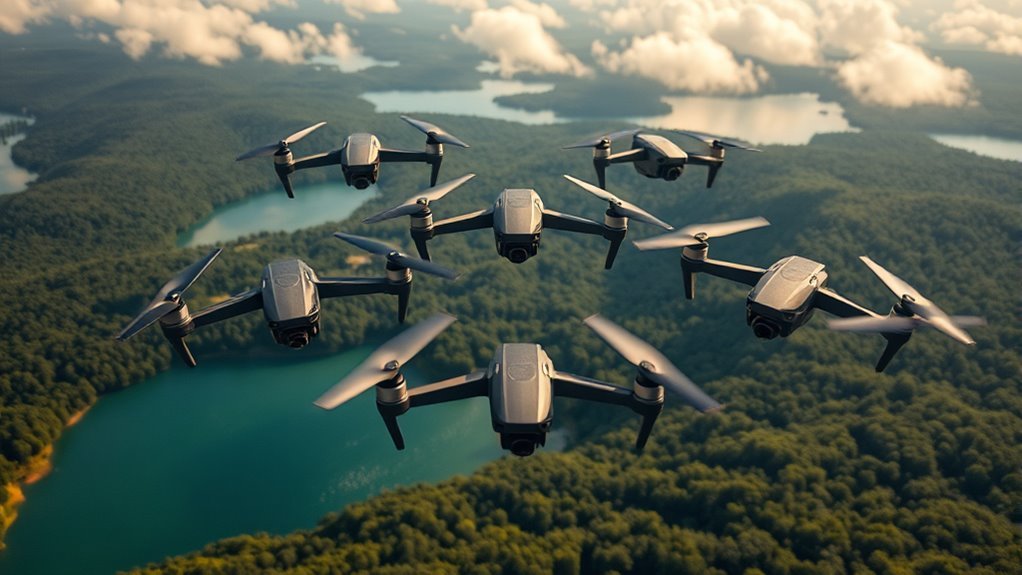
1. DJI Air 3: Best for Enthusiasts and Content Creators
The DJI Air 3 is one of the most well-rounded camera drones for enthusiasts who want advanced imaging performance without moving into the bulkier prosumer category. It stands out with a dual-camera system, giving pilots the flexibility to switch between wide-angle framing and medium telephoto composition. This setup is especially useful for travel photography, cinematic aerial video, landscape work, and social media content creation.
Why the DJI Air 3 Stands Out
One of the biggest advantages of the DJI Air 3 is its blend of intelligent flight features and strong manual control. Flight modes such as ActiveTrack, Point of Interest, and automated route options help streamline complex shots. Instead of focusing entirely on stick input, you can spend more time refining composition, motion, and storytelling.
The drone also includes omnidirectional obstacle sensing, which improves safety during low-altitude passes, tracking shots, and flights in more challenging environments. For users stepping up from an entry-level drone, this adds a noticeable level of confidence.
Best Fit For
- Aerial photographers and videographers
- Enthusiasts upgrading from beginner drones
- Travel creators who want strong image quality and smart automation
Key Strengths
- Dual-camera versatility
- Advanced flight assistance and tracking
- Excellent image quality and stable footage
- Reliable obstacle avoidance for safer flying
Things to Consider
The DJI Air 3 is a premium option, so it may be more than casual users need. If your priority is simple recreational flying or a lower price point, another model may offer better value.
2. Holy Stone HS720: Best Budget Drone with GPS and 4K Video
If you want solid features without paying flagship prices, the Holy Stone HS720 is one of the strongest budget quadcopters in its class. It offers a practical feature set for new pilots and casual users, including 4K video recording, GPS-assisted flight, and respectable flight time. For buyers entering aerial photography for the first time, it delivers good value without overwhelming complexity.
What Makes the HS720 a Smart Buy
Many affordable drones compromise heavily on stability or navigation, but the HS720 provides a more dependable flying experience than many entry-level alternatives. GPS support helps with positioning, return-to-home functionality, and general flight confidence. That matters for beginners who want more control and fewer surprises during outdoor flights.
Its camera performance will not rival a premium DJI or Autel drone, but for the price, it is more than capable of producing clean footage for personal use, travel clips, and hobby content.
Feature Snapshot
| Feature | Holy Stone HS720 | Typical Entry-Level Drone |
|---|---|---|
| Video Resolution | 4K UHD | 720p to 1080p |
| Flight Time | Up to 26 minutes | 10 to 15 minutes |
| GPS Support | Yes | Often limited or absent |
| User Experience | Beginner-friendly | Varies widely |
Best Fit For
- First-time drone buyers
- Budget-conscious hobbyists
- Users who want GPS and 4K features at a lower cost
Things to Consider
The HS720 is built for value, not high-end cinematic production. If advanced tracking, premium low-light performance, or professional-grade stabilization are priorities, you may want to look at a higher-tier drone.
3. Autel Robotics EVO Nano+: Best Portable Drone for Travel
The Autel EVO Nano+ is an excellent choice for users who want a compact drone that does not sacrifice image quality. Weighing under 250 grams, it is highly portable and easy to pack into a day bag, making it ideal for travel, hiking, city exploration, and spontaneous aerial shooting.
Why Portability Matters
A lightweight drone encourages more frequent use. Instead of planning around bulky equipment, you can carry the EVO Nano+ almost anywhere and launch quickly when the lighting or scenery is right. That convenience is a major advantage for travelers and creators who value flexibility.
Despite its compact frame, the drone includes a capable camera sensor that performs well for its size category. This makes it appealing to users who want better-than-basic image quality in a highly mobile platform.
Standout Features
- Ultra-lightweight and easy to transport
- Strong camera performance for a sub-250g drone
- Ideal for travel, everyday carry, and quick deployment
- User-friendly flight experience with modern safety features
Best Fit For
- Frequent travelers
- Outdoor adventurers and hikers
- Users who want a lightweight alternative to larger camera drones
Things to Consider
While the EVO Nano+ is impressive for its size, larger drones can still offer better endurance, stronger wind resistance, and more advanced camera systems. If portability is your top priority, however, it remains a compelling option.
4. Parrot Anafi FPV: Best for Immersive Flying and Unique Camera Angles
The Parrot Anafi FPV offers a different kind of flying experience, combining compact design with an immersive first-person view setup. It is especially attractive to users who want a stronger sense of motion and engagement while flying, rather than focusing only on automated aerial capture.
What Makes the Anafi FPV Different
One of the drone’s most distinctive strengths is its ability to capture creative camera angles. The Anafi line is known for flexible camera movement, which opens up more dynamic framing opportunities than many standard consumer drones. For creators who enjoy unusual perspectives, architectural shots, or tight-location filming, that flexibility can be a real advantage.
The FPV component adds another layer of excitement. Instead of simply watching the drone on a phone screen, pilots can enjoy a more immersive view that makes flight feel more direct and engaging.
Best Fit For
- Users interested in FPV-style flying without jumping straight into racing drones
- Creators who want distinctive camera angles
- Pilots looking for a more immersive flight experience
Key Strengths
- Immersive FPV capability
- Compact and travel-friendly form factor
- Flexible camera positioning for creative footage
- Good balance between cinematic and experiential flying
Things to Consider
The Parrot Anafi FPV appeals most to niche buyers. If you mainly want top-tier automated flight modes or the broad ecosystem offered by DJI, other options may feel more practical.
5. EMAX Tinyhawk II: Best Beginner Racing Drone
For pilots who want to learn fast, responsive flight rather than cinematic shooting, the EMAX Tinyhawk II is a standout option. This small FPV quad is designed for agility, making it a smart pick for users interested in drone racing, freestyle practice, and indoor or backyard maneuvering.
Why Beginners Like the Tinyhawk II
Unlike camera drones built around GPS hovering and automation, the Tinyhawk II teaches core pilot control. It is lightweight, nimble, and generally more forgiving than larger racing rigs. That makes it a great training platform for anyone curious about FPV racing drones.
Because it is smaller and less intimidating than a full-size racing quad, it lowers the barrier to entry. New pilots can practice handling, throttle control, turns, and quick reactions without investing in a large, complex setup right away.
Best Fit For
- Beginners exploring FPV racing
- Pilots who want an agile practice quad
- Users more interested in speed and control than aerial photography
Key Strengths
- Fast, responsive handling
- Beginner-friendly entry into FPV flying
- Compact size for practice in smaller spaces
- Great for building real piloting skills
Things to Consider
The Tinyhawk II is not the right choice if your main goal is stabilized 4K video, GPS navigation, or cinematic travel footage. It is purpose-built for performance and pilot development.
How to Choose the Right Quad Drone for Your Needs
When comparing quad drones, it helps to focus on the features that will matter most in real-world use. The best drone is not always the one with the longest spec sheet. It is the one that fits your flying style, skill level, and content goals.
Camera Quality
If aerial photography or video production is your main priority, look closely at sensor quality, stabilization, lens options, and intelligent shooting features. In this group, the DJI Air 3 leads for serious content creation, while the Autel EVO Nano+ offers a strong portable alternative.
Budget
Price shapes expectations. The Holy Stone HS720 is ideal for buyers who want modern essentials such as GPS and 4K recording without the cost of a premium drone. It is especially appealing for casual recreation and entry-level content capture.
Portability
If you travel often or want a drone that is easy to carry every day, weight and foldability matter. The EVO Nano+ is particularly attractive here because it combines compact design with capable imaging performance.
Flight Experience
Some users prefer smooth autonomous flight with return-to-home and subject tracking, while others want a more direct and immersive control style. The Parrot Anafi FPV and EMAX Tinyhawk II serve very different audiences, but both are strong choices for pilots who want flying itself to be part of the excitement.
Skill Level
Beginners usually benefit from GPS assistance, stable hovering, and simple controls. More advanced users may appreciate manual freedom, specialized flight modes, or camera flexibility. Matching the drone to your experience level helps reduce frustration and improves safety.
Each of these quad drones excels in a different area. The DJI Air 3 is the top pick for enthusiasts who want premium features and creative flexibility. The Holy Stone HS720 is the best value option for cost-conscious buyers. The Autel EVO Nano+ is ideal for portability and travel. The Parrot Anafi FPV caters to immersive flying and unusual angles, while the EMAX Tinyhawk II is a smart choice for aspiring FPV racers. By identifying your priorities first, you can choose a drone that feels less like a compromise and more like the perfect match.
Frequently Asked Questions
How do I choose the best quad drone for my needs?
The best quad drone for you depends on how you plan to use it. If you are a beginner, look for features such as altitude hold, headless mode, one-key takeoff and landing, and built-in obstacle avoidance if available. These functions make the drone easier to control and reduce the learning curve.
If you want a drone for photography or video, focus on camera quality, gimbal stabilization, flight time, transmission range, and intelligent flight modes like follow-me or waypoint navigation. For travel, a foldable design and lightweight body are especially useful. If speed and maneuverability matter most, consider models designed for racing or sport flying, but keep in mind that they often require more skill.
It is also important to compare battery life, replacement part availability, app quality, and overall build durability. Reading quad drone reviews can help you identify which model offers the best balance of features, price, and reliability for your specific goals.
Are quad drones suitable for beginners?
Yes, many quad drones are designed specifically for beginners. Entry-level models often include beginner-friendly controls, automatic hovering, emergency stop functions, and speed settings that allow new pilots to learn gradually. These features help reduce crashes and make the first flying experiences more enjoyable.
Beginners should usually avoid starting with expensive professional drones or high-speed racing drones. Instead, a compact and affordable model with basic safety features is often the best choice. Practicing in an open outdoor space or a large indoor area can also help new users build confidence before moving on to more advanced flying.
When reviewing beginner quad drones, it is a good idea to check how easy the setup process is, whether replacement batteries and propellers are easy to find, and how responsive the controls are. A beginner-friendly drone should be simple to operate while still offering enough performance to keep the experience exciting.
What features matter most when comparing quad drone reviews?
When comparing quad drone reviews, some of the most important features to look at are flight time, camera quality, stability, control range, ease of use, and overall durability. Flight time affects how long you can enjoy each session, while control range determines how far the drone can travel while maintaining a stable connection.
For camera drones, factors such as video resolution, photo quality, stabilization, and live transmission performance are essential. For recreational use, responsive controls, strong hovering capability, and a durable frame may be more important than premium camera features. Reviewers also often highlight app reliability, GPS accuracy, return-to-home performance, and wind resistance.
Price should also be evaluated alongside the features included. A drone that costs more may offer better safety systems, smoother footage, and stronger construction, but a budget model could still be the perfect fit if your needs are simple. The best reviews explain not just what a drone offers, but who it is best suited for.
How long do quad drone batteries usually last?
Quad drone battery life varies by size, design, and intended use. Small beginner drones may only offer around 5 to 10 minutes of flight time per battery, while mid-range consumer drones often provide 20 to 35 minutes. Premium models can sometimes fly even longer under ideal conditions.
Actual battery performance depends on several factors, including wind, flying speed, camera usage, temperature, and how aggressively the drone is maneuvered. Flying in sport mode, carrying extra weight, or battling strong wind will usually reduce flight time. Because of this, many drone owners purchase extra batteries to extend their sessions.
When reading drone reviews, pay attention to whether the listed battery life reflects real-world testing or only manufacturer claims. Real-world reviews often give a more accurate picture of what you can expect during normal use. It is also helpful to consider battery charging time and replacement cost when choosing a drone.
Is it worth buying an expensive quad drone instead of a budget model?
It can be worth buying a more expensive quad drone if you need higher performance, better camera quality, advanced safety features, and more dependable flight stability. Premium drones often include GPS-assisted flight, obstacle sensing, longer battery life, stronger wind resistance, smoother video stabilization, and more intelligent flight modes. These upgrades can make a major difference for aerial photography, travel content, or professional work.
However, a budget drone may be the smarter choice if you are just learning, buying for a child, or simply want a fun recreational flying experience. Lower-cost drones are easier to replace if damaged and can still provide plenty of enjoyment for casual users. In many cases, they are ideal for practicing the basics before investing in a more advanced model.
The right value depends on your expectations. If you prioritize image quality, reliability, and feature-rich performance, spending more can be justified. If you mainly want affordability and simple operation, a budget-friendly quad drone may be your perfect match.
