

Understanding Drone Range: How Far Can Drones Fly Away From You?
In practical terms, “drone range” is the maximum distance you can operate the aircraft while maintaining reliable control and telemetry links. For most consumer quadcopters, that distance is typically measured in kilometers, while enterprise and fixed-wing platforms can sometimes extend to dozens of kilometers when using long-range communications and efficient airframes.
Before you plan any flight, it helps to treat range as a performance envelope rather than a single number. The same drone can behave very differently depending on battery state of charge, RF (radio frequency) conditions, antenna orientation, and local regulations that restrict maximum altitude and operations near airports or controlled airspace.
The Basics of Drone Range (Control Link vs. Flight Endurance)
Drone range is commonly misunderstood because people mix up communication range with how long the drone can stay airborne. The key difference is that flight endurance limits how long the drone can keep flying, while the control link and telemetry range limits how far away it can safely fly while still under command.
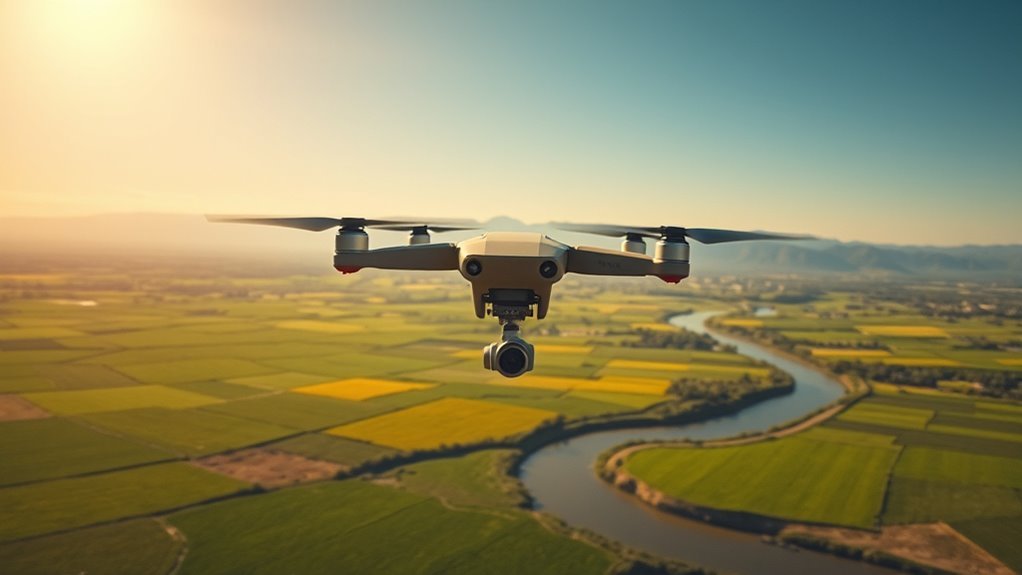
Drone range is defined as the maximum operating distance at which the pilot can reliably send control inputs and receive real-time telemetry such as GPS position, battery status, and signal quality. That definition matters because a drone might still “have battery” at a farther distance, yet fail to maintain a stable command link.
Why “maximum distance” is not one universal figure
Many manufacturers provide “maximum transmission distance,” but real-world control reliability depends on signal strength margins and the way your drone’s communication system performs in your environment. The widely accepted engineering principle is that the system must maintain sufficient link margin, especially when the aircraft is farther away and the antennas are less favorably aligned.
Direct answer: What distance can you expect?
As a rule of thumb, consumer multi-rotor drones often support reliable operation within a few kilometers under typical conditions, but the usable range can be reduced by interference, buildings, terrain, or poor line of sight. Professional and fixed-wing drones can cover much greater distances, sometimes tens of kilometers or more, when they use long-range digital video links, dedicated telemetry radios, and stable flight planning.
What Determines How Far a Drone Can Fly From You?
How far a drone can fly from you is determined by three overlapping systems: the power system (battery and motors), the communications stack (control and telemetry), and the operating environment (wind, obstacles, and signal propagation). Any weak link in that chain can shorten your safe operational distance.
1) Battery life and energy capacity
Battery capacity is defined as the amount of electrical energy the pack can deliver over time, usually expressed in milliamp-hours (mAh) for hobby batteries or watt-hours (Wh) for higher-end packs. The higher the usable watt-hours and the more efficient the propulsion system, the more potential range you typically have in still air.
However, endurance is not the same as “straight-line distance away from you.” If your mission involves flying outward and then returning, you must budget for the entire round trip, including loiter time, climbs or descents, and wind drift. A common planning practice is to keep a safety reserve so you are not dependent on the last minutes of battery discharge.
2) Communication technology (control link, telemetry, and video)
Communication technology is defined as the set of radios and protocols that carry command signals, telemetry, and often live video. The key difference is that some links are optimized for robustness (telemetry and control), while others are optimized for throughput (video), and each link can “fail” at different distances.
Typical consumer systems use Wi-Fi-like protocols or dedicated 2.4 GHz/5.8 GHz links depending on model and region, while professional platforms often use long-range telemetry radios and digital control systems. In many operations, line of sight (LOS) is a dominant factor because it reduces path loss and improves signal reliability.
3) Environmental conditions (wind, terrain, and RF interference)
Environmental conditions can limit distance even when batteries and radios appear capable. The most important environmental variables include wind speed and direction, temperature, humidity, and obstacles such as trees, buildings, and terrain contours.
For RF links, the widely accepted concept is free-space path loss increases rapidly with distance, and real environments add losses from multipath fading and obstruction. Interference from other transmitters in the same band can also reduce link quality.
- Wind and turbulence: reduce hover efficiency and increase battery drain, which shortens the distance you can complete safely.
- Terrain and obstacles: block or reflect signals, especially when the drone is not in clear line of sight.
- Electromagnetic interference: can cause telemetry dropouts or video latency spikes that reduce safe control performance.
4) Weight, payload, and aerodynamic efficiency
Payload weight directly impacts power consumption, particularly for multirotors that rely on lifting thrust. The key difference is that increased payload often reduces flight efficiency, so the drone uses more energy per meter of travel and returns with less remaining battery.
For fixed-wing aircraft, aerodynamic efficiency and glide characteristics can preserve distance better than multirotors in certain conditions, but airframe design still governs how far you can fly under realistic wind and speed profiles.
Typical Drone Ranges by Drone Type
Drone range depends heavily on airframe type, mission profile, and whether the system uses long-range control links. In general, multirotors excel at hovering and precision tasks, while fixed-wing platforms are built for efficient forward flight and longer distances.
Typical Usable Control Distance by Drone Class (Open-Field LOS Planning)
| # | Drone Class | Typical Control Range | Common Control Link | Range Confidence (★) |
|---|---|---|---|---|
| 1 | Micro FPV (Indoor/Short-Range) | 0.5–1.5 km | Analog video + short telemetry | ★☆☆☆☆ |
| 2 | Entry-Level Camera Quadcopters | 1–3 km | 2.4 GHz digital control/telemetry | ★★★☆☆ |
| 3 | Recreational 3–5.5″ Multirotors | 3–7 km | Proportional RC + telemetry | ★★★★☆ |
| 4 | “Long-Range” Consumer-Style Drones | 7–15 km | Enhanced digital control + GPS | ★★★★★ |
| 5 | Prosumer Survey/Inspection Multirotors | 10–25 km | Dedicated telemetry radios | ★★★★★ |
| 6 | Enterprise Multirotors (Industrial Links) | 20–40 km | Long-range control + telemetry | ★★★★★ |
| 7 | Fixed-Wing Long-Range Platforms | 30–80 km | Long-range telemetry + stable navigation | ★★★★★ |
Consumer quadcopters and compact drones
Most consumer multirotors are designed for recreational use within visual and regulatory operating expectations. Real-world reliable distance is often in the range of a few kilometers, though it can be less in dense urban environments or when line of sight is blocked.
Manufacturers may advertise longer “maximum” distances in ideal conditions, but those figures often represent signal reach rather than a guarantee of control reliability under all circumstances.
Prosumer and enterprise multirotors
Prosumer and enterprise-grade multirotors typically use upgraded flight controllers, more robust communications, and mission planning features. In suitable conditions and with appropriate radios and antennas, these systems can sometimes exceed 10 km and operate beyond 30 km in specific configurations.
Still, distance-to-you is not just a product spec; it is a function of antenna placement, RF environment, regulatory constraints, and the aircraft’s ability to complete a safe return-to-home sequence.
Fixed-wing drones and long-range aerial platforms
Fixed-wing drones can cover much larger distances because they achieve higher aerodynamic efficiency during forward flight. The key difference is that endurance and range are often limited by fuel or battery energy, airframe efficiency, and navigation strategy rather than by multirotor hover power demands.
In long-range use cases, operators commonly integrate long-range telemetry, robust navigation, and preplanned routes to maintain controlled operation far from the takeoff point.
Real-World Range Limits: Why “It Can Fly Far” Isn’t Enough
Even if a drone can physically travel farther, safe operation depends on maintaining command authority, reliable telemetry, and predictable behavior on failsafe events. This is why operators treat range as a safety constraint, not a target to maximize.
Failsafe behavior and return-to-home (RTH)
Most modern drones include failsafe logic such as RTH when the link is lost, and the drone will attempt to return using GNSS (GPS/GNSS) and stored parameters. The key difference is that RTH reliability still depends on signal availability for guidance updates, GPS accuracy, and wind conditions during the return flight.
Battery levels and environmental factors can also affect whether the aircraft can complete the return safely. A “link dropout” at long range can occur at the same time as higher battery load, making the return margin critical.
Line of sight (LOS) and antenna orientation
Line of sight is defined as having a clear path between your controller antennas and the drone, with minimal obstruction. The key difference is that non-LOS scenarios often introduce severe attenuation and multipath effects, which reduce effective range.
Simple habits can meaningfully change outcomes: keep the controller’s antennas oriented according to the manufacturer’s guidance, avoid flying around thick interference sources, and maintain an open operating area whenever possible.
How to Estimate Your Drone’s Usable Range Before You Fly
You can estimate usable drone range by combining manufacturer specifications with local conditions and a conservative testing plan. The goal is to understand your real link reliability rather than trusting a single advertised maximum figure.
Step-by-step planning approach
- Check rated transmission specifications: identify whether the spec refers to control link, video downlink, or both.
- Confirm regulatory limits: ensure your planned distance also complies with airspace rules, visual line of sight (where required), and local restrictions.
- Plan for a round-trip margin: budget battery energy for outbound, loiter time, and return flight, including wind.
- Test in safe conditions: perform incremental range checks at low altitude and low risk locations before attempting longer missions.
- Track telemetry quality: observe signal metrics such as RSSI/SNR (where provided) and video latency to detect degrading link quality.
Conversational Q&A: “How far can I fly before it gets risky?”
Q: How far is risky for a drone?
A: It becomes risky when you approach the point where telemetry and command latency increase, video stutters, or link quality indicators degrade. A practical approach is to set a conservative “turn-back” point well before you hit your worst-case observed performance.
Q: Do obstacles reduce drone range?
A: Yes. Buildings, trees, and terrain can block or reflect RF signals, often cutting usable range substantially compared with open-field line-of-sight conditions.
Q: Does a bigger battery always mean farther range?
A: Not always. If your communications link limits distance, a larger battery may extend time but not control distance. Also, added payload can increase power draw, offsetting endurance gains.
Regulations and Safety Factors That Affect Distance
Regulatory compliance directly shapes how far you can safely and legally operate a drone away from you. Even when your technology could fly farther, rules on airspace, altitude, and operating categories may limit practical distance.
In the United States, for example, the Federal Aviation Administration (FAA) requires compliance with Remote ID rules for many aircraft and restricts operations depending on where and how you fly. In the European Union, rules under EASA (European Union Aviation Safety Agency) categorize drone operations into Open, Specific, and Certified categories, with different requirements for altitude, proximity, and operational planning.
Operators should also consider local geofencing systems and airspace authorizations. Many consumer drones incorporate geofencing or altitude limits to help prevent operations in restricted areas.
Frequently Asked Questions About Drone Range
Below are quick, practical answers to the most common questions people ask when trying to understand how far drones can fly away from them. These answers focus on the real-world difference between “maximum spec” and “reliable, safe control.”
Does drone range mean the distance you can see it?
No. Drone range refers to communication reliability (control and telemetry), while visual line of sight (VLOS) refers to whether you can see the drone with your eyes as required or expected by many operating rules. In many cases, you can maintain communications without maintaining VLOS, or you can maintain VLOS without maintaining strong link reliability.
What improves range the most?
Improving range typically means improving link conditions. The most impactful levers are maintaining line of sight, using correct antenna orientation, reducing interference, and selecting a drone system that separates robust telemetry/control links from high-bandwidth video links.
Are advertised long ranges realistic?
Advertised long ranges are often achievable only under ideal conditions such as open terrain, low interference, correct orientation, and stable performance. The key difference is that your “usable range” should be defined by reliable control, not by a single maximum reach measurement under perfect circumstances.
Key Takeaways: How to Think About Drone Distance
Drone range is best understood as an operational safety envelope defined by communications reliability, battery energy, and environmental conditions. When you plan missions with conservative margins and respect line of sight and regulations, you can make your drone flights more predictable and safer.
If you want to maximize distance without increasing risk, focus on robust telemetry/control performance first, then confirm endurance through battery planning, and finally adapt to wind, obstacles, and RF interference. That approach aligns with mainstream field practice used by operators who prioritize link margin, failsafe readiness, and compliant flight operations.
📋 About This Article
This article helps you understand how far your drone can safely fly away from you and still stay under reliable control. It’s for hobbyists and new drone pilots who want clear, practical guidance before they take off. You’ll learn the difference between control range and battery flight time, what affects real-world distance (like signal conditions and antenna setup), and how local rules can limit how far you should go.
Frequently Asked Questions: Understanding Drone Range
How far can a drone fly away from me?
Drone range depends on multiple factors, including the model’s maximum transmission link, battery capacity, regulations, and environmental conditions. Many consumer drones advertise a “max control distance” (often 3–10+ miles / 5–16+ km in ideal conditions), but real-world usable distance is typically less due to signal loss, interference, and wind. A key distinction is between (1) how far the drone can maintain a reliable control signal and (2) how far it can still return safely on the remaining battery. Always prioritize safe return-to-home behavior and follow local laws, which may cap maximum operating distance or altitude.
What determines a drone’s real-world range—battery, signal, or both?
Both battery and signal are usually the limiting factors. Signal (radio link) limits how far you can fly while still controlling or monitoring the drone reliably. Battery limits how long the drone can stay airborne, and therefore how far it can go outward and still return. In practice, you can have strong signal but insufficient battery to return safely—or have adequate battery but weak signal causing control loss. Additional factors such as GPS accuracy, wind speed, obstacle density, aircraft weight, antenna orientation, and local RF interference also affect performance. The safest approach is to plan flights so the drone can return well before the battery reaches low/critical thresholds, and to avoid flying near the maximum advertised distance.
Why do drones lose signal even when I’m within the advertised range?
Advertised range is typically measured under controlled, ideal conditions (open area, minimal interference, proper line-of-sight, and optimal antenna placement). Signal can drop sooner in real life due to: (1) non-line-of-sight situations where terrain, buildings, trees, or vehicles block the radio path; (2) electromagnetic interference from Wi‑Fi routers, cellular towers, power lines, or other RC systems; (3) antenna orientation—holding the controller’s antennas incorrectly can reduce range; (4) weather conditions such as heavy rain or fog; and (5) congestion on the same frequency band or network. If your drone uses a video transmission link, the video quality may degrade first, and control latency can increase before full loss of signal.
Does the drone’s “return to home” (RTH) distance affect how far it can fly?
Yes. RTH behavior is designed to bring the drone back when signal is lost or when you trigger RTH manually, but it doesn’t guarantee a safe outcome if the drone is too far out or the battery is too low to complete the trip. Most drones estimate whether the remaining battery can support an automatic return based on current conditions, flight path, and a configured RTH altitude. If you fly far away at low altitude or with a lot of wind, the drone may require more energy to climb, navigate back, and land safely. You should configure an appropriate RTH altitude that clears obstacles and ensure your flight plan leaves enough battery for the round trip. In addition, avoid flying over areas where an emergency landing would be hazardous, even if RTH is enabled.
How can I estimate my drone’s safe maximum distance from the controller?
A practical way to estimate safe range is to combine manufacturer specs with conservative real-world testing and battery planning. Start by checking the drone’s maximum transmission range and maximum flight time, then apply a safety buffer (for example, many pilots plan to stay at a fraction of advertised range). Next, measure your typical consumption: note how much battery you use for a known distance outward, in calm conditions first and then in moderate wind. Use turn-around planning: decide on a “turn point” where you still have sufficient battery for a full return under the worst realistic conditions. Also consider altitude—higher can sometimes improve line-of-sight, but it increases battery use and may be regulated. Finally, watch signal indicators and latency during the flight; if they begin to degrade, turn back immediately rather than waiting for a fail-safe trigger.
References
- [B] Drones: What everyone needs to know® Google Scholar
https://books.google.com/books?hl=en&lr=&id=bhGHEQAAQBAJ&oi=fnd&pg=PP1&dq=Understanding+Drone+Range:+How+Far+Can+Drones+Fly+Away+From+You%3F&ots=P_PYm8oq65&sig=-uzATcMLK_VSZpzjukFzanMm0oY - The life and flight activity of drones Google Scholar
https://www.tandfonline.com/doi/abs/10.1080/0005772X.1966.11097111 - Drone sightings and close encounters: An analysis Google Scholar
https://dronecenter.bard.edu/files/2015/12/12-10-Drone-Sightings-and-Close-Encounters.pdf - Science, technology and the future of small autonomous drones Google Scholar
https://www.nature.com/articles/nature14542/boxes/bx1 - Drone geographies Google Scholar
https://geographicalimaginations.com/wp-content/uploads/2012/07/gregory-drone-geographies.pdf
📅 Last Updated: July 03, 2026 | Topic: Understanding Drone Range: How Far Can Drones Fly Away From You? | Content verified for accuracy and freshness.
