

Flying a drone at night is legal in many cases, but it is tightly regulated to protect people, aircraft, and property. If you want to fly safely and stay compliant, you must follow FAA requirements for aircraft lighting, visibility, pilot certification, and operating limits, plus any local restrictions that apply where you live.
FAA Rules for Night Drone Flights: What You Must Follow
The FAA’s core requirement for nighttime operations is that you can maintain visual contact with your unmanned aircraft and that the aircraft is properly equipped for low-light visibility. The key difference is that “night flying” triggers additional expectations around lighting and detectability compared with daytime flights.
The FAA defines and regulates small unmanned aircraft operations under 14 CFR Part 107 (and related FAA guidance). For most recreational and business uses, the practical rule set is: you must follow Part 107 operating requirements if you are flying under Part 107, and you must follow any additional nighttime-specific limitations that apply to your operation type.
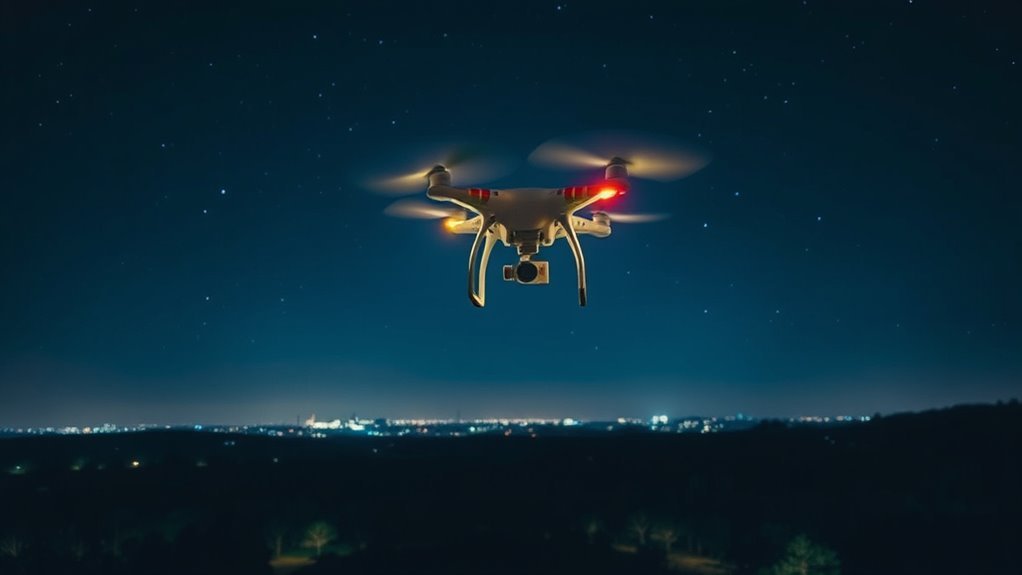
Direct answer: Before you launch after sunset, confirm (1) your operating authority and pilot status, (2) your drone’s lighting and visibility capability, and (3) that you can see and avoid hazards the entire time.
1) Pilot requirements: Part 107 Remote Pilot Certificate (typical for night operations)
To fly a drone at night for most non-recreational uses, you generally need a Part 107 Remote Pilot Certificate (or you must otherwise qualify under a valid FAA exception). The key difference is that recreational pilots generally follow a different framework than Part 107, while night operations under Part 107 expect the same discipline of airspace awareness and aircraft control.
If you are asking, “Do I need Part 107 to fly at night?” a common, widely accepted answer is yes for Part 107-style operations in the United States. If you are flying purely recreationally, rules still apply, and you must check the applicable FAA recreational framework for your exact flight purpose, location, and compliance obligations.
2) Visual line of sight and see-and-avoid obligation
The FAA expects that you can maintain control and that you keep your aircraft in view long enough to manage risk. The key difference is that “at night” reduces natural visual cues, so you must plan lighting, viewing conditions, and equipment accordingly.
Concretely, nighttime operations require planning for obstacles, towers, wires, and other aircraft. Even if your drone has sensors, your legal obligation to operate safely and maintain adequate awareness typically remains with the pilot.
3) Airspace awareness is non-negotiable (authorizations may be required)
Night flying often increases the risk of airspace conflicts because visibility for manned aviation can be reduced or misleading. You must check whether you are operating in controlled airspace and whether you need authorization using the FAA tools that apply to your location.
A best practice is to check the FAA UAS Facility Maps, verify local airspace classification, and confirm if you need sectional-based authorization. If you want the most reliable compliance workflow, use established UAS flight planning apps that integrate FAA data and airspace overlays, then re-verify immediately before takeoff.
Night Drone Lighting Requirements: What “Visible from” Really Means
Lighting is the heart of lawful nighttime drone visibility. The key difference is that your aircraft must be sufficiently lit so people around you and other airspace users can detect it, even in low-light conditions.
FAA guidance commonly referenced for small unmanned aircraft emphasizes that your drone should have anti-collision lights and that its lighting should be visible for a meaningful distance. In practice, many pilots follow the widely cited expectation that drone lights should be visible from at least three statute miles (unless your specific FAA authorization or product documentation indicates different requirements for your configuration and operation type).
Night-Flight Lighting Checks for Part 107-Style Operations (What to Verify)
| # | Lighting item to verify | Visibility target | When you confirm it | Why it matters | Regulatory-alignment score |
|---|---|---|---|---|---|
| 1 | Anti-collision (flashing) lights | ≥ 3 statute miles | Before takeoff + during a short hover test | Detectability of presence and motion | ★★★★★ |
| 2 | Position/orientation lights | Clearly distinguishable from your direction | Before takeoff + after any mode change | Helps observers track heading | ★★★★☆ |
| 3 | Light status indicator (if your controller reports it) | “On/active” matches actual LEDs | Immediately before takeoff | Prevents “light-off” surprises mid-flight | ★★★★☆ |
| 4 | Glare management (no obstructed beam covers) | No blocking by arms/props | Before first arm + after any re-mount | Preserves intended visible-from performance | ★★★★☆ |
| 5 | White balance/visual orientation cue stability | You can keep orientation without “light flicker” | During a short stationary check | Reduces mis-tracking risk from changing brightness | ★★★☆☆ |
| 6 | Light power reliability (fresh charge / stable voltage) | No dimming during 5–10 minute test | Before the full mission | Reduces risk of partial-night lighting failure | ★★★★☆ |
| 7 | Reflective aids (optional add-on) | Visible as an aid, not the primary light | After LED verification (secondary check) | Improves location cues alongside anti-collision lighting | ★★★☆☆ |
Direct answer: Use working anti-collision or navigation lighting that makes your drone easy to spot, and do not rely on screen-only visibility as your primary safety method.
Lighting categories you should plan for before takeoff
Night lighting should be more than a formality. The goal is to support both detectability and orientation (so observers can tell where the drone is going and whether it is moving).
- Anti-collision lights: Helps other airspace users detect your drone’s presence and motion.
- Navigation or position lights: Improves orientation in low-light environments.
- Downward-facing illumination (if appropriate): Can help with landing and obstacle detection, but it must not distract you or create excessive glare.
- Waterproofing and reliability: Outdoor LEDs and mounts should be rated for outdoor conditions and vibration.
Do my drone’s lights have to be “bright” enough for everyone?
Yes, in the practical legal sense that the lighting must make your aircraft detectable and visible to others in the operating environment. The key difference is that “bright” is not your personal guess; it should match the visibility intent described in FAA expectations and product guidance.
To make this measurable, test your lights in realistic conditions. If possible, run a short night visibility check from a safe location, confirm that your lights meet the visibility intent, and ensure they are functioning before each flight.
Equipment and Technology: What Helps You Fly Safely at Night
Proper equipment is what turns “possible” into “safer and compliant” nighttime flying. The key difference is that nighttime constraints reduce your natural depth cues, so you need technology and setup that restore situational awareness.
Night vision and enhanced visual aids (use thoughtfully)
Some pilots use night vision devices or enhanced viewing solutions to maintain situational awareness. The FAA does not eliminate the pilot’s obligation to see and avoid, so night vision should be treated as a tool to improve awareness, not as a substitute for safe operating judgment.
Direct answer: If you use night vision or enhanced displays, test them before the mission, verify compatibility with your drone control workflow, and maintain the ability to control and respond to hazards instantly.
Reflective markers and visibility accessories
Reflective tape, high-contrast markers, and well-placed lights can help people identify the drone’s location. The key difference is that these aids support detectability, which complements anti-collision lighting rather than replacing it.
- Use reflective materials on arms, landing legs, or frame edges.
- Keep wiring secure to prevent light failures mid-flight.
- Avoid adding materials that could interfere with prop wash, sensors, or safe control margins.
Batteries and power management at night
Night flying can increase power draw because lighting, displays, and any imaging or stabilization features may be used more intensively. The key difference is that your “daytime battery assumption” may be inaccurate at night.
As a practical operational safeguard, plan for earlier landing than you would in daylight. Check full charge capacity, monitor voltage under load, and ensure your remaining battery reserve supports a safe landing with margin for unexpected delays.
Pre-Flight Checklist for Nighttime Flights (Non-Negotiable Steps)
A disciplined pre-flight checklist reduces avoidable risk and helps you confirm compliance before you ever take off. The key difference is that nighttime conditions change what you can see, so you must verify lighting, power, and situational awareness intentionally.
- Confirm pilot authority: Ensure you are operating under the correct FAA framework (for example, Part 107 for typical commercial operations) and meet all applicable requirements.
- Verify airspace authorization: Check FAA UAS data, controlled airspace boundaries, and any required waivers or authorizations.
- Night lighting functional test: Ensure anti-collision and position lights are operating normally.
- Visibility and detectability check: Confirm the “visible from” intent using a safe, controlled test where possible.
- Night vision or enhanced display readiness: Verify your gear is working and that you can maintain control with it.
- Battery and power checks: Confirm adequate charge for lighting and any additional electronics; plan conservative reserves.
- Obstacle and landing site review: Identify wires, trees, poles, uneven ground, and reflective surfaces that may affect your sensors or visual cues.
- Emergency plan: Decide in advance how you will handle loss of link, low battery, unexpected hazards, or forced landing.
Quick QA: Common questions before night takeoff
Q: Can I fly at night if my drone has obstacle sensors?
A: Sensors help, but they do not remove the pilot’s responsibility to fly safely and maintain adequate awareness. If your visibility is limited, treat obstacle sensors as secondary support and rely on safe operating procedures.
Q: What should I do if my drone lights fail?
A: Do not take off. Lighting is central to nighttime detectability. If anti-collision or position lights do not function, the safe and compliant action is to troubleshoot or replace the faulty components before flying.
Q: How far should I stay from people and structures at night?
A: Night operations increase the risk of misidentification and unexpected movement from people near the flight area. A widely used safety approach is to maintain generous separation and only operate from locations where you can keep the aircraft in view and manage risk even if visibility changes.
Q: Do I need to check local laws even if the FAA rules are met?
A: Yes. State and local governments, property owners, and event organizers may impose additional restrictions. Always confirm the rules for the exact location where you plan to fly, including curfews, protected sites, and private property boundaries.
Local and Operational Restrictions: Why “FAA-Compliant” Is Not Always “Allowed”
Even if you meet FAA nighttime requirements, you may still face local restrictions that make night flying unsafe or prohibited. The key difference is that FAA rules regulate the national airspace framework, while local rules can control time, location, and permitted activities.
Before your first night flight in a new area, verify whether your city, county, state, or the venue hosting the activity has specific drone rules. This includes restrictions around airports, stadiums, emergency response zones, and areas where night lighting or visual monitoring could be sensitive.
Direct answer: Check both FAA requirements and local limitations, then confirm permission from landowners or venue managers when applicable.
Best Practices for Night Safety and Compliance
Strong safety habits are what help you avoid violations, reduce incidents, and build repeatable compliance. The key difference is that good night procedures compensate for reduced visibility, even when you have the correct legal lighting and equipment.
- Fly with a purpose and a time limit: Plan your route, altitude, and duration before takeoff, then stop early if conditions degrade.
- Maintain conservative altitude: Adjust altitude based on local hazards, not just your GPS reading.
- Choose clear launch and recovery spots: Avoid clutter and reflective surfaces that can confuse visual orientation.
- Use spotters when possible: A second set of eyes can help keep you aware of wires, trees, and unexpected movement.
- Record lessons learned: Note what lighting or visibility changes improved your detectability and control confidence for future flights.
If you want a practical, citation-friendly benchmark for your compliance work, start with the FAA’s Part 107 framework and review the FAA’s published guidance for operations, pilot responsibilities, and airspace awareness. Pair that with your drone manufacturer’s lighting and performance documentation, since different airframes and LED configurations can affect actual nighttime visibility outcomes.
📋 About This Article
This article explains the key rules you need to follow to fly a drone at night safely and legally. It’s for drone owners and pilots who want to take nighttime flights in compliance with FAA requirements and any local limits where they live. You’ll learn what “night flight” means for regulations, what aircraft lighting and visibility you must have, and what operating limits and certification rules apply before you launch.
Frequently Asked Questions: What Are the Rules You Must Follow to Fly Drones at Night?
Do I need special authorization to fly a drone at night?
Often, yes—depending on where you fly and which drone/class you operate. In many countries (including the United States), night operations may be allowed only under specific conditions such as having appropriate lighting, maintaining a visual line of sight, and following any additional operational rules. Some jurisdictions require advance authorization for night flights beyond general permissions.
Practical next steps:
- Check your national aviation authority’s drone guidance for “night operations” or “operations at night.”
- Verify whether your flight is covered by a standard rule set (e.g., basic operating permissions) or requires an additional approval.
- If you’re using an advanced drone, commercial workflow, or flying near controlled airspace, confirm you have the correct clearance/waivers.
What drone lighting rules must I follow for night flights?
Most regulators require drones to be equipped with lights that make the aircraft visible to other airspace users. Typical expectations include:
- Anti-collision/position lighting so your drone is identifiable during flight.
- Operational condition—lights must be functional before takeoff and remain on during the flight.
- Visibility—lights should be sufficient for you to comply with “see-and-avoid” obligations and for others to detect the drone.
Key compliance tips:
- Test lights before every night flight.
- Plan lighting levels so the drone stays visible even with changing backgrounds (streetlights, sky brightness, reflections).
- Confirm your drone’s lighting configuration meets the specific requirements in your country (some rules specify color/flash patterns; others specify visibility/anti-collision only).
Do I still need to maintain visual line of sight (VLOS) at night?
Yes—regulators typically require that you maintain control of the aircraft using direct observation. At night, this requirement is often stricter in practice because visibility is reduced, glare is common, and depth perception can be harder.
What “VLOS” usually means during night operations:
- You must be able to see the drone (including its position and movement) without relying solely on video feed.
- Video-only operation is generally not considered sufficient unless your jurisdiction specifically allows it (and often requires additional safeguards).
- Use lighting and positioning to keep the aircraft detectable, and avoid scenarios where the drone becomes hard to track (e.g., flying over dark, featureless areas without adequate cues).
Safety and compliance best practices:
- Choose launch/recovery areas with good visibility and stable lighting.
- Keep distances short enough that you can confidently track the drone.
- Abort immediately if you cannot maintain clear visual contact.
Are there restrictions on where I can fly a drone at night?
Yes. Night flights don’t remove airspace restrictions—many rules that apply in daytime still apply at night, and some zones can be more dangerous after dark.
Common location-related restrictions:
- Controlled airspace (near airports or approach/departure paths) may require authorization or specific procedures.
- Restricted/prohibited areas (military zones, special-use airspace, emergencies) are often off-limits or require permits.
- Temporary flight restrictions (TFRs) may be active at night due to events, weather, or other safety concerns.
- Over people rules may restrict operations depending on your drone’s size/weight class, configuration, and the jurisdiction’s “over people/near crowds” standards.
- Critical infrastructure and some sensitive sites can have added limitations.
What you should do before taking off:
- Use official airspace/UTM maps or apps provided by your civil aviation authority.
- Check for NOTAMs/TFRs and any event-based restrictions.
- Ensure you’re operating in a legal altitude, distance, and area boundary.
What safety and operational practices should I follow when flying at night?
Even when legal, night flying demands extra discipline. Regulations typically require you to operate safely and follow “operate responsibly” principles, and practical safety measures help you meet those expectations.
Recommended night-flying practices:
- Pre-flight checks: confirm lights, navigation system, battery health, and firmware updates.
- Plan your route: avoid complex maneuvers, stay away from obstacles, and ensure you have clear landing areas.
- Battery management: night flights can drain power faster due to colder temperatures and added caution/hovering—plan conservatively.
- Altitude and speed control: fly slower and lower-risk profiles; avoid rapid climbs/descents if you can’t clearly track the drone.
- Weather awareness: wind and precipitation drastically affect stability and visibility. Postpone flight if visibility is poor.
- Keep a safe margin: reduce distance from yourself and increase spacing from people, vehicles, buildings, and other aircraft.
- Emergency procedures: know how you will land if the drone loses control, suffers signal drop, or you lose visual contact.
Regulatory-aligned mindset:
- If you can’t safely see and control the drone, you should not continue the flight.
- Don’t assume “night” means fewer aircraft—manned aircraft may still be operating, and helicopters or emergency responders can appear suddenly.
References
- Dron’t stop me now: prioritizing drone journalism in commercial drone regulation Google Scholar
https://papers.ssrn.com/sol3/papers.cfm?abstract_id=3374488 - Management and regulation of drone operation in urban environment: A case study Google Scholar
https://www.mdpi.com/2076-0760/11/10/474 - Deadly drones? Why FAA regulations miss the mark on drone safety Google Scholar
https://papers.ssrn.com/sol3/papers.cfm?abstract_id=3453351 - AED delivery at night–Can drones do the Job? A feasibility study of unmanned aerial systems to tr… Google Scholar
https://www.sciencedirect.com/science/article/pii/S0300957223000473 - Bring on the drones: Legal and regulatory issues in using unmanned aircraft systems Google Scholar
https://www.jstor.org/stable/26418852
📅 Last Updated: July 03, 2026 | Topic: What Are the Rules You Must Follow to Fly Drones at Night? | Content verified for accuracy and freshness.
