
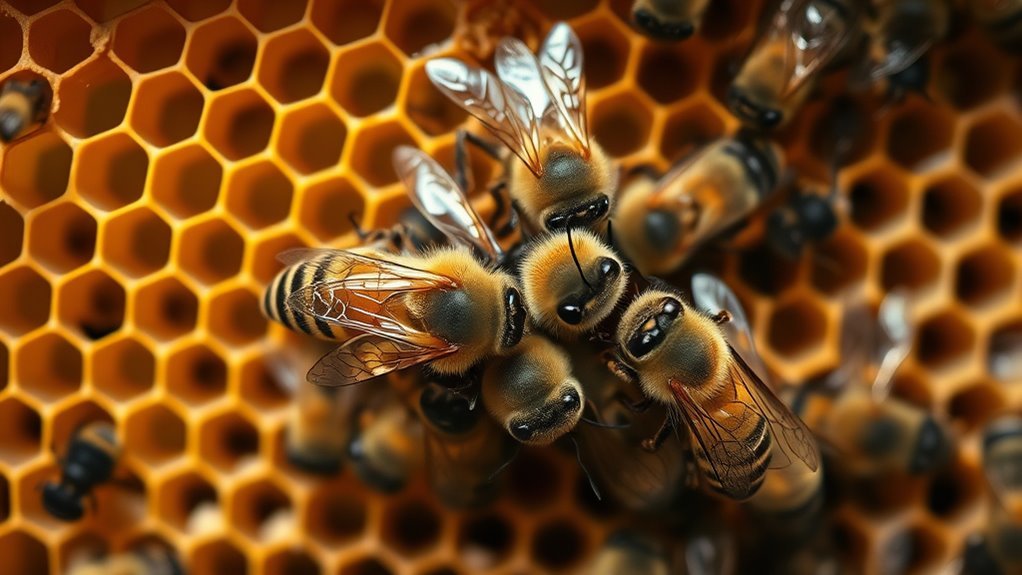
Drone bees in a hive primarily exist to mate with virgin queens, introducing essential genetic diversity that strengthens colony resilience. You’ll notice they’re larger, stingerless, and rely on worker bees for care. Their presence peaks in spring and early summer to match reproductive cycles, then dwindles as resources tighten. Though they don’t gather food or defend the hive, their role is fundamental for healthy offspring and colony survival. Understanding their lifecycle and behaviors reveals even greater complexity within hive dynamics.
The Biological Role of Drone Bees
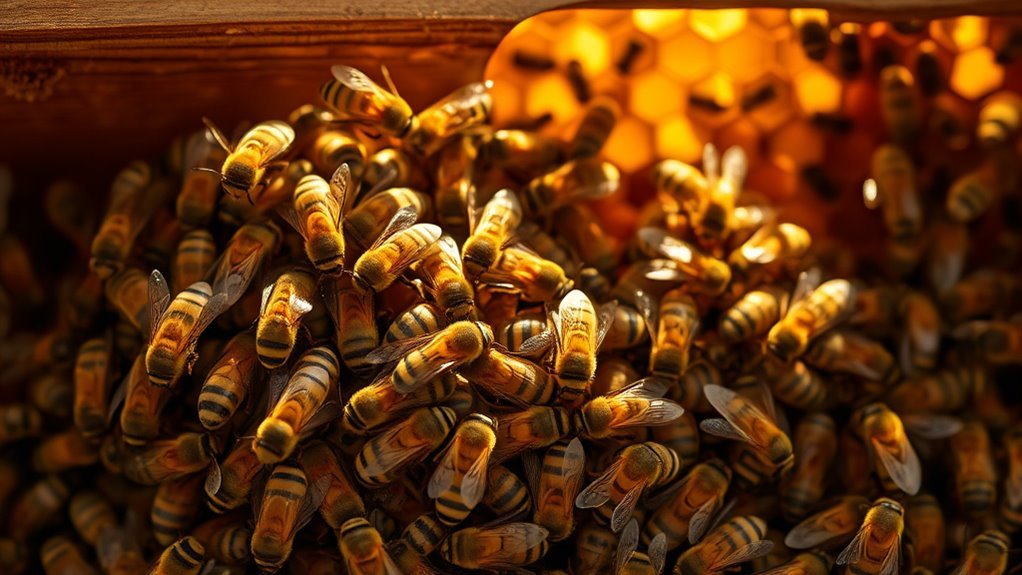
Although drone bees are often overshadowed by their worker counterparts, their biological role is essential for the reproduction and genetic diversity of the hive. You should understand that drone reproduction is the primary function of these males, as they mate with virgin queens during nuptial flights. This process guarantees the introduction of new genetic material, enhancing hive resilience and adaptability. Regarding hive dynamics, drones do not participate in foraging, hive maintenance, or defense; their existence is solely dedicated to this reproductive purpose. You’ll notice that the presence and number of drones within a colony fluctuate seasonally, reflecting the hive’s reproductive needs and environmental conditions. By fulfilling this reproductive role, drones contribute indispensably to the hive’s survival and evolution over time.
Physical Characteristics of Drone Bees
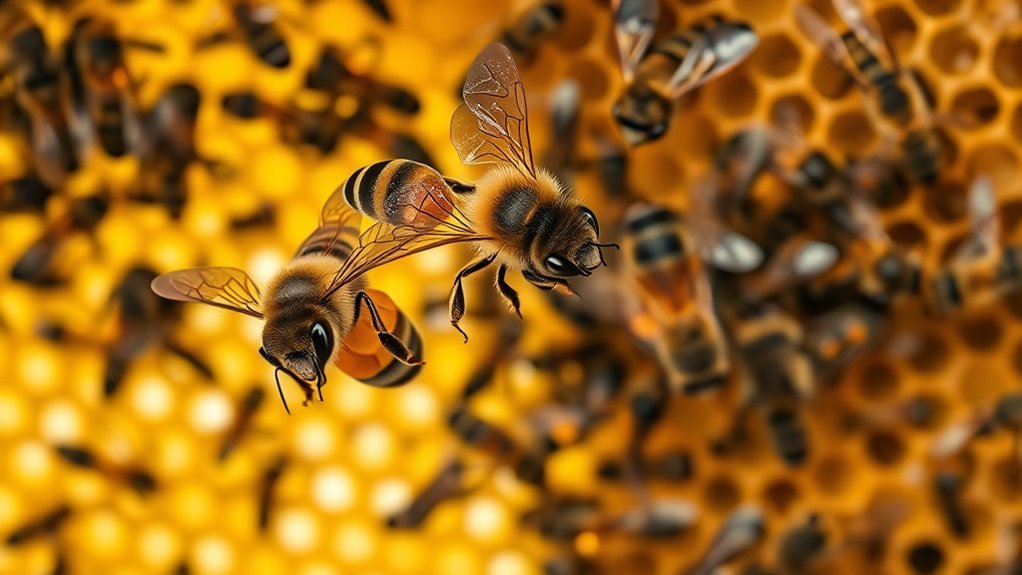
Drone bees possess distinct physical characteristics that set them apart from worker and queen bees, reflecting their specialized reproductive role. When you examine drone anatomy, you’ll notice their larger drone size compared to workers, typically measuring about 15 to 17 millimeters in length. Their bodies are more robust, with broader abdomens housing well-developed reproductive organs. Unlike worker bees, drones lack stingers, emphasizing their non-defensive function within the hive. Their compound eyes are significantly larger, aiding in the detection of queens during mating flights, though this won’t be discussed here. Additionally, drones have shorter antennae and thicker thoraxes to support stronger wing muscles for sustained flight. Understanding these precise physical traits helps you appreciate how drone bees are uniquely adapted to fulfill their biological purpose within the colony.
Drone Bees and Mating Flights
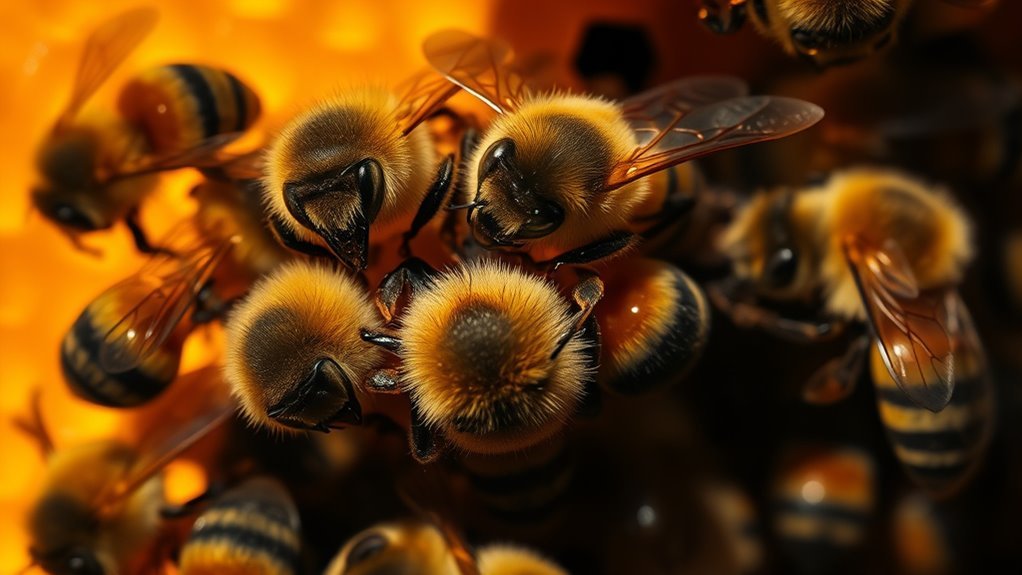
When you observe drone bees, you’ll notice their primary role during mating flights is to locate and mate with a queen. These flights typically occur under specific environmental conditions and last for a limited duration to maximize reproductive success. During these flights, drones exhibit distinct flight patterns and behaviors optimized for finding a queen within drone congregation areas.
Purpose of Mating Flights
A key function of male honeybees involves participating in mating flights, which are critical for the reproductive success of the colony. During these flights, drones engage in specific mating rituals that increase their chances of successful reproduction with virgin queens. You’ll notice that their flight patterns are distinct and purposeful, optimized to locate queen bees within drone congregation areas. These patterns involve precise altitude, speed, and direction adjustments that allow drones to compete effectively. By dispersing genetic material through these flights, drones contribute to the genetic diversity and resilience of honeybee populations. While the process might seem brief, every aspect of the mating flights is finely tuned by evolutionary pressures, ensuring drones fulfill their primary biological role within the hive’s reproductive cycle.
Timing and Duration
Although mating flights occur during specific times, their timing and duration are influenced by environmental factors such as temperature, light levels, and weather conditions. You’ll notice drones emerge primarily in spring and early summer, aligning with seasonal activity peaks. This emergence guarantees that drones are mature and available when queens take their mating flights. Typically, these flights happen midday when ambient temperatures are ideal, and sunlight is sufficient for navigation. Flight duration varies but generally lasts between 15 to 30 minutes, balancing energy expenditure and mating opportunities. Understanding this temporal pattern highlights how drone emergence and environmental conditions synchronize to maximize reproductive success while allowing drones freedom to engage in essential mating behavior within a narrow, ecologically dictated window.
Drone Behavior During Flights
Since drone bees play an essential role in reproduction, their behavior during mating flights is highly specialized and purposeful. You’ll notice that drone navigation techniques rely on visual landmarks and solar positioning, enabling precise orientation. Their drone flight patterns include circling in congregation areas where virgin queens are likely to appear. These flights are brief but intense, maximizing chances for successful mating.
| Aspect | Description |
|---|---|
| Navigation | Visual cues, sun angle |
| Flight Patterns | Circling, altitude control |
| Duration | Short, focused on mating success |
Understanding these behaviors shows how drones are wired for freedom in the air, optimizing their limited flight time to fulfill their reproductive role effectively.
How Drones Differ From Worker Bees
While both drones and worker bees belong to the same hive, their physical characteristics and roles are distinctly different. Drones are larger, with robust bodies and bigger eyes, designed to maximize their ability to locate queens during mating flights. Unlike worker bees, drones lack stingers and specialized structures like pollen baskets. Their primary drone roles focus on reproduction, meaning they do not participate in foraging, hive maintenance, or brood care. Worker differences extend beyond size: workers perform diverse tasks including nectar collection, hive defense, and temperature regulation. Understanding these distinctions clarifies how each bee’s anatomy and behavior support the colony’s freedom to thrive. So, when you observe a hive, recognize that drones’ unique roles contrast sharply with workers’, reflecting a division of labor essential to hive survival and reproductive success.
The Lifecycle of a Drone Bee
When you observe a drone’s development, you’ll notice it follows a distinct lifecycle that supports its reproductive role within the colony. Drone development begins as the queen lays unfertilized eggs, which hatch into male larvae. The drone lifespan is relatively short compared to worker bees, focused on mating flights. The key stages are:
- Egg Stage: Lasts about 3 days; unfertilized eggs are laid in larger cells.
- Larval Stage: Approximately 6 days; larvae are fed by worker bees.
- Pupal Stage: Lasts around 14 days; metamorphosis into adult drones occurs.
- Adult Stage: Mature drones leave the hive for mating flights; their lifespan is typically 8 weeks, ending if they fail to mate or after the mating season.
This lifecycle guarantees drones contribute precisely during their fertile period.
Drone Bee Behavior Inside the Hive
When you observe drone bees inside the hive, you’ll notice their primary purpose is to prepare for mating flights. They interact with worker bees mainly through food exchange and grooming, relying on workers for sustenance. Understanding these behaviors helps clarify the drone’s role within the colony’s social structure.
Mating Role Overview
Although drone bees spend much of their time inside the hive, their primary behavior revolves around preparing for their sole reproductive purpose—mating with a queen. Understanding drone reproduction is key to grasping hive dynamics, as drones contribute genetic diversity essential for colony survival.
To illustrate their mating role, consider these behaviors:
- Maturation: Drones develop sexually mature organs necessary for reproduction.
- Flight readiness: They build muscle strength for mating flights outside the hive.
- Energy conservation: Inside, drones conserve energy to sustain flight endurance.
- Mating flights: Upon maturity, drones leave to seek virgin queens at drone congregation areas.
Interaction With Worker Bees
Because drone bees rely heavily on worker bees for their survival inside the hive, their interactions are primarily centered on receiving care and resources. You’ll observe that drone communication with workers is minimal and mostly unidirectional, as drones depend on workers for feeding and grooming. Worker cooperation guarantees drones receive sustenance, as they lack the ability to forage or care for themselves. This cooperative dynamic is essential for maintaining hive function, with workers regulating drone presence based on colony needs. While drones don’t contribute to hive maintenance, their behavior within the hive is shaped by this dependence. Understanding this interaction clarifies how the division of labor supports colony freedom, allowing drones to focus solely on reproductive roles while workers manage all survival tasks through efficient communication and cooperation.
The Impact of Drones on Hive Genetics
Since drone bees are the sole contributors of male genetic material, they play an essential role in shaping the genetic diversity within a hive. Understanding drone genetics helps you appreciate how diverse genetic traits are maintained and spread throughout bee populations. This diversity is vital for the hive’s adaptability and resilience. Consider these points:
Drone bees, as sole male gene contributors, are crucial for maintaining hive genetic diversity and resilience.
- Drones mate with queens from different colonies, introducing varied genetic material.
- This mating increases heterozygosity, enhancing disease resistance in offspring.
- Genetic diversity reduces the risk of inbreeding, promoting a healthier hive.
- Variations in drone genetics influence traits like foraging efficiency and temperament.
Seasonal Presence of Drone Bees
When you observe a hive throughout the year, you’ll notice that drone bees appear largely during specific seasons. Drone emergence is closely tied to seasonal variations, with drones primarily present in spring and early summer. This timing aligns with reproductive needs, as drones are essential for mating flights. During colder months, drones are scarce or absent, reflecting the hive’s energy optimization.
| Season | Drone Presence |
|---|---|
| Spring | High – Drone emergence peaks for mating |
| Summer | Moderate – Continued presence for reproduction |
| Autumn/Winter | Low to none – Drones expelled or die off |
Understanding these patterns helps you appreciate how nature balances reproductive freedom with survival efficiency in the hive’s lifecycle.
How the Colony Manages Drone Population
Although drone bees play an essential role in reproduction, the colony carefully regulates their numbers to maintain resource efficiency. Drone population management is a critical aspect of colony dynamics, ensuring the hive allocates energy and nutrients effectively. You’ll observe that the colony balances drone presence by:
- Limiting drone brood cells during resource-scarce periods.
- Removing drones when they no longer contribute to mating.
- Adjusting worker behavior to restrict drone feeding as needed.
- Timing drone production seasonally to match reproductive cycles.
The Relationship Between Drones and the Queen Bee
Managing the drone population directly supports the queen bee’s reproductive role within the colony. You’ll find that drones are integral to the reproductive dynamics, primarily because only mature drones mate with the drone queen during nuptial flights. This selective interaction guarantees genetic diversity and colony health. The queen’s ability to store sperm post-mating relies heavily on the quality and quantity of drones available.
| Aspect | Role of Drone | Impact on Queen |
|---|---|---|
| Mating Behavior | Engage in nuptial flights | Enables sperm storage |
| Population Control | Regulated by worker bees | Maintains reproductive health |
| Genetic Contribution | Provides genetic diversity | Enhances colony resilience |
| Lifespan | Short-lived post-mating | Influences queen’s fertility |
Understanding this relationship lets you appreciate the balance sustaining hive freedom and reproduction.
