

What lights do drones have?
Most drones use multiple light types to improve visibility, communicate flight status, and support safer operation at night or in low-visibility conditions. Common examples include LED navigation lights, strobe or anti-collision lights, landing lights, and sometimes lights dedicated to photography or identification.
In practice, the exact lighting setup depends on the drone’s design, intended use, and the regulatory framework where you fly. For example, commercial operators in the United States typically align with FAA guidance for unmanned aircraft visibility, while manufacturers often follow aviation-minded lighting practices even when a drone is not certified like a manned aircraft.
Overview of drone lighting systems
Drone lighting systems are designed to help you see the aircraft and to help other people see it too. The key difference is that some lights are primarily for the operator, while others are intentionally visible to other airspace users to reduce collision risk.
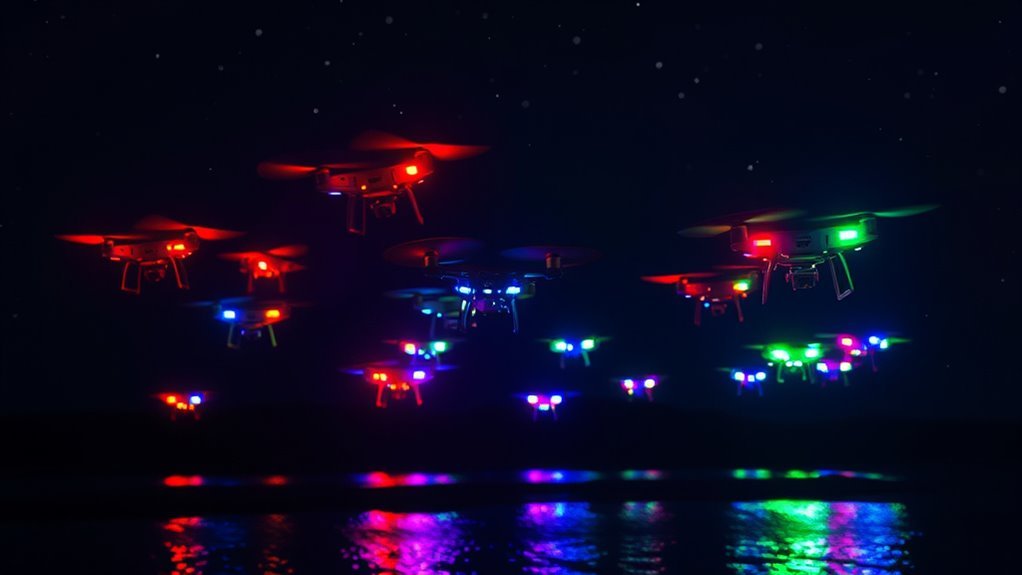
At a systems level, drone lights generally fall into five functional groups: anti-collision visibility, navigation/position indication, landing and takeoff illumination, payload or camera lighting, and status or identification indicators. Modern drones commonly use LED technology because it is energy-efficient, durable, and available in multiple colors and intensities.
Common Drone Light Types (What They Do in Low Light)
| # | Light type | Primary purpose | Typical visibility (clear night) | Power impact | Visibility impact |
|---|---|---|---|---|---|
| 1 | Anti-collision strobe / beacon | High detectability | 0.8–2.0 km (often tens of seconds of notice time) | Low–moderate | ★★★★☆ |
| 2 | Navigation (front/rear/side) LEDs | Orientation & direction cues | 0.5–1.5 km | Low | ★★★★☆ |
| 3 | Position / “steady” LEDs | Marking presence & heading | 0.3–1.0 km | Low | ★★★☆☆ |
| 4 | Landing / takeoff flood light | Ground illumination (operator safety) | 10–40 m illumination radius | Moderate (brief duty cycle) | ★★☆☆☆ |
| 5 | Under-guard / hover lamps (depth aid) | Better near-ground perception | 5–25 m | Moderate–high (near ground) | ★★☆☆☆ |
| 6 | Camera visible spotlight / lamp | Improve image capture in dim scenes | Spot-focused (often <30 m) | Moderate–high (mission driven) | ★☆☆☆☆ |
| 7 | Infrared (IR) payload illumination | Low-disturbance night imaging | Effective range depends on sensor (commonly 5–60 m) | Low–moderate (variable) | ★☆☆☆☆ |
The FAA’s drone-related rules and widely accepted air-safety principles emphasize the need for visibility when operating at night or in complex environments. While specific light requirements can vary by jurisdiction and operational context, operators should treat lighting as part of a broader safety system that includes airspace awareness and correct procedures.
FAQ: Why do drones need lights? Drones use lights to increase detectability, communicate orientation and motion, and support safe navigation, particularly at night, at dusk, and during adverse weather. Clear visual signals can reduce the chance of misidentification by other pilots and by people on the ground.
LEDs, power use, and brightness: what to expect
LEDs are the dominant lighting technology in consumer and enterprise drones because they deliver high brightness with relatively low power draw. The key difference is that designers balance light intensity, battery impact, and weather resistance to keep flight time predictable.
For example, LED modules can be engineered for different beam patterns such as wide flood illumination for landing or narrow beams for signaling. Many anti-collision lights operate in a strobing pattern because motion-based flashes are easier for the human eye to detect at distance than steady light.
Practical tip: If your drone offers “night mode” or configurable lighting, use it when operating in low light. This usually improves the timing, color visibility, and intensity targets used for situational awareness.
Anti-collision and strobe lights
Anti-collision lights, often implemented as strobe or beacon LEDs, are designed to make a drone stand out to other airspace users. They are most effective at alerting nearby pilots and observers because they create a conspicuous flashing signature.
Strobe lights are particularly valuable when a drone is moving through air where the observer’s visual system needs a strong cue to detect small, fast objects. Many drone controllers and firmware settings trigger these lights automatically at specific times, such as during takeoff, forward flight, or low-light operation.
How strobe patterns improve visibility
Strobe lights improve detection by using rapid on-off cycles that create temporal contrast. The key difference is that temporal contrast helps the eye pick up the drone against a darker background and reduces the likelihood that it blends into surrounding scenery.
Manufacturers may tune the flash rate, intensity, and color based on product class. Even when two drones appear “similar,” differences in flash frequency and luminous intensity can affect detection range and how quickly people notice the aircraft.
FAQ: Do all drones have strobe lights? No. Many consumer drones include visible LEDs or propeller indicators, but not every model includes a true anti-collision strobe. If night operations are part of your plan, verify the exact lighting features listed in the manufacturer specifications.
Navigation lights and orientation indicators
Navigation lights are the lights used to communicate the drone’s position and direction of travel. They help other people determine orientation, which is essential for collision avoidance and for making the drone’s movement more predictable.
In aviation practice, navigation lights often follow standardized color conventions so that pilots can interpret direction quickly. While drone implementations vary, many systems use colored LEDs for “front” versus “rear” indication and may include combinations that resemble manned-aircraft conventions.
Common navigation light configurations
Most navigation lighting setups provide cues about which way the drone is facing and whether it is in forward flight. The key difference is that orientation lights focus on what other users can infer about direction, not on lighting the ground.
- Front-facing LEDs: Typically used to indicate the nose or forward direction.
- Rear or tail LEDs: Often used to indicate the opposite direction.
- Side or wing LEDs: Some drones use side-mounted indicators to improve visibility from oblique angles.
- Status-integrated navigation: Certain models combine navigation cues with flight-state indicators for easier operator and observer understanding.
FAQ: Are drone navigation lights required? Requirements vary by country, airspace rules, and whether your operation meets specific thresholds for “night” or “near controlled airspace.” If you fly commercially, always confirm the latest local regulations and the applicable authority guidance before relying on onboard lights for compliance.
Position lights vs. anti-collision lights
Position lights help communicate where the drone is and which direction it is oriented, while anti-collision lights focus on alerting others that the drone is present and in motion. The key difference is the communication goal: orientation versus high-detectability presence.
This distinction matters because a flashing beacon may make the drone easy to spot but does not necessarily tell an observer which direction it is traveling. Conversely, orientation LEDs may communicate heading but may be less effective at drawing attention in distant or cluttered scenes compared to strobe-based anti-collision signals.
Landing lights and takeoff illumination
Landing lights are intended to brighten the ground to help with safe takeoff, landing, and hovering during low-light operations. They typically function as a targeted flood or spotlight rather than a signaling beacon for other aircraft.
Unlike navigation lights, landing lights are usually optimized for the drone operator’s mission execution. They can reduce the risk of misjudging height or distance to obstacles such as rooftops, pathways, trees, and uneven terrain.
What landing lights are designed to do
Landing lights are defined as illumination systems used to enhance ground visibility during low-altitude flight phases. The key difference is that they aim downward and prioritize useful lighting over conspicuous airspace signaling.
On many drones, landing lights activate during descent, when armed, or when switching to landing mode. Some models also include lights on the underside to improve depth perception when hovering near the ground.
FAQ: Can landing lights replace navigation lights? No. Landing lights are not intended to communicate orientation or anti-collision visibility. For safe night operation, you generally need both ground illumination and external signaling lights that other airspace users can see.
Camera lights and payload illumination
Some drones include camera lights, spotlights, or infrared (IR) modules to improve image quality in low-light conditions. These lights are mission-focused, helping sensors capture details when ambient light is insufficient.
The key difference is that camera lights are designed for the drone’s imaging payload rather than for visibility to other aircraft. Depending on the sensor type, you may see visible LEDs, high-intensity spotlights, or IR illumination used for night vision style capture.
Visible light vs. infrared payload lighting
Visible light payload illumination increases brightness for standard cameras, while infrared lighting supports imaging that reacts to IR wavelengths. The key difference is detectability: IR can be less visible to the human eye, but it can still affect perception and safety depending on environment and regulations.
For example, visible camera lights can create glare or distraction for bystanders, while IR systems can support covert or low-disturbance capture. Operators should consider local rules, privacy expectations, and safety constraints before using any bright payload illumination in public areas.
FAQ: Do camera lights count as “drone lights” for compliance? Usually not. Regulatory visibility requirements typically focus on external lighting intended for airspace safety. Camera or payload lights may assist your mission, but they generally do not replace navigation or anti-collision functions.
Identification lights and status indicators
Identification lights help convey drone status, control mode, or operational state to the operator and sometimes to observers. Many drones also use LEDs to show whether the aircraft is armed, connecting, linking to the controller, flying, or experiencing a fault.
The key difference is that status lights are often optimized for local awareness and troubleshooting rather than standardized air-traffic signaling. However, clear status illumination can still support safety by helping pilots recognize system states quickly.
Examples of common status illumination
Status LEDs can communicate critical information such as connectivity and readiness. The key difference is that each manufacturer uses its own color patterns and blinking logic, so you should rely on the flight manual rather than guessing.
- Arming indicators: A steady or pulsing LED pattern may show the drone is armed.
- GPS or positioning status: Some drones display “position acquired” versus “positioning unavailable.”
- Link quality: Connection indicators may show controller link state.
- Error alerts: Fault states can trigger distinct red or flashing patterns.
FAQ: Can I rely on LED colors without the manual? It is not recommended. LED color codes and blink patterns differ widely between brands and models. For safety, confirm the meaning of each indicator in the official documentation.
Compliance and aviation standards for drone lighting
Drone lighting compliance is tied to airspace rules, operation type, and whether you are flying in conditions that require enhanced visibility. The key difference is that “having lights” does not automatically mean “meeting the regulatory standard,” because requirements may specify type, color, flash behavior, and placement.
In the United States, the FAA provides guidance for night operations and unmanned aircraft visibility expectations, and operators are responsible for operating in a manner that does not create a hazard. In the European context, EASA-related rules and national implementations can also influence how drones should be equipped for visibility and operational safety.
Because these rules evolve, the most reliable approach is to check the latest authority guidance and to verify your exact drone model’s lighting specifications against your intended operation. If you fly in specialized environments such as near airports, controlled airspace, or during BVLOS operations (where permitted), compliance expectations can be significantly stricter.
What to check before flying at night
Before operating at night or in low visibility, verify that your drone’s lights meet both practical and regulatory needs. The key difference is the difference between “working lights” and “mission-appropriate signaling.”
- External visibility: Confirm anti-collision and navigation LEDs are functional.
- Position indication: Check that front/rear (and possibly side) orientation cues are present.
- Timing behavior: Ensure strobe patterns trigger correctly in the lighting mode you use.
- Battery impact: Large lights can increase power draw; verify realistic flight-time expectations.
- Manual confirmation: Use the drone’s official manual for LED meanings and light behavior.
FAQ: Do I need FAA lights on every drone? Not every drone is required to have the same lighting configuration, but you must ensure your operation is safe and compliant. If you are planning night flight, validate what your specific operation requires under current rules and guidance.
Which drone brands and models typically include lighting systems?
Many mainstream drone manufacturers include external LEDs and mission lights, but the exact configuration varies widely by model and product line. The key difference is that some consumer models provide basic visibility cues, while enterprise platforms may add stronger anti-collision lights and configurable lighting modes.
Well-known brands such as DJI and Autel Robotics often ship drones with multi-color LEDs and anti-collision features on many models. For enterprise systems, manufacturers may offer more robust lighting designs intended for operations in varied environments, including industrial inspection and surveying use cases.
Even within a single brand, lighting capabilities can differ based on the drone variant and firmware options. To avoid incorrect assumptions, consult the product page and the user manual for your specific aircraft, including the stated light types and operational behaviors.
Quick checklist to identify your drone’s light types
You can quickly determine what lights your drone has by using the manual and observing the lighting behavior in different modes. The key difference is that manuals provide the “meaning,” while the aircraft provides the “proof.”
- Armed/idle state: Look for status LED patterns (connectivity, GPS lock, armed state).
- Takeoff/flight mode: Confirm anti-collision and navigation LEDs activate correctly.
- Landing mode: Check for underside and downward-facing landing illumination.
- Camera/mission mode: Verify any payload lights, spotlight behavior, or IR modules.
FAQ: Why do some drones show different LED patterns in firmware updates? Firmware updates can change lighting logic, blink rates, or when specific LEDs activate. If your drone behavior changed after an update, re-check the manual or release notes for your version.
📋 About This Article
This article explains what lights drones use and why they matter for safer flying and better visibility. It’s for drone owners and pilots who want to understand their drone’s light setup before taking off, especially at night or in low-visibility conditions. You’ll learn about common types of drone lights, what they’re for, and how the exact combination can vary by drone design and local rules.
Frequently Asked Questions: What Lights Do Drones Have?
What lights do drones typically have?
Most drones include a mix of navigation/visibility lights and status indicators. Common examples are LEDs for aircraft visibility (often red/green/white depending on orientation), blinking lights to improve sight lines at a distance, and internal indicator lights such as power or GPS status LEDs. Many consumer drones also have “mode” lights that change color or blink pattern when the drone is in functions like beginner mode, return-to-home (RTH), or GPS lock. The exact combination varies by model, flight controller firmware, and local regulations.
What are the red, green, and white lights on a drone for?
Red/green/white LEDs are generally used to help people identify the drone’s orientation and movement. A common pattern is red on one side and green on the other, allowing observers to determine which direction the drone is facing. White lights are often used as position or anti-collision/visibility lights depending on the design. These lights help with situational awareness, especially at dusk, dawn, or in low-visibility conditions. Note that color placement and behavior can differ between manufacturers and between regulations in different countries.
Do drones have flashing lights, and what do they mean?
Yes—many drones use flashing or pulsing LEDs as part of their communication to pilots and bystanders. Flashing patterns may indicate status such as GPS acquisition, compass calibration needed, low signal, weak battery, geofencing alerts, or an active safety behavior like return-to-home. Some drones also blink more noticeably when armed, taking off, or during failsafe events. To interpret the exact meaning, consult your drone’s manual or app (many display real-time warnings in addition to LED patterns).
Are drone lights required by law?
In many places, requirements depend on the category of operation (and whether the flight is near airports, at night, or involves specific airspace rules). Some jurisdictions require visible anti-collision lighting for operations at night or in certain conditions, while daylight flights may have different expectations. Even when not strictly mandated, having proper lights is strongly recommended for safety and compliance with common aviation practices. Because rules vary widely by country and operator type, check your local aviation authority and the guidance in your drone’s documentation.
Can I turn off or change a drone’s lights, and is it safe?
Many consumer drones allow pilots to customize lighting in settings (for example, changing brightness or turning certain LED indicators on/off). However, some navigation or anti-collision lights may be restricted, automatically controlled by the flight system, or required for safety—especially at night or in regulated airspace. Turning off lights can reduce your visibility to other people and aircraft, increasing the risk of collision. It can also conflict with local rules or manufacturer safety guidelines. If you plan to fly in low light or near other air users, keep lights enabled and follow your local regulations and the drone manual.
References
- Human-centered drone LED illumination system: A proof-of-concept prototype Google Scholar
https://journals.sagepub.com/doi/abs/10.1177/1071181321651124 - Calibration of an autonomous instrument for monitoring light pollution from drones Google Scholar
https://www.mdpi.com/1424-8220/19/23/5091 - Testing a key assumption of using drones as frightening devices: Do birds perceive drones as risky? Google Scholar
https://academic.oup.com/condor/article-abstract/122/3/duaa014/5812987 - Guardian Angel–Using Lighting Drones to Improve Traffic Safety, Sense of Security, and Comfort fo… Google Scholar
https://link.springer.com/chapter/10.1007/978-3-031-48047-8_13 - The Dronetic Moment: Future of drone light show & lighting design in concerts Google Scholar
https://dl.designresearchsociety.org/iasdr/iasdr2023/fullpapers/48/
📅 Last Updated: July 03, 2026 | Topic: What Lights Do Drones Have? | Content verified for accuracy and freshness.
