

When you’re comparing the Wingtra One Gen II and DJI Mavic 3 Enterprise for mapping, you’ll see the Wingtra’s 59-minute flight time delivers broader coverage and high-precision accuracy, ideal for large-scale surveys. In contrast, the DJI’s 45-minute duration emphasizes versatility and agile maneuvers for dynamic tasks. This endurance versus flexibility debate highlights key trade-offs, so you’ll uncover additional layers in the full breakdown.
Key Features Breakdown
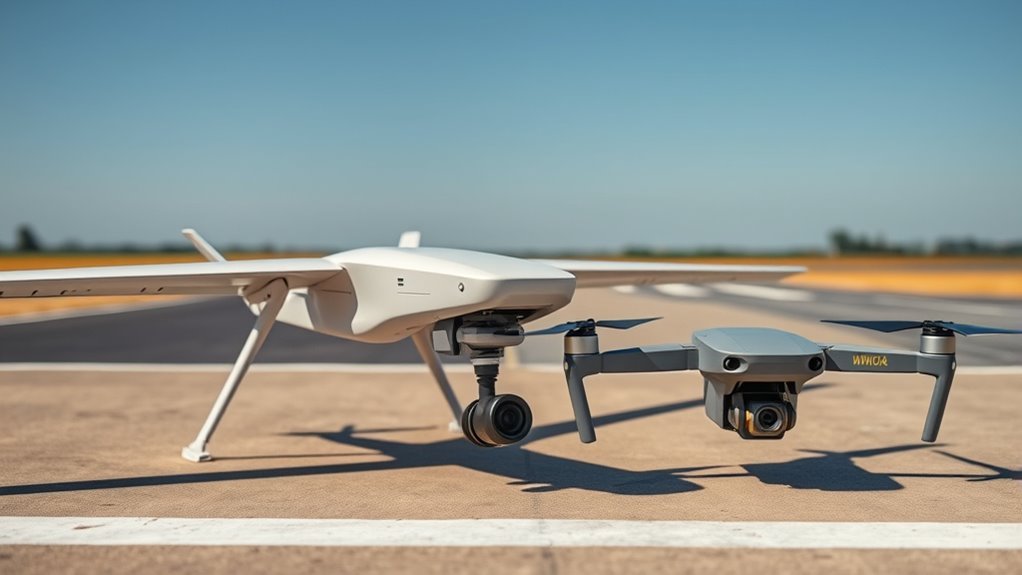
When comparing the Wingtra One Gen II and the DJI Mavic 3 Enterprise, you’ll find that their key features highlight distinct strengths for different applications. The Wingtra One Gen II excels in camera capabilities, featuring a high-resolution sensor optimized for precise mapping and surveying, empowering you to capture detailed aerial data with minimal distortion. In contrast, the DJI Mavic 3 Enterprise offers versatile camera options, including a 4/3 CMOS sensor and thermal imaging in some variants, giving you flexible tools for dynamic inspections without being tied to specialized setups.
Battery life further differentiates these drones, with the Wingtra One Gen II providing up to 59 minutes of flight time, allowing you the freedom to explore vast areas uninterrupted. Meanwhile, the DJI model delivers around 45 minutes, which suits shorter, agile operations where quick deployment is key. This balance lets you choose based on your need for endurance versus portability, ensuring your projects align with your operational liberty. Ultimately, these features enable informed decisions tailored to your aerial pursuits. Additionally, the Wingtra One Gen II’s high-precision RTK GPS provides centimeter-level accuracy, enhancing its capabilities for mapping applications.
Performance Comparison
While both the Wingtra One Gen II and DJI Mavic 3 Enterprise boast impressive features, their performance in real-world scenarios reveals distinct advantages based on operational demands. You’ll notice that flight endurance plays a key role in your missions; the Wingtra One Gen II’s 59-minute capability lets you soar longer, granting the freedom to map vast areas without interruptions, ideal for expansive surveys. In contrast, the DJI Mavic 3 Enterprise’s 45-minute limit might require more frequent returns, suiting shorter, agile operations.
When evaluating camera capabilities, you gain flexibility with the Wingtra’s high-resolution sensors, which deliver precise aerial imagery for detailed terrain analysis. Meanwhile, the DJI’s versatile optics, including thermal options, empower you to adapt quickly to diverse environments. Ultimately, your choice hinges on whether you prioritize extended endurance or multifaceted imaging, ensuring you operate with the autonomy you crave. This balance helps you select the drone that truly enhances your fieldwork efficiency. Additionally, the Wingtra One Gen II achieves sub-2 cm horizontal accuracy, making it a superior choice for precision mapping tasks.
Efficiency and Accuracy Analysis
Efficiency and accuracy in drone operations depend on how well a model enhances flight paths and delivers reliable data. When you’re evaluating the Wingtra One Gen II and DJI Mavic 3 Enterprise, you’ll appreciate how their mapping techniques influence outcomes. The Wingtra’s advanced path enhancement lets you cover expansive areas efficiently, minimizing flight time while maintaining high precision in data capture. In contrast, the DJI’s agile design suits tighter spaces, though it may require more manual adjustments for peak accuracy.
For data processing, the Wingtra streamlines workflows with robust algorithms, enabling you to process large datasets swiftly and independently. This empowers your operations with greater freedom to analyze and act on insights without delays. The DJI, however, offers quicker onboard processing for immediate feedback, ensuring you’re not tethered to extensive post-flight routines. Ultimately, your choice hinges on balancing speed and reliability to maximize mapping efficiency. By prioritizing these factors, you’ll gain the autonomy to achieve superior results in your drone endeavors. Moreover, Wingtra’s sub-centimeter mapping accuracy significantly enhances the quality of your data, ensuring that your outcomes are both precise and actionable.
Frequently Asked Questions
What Is the Price of Wingtra One Gen II?
You’re wondering about the price of the Wingtra One Gen II, which offers impressive features like extended flight times and precise mapping capabilities. It’s priced around $10,000, positioning it as a premium option in pricing comparisons with competitors. You’ll appreciate how its advanced tech empowers your freedom for independent aerial surveys, though it’s costlier than entry-level drones, demanding a thoughtful investment.
Where Can I Buy DJI Mavic 3 Enterprise?
When you’re exploring where to buy the DJI Mavic 3 Enterprise, you’ll discover diverse purchase options and assess retail availability to suit your needs. You can acquire it from DJI’s official website for direct authenticity, or through authorized retailers like Best Buy and Amazon for convenient delivery. It’s also available at specialized drone stores, empowering you to choose freely based on price and service comparisons, ensuring objective value in your investment.
What Warranty Comes With These Drones?
When you’re exploring drone options like the DJI Mavic 3 Enterprise, warranty coverage plays a key role in ensuring drone reliability. You’ll typically get a one-year limited warranty from DJI, covering manufacturing defects and parts, which helps maintain your device’s performance. This protection lets you fly with freedom, minimizing risks and empowering your aerial adventures—always check official sources for specifics.
How User-Friendly Are These for Beginners?
When you’re evaluating how user-friendly these drones are for beginners, you’ll find the DJI Mavic 3 Enterprise offers an intuitive user interface that simplifies controls, while the Wingtra One Gen II provides extensive beginner tutorials to ease setup. Both emphasize straightforward navigation, allowing you to quickly gain independence in the air without overwhelming complexity, empowering your exploration with minimal learning curves. This analytical approach highlights their accessibility for novice pilots.
Are Software Updates Free for These Models?
You might be wondering if software updates are free for your drone models. With reliable software support, both typically provide free updates, ensuring you’re always equipped with the latest features and security enhancements. Update frequency varies, but it’s generally regular, allowing you to maintain peak performance without additional costs. This freedom lets you focus on exploring and innovating on your own terms.
