
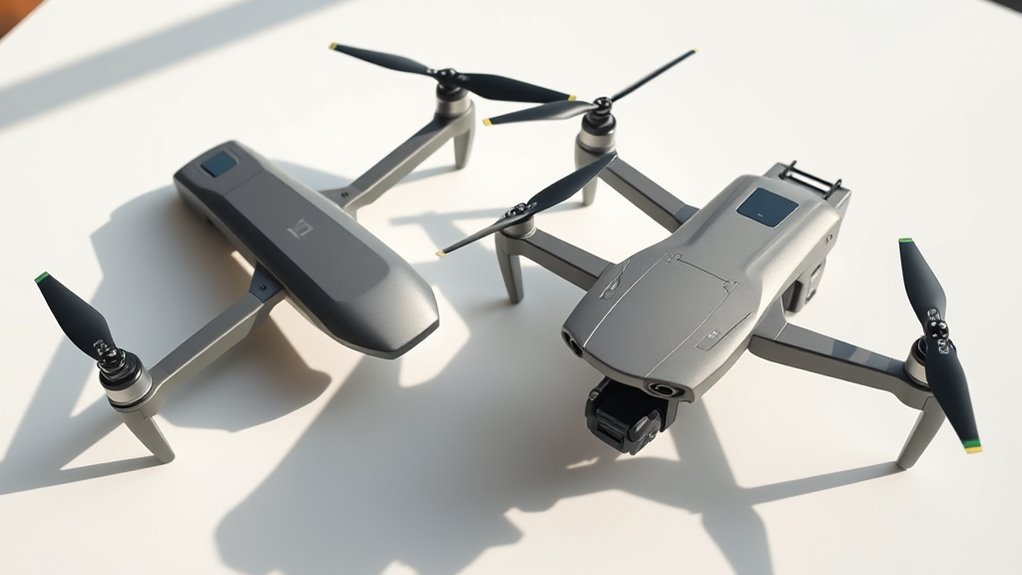
You’re weighing Wingtra One against Freefly Astro for your aerial needs in this mapping versus enterprise showdown. Wingtra One’s 42 MP camera and 55-minute flight time excel in precise surveys and mapping accuracy, while Freefly Astro’s 24 MP sensor and 40 km/h speed deliver versatile agility for dynamic tasks. You’ll find Wingtra prioritizes precision, whereas Astro emphasizes mobility. Keep exploring these comparisons to pinpoint what suits your operations best.
Design and Build Quality
While the Wingtra One features a durable fixed-wing design optimized for long flights, the Freefly Astro counters with a robust VTOL build that enhances versatility in tight spaces. You’ll appreciate how both drones prioritize material quality, using high-grade composites that withstand harsh environments, giving you the freedom to explore without constant worries about durability. The Wingtra One’s ergonomic design guarantees intuitive handling, with user-friendly controls that let you operate effortlessly during extended missions. In contrast, the Freefly Astro’s ergonomic features, like balanced grips and modular components, offer you adaptable setups for quick deployments in confined areas. This focus on material quality and ergonomic design empowers your workflow, minimizing fatigue and maximizing reliability, so you’re always ready to capture the world on your terms. Ultimately, these elements provide the liberation you seek in aerial operations.
Flight Performance Comparison
As you compare the Wingtra One and Freefly Astro, you’ll first notice their differences in flight speed, which directly impacts how quickly you can cover ground. Next, battery endurance plays an essential role in determining how long each drone sustains operations without recharging. By evaluating these aspects side by side, you’ll gain insights into which model best suits your aerial missions.
Flight Speed
Flight speed plays a pivotal role in drone operations, influencing efficiency during tasks like mapping or inspections. When you’re evaluating the Wingtra One and Freefly Astro, you’ll notice how their speeds affect your flight efficiency and speed optimization, letting you maximize productivity without unnecessary delays.
- Wingtra One’s edge: It reaches up to 36 km/h, boosting your flight efficiency for rapid, precise mapping runs that free you from time constraints.
- Freefly Astro’s capability: Hitting 40 km/h, it optimizes speed for dynamic enterprise tasks, empowering you to adapt quickly and cover more terrain.
- Efficiency in practice: You’ll appreciate Wingtra’s wind resistance, which enhances speed optimization in varying conditions, giving you greater operational liberty.
- User-focused optimization: Astro’s intuitive controls let you fine-tune speeds easily, ensuring your missions run smoothly and efficiently, releasing your creative freedom.
Battery Endurance
Battery endurance directly impacts how long your drone missions can last, making it an essential aspect of flight performance alongside speed. When you’re evaluating the Wingtra One and Freefly Astro, battery life emerges as a key differentiator. The Wingtra One boasts up to 55 minutes of flight time, thanks to its advanced power management systems that optimize energy use, letting you explore vast areas with minimal downtime. In contrast, the Freefly Astro offers around 30-40 minutes, requiring more strategic power management to extend operations. This disparity means you’ll enjoy greater freedom with the Wingtra One for extended mapping tasks, while the Astro demands careful planning to avoid mid-mission recharges, empowering your enterprise workflows without unnecessary constraints. Ultimately, prioritizing battery life helps you seize more aerial opportunities.
Camera Systems and Imaging
As you compare the Wingtra One and Freefly Astro, you’ll first examine their camera specifications to see how resolution and features stack up. It’s crucial to assess image quality, including factors like clarity and low-light performance, alongside the sensor types that drive these outcomes. This evaluation will help you determine which drone delivers the imaging precision your projects demand.
Camera Specifications
When comparing the Wingtra One and Freefly Astro, their camera systems stand out as key differentiators in imaging quality and versatility. You’ll find that these drones empower you to select specs that align with your mapping or enterprise needs, focusing on camera resolution and lens options for maximum freedom in operations.
- Camera Resolution: The Wingtra One’s 42 MP sensor gives you crisp, detailed imagery for precise mapping, while the Freefly Astro’s 24 MP resolution offers a solid alternative for versatile enterprise tasks without overwhelming file sizes.
- Lens Options: With the Wingtra One, you can swap lenses like the 28 mm or 35 mm to adapt freely to various altitudes and terrains, enhancing your aerial flexibility.
- Integration Ease: You’ll appreciate how the Wingtra One’s modular design lets you upgrade resolutions effortlessly, freeing you from obsolescence worries.
- Versatility in Use: The Freefly Astro provides multiple lens mounts, allowing you to experiment with wide-angle or telephoto options, so you’re not locked into one setup.
Image Quality
While camera specifications outline the basics, image quality in the Wingtra One and Freefly Astro ultimately hinges on sensor performance and processing algorithms. You’ll find that the Wingtra One excels in color accuracy, delivering vibrant, true-to-life hues that help you capture detailed aerial maps without distortion. Its dynamic range stands out too, allowing you to handle high-contrast scenes effortlessly, so you’re free to explore challenging lighting conditions. In contrast, the Freefly Astro offers solid color accuracy for enterprise tasks, but its dynamic range might fall short in extreme scenarios, potentially limiting your creative freedom outdoors. As you weigh these factors, remember that Wingtra’s processing gives you sharper results in post-editing, empowering you to achieve professional-grade imagery on the fly. Ultimately, your choice depends on prioritizing precision in varied environments.
Sensor Types
Understanding sensor types is essential for evaluating the Wingtra One and Freefly Astro’s camera systems, as they directly influence imaging capabilities. As you explore these drones, you’ll appreciate how sensor resolution and capabilities shape your aerial photography freedom, letting you capture stunning, precise data without constraints.
- Wingtra One’s High-Resolution Sensor: Boasts impressive sensor resolution for detailed mapping, empowering you to explore vast areas with crystal-clear imagery.
- Freefly Astro’s Versatile Capabilities: Offers advanced sensor capabilities tailored for enterprise tasks, giving you the flexibility to adapt to dynamic environments.
- Resolution Impact on Freedom: Higher sensor resolution on Wingtra One means you can achieve finer details, freeing you from post-processing guesswork.
- Capability Comparisons: Freefly Astro’s robust sensor capabilities enhance low-light performance, allowing you to operate independently in challenging conditions.
This analytical look helps you choose based on your needs for liberated, high-quality imaging. (124 words)
Mapping and Surveying Features
When comparing the Wingtra One and Freefly Astro, their mapping and surveying features reveal key differences that can influence your project choices. The Wingtra One stands out for its superior surveying accuracy, leveraging high-resolution sensors to deliver precise geospatial data, which helps you capture detailed terrain models with minimal error. This accuracy empowers you to make informed decisions in demanding environments, freeing you from rework and uncertainty.
In contrast, the Freefly Astro emphasizes mapping efficiency, allowing you to cover larger areas quickly with its agile design and streamlined workflows. You’ll appreciate how it optimizes flight paths, enabling faster data collection without sacrificing quality, so you’re not tied down by lengthy operations. Ultimately, if surveying accuracy is your priority, the Wingtra One gives you the edge for critical projects; if mapping efficiency drives your needs, the Astro lets you operate with greater speed and flexibility. This choice puts the power in your hands to select what’s truly liberating for your ventures. (148 words)
Autonomy and Software Integration
Shifting focus to autonomy and software integration, you’ll find that the Wingtra One excels with its robust, AI-driven flight autonomy, seamlessly integrating with industry-standard software like Pix4D for precise mission planning and real-time adjustments. It’s designed for effortless autonomous operations, giving you the freedom to execute complex flights with minimal intervention, while its software compatibility guarantees smooth data workflows. In comparison, the Freefly Astro provides reliable autonomous operations but might limit your options in software compatibility, potentially requiring more custom setups.
- Empower your missions: Wingtra One’s AI autonomy lets you focus on results, not constant oversight, embracing true operational freedom.
- Seamless tool integration: Enjoy broad software compatibility that connects effortlessly with your existing ecosystem, enhancing efficiency without constraints.
- Flexible flight control: Its advanced autonomous features adapt to changing conditions, offering you the independence to innovate on the fly.
- Streamlined operations: Unlike some rivals, Wingtra’s setup reduces downtime, allowing you to prioritize exploration and discovery in your work.
Applications and User Experiences
Delving into applications and user experiences, you’ll see that the Wingtra One excels in surveying, mapping, and inspection tasks due to its precise flight capabilities, while the Freefly Astro shines in cinematic and industrial uses with its agile maneuverability. In various application scenarios, the Wingtra One’s stability lets you capture detailed data for construction or agriculture, drawing positive user feedback for reliability in demanding environments. Conversely, the Freefly Astro’s flexibility empowers you in dynamic industry usage, like film production or search and rescue, where user experience highlights its quick adaptability and creative freedom. User feedback often praises the Wingtra for seamless integration in professional workflows, but notes the Astro’s edge in intuitive controls that liberate you from complex setups. Ultimately, your choice hinges on whether you prioritize precision or versatile mobility in real-world operations.
Frequently Asked Questions
What Is the Price of Wingtra One?
You’re wondering about the price of the Wingtra One, a drone packed with impressive features like high-precision mapping and robust specifications including a 42-minute flight time and 1 cm accuracy. It’s designed for your freedom to explore and capture data autonomously. While prices vary, expect around $10,000 to $15,000 depending on configurations, offering great value for its analytical mapping prowess. Check official sources for exact quotes.
Are Financing Options Available for Purchase?
Just like a key revealing endless horizons, financing options can open doors to your drone purchase without weighing you down. You’ll find various financing options and purchase plans available from many providers, offering flexible installments or leases to spread costs over time. This analytical choice empowers you, giving the freedom to invest in advanced tech while managing your budget effectively—always check terms for the best fit.
Where Are These Drones Manufactured?
You’re wondering where these drones are manufactured, and it’s fascinating to explore drone manufacturing’s geographic locations. You’ll find that many are produced in Switzerland and the United States, hubs of innovation that emphasize freedom in technology. This setup lets you access cutting-edge tools, reflecting global choices in production while ensuring quality and reliability in your aerial endeavors. It’s all about empowering your decisions.
What Is the Warranty Period for Each?
Oh, you’re diving into the hilarious world of warranties, where promises of protection feel as reliable as a drone in a windstorm! In your warranty comparison for drone reliability, you’ll find the Wingtra One offers a straightforward 1-year warranty, focusing on durable performance. The Freefly Astro matches this with its own 1-year coverage, ensuring you’re free to explore skies confidently, backed by objective assurance.
How Do I Contact Customer Support?
You’re wondering how to contact customer support, and it’s straightforward to get the help you need. You’ll find various support channels like email, phone, or live chat, all designed for efficient customer service. This analytical approach lets you choose what’s best, empowering your freedom to resolve issues quickly. Check the official website or app for direct access, ensuring a seamless connection without delays.
