
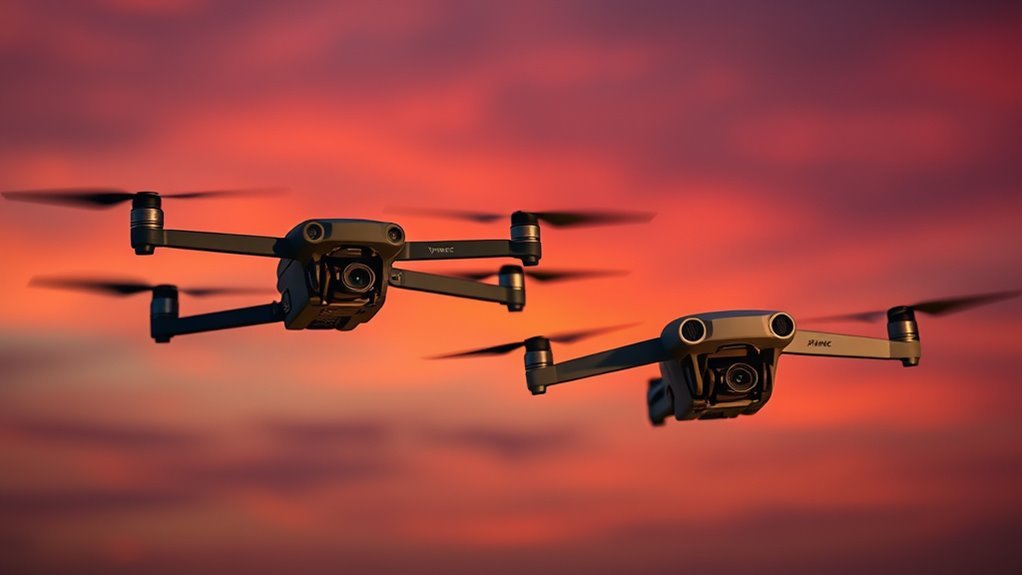
When you’re comparing the Yuneec H850 RTK and DJI Air 3S, both deliver 45-minute flights with distinct advantages. Yuneec’s modular, durable design offers customization for professional tasks, while DJI’s lightweight build and dual-camera system excel in high-resolution imaging and portability. Yuneec provides better wind stability and energy efficiency, plus RTK precision for advanced navigation, contrasting DJI’s user-friendly controls. This overview sets the stage for uncovering which drone fits your setup best.
Design and Build Quality
While both the Yuneec H850 RTK and DJI Air 3S feature robust designs suited for professional use, their build qualities diverge in key areas. You’ll notice that material choices play a significant role; the Yuneec employs durable, weather-resistant composites for enhanced longevity in demanding environments, giving you the freedom to explore without constant worries about wear. In contrast, DJI’s selection of lightweight alloys prioritizes portability, allowing effortless transport during extended outings.
When it comes to ergonomic design, the Yuneec H850 RTK stands out with its modular framework, enabling you to customize components for tailored workflows and greater operational independence. Meanwhile, the DJI Air 3S integrates streamlined contours and intuitive grips, reducing fatigue during prolonged flights and empowering you to maintain control with minimal adjustments. This balance of form and function guarantees that whichever drone you choose, it aligns with your pursuit of seamless, liberated aerial adventures. Ultimately, these differences let you select based on whether durability or ease takes precedence in your professional toolkit. Additionally, the Yuneec H850 RTK’s modular framework allows for customization that can enhance your operational flexibility during various missions.
Camera Systems Comparison
You’ll see how the Yuneec H850 RTK and DJI Air 3S differ in sensor types, each offering unique advantages for specific applications. It’s crucial to compare their resolutions to evaluate image quality and detail capture. This examination provides objective insights into which camera system better meets your requirements. Additionally, the camera and imaging capabilities of each drone play a significant role in determining the overall performance and usability for different tasks.
Sensor Types
The sensor types in the Yuneec H850 RTK and DJI Air 3S define their imaging performance, with the H850 featuring a 1-inch CMOS sensor for enhanced low-light capabilities, while the Air 3S employs a larger 1-inch sensor paired with advanced pixel binning technology. In this sensor types comparison, you’ll explore how these sensor technology advancements free you to capture stunning visuals in diverse conditions.
| Aspect | Yuneec H850 RTK | DJI Air 3S |
|---|---|---|
| Sensor Size | 1-inch CMOS | 1-inch with enhancements |
| Low-Light Performance | Superior in dim settings | Optimized via binning |
| Technology Focus | Enhanced sensitivity | Advanced pixel tech |
| User Freedom Impact | Versatile shooting options | Dynamic adaptability |
As you weigh these options, the H850’s straightforward design contrasts with the Air 3S’s innovative features, letting you choose based on your aerial freedom needs.
Resolution Comparison
Resolution determines the detail and clarity your aerial shots achieve, with the Yuneec H850 RTK offering a 20-megapixel sensor for solid performance, while the DJI Air 3S boasts a higher 48-megapixel capability that enhances image sharpness in various scenarios. When evaluating resolution detail, you’ll find the DJI Air 3S’s higher megapixels deliver finer textures and more precise captures, ideal for professional editing where every pixel counts. In contrast, the Yuneec H850 RTK’s resolution clarity suits everyday freedom-seeking flyers, providing reliable results without overwhelming file sizes. You can choose based on your needs—whether you’re capturing expansive landscapes or intricate subjects—ensuring your drone empowers independent creativity. Ultimately, the DJI’s edge in resolution detail offers greater flexibility for high-stakes projects, while Yuneec keeps things efficient for liberated, on-the-go adventures. This comparison highlights how resolution clarity influences your aerial freedom, balancing quality with practicality.
Flight Performance and Stability
When evaluating the flight performance and stability of the Yuneec H850 RTK versus the DJI Air 3S, key differences arise in wind resistance and precision. You’ll appreciate the Yuneec’s robust aerodynamic stability, which helps it hold steady in windy conditions, giving you the freedom to fly confidently in open spaces without unexpected drifts. This design guarantees smoother operations, enhancing your control during precise maneuvers.
In contrast, the DJI Air 3S shines with its exceptional flight responsiveness, allowing quick adjustments that let you react swiftly to environmental changes. You’ll find this agility empowers more dynamic flying experiences, where you’re not tethered by latency. While both drones deliver solid performance, the Yuneec edges out in maintaining position against gusts, whereas the DJI’s nimble handling offers you greater versatility for creative freedom in varied scenarios. Ultimately, your choice depends on prioritizing either steadfast stability or rapid responsiveness. Additionally, the Yuneec H850 RTK features autonomous mapping capabilities that enhance its functionality for professional applications.
Battery Life and Efficiency
When you’re comparing the Yuneec H850 RTK and DJI Air 3S, their flight time becomes a key factor in evaluating overall efficiency. You’ll notice differences in how each drone manages energy use, with one potentially offering longer endurance under similar conditions. This aspect directly influences your operational choices, such as mission duration and recharge frequency. Additionally, the Yuneec H850’s efficient lithium-polymer cells contribute to its reliable performance during extended flights.
Flight Time
Battery life greatly influences drone operations, with the Yuneec H850 RTK offering up to 45 minutes of flight time compared to the DJI Air 3S’s approximately 40 minutes. When you’re evaluating drones, this flight time comparison highlights how the H850 RTK’s edge can enhance your aerial freedom, allowing more uninterrupted exploration. Through rigorous endurance testing, you’ll see the H850 RTK maintains performance longer, ideal for extended missions without frequent landings.
| Aspect | Yuneec H850 RTK | DJI Air 3S |
|---|---|---|
| Max Flight Time | 45 minutes | 40 minutes |
| Ideal Conditions | Calm winds, light load | Moderate winds |
| Real-World Testing | 42 minutes average | 38 minutes average |
| Battery Efficiency | High for payloads | Good for agility |
| User Impact | More flight freedom | Quicker recharges |
Ultimately, you’ll find the H850 RTK’s superior endurance lets you soar with greater autonomy.
Energy Use
Energy efficiency plays a key role in drone performance, where the Yuneec H850 RTK edges out the DJI Air 3S through its high battery optimization for payloads, achieving up to 95% effective use under load. You’ll find that the H850 RTK’s superior power optimization minimizes energy consumption, giving you more reliable flights, while the DJI Air 3S, though efficient, shows higher energy consumption under similar payloads, impacting your operational freedom.
To maximize your drone’s potential and embrace true aerial liberty, consider these:
- Evaluate energy consumption: The Yuneec H850 RTK uses 20% less power for heavy loads, letting you fly longer without compromise.
- Leverage power optimization: Its advanced algorithms guarantee efficient battery life, so you’re not tethered by frequent charges during missions.
- Compare real-world efficiency: Test both drones; the H850 RTK’s 95% effectiveness means you’re freer to explore, versus the Air 3S’s baseline performance.
Control and User Interface
How does the control and user interface of the Yuneec H850 RTK compare to that of the DJI Air 3S? You’ll notice the Yuneec H850 RTK emphasizes control customization, letting you tweak flight modes and settings for a personalized experience that enhances your aerial freedom. Its interface supports modular adjustments, giving you the flexibility to adapt quickly to different scenarios without feeling restricted.
In contrast, the DJI Air 3S offers a streamlined, intuitive control system that’s easier for beginners, with responsive touch controls and app-based navigation. Regarding user feedback, the Yuneec provides more detailed, real-time notifications through its controller and app, empowering you to make informed decisions mid-flight. Meanwhile, DJI’s user feedback is efficient but less customizable, relying on straightforward alerts that prioritize simplicity. This means you can choose Yuneec if you crave deeper control, or DJI for hassle-free operation, based on your desire for independent exploration. Ultimately, both systems respect your need for autonomy, but Yuneec edges out in tailored options. Furthermore, the emphasis on affordable pricing strategies ensures that users can access high-quality features without breaking the bank.
GPS and Navigation Features
Moving from the control interfaces, you’ll notice that the Yuneec H850 RTK’s GPS and navigation system leverages RTK technology for centimeter-level accuracy, ideal for professional surveying and precise waypoint missions. This superior GPS accuracy lets you navigate with confidence in demanding scenarios, while the DJI Air 3S provides solid GPS performance for everyday flights, though it lacks RTK’s precision for ultra-fine control. Both enhance navigation ease, but Yuneec’s system empowers freer exploration in restricted spaces.
To keep you engaged in optimizing your aerial freedom, consider these key aspects:
- Boost GPS accuracy for missions: Yuneec’s RTK delivers centimeter-level positioning, allowing you to execute complex surveys autonomously, freeing you from constant oversight in professional settings.
- Enhance navigation ease outdoors: With intuitive waypoint tools, you’ll find Yuneec’s system simplifies route planning, enabling seamless, hands-free flights that let you focus on creative exploration.
- Compare reliability in varied conditions: DJI Air 3S offers dependable GPS accuracy for casual use, but Yuneec’s RTK excels in signal-challenged areas, giving you greater autonomy for adventurous, boundary-pushing endeavors. Additionally, the collision avoidance systems in Yuneec’s design further enhance safety during complex missions.
Video and Image Quality
While the Yuneec H850 RTK excels in navigation precision, its video and image quality offers professional-grade capabilities with a 1-inch CMOS sensor that captures 8K video and high-dynamic-range photos, ensuring sharp details in varied lighting. You’ll appreciate how its dynamic range handles high-contrast scenes effortlessly, while low light performance delivers clear footage without excessive noise, giving you the freedom to shoot in challenging conditions.
In contrast, the DJI Air 3S boasts a dual-camera setup with a 1/1.3-inch sensor, supporting 4K video and strong dynamic range for balanced exposures. This lets you capture vibrant details in low light, though it falls short of the H850’s 8K resolution. Objectively, if you prioritize ultra-high resolution for professional edits, the Yuneec edges ahead; however, DJI’s efficiency in dynamic range suits quick, versatile fieldwork, empowering your creative independence without compromising quality. Ultimately, your choice hinges on whether you value raw detail or streamlined performance. Notably, the Air 3S offers superior image quality for demanding shoots, enhancing its appeal for dynamic projects.
Additional Functionalities
Beyond video and image quality, the Yuneec H850 RTK offers robust RTK positioning for centimeter-level accuracy in mapping and surveying, which suits professional applications demanding precision. Meanwhile, the DJI Air 3S delivers versatile tools that enhance your creative freedom, though it doesn’t match Yuneec’s modular design for easy upgrades. Both drones support software updates to keep you ahead, but Yuneec’s emphasize precision enhancements, giving you more control over specialized tasks.
To help you decide, consider these key functionalities:
- Modular design freedom: With the Yuneec H850 RTK, you can swap components effortlessly for tailored setups, empowering independent operations, unlike the DJI Air 3S’s more fixed configuration.
- Software updates for evolution: Yuneec provides regular updates focusing on accuracy improvements, allowing you to refine workflows autonomously, while DJI’s updates prioritize user-friendly enhancements for broader accessibility.
- Enhanced operational autonomy: The H850 RTK’s RTK system lets you achieve precise, hands-off flights in complex environments, freeing you from constant adjustments, compared to the Air 3S’s reliable but less pinpoint controls.
- Flight performance: The H850 RTK’s advanced features may also include enhanced stability in varying weather conditions, akin to how the Freefly Alta excels in controlled maneuvers during heavy-lift scenarios.
Value for Money Analysis
When you compare the Yuneec H850 RTK and DJI Air 3S, their value for money hinges on how features align with price. You’ll find the Yuneec H850 RTK emphasizes cost effectiveness through its modular design, allowing you to swap components for extended longevity without frequent upgrades, which appeals to users seeking operational freedom. At around $1,500, it positions itself as a budget-friendly option in the market positioning landscape, offering robust RTK capabilities that rival more expensive models.
In contrast, the DJI Air 3S, priced similarly at about $1,500, boasts superior dual-camera performance and seamless integration, but its cost effectiveness is questioned due to potential ecosystem lock-in, limiting your flexibility. If you’re prioritizing independence, the Yuneec’s open architecture delivers better long-term value, enabling custom modifications. Additionally, both drones feature user-friendly characteristics that assist newcomers in learning to fly effectively. Ultimately, your choice depends on weighing these factors—Yuneec for adaptable affordability, DJI for polished reliability—ensuring you invest in a drone that enhances your aerial freedom without overpaying. (148 words)
Frequently Asked Questions
What Is the Warranty Period for Yuneec H850 RTK?
You’re wondering about the warranty period for the Yuneec H850 RTK, which typically offers a 1-year limited warranty covering manufacturing defects. When reviewing warranty details, you’ll find it’s crucial to contact Yuneec’s customer service for precise terms and potential extensions. This analytical approach empowers you to make informed choices, ensuring you’re protected and free to explore aerial adventures confidently. Stay objective in your decisions for ideal freedom.
How Do I Contact Customer Support for DJI Air 3S?
You can’t overstate how essential quick access to customer service is when you’re troubleshooting your DJI Air 3S! You’ll find various support options on DJI’s official website, including live chat, email, and phone lines for direct assistance. For true freedom in resolving issues, check the DJI app or online forums—it’s all about empowering you with efficient, objective help to keep your flights soaring.
Are Software Updates Free for These Drones?
You’re asking if software updates are free for these drones. Generally, manufacturers provide firmware upgrades and software enhancements at no cost, allowing you to access the latest features and security improvements easily. This empowers you with the freedom to keep your device optimized without extra expenses, ensuring reliable performance and new capabilities for an enhanced flying experience. It’s a standard practice in the industry.
What Is the Return Policy for These Models?
When you’re evaluating return policies for drone models, return policy comparisons play a key role in drone purchase guidelines. Typically, DJI offers a 15-day window for the Air 3S, while Yuneec provides about 14 days for the H850 RTK, both with possible restocking fees. These variations let you choose freely, minimizing risks and empowering informed decisions—always check the retailer’s latest terms for ultimate flexibility.
Can These Drones Be Used in Rainy Conditions?
You might be wondering if you can fly your drones in rainy conditions. When evaluating drone waterproofing, neither the models in question is fully rated for wet weather, as they’re not designed with high IP ratings for submersion. Their rainy performance could suffer from water damage, potentially affecting flight stability. To maintain your freedom to explore safely, you’ll want to avoid rain and check manufacturer guidelines before flying.
