
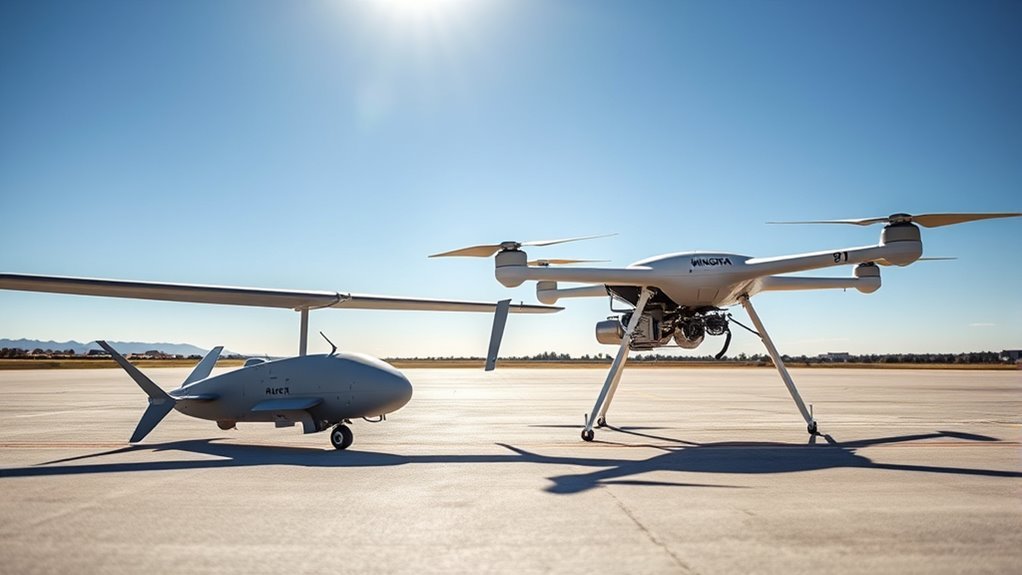
You’re comparing the AeroVironment Raven B’s tactical edge, with its 90-minute endurance and 55-knot speed for rapid deployments, against the Wingtra One’s mapping focus, offering 59-minute flights and 70 km/h velocity for precise surveys. The Raven B’s lightweight design and manual controls prioritize maneuverability in reconnaissance, while the Wingtra One’s VTOL system and high-res cameras guarantee sub-centimeter accuracy. As you move on, uncover how these differences shape real-world applications and performance outcomes.
Design and Build Comparison
When comparing the design and build of the AeroVironment Raven B and Wingtra One, you’ll notice that the Raven B prioritizes portability and rapid deployment, featuring a lightweight, hand-launched fixed-wing structure weighing around 1.9 kg with a simple assembly for tactical operations. In contrast, the Wingtra One’s design aesthetics focus on sleek, functional precision for mapping tasks, incorporating a VTOL system that enhances versatility in confined spaces. You’ll find its build balances aerodynamics and user accessibility, empowering you to operate independently in diverse environments.
Analyzing material durability, the Raven B employs resilient, lightweight composites that endure field stresses without adding bulk, supporting your freedom in rapid-response scenarios. Meanwhile, the Wingtra One utilizes high-strength materials like carbon fiber reinforcements, offering superior resistance to wear and environmental factors, which bolsters long-term reliability for autonomous missions. This comparison highlights how each drone’s design aesthetics and material choices cater to distinct operational freedoms, allowing you to select based on your tactical or exploratory needs. Furthermore, the Raven B’s advanced engineering ensures superior performance in surveillance missions, making it an appealing option for tactical operations.
Flight Endurance and Battery Life
Examining flight endurance, the AeroVironment Raven B achieves up to 90 minutes of flight per battery, catering to prolonged tactical operations where rapid redeployment is key. You’ll appreciate how its advanced battery technology enhances flight time, enabling seamless, extended missions that prioritize your operational freedom. In contrast, the Wingtra One delivers about 59 minutes of flight time, tailored for mapping efficiency, where shorter bursts suffice for detailed surveys.
When evaluating battery technology, the Raven B’s design emphasizes durability and quick swaps, allowing you to maintain autonomy in dynamic environments. The Wingtra One, however, integrates high-energy-density batteries for precise, energy-optimized flights, though this limits overall endurance. This disparity means you’re better equipped for reconnaissance with the Raven B’s superior flight time, offering the liberty to adapt without constant recharges, while the Wingtra One suits controlled, data-focused tasks. Ultimately, your choice hinges on whether extended freedom or targeted efficiency aligns with your needs. Additionally, the Raven B’s military-grade endurance enhances its capability for operations in challenging terrains. (148 words)
Speed and Maneuverability Features
As you compare the AeroVironment Raven B and Wingtra One, you’ll evaluate their maximum speeds to assess performance in time-sensitive missions. Turning radius plays a critical role in maneuverability, affecting how each drone navigates tight spaces or complex environments. This analysis will provide objective insights into which model offers superior agility for your specific applications. Additionally, the advanced stabilization techniques employed by these drones can significantly enhance their performance in challenging conditions.
Maximum Speed
When you’re evaluating drones for your missions, the maximum speed comparison between the AeroVironment Raven B and Wingtra One highlights key differences in speed performance. The AeroVironment Raven B reaches a maximum speed of approximately 55 knots, while the Wingtra One hits up to 70 km/h, directly influencing their maneuverability in different operational scenarios. This disparity means you’re getting quicker response times with the Wingtra One for mapping tasks, offering you greater freedom in dynamic environments, whereas the Raven B’s speed suits tactical, endurance-focused operations.
To break it down analytically:
| Aspect | Details |
|---|---|
| Maximum Speed (knots) | Raven B: 55; Wingtra: ~38 |
| Speed Performance | Raven B excels in stability; Wingtra offers agility |
| Unit Conversion Impact | Knots favor Raven B’s range; km/h boosts Wingtra’s precision |
| Operational Flexibility | Raven B for prolonged flights; Wingtra for rapid coverage |
| Comparison Advantage | Choose based on your mission’s speed needs for ultimate freedom |
Turning Radius
How does the turning radius of the AeroVironment Raven B compare to the Wingtra One with respect to maneuverability? The Raven B boasts a superior tight turning capability, enabling you to execute sharp maneuvers in confined spaces, which enhances your freedom during tactical missions. Its smaller radius allows for precise flight paths that adapt swiftly to changing environments, giving you greater control over dynamic operations.
In contrast, the Wingtra One features a larger turning radius, optimized for efficient, stable flight paths ideal for mapping tasks. You’ll find this design prioritizes endurance and accuracy over agility, letting you cover vast areas with minimal adjustments, thereby freeing you from frequent interventions in structured scenarios. Overall, the Raven B’s edge in tight turning suits high-maneuverability needs, while the Wingtra One emphasizes streamlined paths for broader autonomy.
Camera and Sensor Capabilities
While the AeroVironment Raven B relies on a straightforward electro-optical and infrared setup for tactical reconnaissance, the Wingtra One boasts high-resolution cameras and multispectral sensors optimized for precision mapping. You’ll appreciate how the Raven B’s sensor types, including basic electro-optical and infrared, prioritize rapid deployment in field operations, delivering adequate camera resolution for real-time situational awareness without overwhelming data loads. In contrast, the Wingtra One’s advanced sensor types—such as RGB, multispectral, and thermal—coupled with superior camera resolution up to 42 MP, empower you to capture intricate details for applications like agriculture or surveying. This analytical edge means you’re getting precise, actionable insights from the Wingtra, while the Raven B keeps things streamlined for your freedom in dynamic environments. Moreover, the Wingtra One’s sub-centimeter accuracy enhances its reliability for independent mapping endeavors, ensuring operational liberty tailored to your needs. Objectively, your choice hinges on whether you need tactical speed or mapping depth, ensuring operational liberty tailored to your needs.
Autonomy and Control Systems
The AeroVironment Raven B’s autonomy centers on manual overrides and basic waypoint navigation, enabling quick operator interventions during field missions. You’ll appreciate how its autonomous navigation relies on straightforward control algorithms, giving you the freedom to adapt swiftly in dynamic environments without complex setups. In contrast, the Wingtra One offers more advanced autonomous navigation, featuring sophisticated control algorithms that automate flight paths for precision mapping tasks. This allows you to execute missions with minimal input, freeing you from constant monitoring and enhancing efficiency in controlled scenarios.
Analytically, Raven B’s system prioritizes your operational independence through rapid overrides, ideal for tactical operations where unpredictability demands flexibility. Meanwhile, Wingtra One’s algorithms emphasize reliability and precision, letting you focus on data collection rather than piloting. Ultimately, your choice hinges on whether you value immediate control or seamless, hands-off autonomy, both empowering your aerial endeavors without unnecessary constraints. Moreover, the integration of advanced AI technology in drone design is reshaping operational capabilities and enhancing user experience.
Payload and Integration Options
As you compare the AeroVironment Raven B and Wingtra One, you’ll encounter varying payload types that influence their suitability for surveillance or mapping tasks. Integration methods for these payloads differ, requiring you to assess ease of attachment and system compatibility in your operations. Modular compatibility options further determine how flexibly you can adapt each drone to meet evolving mission demands. Additionally, the advanced sensors for tactical surveillance equipped on these drones enhance their effectiveness in real-time operational scenarios.
Payload Types
Payload types differ markedly between the AeroVironment Raven B and Wingtra One, tailored to their distinct operational roles. The Raven B’s payload capacity suits tactical scenarios, letting you carry compact sensors for real-time intelligence, such as EO/IR systems that boost sensor versatility in combat zones. This setup empowers you to adapt quickly, maintaining operational freedom without excess weight.
On the other hand, the Wingtra One’s payload capacity focuses on mapping efficiency, accommodating high-resolution cameras and multispectral sensors for detailed geospatial data. You’ll appreciate its sensor versatility for versatile applications like agriculture or environmental monitoring, giving you the autonomy to capture accurate imagery autonomously. By choosing based on your needs, you guarantee maximum flexibility in unmanned aerial operations.
Integration Methods
Integrating payloads with the AeroVironment Raven B relies on its modular design, allowing you to swap sensors quickly via standardized interfaces that minimize downtime in field operations. This approach emphasizes efficient integration techniques, ensuring seamless system compatibility with various tactical sensors, so you’re free to adapt on the fly without constraints. In contrast, the Wingtra One’s integration techniques focus on precision mapping payloads, where you’re offered robust system compatibility through proprietary mounts and software, enabling you to integrate cameras and sensors with minimal setup for extended flights. Analytically, Raven B’s method prioritizes rapid field swaps for urgent scenarios, granting you greater operational freedom, while Wingtra One delivers reliable, plug-and-play compatibility for detailed surveys, though it may require more initial configuration to maintain accuracy and autonomy in your missions.
Modular Compatibility
Modular compatibility in the AeroVironment Raven B lets you swap payloads effortlessly through its standardized interfaces, ensuring quick adaptations for various sensors without compromising field efficiency. You’ll appreciate its modular upgrades, which deliver flexible compatibility options for integrating thermal imaging, electro-optical payloads, or custom sensors, empowering you to operate with minimal downtime and maximum autonomy in dynamic environments.
- Raven B’s Upgrades: Its modular upgrades let you rapidly configure payloads, granting the freedom to switch sensors mid-mission for tactical versatility.
- Compatibility Options: Compared to Wingtra One’s more rigid setup, Raven B’s options enhance your adaptability, allowing seamless integrations that liberate you from fixed configurations.
- Operational Freedom: This setup analytically boosts your efficiency, offering unrestricted choices that outpace Wingtra One’s mapping-focused limitations in rapid-response scenarios.
Real-World Applications and Use Cases
While both the AeroVironment Raven B and Wingtra One drones serve diverse real-world needs, their applications diverge based on design and capabilities; for instance, you’ll find the Raven B dominating tactical military reconnaissance due to its portability and endurance, whereas the Wingtra One shines in precision mapping for agriculture and construction, offering high-resolution data collection that’s ideal for commercial operations.
As you consider these drones, you’ll value the Raven B’s role in military applications and disaster response, enabling rapid deployment for search operations and wildlife tracking. Meanwhile, the Wingtra One empowers agricultural monitoring and environmental assessment, supporting urban planning and energy management through precise infrastructure inspection and construction surveying. Additionally, the Raven B’s superior imaging and situational awareness ensures effective reconnaissance in dynamic environments.
To compare effectively:
| Application | Primary Drone |
|---|---|
| Military applications | AeroVironment Raven B |
| Agricultural monitoring | Wingtra One |
| Disaster response | AeroVironment Raven B |
| Environmental assessment | Wingtra One |
| Infrastructure inspection | Both |
This setup lets you choose based on your freedom to operate in dynamic environments. (148 words)
Overall Performance Evaluation
When evaluating the overall performance of the AeroVironment Raven B and Wingtra One, you’ll compare metrics like flight endurance, payload capacity, and operational reliability. These performance metrics serve as key evaluation criteria, helping you assess which drone aligns with your operational needs for freedom in tactical or mapping missions. The Raven B excels in endurance for rapid deployments, while the Wingtra One prioritizes precision in mapping tasks.
- Flight Endurance Comparison: You’ll find the Raven B’s 90-minute capability offers greater flexibility for extended surveillance, contrasting the Wingtra One’s 59-minute limit that demands quicker turnaround for mapping efficiency.
- Payload Capacity Analysis: Evaluation criteria highlight the Raven B’s robust capacity for tactical payloads, enabling you to carry more gear for autonomous operations, whereas the Wingtra One focuses on high-resolution sensors for detailed data collection.
- Operational Reliability Metrics: In your assessment, the Raven B’s military-grade reliability guarantees dependable performance in challenging environments, while the Wingtra One’s advanced autonomy provides reliable mapping with minimal intervention, empowering your freedom to innovate. Additionally, the advanced sensors integrated into these drones play a vital role in enhancing their operational capabilities and versatility in various missions.
Frequently Asked Questions
How Much Does the Raven B Cost?
You’re wondering about the cost of the Raven B, a drone known for its tactical prowess. When evaluating Raven B specifications, you’ll note its lightweight design and 5-pound payload capacity, while Raven B features like autonomous flight and real-time video feed enhance its value. Though exact pricing isn’t publicly disclosed, it’s typically in the tens of thousands, reflecting its advanced, freedom-enabling capabilities for independent operations.
What Is the Maintenance Schedule for Wingtra One?
Imagine you’re releasing the ultimate freedom of endless flights with your Wingtra One—it’s that exhilarating! When it comes to its maintenance schedule, you’ll follow structured maintenance procedures, including routine drone upkeep like daily pre-flight inspections, weekly battery checks, and monthly software updates. This analytical approach guarantees peak performance, minimizing downtime so you’re always ready for autonomous adventures in the skies. Stay vigilant for annual overhauls to maintain maximum efficiency.
Is Pilot Training Required for These Drones?
You might be asking if pilot training is required for these drones. In drone operation, pilot certification is typically necessary to meet safety and regulatory standards, allowing you to fly legally and efficiently. This guarantees you’re equipped for autonomous missions, enhancing your freedom to explore without risks. While specifics vary by model and region, basic certification empowers independent, analytical control over your aerial activities. Always verify local rules for seamless operations.
Are There FAA Restrictions for These Models?
You’re asking about FAA restrictions for these drone models. When operating them, you’ll navigate FAA regulations and drone classifications, which categorize based on weight, purpose, and altitude. For commercial flights, you’re required under Part 107 to obtain a pilot certificate and adhere to line-of-sight rules, preserving your aerial freedom while ensuring safety. Always check for waivers to maximize operational flexibility.
Where Can I Buy the Aerovironment Raven B?
You’re seeking the AeroVironment Raven B, exploring its specifications and hunting for retailers that align with your quest for freedom. The Raven B’s technical prowess includes a 90-minute flight endurance and tactical versatility, making it ideal for your operations. For purchases, you’ll find authorized Raven B retailers like AeroVironment’s official site or select military suppliers, ensuring objective, reliable access to this analytical tool.
